Zelle taxes start with one fact: Zelle doesn’t report payments to the IRS and never sends a 1099-K, at any amount. That doesn’t make Zelle money tax-free. Pay for your work, rent from a tenant and a gain on something you sold are taxed the same whether they came by Zelle, check or cash, while gifts, split bills and a roommate’s share of the rent aren’t income at all.
That makes Zelle the opposite of Venmo and PayPal. There’s no goods and services tag, no seller fee from Zelle and no 1099-K, even on a small business account. The only form you might see is a 1099-NEC from a business that paid you $2,000 or more for your work, and the only record of everything else is your bank statement.
I’ve only used Zelle for personal transfers, and I’ve done my own taxes with TaxAct every year since 2022, with 1099s from Outlier and Clickworker. I file two side gigs on their own Schedule Cs, which is where Zelle pay for your work goes too. Everything Zelle-specific here comes from Zelle’s own tax FAQ, the IRS and my 1099 tax calculator, with links so you can check each part.
Zelle taxes, the short answer:
- Does Zelle report to the IRS? No. Zelle says it doesn’t report payments to the IRS and the 1099-K rules don’t apply to its network, even over $600 and even on small business accounts.
- Do you pay taxes on Zelle payments? On income, yes: pay for your work, rent from a tenant and gains on things you sold. Not on gifts, split bills or a roommate’s share of the rent.
- Will you get any tax form? Not from Zelle or your bank. A business that pays you $2,000 or more for your work in 2026 should send a 1099-NEC.
- Can the IRS see Zelle payments? They’re in your bank records, which the IRS can ask for in an audit. Report the income and keep your own log.
- How much should you set aside? About 14% of your Zelle profit with no other income, or about 23% with a job in the 12% bracket, plus your state’s rate.
Table of Contents
Does Zelle Report to the IRS?
No. Zelle’s tax FAQ says it doesn’t report payments on its network to the IRS, even when you receive more than $600 in a year, because the 1099-K law for payment apps doesn’t apply to Zelle. Its small business FAQ says the same for business accounts, including payments for goods and services.
The reason is how Zelle works. It moves money straight from one bank account to another inside your bank’s app, with no payment company holding the money in between. The 1099-K covers payment cards and payment networks like Venmo and PayPal that settle payments for sellers, and Zelle isn’t one.
Zelle is also clear about the other half: if what you receive is taxable, reporting it is your job. The IRS says the same on its 1099-K page: you must report payments for goods, services or property even if you don’t get a 1099-K.
Zelle vs. Venmo, PayPal and a Check: Which Form You Get
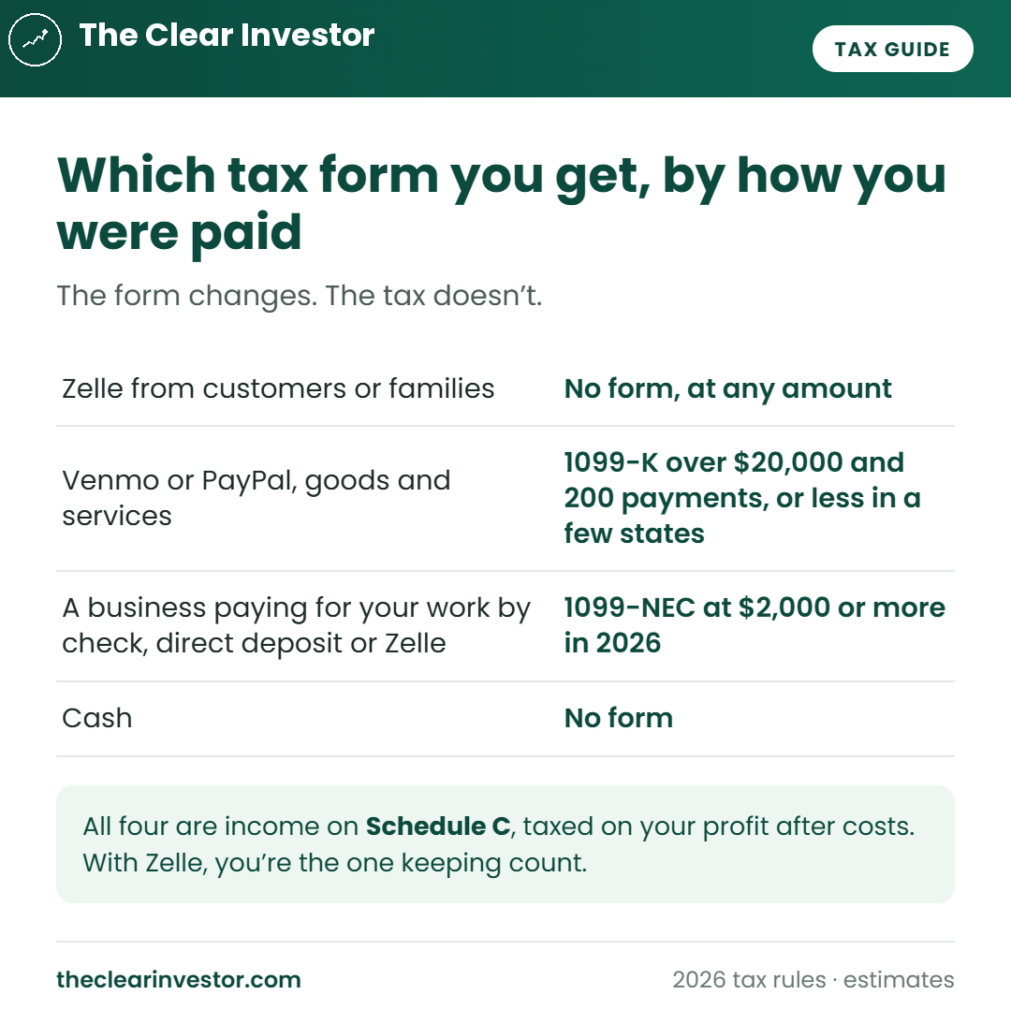
How you were paid changes which form you get, if any. It doesn’t change the tax:
- Zelle: no form from Zelle or your bank, at any amount.
- Venmo or PayPal for goods and services: a 1099-K once payments top $20,000 and 200 in a year, or a lower line in a few states. My Venmo taxes guide has Venmo’s list.
- A business paying you by check, direct deposit or Zelle: a 1099-NEC once it pays you $2,000 or more in 2026.
- Cash: no form.
Each of these is income on the same Schedule C, taxed the same way. A Zelle payment just leaves you to do the counting.
Which Zelle Payments Are Taxable
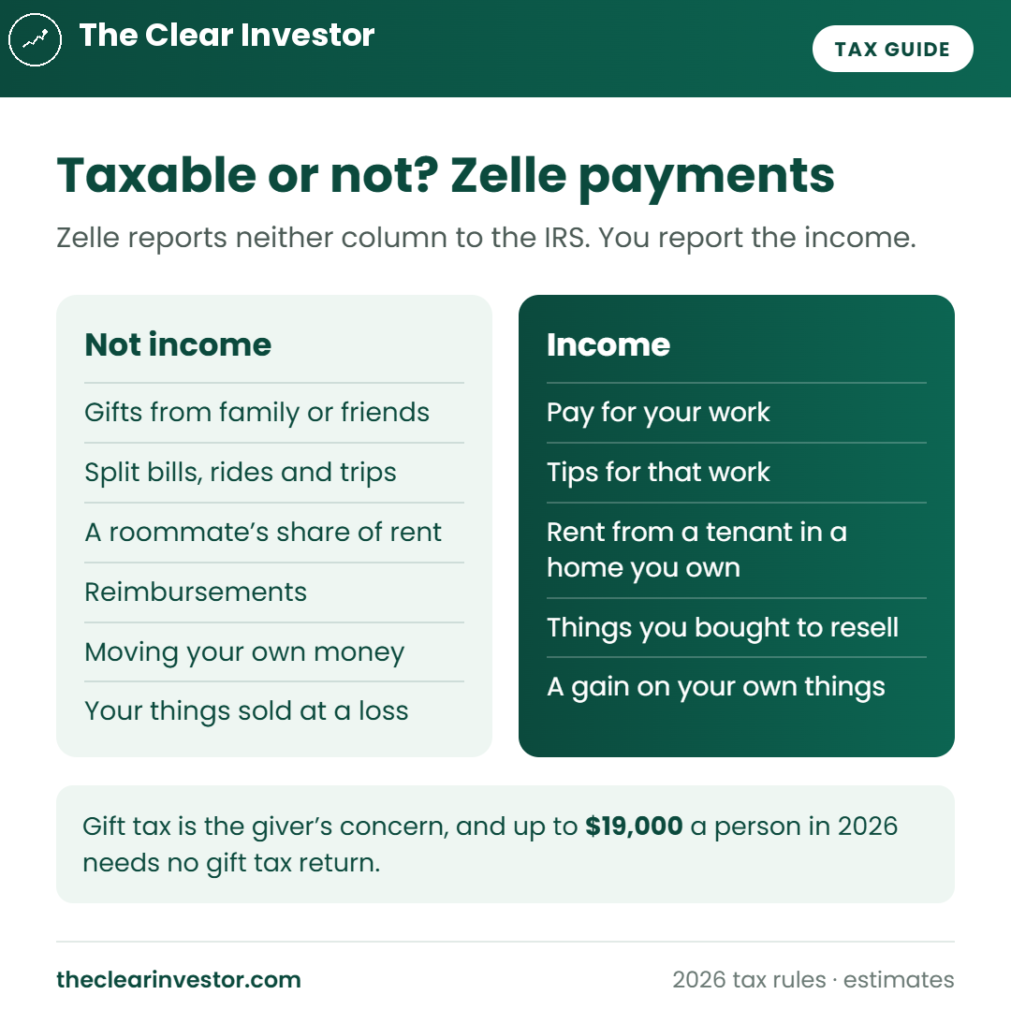
Zelle money falls into two groups.
Not income:
- Gifts from family or friends, for a birthday, a holiday or help with bills.
- Split costs, like dinner, a ride or a trip, and a roommate repaying you for rent or a household bill. The IRS lists these as payments that aren’t taxable.
- Reimbursements for something you bought for someone else.
- Money moving between your own accounts, or a loan you’ll repay.
- Your own things sold for less than you paid, like an old phone or furniture.
Income:
- Pay for your work: cleaning, tutoring, babysitting, lawn care, hair, repairs, freelance work or anything else people pay you to do.
- Tips for that work.
- Rent from a tenant in a home you own.
- Things you bought to resell.
- A gain on your own things, when you sell something for more than you paid.
Paid by a Business Through Zelle? Expect a 1099-NEC
The IRS’s 1099-NEC instructions say payments made by card or through payment networks go on a 1099-K and aren’t reported on a 1099-NEC. Zelle isn’t one of those networks, so a business that pays you for your work through Zelle should treat it like a check:
- The line is $2,000 for 2026. It was $600 through 2025. A business that pays you $2,000 or more in 2026 should send a 1099-NEC by January 31, 2027.
- Families don’t send one. A household paying you to tutor their kids or clean their home isn’t paying as a business, so you won’t get a form from them. The income is still yours to report.
- A missing or wrong form doesn’t change your tax. Report what you were actually paid, and ask the business for a corrected form if its number is off.
If you get a 1099-NEC for Zelle payments, count that income once. The form and your bank statement show the same money.
Zelle for Small Business
Some banks let you use Zelle on a business checking account. Your customers can pay you by email, phone number or a Zelle tag. Zelle says to ask your bank whether you can create a tag (Zelle). For taxes:
- Still no 1099-K, whatever you sell and however much comes in.
- Bank fees may apply. Zelle says to check with your bank. Any fee on business payments is a deductible business cost.
- No purchase protection. Zelle says it doesn’t offer any, and payments to enrolled users generally can’t be canceled. That’s a customer-service issue more than a tax one, but it’s why some customers won’t pay this way.
- A business account keeps your records clean. When business payments land in their own account, your bank statement is close to a ready-made income log.
Rent and Roommates on Zelle
Rent is where Zelle gets confusing, because the same payment can be income or not:
- A roommate paying you their share, when you’re both tenants and you pay the landlord, isn’t income. The IRS lists it with the other personal payments.
- A tenant paying you rent for a room, a unit or a home you own is rental income, usually on Schedule E, with a share of your mortgage interest, property tax, repairs and depreciation to deduct. My Airbnb taxes guide covers Schedule E.
- A security deposit you plan to return isn’t income when you get it, according to IRS Publication 527. If you keep part of it, that part is income then.
Gifts and Family Money on Zelle
Money from your parents, a grandparent or a friend as a gift isn’t income for you, however much it is. Gift tax is the giver’s concern: for 2026 someone can give you up to $19,000 without even filing a gift tax return, according to the IRS. Over that, the giver files Form 709 and usually still owes nothing.
A family member paying you for real work is different. If your aunt pays you $600 a month by Zelle to manage her online store, that’s pay for your work, and it’s taxable like any other client’s.
Selling Your Own Things for Zelle
Selling your own stuff to someone who pays by Zelle is taxed like any other sale of personal items:
- Sold for less than you paid: not taxed, the loss isn’t deductible, and with no 1099-K there’s nothing to report.
- Sold for more than you paid: the gain is taxed, on Form 8949 and Schedule D.
- Bought to resell: that’s a business on Schedule C.
Because Zelle has no purchase protection, only take or send Zelle payments with people you know and trust. Money lost to a scam on a personal purchase usually isn’t deductible.
Keeping Records When Zelle Sends No Form
With no 1099, your records are your proof of what you earned and what you didn’t:
- Your bank statement shows every Zelle payment with the sender’s name and date.
- Keep a simple log. I logged every Amazon Flex day in Excel, with the date, earnings, hours, miles and fuel, and the same habit works for Zelle: date, who paid, what it was for and how much. Mark personal payments as personal so you don’t have to remember in April.
- Use the memo. Ask customers to add what the payment was for, so your statement explains itself.
- Keep it for at least three years after you file, along with receipts for your costs.
How Much Tax Will You Owe on Zelle Income?
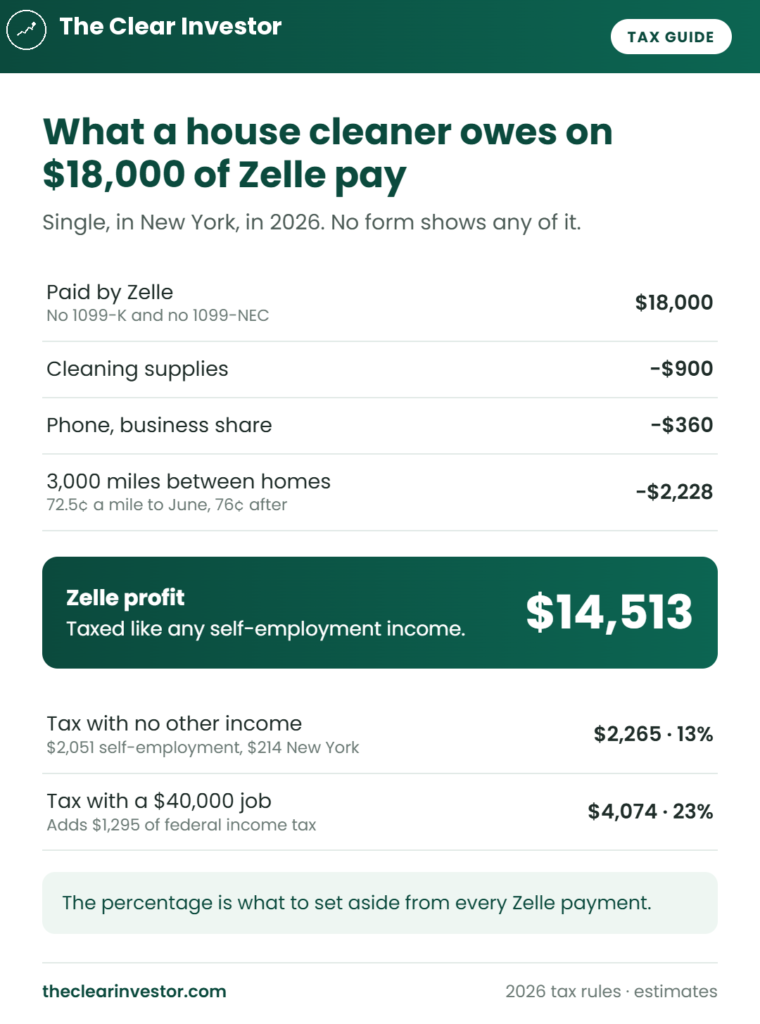
Take a house cleaner in New York whose clients pay $18,000 by Zelle in 2026. Supplies cost $900, the business share of their phone is $360, and they drive 3,000 miles between homes, 1,500 before July at 72.5 cents and 1,500 after at 76 cents, which is $2,228. Their profit is $14,513, and no form shows any of it.
With no other income, my 1099 tax calculator puts their tax at $2,265: $2,051 of self-employment tax and $214 of New York tax, with no federal income tax because the standard deduction covers it. Setting aside 13% of every payment covers it. With a $40,000 job, it’s $4,074, with $1,295 of federal income tax and $728 of New York tax, so they’d set aside 23% of every payment.
Here’s the tax for a single person in a state with no income tax, by Zelle profit after every cost:
| Zelle profit | No other income | With a $45,000 job |
|---|---|---|
| $1,000 | $141 | $231 |
| $3,000 | $424 | $692 |
| $5,000 | $706 | $1,153 |
| $10,000 | $1,413 | $2,305 |
| $20,000 | $3,025 | $4,610 |
| $40,000 | $7,427 | $10,044 |
With no other income, the standard deduction covers your income tax until your profit passes about $17,000, so you pay about 14% of your profit, all of it self-employment tax. With a job in the 12% bracket, it’s about 23%. At $40,000 with a $45,000 job, part of the profit reaches the 22% bracket, so the tax jumps to $10,044. Add your state’s rate on top.
Do You Need to Pay Zelle Taxes Quarterly?
Often, yes. The IRS expects estimated tax payments when you’ll owe $1,000 or more at tax time, which you reach at about $7,100 of profit with no other income.
The house cleaner with no job owes $2,051 of federal tax, so they’d pay about $513 by each of April 15, June 15, September 15 and January 15. With a job, raising your Form W-4 withholding at work can cover it instead. The safe harbor that keeps you penalty-free is in how quarterly payments work.
Free tax tracker + deadline reminders
Get my free side income tax tracker
Sign up and I’ll send you my Google Sheets tracker that shows how much of each payout to set aside. You’ll also get an email before each quarterly tax deadline (Jan 15, Apr 15, Jun 15 and Sep 15), plus my new guides. Unsubscribe anytime.
Earn on several platforms or drive for work? Get the full 1099 Side Income Tracker ($12) →
Zelle Taxes: How to File
- Download a year of bank statements, or your bank’s Zelle activity for the year, plus any 1099-NEC you got.
- Mark each Zelle payment you received as personal, your own things, rent from a tenant or business income.
- Report all your business income on line 1 of Schedule C, including amounts on a 1099-NEC (once, not twice) and everything no form shows. Add your costs, mileage and any bank fees.
- Report rent from a tenant on Schedule E, and a gain on your own things on Form 8949 and Schedule D.
- Pay self-employment tax on Schedule SE, claim the qualified business income deduction on Form 8995, and subtract any estimated payments.
I file with TaxAct. I keep a separate Schedule C for each kind of work and attach each 1099 to the one it belongs to, so the income and costs for each stay together.
Special Situations
If a client paid you by Zelle and also sent a 1099-NEC
The form covers what that client paid. Report it once, and add only the Zelle payments from clients who didn’t send a form.
If you also get paid on Venmo or PayPal
Those apps send a 1099-K once you pass their line, and Zelle never does. Each one counts only its own payments, so add them all up yourself.
If you were paid in your business’s name
A Zelle payment to your business account is still your income if you’re a sole proprietor or a single-member LLC, and it goes on your Schedule C.
If you received money for a group
Money you collect and pass on, like a group gift, a shared rental or a team fee, isn’t income. Keep a note of who paid what and where it went.
If your Zelle income was small
There’s no minimum for reporting business income. Self-employment tax starts at $400 of net earnings, and income tax depends on your total income.
Common Zelle Tax Mistakes
- Thinking no 1099-K means no tax. Zelle never sends one, and the income is still taxable.
- Believing a $600 Zelle rule. There isn’t one. Zelle doesn’t report payments at any amount.
- Counting a 1099-NEC twice. If a client sent one, that money is already in your bank statement.
- Reporting gifts and roommate rent as income. They aren’t.
- Mixing a tenant’s rent with a roommate’s share. One is rental income and the other isn’t.
- Keeping no records. Your bank statement shows names and amounts but not what each payment was for.
- Not saving for the tax. Nothing is withheld, so set aside your percentage of every payment.
My Verdict: No Form, Same Tax
Zelle is the simplest payment app at tax time, because there’s nothing to correct and nothing to sort out with a 1099-K. It’s also the easiest to get wrong, because nothing reminds you the income is there. Treat every Zelle payment for your work like a paycheck with no tax taken out: log it, set aside your share and report it on Schedule C.
Keep gifts, split bills and roommate rent out of your income, and keep business payments in their own account if your bank allows it. Then set aside about 14% of your profit with no other income, or about 23% with a job, plus your state’s rate.
My 1099 tax calculator works out your number from what you were paid and your costs, and shows what to pay each quarter.
Want more ways to earn? See every platform I’ve used in How I make money online.
FAQ
Does Zelle report to the IRS?
No. Zelle says it doesn’t report payments on its network to the IRS and the 1099-K rules don’t apply to it, including on small business accounts.
Do I have to pay taxes on money received through Zelle?
Only on income: pay for your work, rent from a tenant and gains on things you sold. Gifts, split bills and a roommate’s share of rent aren’t taxed.
Does Zelle send a 1099-K?
No, at any amount. Zelle says the 1099-K rules don’t apply to its network, so there’s no 1099-K for Zelle payments from your bank either.
Can the IRS see my Zelle payments?
Zelle doesn’t report them, but they’re in your bank records, which the IRS can ask for in an audit.
Is there a $600 Zelle rule?
No. Zelle says it doesn’t report payments even when you receive more than $600. The $600 line was a planned federal 1099-K rule for payment apps that never took effect, and Zelle wasn’t covered by it anyway.
Do I pay taxes on Zelle money from family?
Not on gifts. The giver only files a gift tax return if they give you more than $19,000 in 2026, and even then usually owes nothing.
Will my client send a 1099 if they paid me with Zelle?
A business that pays you $2,000 or more for your work in 2026 should send a 1099-NEC. A family paying you for personal services doesn’t.
How much should I set aside for Zelle taxes?
About 14% of your profit with no other income, or about 23% with a job in the 12% bracket. Add your state’s rate.
I’m not a licensed financial advisor or tax professional. This guide is based on Zelle’s FAQ, IRS rules and my own experience filing 1099 income on Schedule C. It’s for educational purposes and isn’t tax advice. Tax rules change, so check the links above or talk to a tax professional about your situation. I’m not affiliated with Zelle, any bank or TaxAct.