Venmo taxes depend on what each payment was for, not on the app. Money from friends and family for a split dinner, your share of the rent or a birthday gift isn’t income, and Venmo doesn’t report it. Money for your work or for things you sold is reported on a 1099-K once you pass Venmo’s line, and pay for your work is taxed whether it shows up on a form or not.
What makes Venmo different is that one account holds both kinds of money. A goods and services payment costs you a 2.99% seller fee and counts toward a 1099-K. A business profile charges 1.9% plus 10 cents and reports every payment. A payment sent as friends and family has no fee and no form. That tag decides what Venmo reports, but it doesn’t decide what you owe.
I’ve filed my own taxes with TaxAct every year since 2022, I’ve received 1099s from Outlier and Clickworker, and I report two side gigs on their own Schedule Cs, the same form Venmo business income goes on. Everything Venmo-specific here comes from Venmo’s tax FAQ and fee pages, the IRS and my 1099 tax calculator, and each piece links to its source so you can check it yourself.
Venmo taxes, the short answer:
- Do you pay taxes on Venmo? Only on income: pay for your work, sales of things you bought to resell, and gains on your own things. Split bills, rent shares, reimbursements and gifts aren’t taxed.
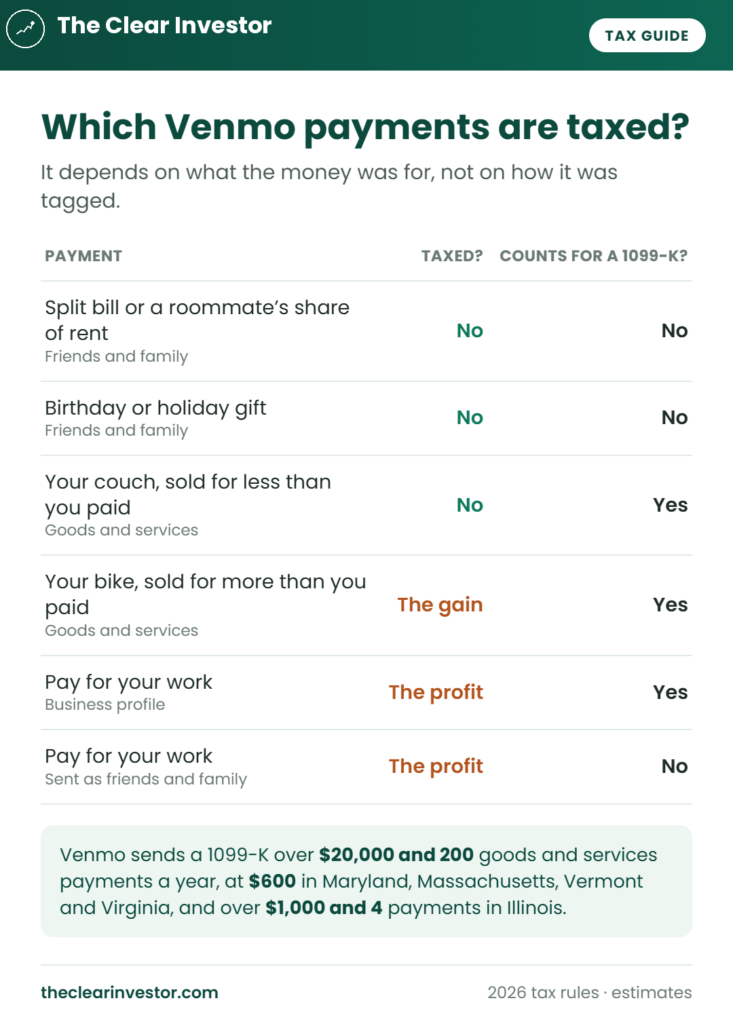
- Does Venmo report to the IRS? Only goods and services payments, on a 1099-K, once they top $20,000 and 200 payments in a year, or a lower line in Illinois, Maryland, Massachusetts, Vermont and Virginia. Friends and family payments are never on it.
- Is friends and family money taxable? Not when it’s personal. Pay for your work that a customer sent as friends and family is still taxable. It just isn’t reported.
- Why is my 1099-K more than I made? It counts what people paid before Venmo’s fees, refunds and your costs, and it can include your own things sold at a loss.
- How much should you set aside? About 14% of your profit with no other income, or about 23% with a job in the 12% bracket, plus your state’s rate. For the dog walker in my example below, with a job in Virginia, that’s 28% of every payment.
Table of Contents
Do You Pay Taxes on Venmo?
Venmo only moves money, so the IRS looks at what the money was for:
- Personal money isn’t income. The IRS gives these examples of payments that aren’t taxable: sharing the cost of a meal or a car ride, birthday or holiday gifts, and a roommate repaying you for rent or a household bill.
- Pay for your work is business income. Dog walking, tutoring, hair and nails, cleaning, photography or freelance design: when people pay you on Venmo, it’s self-employment income, however they tagged it.
- Things you sold depend on what they were. Your own things sold for less than you paid aren’t taxed. A gain on your own things is. Things you bought to resell are a business.
A form isn’t what makes money taxable. The IRS’s 1099-K page says you must report payments for goods, services or property even if you don’t get a 1099-K, and that a payment on a 1099-K isn’t automatically taxable either.
When Venmo money is business income, this is how it’s taxed:
- Nothing is withheld. Venmo doesn’t take income tax out of your payments, so part of every payment is tax you’ll owe later.
- You report it as a business. Your payments, Venmo’s fees and your costs go on Schedule C, and only the profit is taxed.
- Self-employment tax is 15.3% on 92.35% of your profit once it’s $400 or more. It’s your Social Security and Medicare, and you owe it even when you owe no income tax.
- Income tax only applies to income above your standard deduction, $16,100 for single filers in 2026. With a job, your pay usually uses that up, so your Venmo profit is taxed at your bracket.
The rules every side hustle shares are in my side hustle taxes guide, and the full 1099 picture is in my 1099 taxes guide. This guide covers what’s different about Venmo.
Friends and Family vs. Goods and Services
Money reaches you on Venmo in one of three ways, and each one is treated differently:
- Friends and family. A plain payment to your personal profile. No fee, not on a 1099-K and not covered by Venmo’s Purchase Protection. It’s meant for personal money.
- Goods and services to a personal profile. The sender tags the payment as a purchase. You pay a 2.99% seller fee, the buyer gets Purchase Protection, and the payment counts toward your 1099-K.
- A business profile. A separate profile on your Venmo account for a side business. Every payment to it is tagged as a purchase automatically, the fee is 1.9% plus 10 cents, and every payment counts toward your 1099-K.
Venmo’s own rules say the only ways to accept payment for goods or services are a business profile or a payment the sender tags as a purchase, according to its buying and selling page. So asking customers to send friends and family to skip the fee breaks Venmo’s rules and leaves your buyers without Purchase Protection, and it doesn’t lower your tax by a cent.
If people pay you for work every week, a business profile is usually the better choice. Its fee is lower than the 2.99% on a personal profile, and it keeps your business payments apart from the dinners you split, which makes tax time much easier.
Does Venmo Report to the IRS? Your 1099-K
Venmo sends a Form 1099-K for any year you pass the federal line or your state’s, according to its tax law page:
- The federal line for 2026 is more than $20,000 in goods and services payments and more than 200 of them. You need both. The 2025 tax law restored this line after years of planned cuts to $600, and Venmo says it’s now permanent.
- Lower state lines. Venmo’s page lists these, with Vermont’s line updated for 2026:
| State | 1099-K line for 2026 payments |
|---|---|
| Illinois | Over $1,000 and 4 or more payments |
| Maryland | $600 or more |
| Massachusetts | $600 or more |
| Vermont | $2,000 or more (Venmo’s page still shows $600) |
| Virginia | $600 or more |
Vermont’s law ties its 1099-K line to the federal line for other 1099 forms (32 V.S.A. § 5862d), and that line went from $600 to $2,000 for payments made in 2026 (IRS). Venmo’s page still shows Vermont’s old $600, so you may get a form below $2,000 anyway. You report the same income either way.
- Only goods and services payments count. Friends and family payments are left out. Payments to a business profile always count.
- Where to find it: the 1099-K is out by January 31. In the app, tap the Me tab, then Settings, then Tax Documents. On the web, it’s under Settings, then Tax Documents (Venmo). Venmo only mails paper forms for accounts opened before July 22, 2022.
- Other Venmo forms: a 1099-MISC for some rewards, including crypto and PYUSD rewards, and a 1099-DA for crypto you sold or exchanged. Both are out by February 15.
Arkansas, New Jersey, Montana and the District of Columbia have lower lines in their own state rules that Venmo’s page doesn’t list. If you live there, check Tax Documents in late January anyway.
The 24% hold. If Venmo doesn’t have your Social Security number, ITIN or EIN, it holds goods and services payments and takes 24% backup withholding out of them, which it sends to the IRS each month (Venmo). Venmo can’t return that money, but it isn’t lost: it’s tax you’ve already paid, and you claim it on line 25b of Form 1040. Venmo sends a 1099-K to anyone it withheld from, whatever their total. To stop the hold, add your tax ID under Me, then Settings, then Identity Verification, or tap Provide tax info on your business profile.
Under the line you may get no form at all, but the income is just as taxable. Download your transaction history for the year either way, because it’s your record of what came in.
Why Your Venmo 1099-K Is More Than You Made
The amount in box 1a is gross. The IRS says it isn’t adjusted for fees, credits, refunds, shipping or discounts, so it can be well over what you earned:
- Venmo’s fees are still in it. The 2.99% or the 1.9% plus 10 cents comes out before the money reaches you, but the form counts the full payment.
- Refunds are still in it. If you refunded a customer, the original payment still counts.
- Your own things sold at a loss are in it. They count toward the line even though they aren’t taxed.
- Personal money a friend tagged as a purchase is in it. A rent share or a split bill sent as goods and services shows up as if it were a sale.
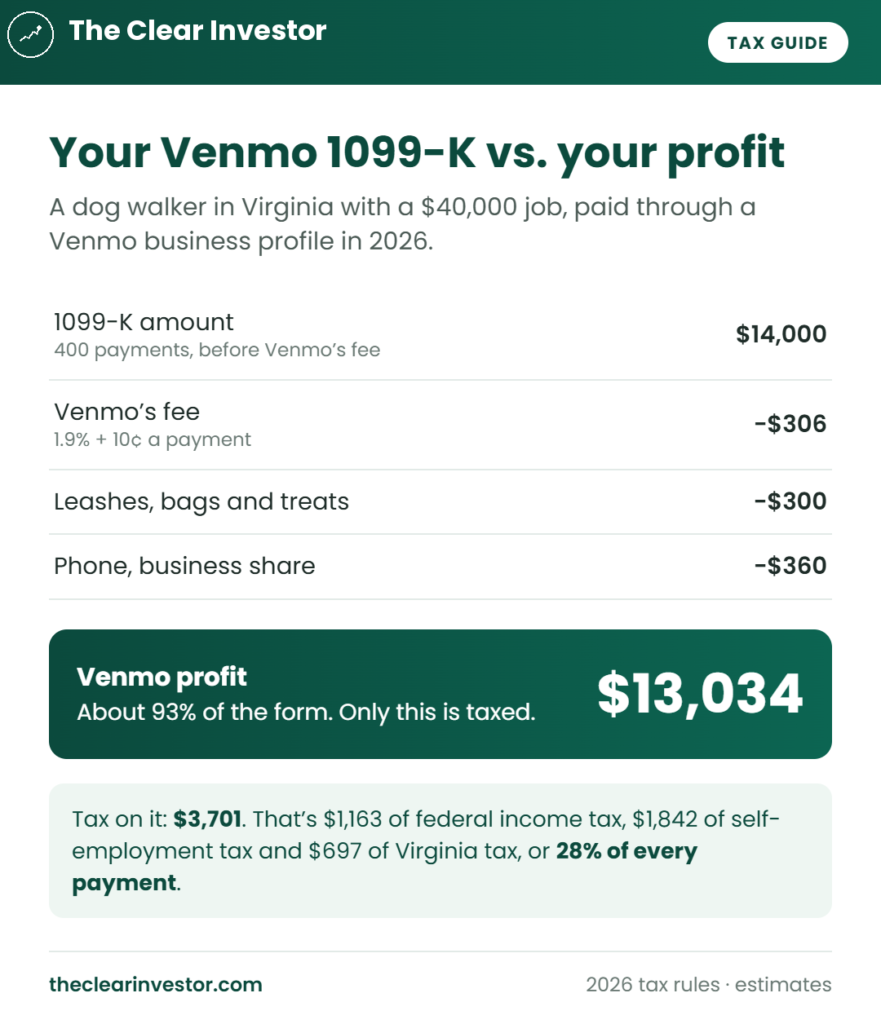
You report the whole 1099-K and then take out what isn’t income. Take a dog walker in Virginia who gets paid through a Venmo business profile. Their 1099-K says $14,000. After $306 of Venmo fees, $300 of leashes, bags and treats and $360 for the business share of their phone, their profit is $13,034, and that’s the number the tax is worked out from.
Venmo’s Fees: What Comes Off
These are Venmo’s fees on its fee page, and what you can deduct when it’s business money:
| Fee | Who pays it | Deductible? |
|---|---|---|
| Goods and services to a personal profile: 2.99% | You, the seller | Yes |
| Business profile: 1.9% + $0.10 | You | Yes |
| Instant transfer to your bank: 1.75% ($0.25 to $25) | You | Yes, on business money |
| Paying with a credit card: 3% | The sender | Not your cost |
| Standard transfer to your bank | Free | Nothing to deduct |
Business fees go on Schedule C as a cost. On your own things, the 2.99% just lowers what you got for the item, which matters only if you sold it at a gain.
Selling Your Own Things on Venmo
Selling a couch, a bike or concert tickets you can’t use isn’t a business, and the tax depends on what you paid:
- Sold for less than you paid: not taxed, and the loss isn’t deductible. If it’s on a 1099-K, you report it so it comes to zero (below).
- Sold for more than you paid: the gain is taxed, on Form 8949 and Schedule D. Owned more than a year, it gets the lower long-term rates, unless it’s a collectible like cards, coins or art, which can be taxed at up to 28%. My Whatnot taxes guide has more on that rate.
- Bought to resell: that’s a business on Schedule C, even if you only do it now and then.
Say you live in Massachusetts and sell a couch for $400, a bike for $350 and a TV for $300, and each buyer tags the payment as a purchase. You paid $2,600 for the three. Massachusetts has a $600 line, so Venmo sends you a 1099-K for $1,050. Your tax on it is $0. You enter the $1,050 at the top of Schedule 1, or on Form 8949 with code L, so it comes to zero, the way the IRS describes. If you sell your own things often, my eBay tax calculator splits personal items from reselling for you.
If You Got a Venmo 1099-K by Mistake
It happens when friends tag split bills or rent as purchases, or when personal money goes to a business profile. The IRS’s steps for a 1099-K you shouldn’t have gotten:
- Ask Venmo for a corrected form. On the Venmo website, not the app, go to Settings, then Tax Documents, pick the year and select Make changes next to the 1099-K (Venmo). Venmo says you’ll get an update by email within 7 business days. It can’t re-tag a payment after it went through, so the fix is a corrected form, not a changed payment.
- Keep everything: the original form, the corrected one and your messages with Venmo.
- Don’t wait to file. If the corrected form doesn’t come, the IRS says to enter the amount from the incorrect 1099-K in the space at the top of Schedule 1, and keep records that show the payments were personal.
Don’t call the IRS about it: the IRS says it can’t correct a 1099-K. To stop it happening again, ask friends to send personal money as friends and family, and keep personal money off your business profile.
Gifts, Rent and Split Bills
Most Venmo money between people who know each other isn’t income:
- Gifts aren’t income for you. Gift tax is the giver’s concern, and for 2026 someone can give you up to $19,000 without even filing a gift tax return, according to the IRS. Over that, the giver files Form 709 and usually still owes nothing.
- A roommate’s share of the rent isn’t income when you’re both tenants and you pay the landlord. If you own the home and rent a room to someone, that’s different: it’s rental income, usually on Schedule E, with a share of your costs to deduct.
- Money you collect and pass on, like a group gift or trip costs, isn’t income either. Venmo says personal profiles shouldn’t be used for donation campaigns, so use a fundraising site for those.
Taking Business Payments as Friends and Family
Some sellers and service workers ask customers to send friends and family to skip the fee. It saves 2.99%, and that’s all it does:
- The income is still taxable. No 1099-K doesn’t mean no tax. You report all of it on Schedule C, and in an audit your Venmo history and bank deposits show where it came from.
- It breaks Venmo’s rules. Payments for goods and services are supposed to be tagged as purchases or go to a business profile.
- Your customers lose Purchase Protection, which can cost you repeat business.
The fee is deductible, so it costs less than it looks. On $14,000 of payments, 2.99% is $419 and a business profile’s 1.9% plus 10 cents is about $306, and either way you subtract it before the tax is worked out.
How Much Tax Will You Owe on Venmo Income?
Here’s the dog walker from above. They’re paid $14,000 in 2026 through their business profile, from 400 walks. Venmo’s fee takes $306, and with $660 of other costs their profit is $13,034. Virginia’s line is $600, so Venmo sends a 1099-K for the full $14,000.
With a $40,000 job, my 1099 tax calculator puts the tax on their Venmo income at $3,701: $1,163 of federal income tax, $1,842 of self-employment tax and $697 of Virginia tax. That’s about 27% of the $13,694 that reached them after fees, so they set aside 28% of every payment. With no job, it’s $1,890, almost all self-employment tax, so 14% of every payment covers it.
Here’s the tax for a single person in a state with no income tax, by Venmo business profit after every cost:
| Venmo profit | No other income | With a $30,000 job |
|---|---|---|
| $1,000 | $141 | $231 |
| $3,000 | $424 | $692 |
| $5,000 | $706 | $1,153 |
| $10,000 | $1,413 | $2,305 |
| $20,000 | $3,025 | $4,610 |
| $40,000 | $7,427 | $9,221 |
With no other income, the standard deduction covers your income tax until your profit passes about $17,000, so you pay about 14% of your profit, all of it self-employment tax. With a job in the 12% bracket, it’s about 23%. Add your state’s rate on top.
Do You Need to Pay Venmo Taxes Quarterly?
Once it adds up, yes. The IRS expects estimated tax payments when you’ll owe $1,000 or more at tax time. With no other income, you get there at about $7,100 of profit.
Set aside your percentage of each payment when it comes in, then pay by April 15, June 15, September 15 and January 15. The dog walker with a job would pay about $751 a quarter, or raise their Form W-4 withholding at work instead. The safe harbor that keeps you penalty-free is in how quarterly payments work.
Free tax tracker + deadline reminders
Get my free side income tax tracker
Sign up and I’ll send you my Google Sheets tracker that shows how much of each payout to set aside. You’ll also get an email before each quarterly tax deadline (Jan 15, Apr 15, Jun 15 and Sep 15), plus my new guides. Unsubscribe anytime.
Earn on several platforms or drive for work? Get the full 1099 Side Income Tracker ($12) →
Venmo Taxes: How to File
- Download your 1099-K if you got one, and your transaction history for the year from every profile you use.
- Sort your payments into three piles: personal money (gifts, rent shares, split bills), your own things you sold, and business income.
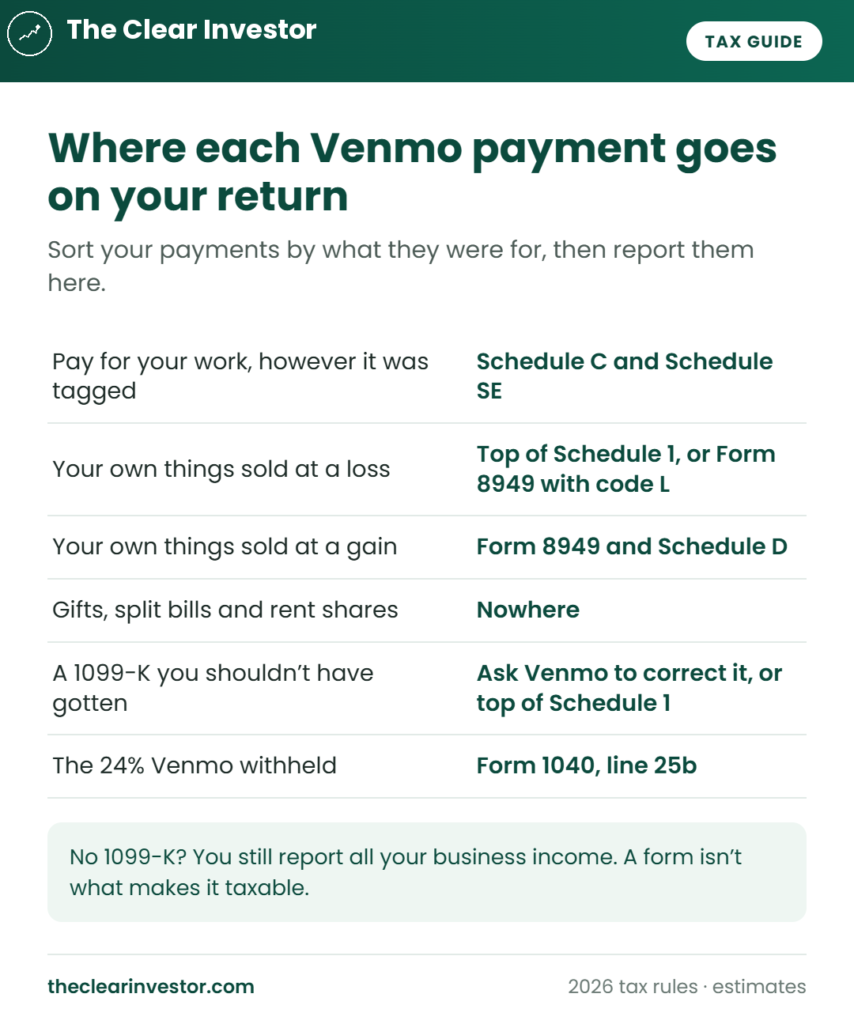
- Report all your business income on line 1 of Schedule C, including payments sent as friends and family and anything under the 1099-K line. Put refunds on line 2, Venmo’s fees on line 10 and your other costs in their own lines.
- Report your own things: a loss at the top of Schedule 1 or on Form 8949 with code L, so it comes to zero, and a gain on Form 8949 and Schedule D.
- Pay self-employment tax on Schedule SE, claim the qualified business income deduction on Form 8995, and enter any 24% Venmo withheld on line 25b of Form 1040.
I file with TaxAct. I keep a separate Schedule C for each kind of work and attach each 1099 to the one it belongs to, so each one’s income and costs stay together.
Special Situations
If you use a personal and a business profile
Check Tax Documents on both. Payments to your business profile always count toward the 1099-K line, and goods and services payments to your personal profile count too.
If you also get paid on PayPal, Cash App or Zelle
Each company counts only its own payments toward its line, so you can be under every line and still owe tax on the total. Zelle never sends a 1099-K at all, which my Zelle taxes guide explains. PayPal’s 1099-K works like Venmo’s, and my PayPal taxes guide covers its fees and forms.
If customers tip you on Venmo
Tips are income, taxed with the rest of your profit. The new federal tips deduction only covers tips in jobs on the IRS’s list that are reported to you on a form, and Venmo says its 1099-K for 2025 doesn’t show tips separately, so check what your form shows before you count on it.
If you bought or sold crypto on Venmo
A sale or exchange is a gain or loss on Form 8949, and Venmo sends a 1099-DA for it by February 15. Crypto rewards come on a 1099-MISC.
If your business is a single-member LLC
It’s still Schedule C, unless you chose to be taxed as a corporation. If you gave Venmo your LLC’s EIN, the 1099-K comes under that number, and it still goes on your Schedule C.
If you sold under the 1099-K line
You owe the same tax with or without a form. Use your transaction history as your record of every payment.
Common Venmo Tax Mistakes
- Thinking no 1099-K means no tax. Business income is taxable from the first dollar of profit.
- Reporting gifts and split bills as income. They aren’t, and you only need to deal with them if they ended up on a 1099-K.
- Paying tax on the whole 1099-K. Take out Venmo’s fees, refunds, your own things sold at a loss and your costs.
- Asking customers to send friends and family. It breaks Venmo’s rules and changes nothing about your tax.
- Leaving out your tax ID. Venmo then holds payments and takes 24%. If it already did, claim it on line 25b.
- Mixing personal and business money on one profile. It turns a simple tax return into an afternoon of sorting.
- Not saving for the tax. Nothing is withheld, so set aside your percentage of every payment.
My Verdict: The Tag Decides the Form, Not the Tax
Venmo taxes look confusing because one app holds your rent share, your birthday money and your side hustle pay. Sort them by what they were for and it gets simple: personal money isn’t taxed, your own things are only taxed on a gain, and pay for your work is taxed on the profit, tagged or not.
If people pay you for work, a business profile is worth it for the lower fee and the clean records. Give Venmo your tax ID before the first payment so nothing gets held, and set aside about 14% of your profit with no other income, or about 23% with a job, plus your state’s rate.
My 1099 tax calculator works out your number from your Venmo payments, fees and costs, and shows what to pay each quarter.
Want more ways to earn? See every platform I’ve used in How I make money online.
FAQ
Do I have to pay taxes on Venmo?
Only on income: pay for your work, things you bought to resell, and gains on your own things. Split bills, rent shares, reimbursements and gifts from friends and family aren’t taxed.
Does Venmo report friends and family payments to the IRS?
No. Venmo’s 1099-K only counts goods and services payments, including every payment to a business profile.
What is the Venmo 1099-K threshold for 2026?
More than $20,000 in goods and services payments and more than 200 of them. Venmo’s page lists lower lines in Illinois (over $1,000 and 4 payments) and Maryland, Massachusetts and Virginia ($600). Vermont’s line is $2,000 for 2026 payments under state law, though Venmo’s page still shows $600.
Where do I find my Venmo 1099-K?
In the app under Me, then Settings, then Tax Documents, or on the website under Settings, then Tax Documents. It’s there by January 31.
Why is my Venmo 1099-K more than I made?
It counts what people paid before Venmo’s fees and refunds, and it can include your own things sold at a loss. You report it, then take those out.
Is money from friends on Venmo taxable?
Not when it’s a gift, a split bill or a roommate’s share of rent. Pay for your work is taxable even when it’s sent as friends and family.
What if I got a Venmo 1099-K by mistake?
Ask Venmo for a corrected form on its website under Settings, then Tax Documents. If it doesn’t come, enter the amount at the top of Schedule 1 and keep records showing the payments were personal.
How much should I set aside for Venmo taxes?
About 14% of your profit with no other income, or about 23% with a job in the 12% bracket. Add your state’s rate.
I’m not a licensed financial advisor or tax professional. This guide is based on Venmo’s help pages, IRS rules and my own experience filing 1099 income on Schedule C. It’s for educational purposes and isn’t tax advice. Tax rules change, so check the links above or talk to a tax professional about your situation. I’m not affiliated with Venmo, PayPal or TaxAct.