
This Depop tax calculator shows how much tax you’ll owe on your Depop sales in 2026, how much of each payout to set aside, and what you keep per order and per hour once Depop’s fees, your thrift finds and the tax come off. It splits your reselling from the clothes you sold out of your own closet, and if your parents claim you as a dependent, it shows what that changes. Want to know how Depop sellers are taxed first? Read my Depop tax guide.
I haven’t sold on Depop, but I file my own taxes with TaxAct and keep each side gig on its own Schedule C, which is where Depop reselling goes. Depop makes a few things harder than other side gigs. Its 1099-K counts what buyers paid before refunds and fees, including the Marketplace fee buyers pay Depop, which you never get. A lot of what sells on it comes out of sellers’ own closets, which usually isn’t taxed at all. And a lot of sellers are students whose parents claim them. So this calculator estimates Depop’s fees from your sales, keeps your own clothes out of your profit, and handles the dependent rules.
Depop Tax Calculator
See how much tax you’ll owe on your Depop sales in 2026: reselling profit after Depop’s fees and what your thrift finds cost, clothes from your own closet sold at a loss, the smaller standard deduction if your parents claim you, and how much of each payout to set aside.
Your 2026 Depop sales
Your own clothes in those sales
Your reselling costs
Your other income
About you
Your 1099-K vs. what Depop paid you
Which sales are taxed
| Sales | Item sales | Taxed |
|---|
Claimed as a dependent vs. not
| Claimed | Not claimed |
|---|
What you keep
Your tax forms
| Form | From | Amount |
|---|
Your total 2026 tax: before vs. after deductions
| Before deductions | After deductions |
|---|
How your taxable income is worked out
How this is calculated
- Your sales = what buyers paid for items and shipping. Depop’s 1099-K counts that before refunds and fees, plus the Marketplace fee buyers pay Depop (up to 5% of the item price and up to $1 an order), which never reaches you. Sales tax Depop collects for the states isn’t your income.
- Depop’s fees (estimate) = 3.3% of items, shipping and sales tax + 45¢ an order for payment processing, plus 12% of the item price on sales from boosted listings. There’s no selling fee in the US. Depop reverses the fees on refunded orders.
- Your own things vs. reselling: clothes you bought for yourself and sold for less than you paid aren’t taxed, and the loss isn’t deductible. Things you kept for yourself that sold for more than you paid are a capital gain. Everything else counts as reselling, a business on Schedule C. Shipping, refunds, Depop’s fees and labels are split between them by item sales.
- Cost of what you sold = unsold stock on Jan. 1 + stock you bought this year (with sales tax and shipping) − unsold stock on Dec. 31, the way Part III of Schedule C works it out.
- Reselling profit = reselling sales and shipping − refunds − cost of what you sold − Depop’s fees − shipping labels − supplies − mileage − other costs. Mileage is business miles from January through June × 72.5¢ + July through December × 76¢, the 2026 IRS rates.
- Self-employment tax is 15.3% (12.4% Social Security and 2.9% Medicare) on 92.35% of your self-employment profit. You only owe it when that comes to $400 or more, which means about $433 of profit, and it’s the same whether or not someone claims you. Social Security tax stops at $184,500 of combined W-2 pay and self-employment earnings, and an extra 0.9% Medicare tax applies above $200,000 ($250,000 married filing jointly, $125,000 separately). Half of the 15.3% is deductible.
- Claimed as a dependent: your federal standard deduction is the larger of $1,350 or your earned income plus $450, up to $16,100, where earned income is W-2 pay plus self-employment profit after half of the self-employment tax. You file as single, with no child tax credit.
- Federal income tax uses the 2026 brackets and standard deduction ($16,100 single or married filing separately, $32,200 married filing jointly, $24,150 head of household). It includes the qualified business income deduction: 20% of your reselling and other self-employment profit after the self-employment tax deduction, capped at 20% of your taxable income minus long-term gains, and at least $400 when that profit is $1,000 or more. Long-term gains are taxed at 0% up to $49,450 of taxable income ($98,900 married filing jointly, $66,200 head of household), 15% up to $545,500 and 20% above, with the 3.8% net investment income tax above $200,000 of income ($250,000 jointly).
- Child tax credit is $2,200 per child under 17. Up to $1,700 per child can be paid to you as a refund, based on 15% of your earned income over $2,500.
- State income tax uses 2026 rates, brackets, standard deductions and exemptions from the Tax Foundation, updated for the 2026 cuts in Arkansas, Georgia, South Carolina, Utah and West Virginia, and for the higher 2026 standard deductions in Arizona and Maine. A few states (like California) hadn’t published 2026 bracket amounts, so their 2025 amounts are used. For dependents, California uses its dependent worksheet (up to $5,706) with no personal exemption credit, New York uses its $3,100 dependent deduction, states that use the federal standard deduction get the dependent amount, and other states get the federal formula on their own standard deduction, an estimate. Gains are counted as regular income.
- Tax on your Depop sales = your total tax minus what your total tax would be without Depop. The set-aside percentage is that tax divided by what Depop paid you: your sales minus refunds, fees and shipping labels.
- Tax forms: Depop sends a Form 1099-K through Stripe when sales are over $20,000 with more than 200 transactions, or over a lower line in some states: $600 in DC, Maryland, Massachusetts, Montana and Virginia, $1,000 in New Jersey, $1,000 with 4 transactions in Illinois, $2,000 in Vermont and $2,500 in Arkansas.
Not included: hobby selling (income from an activity that isn’t a business, reported on Schedule 1), depreciation on equipment, the home office deduction, the kiddie tax on a dependent’s unearned income, state rules for dependents beyond California and New York, the earned income tax credit, education credits, city and county income taxes, itemized deductions, and tax withheld from a W-2 job. Your real tax can be lower.
Free tax tracker + deadline reminders
Get my free side income tax tracker
Sign up and I’ll send you my Google Sheets tracker that shows how much of each payout to set aside. You’ll also get an email before each quarterly tax deadline (Jan 15, Apr 15, Jun 15 and Sep 15), plus my new guides. Unsubscribe anytime.
Earn on several platforms or drive for work? Get the full 1099 Side Income Tracker ($12) →
Table of Contents
How to Use the Depop Tax Calculator
- Download your sales from Depop. On a computer, go to Selling Hub, then Stats, then Download sales. It gives up to 3 months at a time, with every sale, fee and shipping cost, per Depop’s sales download page.
- Enter your item sales, shipping, orders and refunds. Item sales are what buyers paid for your items, without shipping, sales tax or the Marketplace fee.
- Choose how to count Depop’s fees. Let the calculator estimate them from your sales, the sales tax buyers paid and your boosted sales, or add up the fee columns in your download. Then enter what Depop took out for shipping labels.
- Enter any of your own clothes you sold. Things you bought for yourself and sold for less than you paid aren’t taxed. Things you kept and sold for more than you paid are a gain.
- Add your stock, supplies, miles, other costs and hours, then your other income, whether someone can claim you as a dependent, and your state.
Who This Calculator Is For
- Students who resell thrift finds, especially if your parents claim you as a dependent.
- Full-time and side-hustle resellers who source from thrift stores, bins and estate sales.
- People clearing out their closets, to see whether any of it is taxed (usually none of it is).
- Sellers with a W-2 job, to see how much more tax Depop adds.
- Shops under $20,000 in sales, which may not get a 1099-K but still owe tax on their profit.
If you also sell on eBay, Etsy or Whatnot, enter that profit as other self-employment profit, so your tax bracket counts both. My eBay tax calculator, Etsy tax calculator and Whatnot tax calculator can work out that profit, and my 1099 tax calculator covers any other 1099 work.
How to Read Your Results
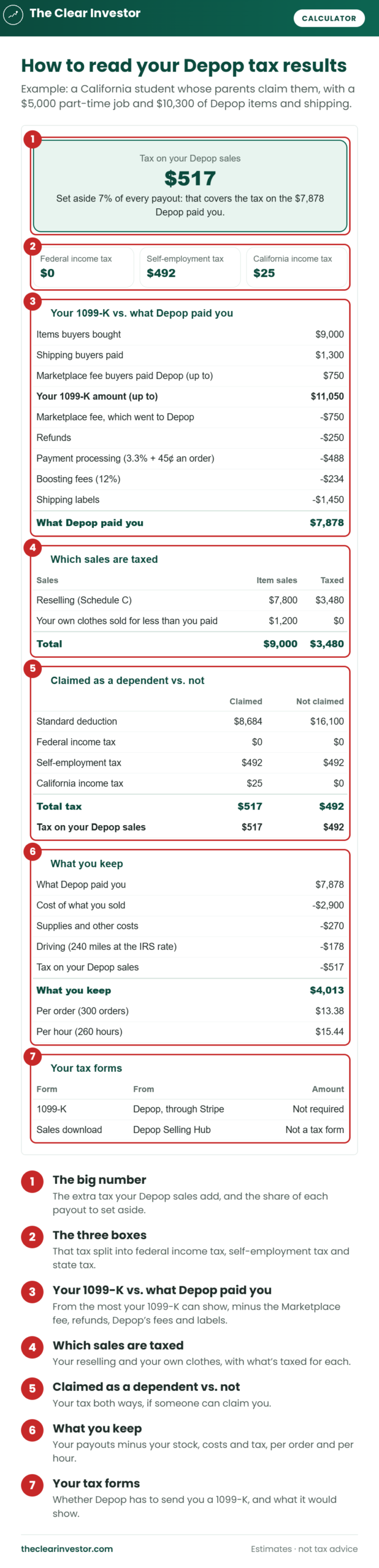
- The big number is the extra tax your Depop sales add, and the line under it says what share of each payout to set aside.
- The three boxes split it into federal income tax, self-employment tax and state tax.
- Your 1099-K vs. what Depop paid you starts from the most your 1099-K can show and takes off the Marketplace fee, refunds, Depop’s fees and labels.
- Which sales are taxed splits your reselling from your own clothes, with what’s taxed for each.
- Claimed as a dependent vs. not shows your tax both ways, if someone can claim you.
- What you keep takes the cost of what you sold, your other costs and the tax off your payouts, per order and per hour.
- Your tax forms shows whether Depop has to send you a 1099-K, and the notes cover fees, thrift stock, your own clothes, sales tax, mileage, filing and quarterly payments.
Below them, tables show your tax before and after deductions and how your taxable income is worked out.
Worked Example 1: A College Student in California Whose Parents Claim Them
This is the calculator’s starting example: a full-time student in California whose parents claim them, with a $5,000 part-time job, who resells thrift finds and some of their own clothes. Over 300 orders, buyers paid $9,000 for items, $1,300 for shipping and $750 in sales tax, and they refunded $250. $1,200 of the item sales were their own clothes, sold for less than they paid, and $2,000 came through boosted listings.
They had $300 of thrifted stock on January 1, bought $3,000 more, and had $400 left on December 31. Depop took $1,450 for labels, and they spent $120 on mailers, drove 240 miles on thrift runs and post office trips, and spent $150 on a clothing rack and photo backdrop, over about 260 hours.
| Step | Amount |
|---|---|
| Items and shipping buyers paid | $10,300 |
| Their own clothes, with their shipping | −$1,373 |
| Reselling sales and shipping | $8,927 |
| Refunds (reselling share) | −$217 |
| Thrifted stock in what they sold ($300 + $3,000 − $400) | −$2,900 |
| Depop’s fees (3.3% + 45¢ processing, 12% boosting) | −$625 |
| Shipping labels | −$1,257 |
| Mailers, mileage and other costs | −$448 |
| Reselling profit | $3,480 |
| Federal income tax | $0 |
| Self-employment tax | $492 |
| California income tax | $25 |
| Tax on their Depop sales | $517 |
Depop paid them $7,878 after refunds, its $722 of fees and the labels, so the calculator says to set aside 7% of every payout. Their 1099-K could show up to $11,050 with the Marketplace fee, but they’re under the $20,000 line and California doesn’t have a lower one, so they don’t get a form. They still have to file, because their self-employment earnings are over $400.
Being claimed doesn’t add any federal income tax. A dependent’s standard deduction is their earned income plus $450, which here is $8,684, more than their $8,234 of income. The $25 of California tax is there because California gives a dependent no personal exemption credit. The $492 of self-employment tax is the same either way. After what they spent and the tax, they keep $4,013, about $13.38 an order or $15.44 an hour.
Worked Example 2: A Thrift Reseller With a $38,000 Job in Texas
This seller works full time for $38,000, files single and resells vintage on Depop on nights and weekends. Over 820 orders, buyers paid $24,000 for items, $3,400 for shipping and $2,000 in sales tax, and they refunded $500. $6,000 of their sales came through boosted listings. They had $1,500 of stock on January 1, bought $8,500 more, and had $1,800 left on December 31. Depop took $3,700 for labels, and they spent $300 on supplies, drove 1,200 miles sourcing and shipping, and spent $400 on other costs, over about 1,100 hours.
| Step | Amount |
|---|---|
| Items and shipping buyers paid | $27,400 |
| Refunds | −$500 |
| Stock in what they sold ($1,500 + $8,500 − $1,800) | −$8,200 |
| Depop’s fees (3.3% + 45¢ processing, 12% boosting) | −$2,022 |
| Shipping labels | −$3,700 |
| Supplies, mileage and other costs | −$1,591 |
| Reselling profit | $11,387 |
| Federal income tax | $1,016 |
| Self-employment tax | $1,609 |
| Texas income tax | $0 |
| Tax on their Depop sales | $2,625 |
They get a 1099-K: their sales are over $20,000 with more than 200 transactions, and it could show up to $29,420 once the $2,020 Marketplace fee buyers paid Depop is in it. That’s more than twice their profit. Depop paid them $21,178, so the calculator says to set aside 13% of every payout.
Their job uses up the standard deduction, so the profit is taxed at 12% after a $2,117 qualified business income deduction. They’ll owe more than $1,000 in federal tax on Depop, so they should make quarterly payments or raise the withholding at their job. They keep $8,762, about $10.69 an order or $7.97 an hour.
Worked Example 3: A Closet Clear-Out in Maryland
This student’s parents claim them, and they have no job. They cleared out their closet: buyers paid $1,800 for clothes they’d bought for themselves and worn, $280 for shipping and $110 in sales tax, over 55 orders. Everything sold for less than they paid.
| Step | Amount |
|---|---|
| Items and shipping buyers paid | $2,080 |
| Marketplace fee buyers paid Depop (up to) | $145 |
| Their 1099-K amount (up to) | $2,225 |
| Marketplace fee, which went to Depop | −$145 |
| Depop’s processing fees and labels | −$397 |
| What Depop paid them | $1,683 |
| Tax on their Depop sales | $0 |
Selling your own clothes for less than you paid isn’t taxed, and the loss isn’t deductible either. The difference is the paperwork. Maryland is one of the states with a $600 line, so Depop sends a 1099-K for up to $2,225. With no other income they don’t have to file, but filing lets them show the form was for their own clothes sold at a loss: on Form 8949 with code L, or at the top of Schedule 1 as “Form 1099-K Personal Item Sold at a Loss” with the same amount subtracted in Part II, so it comes to zero. In a state without a lower line, there’d be no form at all.
Worked Example 4: A New York Student Who Sold Their Own Sneakers
This full-time student in New York has no job, and their parents claim them. Over 400 orders, buyers paid $12,000 for items, $1,700 for shipping and $1,000 in sales tax, and they refunded $300. $3,000 of sales came through boosted listings. $1,500 of the item sales was a pair of sneakers they’d bought for themselves for $900 more than a year before. They had $500 of stock on January 1, bought $4,200 more and had $600 left on December 31. Depop took $1,900 for labels, and they spent $150 on supplies, drove 200 miles and spent $200 on other costs, over about 350 hours.
| Claimed as a dependent | Not claimed | |
|---|---|---|
| Reselling profit | $4,587 | $4,587 |
| Gain on the sneakers | $412 | $412 |
| Standard deduction | $4,713 | $16,100 |
| Federal income tax | $0 | $0 |
| Self-employment tax | $648 | $648 |
| New York income tax | $61 | $0 |
| Tax on their Depop sales | $709 | $648 |
The sneakers sold for $600 more than they paid, but after their share of shipping, refunds, fees and labels, the gain is $412. It goes on Form 8949 and Schedule D, and there’s no self-employment tax on it. Their standard deduction of $4,713 still covers it, so there’s no federal income tax either way. New York gives a dependent a $3,100 standard deduction instead of $8,000, which is where the $61 comes from. They set aside 7% of every payout and keep $5,189, about $12.97 an order or $14.83 an hour.
More Example Results
Here’s how a W-2 job changes the tax for the student in Example 1 ($3,480 of reselling profit, 300 orders, 260 hours, in California), claimed as a dependent and not:
| W-2 job | Tax if claimed | Tax if not claimed | Set aside | You keep per hour |
|---|---|---|---|---|
| None | $492 | $492 | 7% | $15.53 |
| $5,000 | $517 | $492 | 7% | $15.44 |
| $12,000 | $524 | $492 | 7% | $15.41 |
| $20,000 | $815 | $815 | 11% | $14.29 |
| $30,000 | $892 | $892 | 12% | $13.99 |
The $492 of self-employment tax is on every row, because it depends only on the Depop profit. Being claimed never adds federal income tax here: until W-2 pay and profit pass $15,650, a dependent’s standard deduction covers them, and past that it’s the full $16,100 anyway. The only difference is California’s personal exemption credit, worth up to $153, which a dependent doesn’t get. With a $20,000 job, the profit starts to be taxed at 10%, then 12% as the job grows.
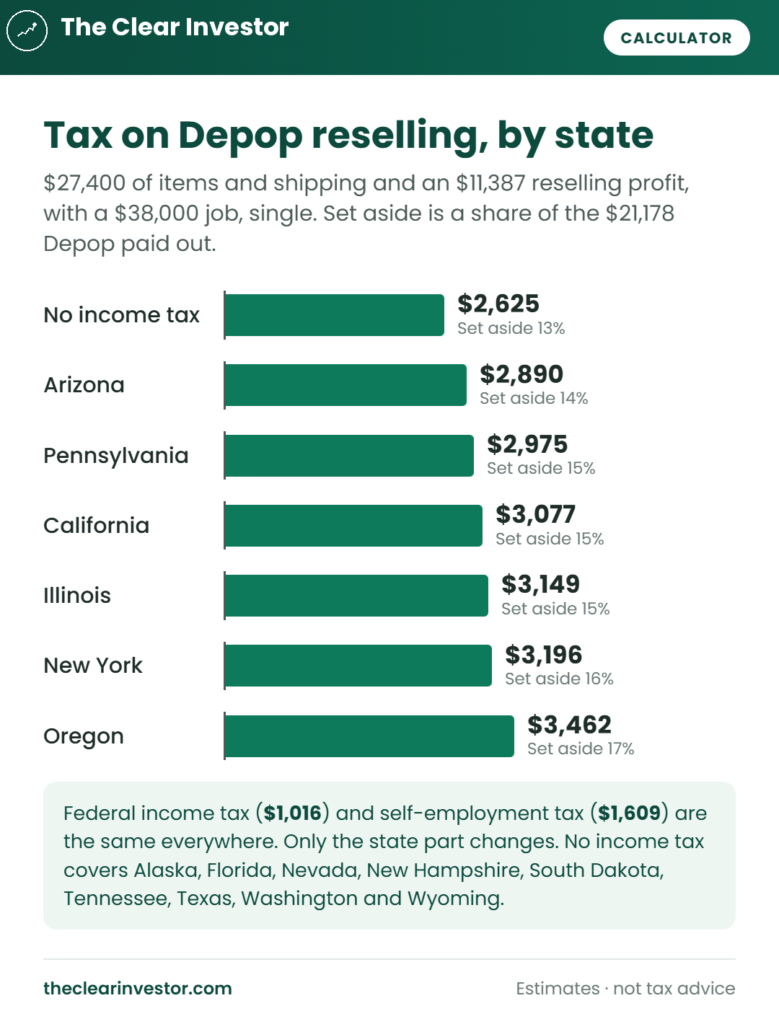
Your state matters too. The tax on the reseller in Example 2 would be $2,625 in states with no income tax, like Florida, Texas and Tennessee, and up to $3,462 in Oregon:
How the Depop Tax Calculator Works
- Sales: what buyers paid for items and shipping. Depop’s 1099-K page says the form counts unadjusted gross sales, with refunds, seller fees and fees buyers pay, including the Marketplace fee, still in it.
- Depop’s fees: no selling fee for US sellers, and payment processing of 3.3% plus 45¢ an order, charged on the item, shipping and sales tax, per Depop’s seller fees page. Boosted listings cost 12% of the item price in the US when a buyer interacted with the boosted listing and bought within 28 days. Depop reverses its fees on a refund.
- Marketplace fee: paid by US buyers, up to 5% of the item price plus up to $1 an order, per Depop’s Marketplace fee page. The calculator adds the most it can be to your 1099-K amount and then subtracts it, since it isn’t yours.
- Shipping labels: Depop pays you the item price plus shipping and then takes out the label cost, per its fees and charges help page. Listings since October 28, 2026 all use a Depop label.
- Sales tax: Depop collects and sends US sales tax for you in every state that has one, per its sales tax page, so it isn’t your income.
- Your own clothes: the IRS says a loss on a personal item can’t be deducted and a gain is taxable. Shipping, refunds, fees and labels are split between reselling and your own things by item sales.
- Thrifted stock: the cost of goods sold from Part III of Schedule C: what you had on January 1, plus what you bought, minus what’s left on December 31.
- Mileage: 72.5¢ a mile through June 2026 and 76¢ from July, the IRS standard mileage rates.
- Self-employment tax: 15.3% on 92.35% of your profit once that’s $400 or more, per the IRS.
- Income tax: the 2026 brackets and $16,100 standard deduction, the qualified business income deduction (at least $400 once your business income is $1,000 or more), long-term gain rates and the child tax credit.
- Dependents: the standard deduction is the larger of $1,350 or earned income plus $450, up to $16,100, from IRS Publication 501 and the 2026 amounts in Revenue Procedure 2025-32. Earned income includes self-employment profit minus half of the self-employment tax. California uses its dependent worksheet with no personal exemption credit, and New York’s dependent standard deduction is $3,100.
- Your 1099-K: over $20,000 with more than 200 transactions, or the lower lines in Arkansas, DC, Illinois, Maryland, Massachusetts, Montana, New Jersey, Vermont and Virginia, from Stripe’s state requirements.
- State tax: your state’s 2026 rates and deductions.
- Your Depop tax: your total tax minus your tax without Depop, so your job’s bracket counts.
- The set-aside: that tax divided by what Depop paid you, rounded up.
- Per order and per hour: what Depop paid you minus the cost of what you sold, your supplies and other costs, your car at the mileage rate and the tax, divided by your orders and hours.
What the Calculator Leaves Out
- Dependent rules in states other than California and New York. It uses the federal formula on your state’s standard deduction and keeps the state’s personal exemption, so treat that state number as an estimate.
- The kiddie tax, which can tax a dependent’s gains and other unearned income over $2,700 at the parent’s rate.
- Hobby selling, depreciation on equipment, the home office deduction and the actual-expense method for your car.
- Sales outside Depop, like in-person sales or other apps. Add their profit as other self-employment profit.
- Health insurance and retirement deductions, the earned income tax credit, education credits, city and county income taxes, and itemized deductions.
Tips for Accurate Results
- Use your sales download, not your bank deposits. Depop takes its fees and labels out first, and money sits in your Depop Balance before you withdraw it.
- Count your rack on December 31. Write down what you paid for every piece you haven’t sold. Without that count, you can’t work out the cost of what you sold.
- Keep your own clothes separate. List what you sold from your own closet, and keep receipts or order emails that show what you paid.
- Use your fee total if you have it. The download lists the Depop Payment and Boosting fees for every sale.
- Check whether your parents can claim you. It depends on your age, school and support, not on whether they choose to.
What to Do With Your Result
- Set aside your percentage of every payout in a savings account when you withdraw from your Depop Balance.
- Make quarterly payments if you’ll owe $1,000 or more in federal tax, or raise the withholding at your job.
- Confirm your tax info in Stripe Express by December 31, 2026, so your 1099-K has the right name and number.
- Look for your 1099-K by January 31, 2027 in Stripe Express, if you passed the federal line or your state’s.
- Tell your parents what you made if they claim you, so you both file the right way.
Depop Tax Calculator FAQ
Where do I find my Depop sales for taxes?
In your sales download: on a computer, go to Selling Hub, then Stats, then Download sales. It covers up to 3 months at a time and lists each sale’s price, fees and shipping, so download all four quarters.
Does Depop send a 1099-K?
For 2026, when your sales are over $20,000 with more than 200 transactions, or over a lower line in Arkansas, DC, Illinois, Maryland, Massachusetts, Montana, New Jersey, Vermont or Virginia. It comes from Stripe, in Stripe Express, by January 31.
Why is my Depop 1099-K more than I made?
It counts what buyers paid before refunds and Depop’s fees, plus the Marketplace fee buyers pay Depop. You report it, then take out the Marketplace fee, refunds, fees, labels and the cost of what you sold.
Do I pay tax on clothes from my own closet?
Not if they sold for less than you paid, and most worn clothes do. If they’re on a 1099-K, report them so they come to zero. Things you kept that sold for more than you paid are a taxable gain.
Can my parents still claim me if I sell on Depop?
If you’re a full-time student under 24, yes, at any income, as long as you don’t pay more than half of your own support. You still file your own return once your self-employment earnings reach $400.
Does Depop take out taxes?
No. Depop doesn’t take income tax out of your payouts, so set aside part of each one for tax.
Does it include state tax?
Yes. Pick your state and it adds your state’s 2026 income tax. City and county taxes aren’t included.
Is my information saved?
No. Everything runs in your browser. Nothing you enter is sent anywhere or stored.
What tax year does the Depop tax calculator use?
2026: the 2026 brackets, standard deductions, mileage rates, 1099-K lines and Depop’s US fees as of November 2026. I update it every year.
Estimates for educational purposes only. I’m not a licensed financial advisor or tax professional, and this isn’t tax advice. Not affiliated with Depop.