
Updated November 6, 2026
This Alignerr tax calculator estimates your federal, self-employment and state tax on your Alignerr pay, and how much to set aside from each weekly payment. It uses the current tax year’s numbers and tells you when you’ll need quarterly payments. Not sure how Alignerr is taxed? Start with Do You Have to Pay Taxes on Alignerr?
Alignerr Tax Calculator
See how much tax you’ll owe on your Alignerr earnings in 2026, and how much to set aside from each weekly payment.
Your Alignerr earnings in 2026
Your other income
About you
Your total 2026 tax: before vs. after deductions
| Before deductions | After deductions |
|---|
How your taxable income is worked out
How this is calculated
- Gig profit = Alignerr + other gig income − gig expenses. Alignerr says all Alignerrs are engaged as 1099 independent contractors, so this is self-employment income, reported on Schedule C.
- Self-employment tax is 15.3% (12.4% Social Security and 2.9% Medicare) on 92.35% of your gig profit. You only owe it when that comes to $400 or more, which means about $433 of profit. Social Security tax stops at $184,500 of combined W-2 pay and gig earnings. Half of it is deductible.
- Federal income tax uses the 2026 brackets and standard deduction ($16,100 single, $32,200 married filing jointly, $24,150 head of household). It also includes the qualified business income deduction: 20% of your gig profit after the self-employment tax deduction, and at least $400 when that’s $1,000 or more.
- Child tax credit is $2,200 per child under 17. Up to $1,700 per child can come back as a refund, based on 15% of your earned income over $2,500.
- State income tax uses 2026 rates, brackets, standard deductions and exemptions from the Tax Foundation, updated for the 2026 cuts in Arkansas, Georgia, South Carolina, Utah and West Virginia. A few states (like California) hadn’t published 2026 bracket amounts, so their 2025 amounts are used. Head of household uses single brackets.
- Tax on your Alignerr earnings = your total tax minus what your total tax would be without Alignerr. That’s the extra tax Alignerr adds.
- Tax forms: Alignerr pays through Stripe or PayPal, depending on your country. Its tax help says it doesn’t issue a 1099-NEC for PayPal payments. Those count toward PayPal’s Form 1099-K, which PayPal sends when you get more than $20,000 in more than 200 payments in a year (over $600 in Maryland, Massachusetts, Vermont and Virginia, and over $1,000 in 4 or more payments in Illinois). Workers paid through Deel get a 1099-NEC from Alignerr by the end of January. Either way, you report all your Alignerr income.
- Tax forms depend on how Alignerr pays you: a 1099-NEC through Deel, PayPal’s 1099-K above its limits, or whatever your Stripe dashboard shows. The tax is the same either way.
- Before deductions leaves out the standard deduction, the qualified business income deduction, and state deductions and exemptions, so you can see how much they save you.
Not included: the earned income tax credit, city and county income taxes (like New York City or Maryland counties), state low-income credits, itemized deductions, and retirement or health insurance deductions. Your real tax can be lower.
Free tax tracker + deadline reminders
Get my free side income tax tracker
Sign up and I’ll send you my Google Sheets tracker that shows how much of each payout to set aside. You’ll also get an email before each quarterly tax deadline (Jan 15, Apr 15, Jun 15 and Sep 15), plus my new guides. Unsubscribe anytime.
Earn on several platforms or drive for work? Get the full 1099 Side Income Tracker ($12) →
Table of Contents
How to Use the Alignerr Tax Calculator
Each box asks for one number. Here’s where to find it.
- Earned on Alignerr. Your total for the year, referral bonuses included. Add up your weekly payments in Stripe or PayPal, whichever Alignerr pays you through, by the date you were paid.
- How Alignerr pays you. Stripe, PayPal or Deel. The notes then tell you which tax form to expect: a 1099-NEC through Deel, PayPal’s 1099-K above its limits, or a form in your Stripe dashboard.
- Other gig income. Pay from other platforms that treat you as a contractor, like Outlier, Handshake AI or DataAnnotation. The $433 self-employment tax line counts all of it together, and it changes your bracket.
- Gig expenses. The business share of your internet, a computer or headset you use for the work, and a home office (the IRS’s simplified option is $5 per square foot, up to 300 square feet).
- W-2 job income. Use box 1 of your W-2, not your gross pay. If you’re married filing jointly, add your spouse’s.
- Filing status, children under 17 and state. These set your standard deduction, child tax credit and state tax.
Don’t know your yearly total yet? Estimate it from your hours and rate. Here’s a year of 52 weeks:
| Hours per week | At $20/hour | At $40/hour | At $80/hour |
|---|---|---|---|
| 5 | $5,200 | $10,400 | $20,800 |
| 10 | $10,400 | $20,800 | $41,600 |
| 20 | $20,800 | $41,600 | $83,200 |
On a per-task project, use what you’ve earned so far and how much longer you expect the project to run.
Who This Calculator Is For
The Alignerr tax calculator is built for US taxpayers who are:
- Thinking about applying and want to know what they’d keep after tax.
- Already working on Alignerr and want to know what to set aside from each weekly payment.
- Earning enough to owe $1,000 or more and need a number for quarterly payments.
It covers US federal and state tax only. If you work on Alignerr from another country, your country’s rules apply.
How to Read Your Results
The Alignerr tax calculator shows your results in three parts.
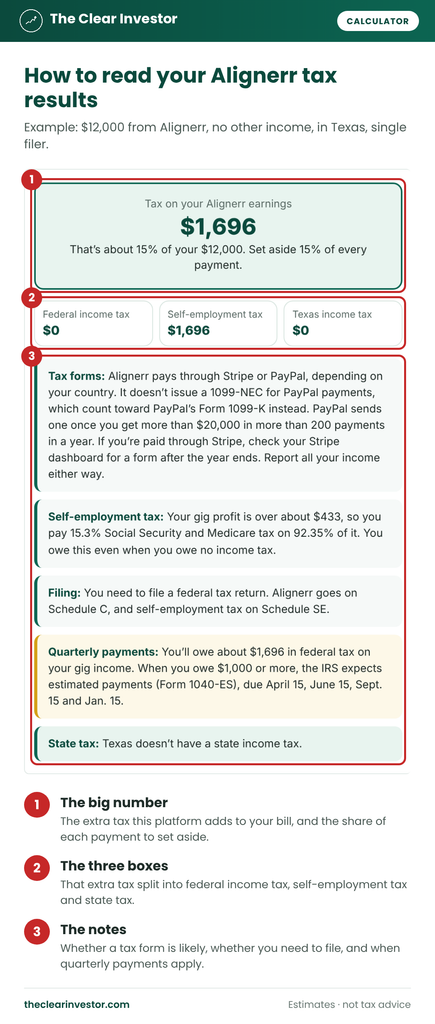
The big number is the tax Alignerr adds to your bill, with the share of each weekly payment to set aside. Under it, the three boxes split that into federal income tax, self-employment tax and state tax.
The notes flag what matters for Alignerr pay: which tax form to expect from Deel, Stripe or PayPal, and when you’ll owe enough to pay quarterly. Here’s what every part of the results means, including the before-and-after-deductions tables.
Worked Example 1: $10,000 from Alignerr, No Other Income, in Florida
Someone works about 5 hours a week at $40 and has no other income:
| Step | Amount |
|---|---|
| Alignerr earnings | $10,000 |
| Net earnings ($10,000 × 92.35%) | $9,235 |
| Self-employment tax ($9,235 × 15.3%) | $1,413 |
| Half of self-employment tax (deduction) | −$707 |
| Income left for income tax | $9,293 |
| Federal income tax | $0 (under the standard deduction) |
| Florida income tax | $0 (no state income tax) |
| Tax on Alignerr | $1,413, about 14% |
No income tax, but $1,413 is over $1,000, so the calculator’s quarterly note shows up: about $353 on each federal due date.
Worked Example 2: $15,000 from Alignerr + a $90,000 Job in Texas
Someone with a well-paid job does Alignerr on the side:
| Step | Amount |
|---|---|
| Alignerr earnings | $15,000 |
| Self-employment tax ($15,000 × 92.35% × 15.3%) | $2,119 |
| Half of self-employment tax (deduction) | −$1,060 |
| Qualified business income deduction (20% of $13,940) | −$2,788 |
| Alignerr’s addition to taxable income | $11,152 |
| Federal income tax ($11,152 × 22%) | $2,453 |
| Texas income tax | $0 (no state income tax) |
| Tax on Alignerr | $4,573, about 30% |
A $90,000 job puts all of the Alignerr pay in the 22% bracket. The quarterly note shows $4,573 of federal tax on the gig income, so this person would pay about $1,143 on each due date, or raise their W-4 withholding to cover it.
More Example Results
Here’s what the Alignerr tax calculator shows for a single filer in Texas or Florida:
| Situation | Federal income tax | Self-employment tax | Tax on Alignerr |
|---|---|---|---|
| $3,000, no other income | $0 | $424 | $424 (14%) |
| $12,000, no other income | $0 | $1,696 | $1,696 (14%) |
| $5,000 + a $40,000 W-2 job | $446 | $706 | $1,153 (23%) |
| $10,000 + a $40,000 W-2 job | $892 | $1,413 | $2,305 (23%) |
| $5,000 + a $90,000 W-2 job | $818 | $706 | $1,524 (30%) |
| $10,000 + a $90,000 W-2 job | $1,636 | $1,413 | $3,049 (30%) |
About 14% while the standard deduction covers your income tax, about 23% in the 12% bracket and about 30% in the 22% bracket. In a state with an income tax, add your state’s rate.
Turning Your Result Into Quarterly Payments
Once the calculator shows the quarterly payments note, divide its federal number by 4 and pay that on each of the IRS due dates. Re-run it when a new project changes your hours or rate. Starting late, or have a W-2 job? Here’s how quarterly payments and the W-4 option work.
How the Alignerr Tax Calculator Works
It figures your total tax twice, once with your Alignerr earnings and once without, and shows you the difference. That way, your other income, the standard deduction and your tax bracket are all accounted for.
It treats your Alignerr pay as self-employment income on Schedule C, whether a project pays by the hour, the task or the minute. Self-employment tax is 15.3% of 92.35% of your profit once that passes about $433. Federal income tax uses the current brackets, standard deduction and qualified business income deduction, and your state’s tax goes on top.
Every number it uses, from the brackets and standard deduction to each state’s rates, is on my How My Tax Calculators Work page, with sources.
What the Calculator Leaves Out
It doesn’t include a SEP IRA, solo 401(k) or self-employed health insurance, which can lower your income tax at Alignerr’s higher rates. It also shows your total tax, not what’s left after estimated payments you’ve already made. Here’s the full list of what my calculators leave out.
Tips for Accurate Results
To get the most out of the Alignerr tax calculator:
- Count by pay date. Work from late December that’s paid in January belongs to the new year.
- Enter expenses. They lower both self-employment tax and income tax, so leaving them out overstates your tax.
- Add all your gig income. Other AI training pay changes your bracket and the $433 line.
- Use W-2 box 1, not your salary. Pre-tax 401(k) and health insurance contributions are already taken out of box 1.
What to Do With Your Result
- Set aside that percentage from each weekly payment, in a separate savings account if you can.
- Make quarterly payments if the calculator says you’ll owe $1,000 or more in federal tax on your gig income. With a job, you can raise your W-4 withholding instead.
- Keep your Stripe or PayPal history each year as your record.
- Report it on Schedule C. Here’s how Alignerr taxes work, and which 1099 you’ll get.
Alignerr Tax Calculator FAQ
How do I estimate my yearly total?
Multiply your hours by your rate. 10 hours a week at $40 is $20,800 a year.
Should I include referral bonuses?
Yes. Alignerr pays them with your weekly payments, and they’re income.
Does it work for per-task projects?
Yes. Enter what a per-task project paid you in total. Hourly, per-task and per-minute pay are all the same self-employment income.
Why is self-employment tax so high?
It’s 15.3%, covering both halves of Social Security and Medicare, since no employer pays half for you.
Why is my income tax $0?
With no other income, the standard deduction and the deduction for half your self-employment tax cover it. You still owe self-employment tax.
How do I use it for quarterly payments?
Take the federal tax on your gig income from the quarterly payments note and divide it by 4.
What tax year does the Alignerr tax calculator use?
The current tax year. I update the brackets, standard deduction and state rates every year.
Estimates for educational purposes only. I’m not a licensed financial advisor or tax professional, and this isn’t tax advice. Not affiliated with Alignerr or Labelbox.