Side hustle taxes catch people off guard because nobody takes tax out of your payouts. Whether you train AI, take paid studies, drive deliveries or post videos, the money is taxable. Once your profit passes about $433 in a year, you owe 15.3% self-employment tax, on top of regular income tax.
I’ve earned money online since 2021 on about 10 platforms, from Qmee and Prolific to Outlier and Handshake AI, and I drove Amazon Flex for about 18 months. I’ve gotten 1099s from Outlier and Clickworker and none at all from Prolific, which still owed tax. This guide covers the rules every side hustle shares. Each of my platform tax guides links back here and covers only what’s different about that platform.
Side hustle taxes, the short answer:
- Is side hustle income taxable? Yes, all of it, with or without a tax form.
- Is there a minimum? Self-employment tax starts at about $433 of profit. Income tax starts once your total income passes your standard deduction, so with a job, it applies from the first dollar.
- Will you get a 1099? Usually only once a company pays you $2,000 or more in a year, or a payment app sends you more than $20,000. No form doesn’t mean no tax.
- How much should you set aside? About 14% with no other income, 23% with a job in the 12% bracket and 30% in the 22% bracket. Add your state’s rate on top.
- Do you need to pay quarterly? Once you expect to owe $1,000 or more when you file. With a job, extra paycheck withholding can cover it instead.
- Where does it go on your return? Gig work goes on Schedule C and Schedule SE. Rewards from survey and receipt apps go on Schedule 1.
Table of Contents
Do You Have to Pay Taxes on a Side Hustle?
Yes. The IRS says gig income has to be reported even if you don’t get a 1099-K, 1099-MISC or W-2. The $600 you’ve heard about, now $2,000, is when a company has to send you a form. It isn’t when you start owing tax.
Two different taxes can apply, and you can owe one, both or neither:
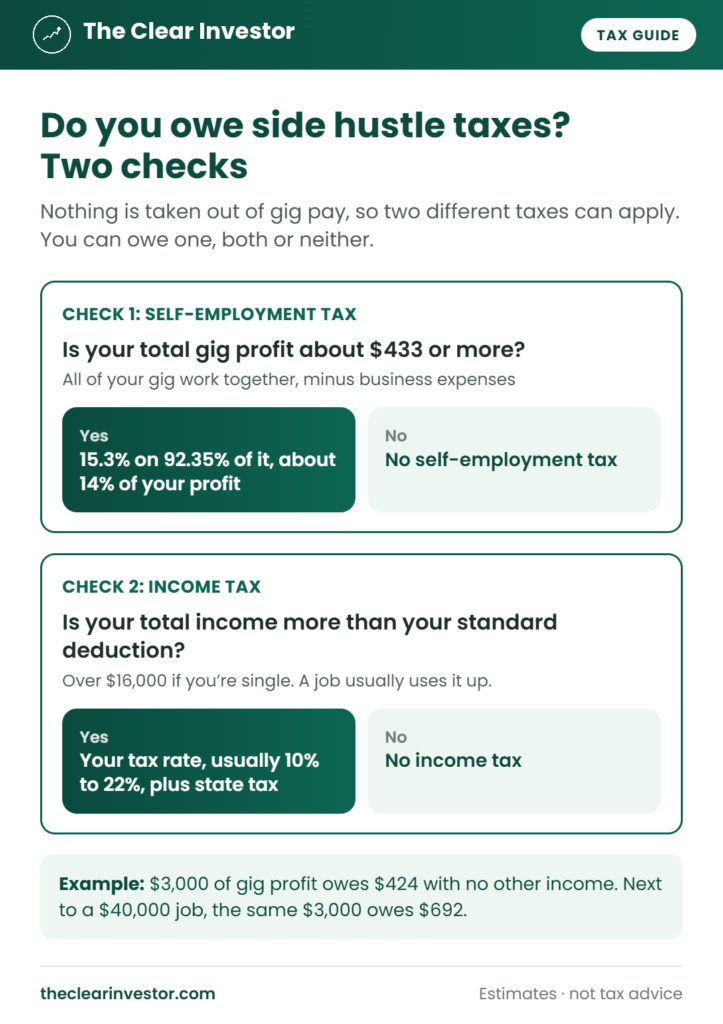
- Self-employment tax starts when your net earnings from self-employment are $400 or more. Net earnings are 92.35% of your profit, so the line is about $433 of profit, counting all of your gig work together. It applies even if you owe no income tax.
- Income tax only applies to income above your standard deduction, which is over $16,000 for single filers, over $32,000 for married couples filing jointly and over $24,000 for heads of household. It goes up with inflation each year.
That’s why the same side hustle is taxed so differently from one person to the next. With no other income, $3,000 of gig profit owes about $424, all of it self-employment tax. Next to a $40,000 job, the same $3,000 owes about $692, because the job has already used up the standard deduction.
What Kind of Income Is Your Side Hustle?
Before any math, figure out which kind of income you have. It decides where your side hustle taxes go on your return and whether self-employment tax applies at all.
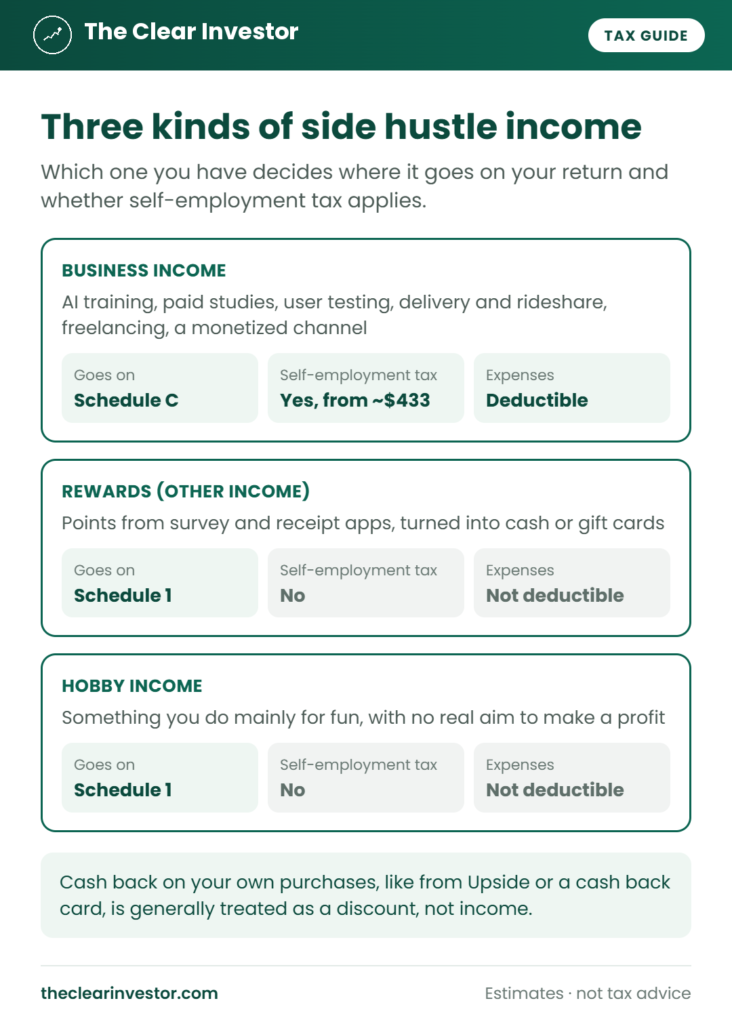
| Kind of income | Examples | Where it goes | Self-employment tax? |
|---|---|---|---|
| Business income | AI training, paid studies, user testing, delivery and rideshare, freelancing, a monetized channel | Schedule C | Yes, from about $433 of profit |
| Rewards (other income) | Points from survey and receipt apps, turned into cash or gift cards | Schedule 1 | No |
| Hobby income | Something you do for fun, with no real aim to make a profit | Schedule 1 | No, but no deductions either |
Business income is pay for work you do as an independent contractor. Most AI training and paid study platforms say so in their terms. Outlier, Handshake AI and Prolific all treat you as a contractor, not an employee. The IRS explains the difference on its independent contractor page.
Rewards are what you get from apps like Qmee, Crowdtap and Amazon Shopper Panel, where you answer polls or upload receipts for points. You’re not running a business by tapping through surveys, so I treat them as other income. They’re still taxable at face value. A $5 gift card is $5 of income.
Hobby income is for things you mainly do for fun. The IRS looks at things like whether you run the activity like a business and whether you depend on the income (how to tell a hobby from a business). A hobby skips self-employment tax, but you can’t deduct a single expense or take the qualified business income deduction. If you’re trying to make money, it’s a business.
Cash back on your own purchases is a different case. Cash back from an app like Upside or a cash back card is generally treated as a discount on what you bought, not income. Referral bonuses and bank sign-up bonuses are income, though.
How Self-Employment Tax Works on Side Hustle Income
Self-employment tax is 15.3%: 12.4% for Social Security and 2.9% for Medicare. An employer pays half of that for W-2 workers. As a contractor, you pay both halves, which is the biggest reason side hustle taxes feel high.
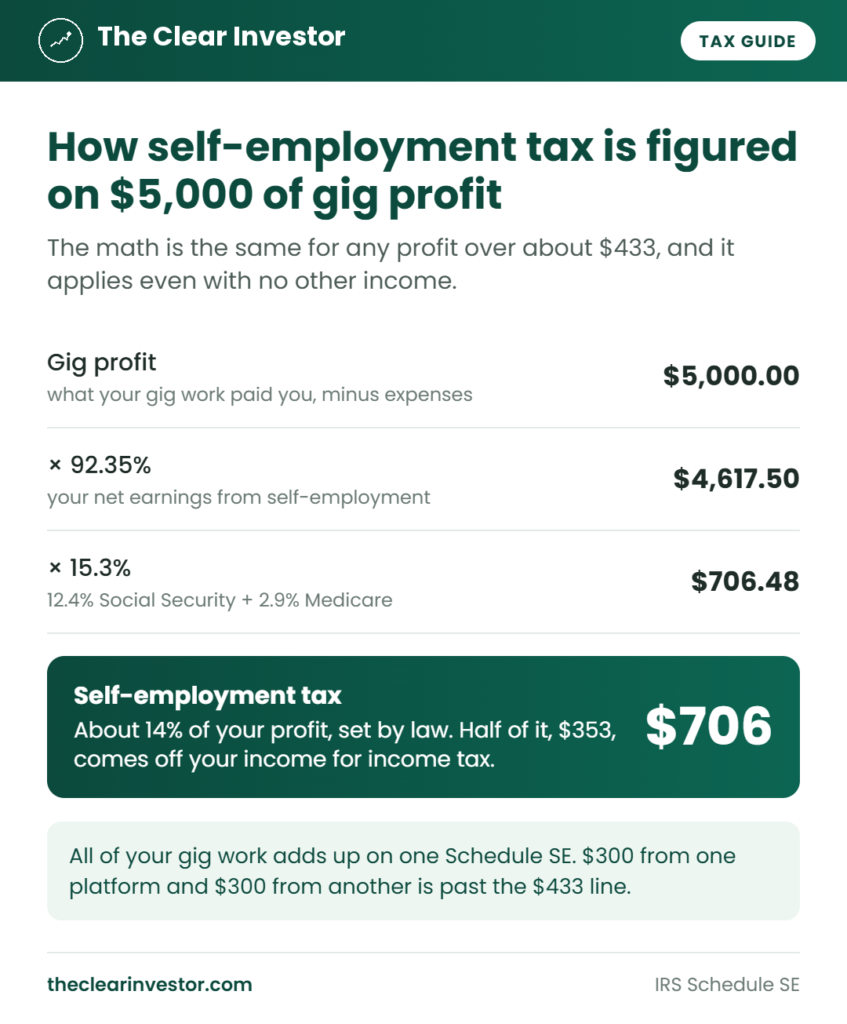
Here’s how it’s figured on Schedule SE:
- Start with your profit. That’s everything your gig work paid you, minus business expenses.
- Multiply by 92.35%. That’s your net earnings from self-employment. Leaving out 7.65% puts you on the same footing as an employee, whose wages never include the employer’s half of the tax.
- Multiply by 15.3%. On $5,000 of profit, that’s $4,617.50 × 15.3% = $706.
- Deduct half of it from your income for income tax. On $5,000, that’s $353.
So self-employment tax is about 14% of your profit, every year. The rate is set by law, so the math doesn’t change with inflation.
Two limits matter only at higher incomes. The 12.4% Social Security part stops at the yearly Social Security wage base, and your W-2 pay counts toward it first. Above $200,000 ($250,000 if married filing jointly), an extra 0.9% Medicare tax applies.
All of your gig work goes on one Schedule SE. $300 from Prolific and $300 from CloudResearch Connect is $600 of profit, past the $433 line, even though neither one is past it alone.
How Income Tax Works on Side Hustle Income
Your side hustle profit is added to the rest of your income and taxed at your normal federal tax rates. Three things come off first:
- Your standard deduction. With a job, your job has usually used it up already.
- Half of your self-employment tax.
- The qualified business income deduction. It takes up to 20% of your business profit, after the self-employment tax deduction, off your taxable income. Rewards and hobby income don’t get it.
Here’s what that looks like for $5,000 of gig profit next to a $40,000 W-2 job, for a single filer in Texas, which has no state income tax:
| Step | Amount |
|---|---|
| Gig profit | $5,000 |
| Self-employment tax ($5,000 × 92.35% × 15.3%) | $706 |
| Half of self-employment tax (deduction) | −$353 |
| Qualified business income deduction (20% of $4,647) | −$929 |
| Gig profit’s addition to taxable income | $3,718 |
| Federal income tax ($3,718 × 12%) | $446 |
| Total side hustle taxes | $1,153, about 23% |
That’s why the income tax part of side hustle taxes is less than your bracket. In the 12% bracket, it works out to about 9% of your profit, because the two deductions come off first.
Rewards income is taxed at your full bracket. There’s no self-employment tax, but there’s no qualified business income deduction either. $500 of survey gift cards next to the same $40,000 job adds $60 of federal tax, 12% of it.
Which 1099 Will You Get for Your Side Hustle?
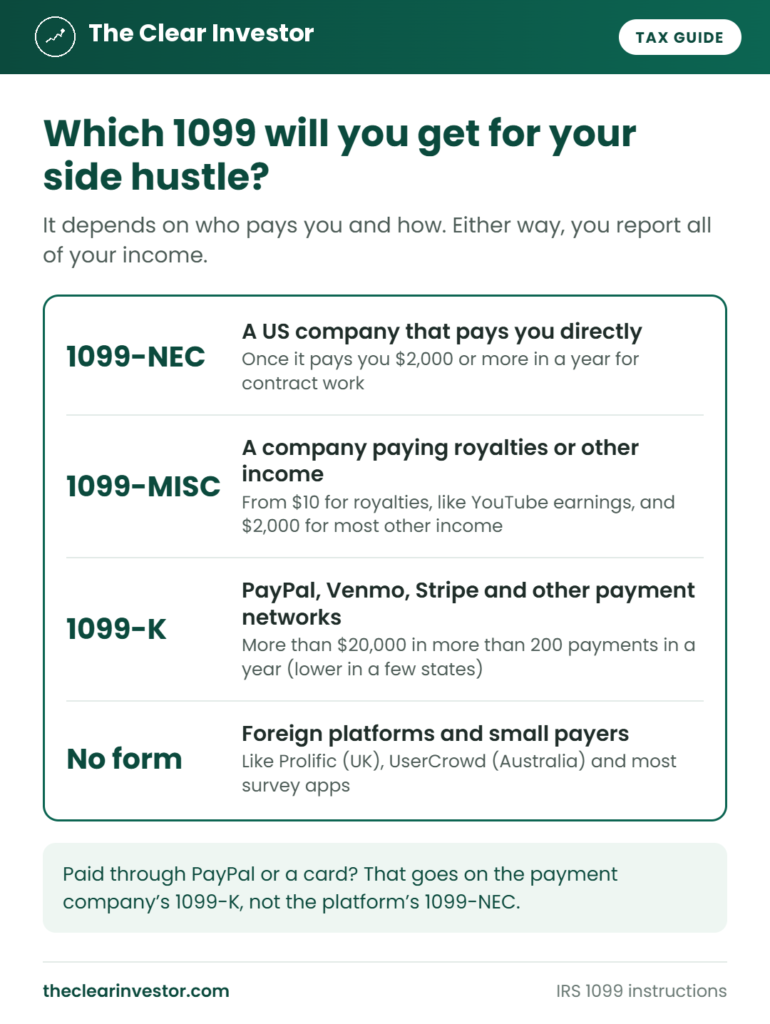
It depends on who pays you and how. The form doesn’t change your side hustle taxes, but it does change how much of the adding up falls on you. Here are the forms you’re likely to see:
| Form | Who sends it | When you get one |
|---|---|---|
| 1099-NEC | A US company that pays you directly for contract work | Once it pays you $2,000 or more in a year (it was $600 through 2025) |
| 1099-MISC | A company paying you royalties, prizes or other income | From $10 for royalties, like YouTube earnings, and $2,000 for most other income |
| 1099-K | PayPal, Venmo, Stripe and other payment networks | Once you get more than $20,000 in more than 200 payments in a year |
| No form | Foreign platforms and small payers | Prolific (UK), UserCrowd (Australia) and most survey apps |
A few rules explain most of the confusion:
- Payments made through PayPal or a card go on the payment company’s form, not the platform’s. The 1099 instructions say those payments aren’t reported on a 1099-NEC. So a platform that pays you through PayPal usually sends nothing, and PayPal only sends a 1099-K at high volume. A few states set a lower bar, like Maryland, Massachusetts, Vermont, Virginia and Illinois.
- The $2,000 limit rises with inflation after 2026, so expect it to creep up over time.
- Without a W-9, a US payer can hold back 24%. That’s called backup withholding. It shows up on your 1099 and counts as tax you’ve already paid.
- Your 1099 can be wrong. A 1099-K can include money that isn’t income, like refunds or money from friends. The IRS says to ask the issuer for a corrected form and keep records of what you actually earned.
Most 1099s are due to you by January 31, though some platforms post theirs later. If you’re expecting one and it doesn’t show up, check the platform’s dashboard. Handshake AI posts its 1099-NEC on your Payments tab, and Stripe posts forms in your Stripe Express account.
When Does Side Hustle Income Count?
Most people report on a cash basis, so income counts in the year you receive it. That includes money that’s credited to you and that you could take out, even if you leave it there. The IRS calls that constructive receipt.
For side hustle taxes at the end of the year, that means:
- An approved balance sitting in your account on December 31 counts for that year, even if you cash out in January.
- Pay for late-December work that’s approved or paid in January counts in the new year.
- Points count once you trade them for cash or a gift card, not while they sit in your account.
- Products a brand sends you to keep count in the year you get them, at what they’d cost to buy.
Your 1099 may draw the line in a slightly different spot, like the date a payment left the platform. If your number and the form’s are close but not the same, keep a note of why.
How Much Should You Set Aside for Side Hustle Taxes?
Here’s a rule of thumb for federal side hustle taxes. It works because self-employment tax is about 14% no matter what, and the income tax part depends on your bracket.
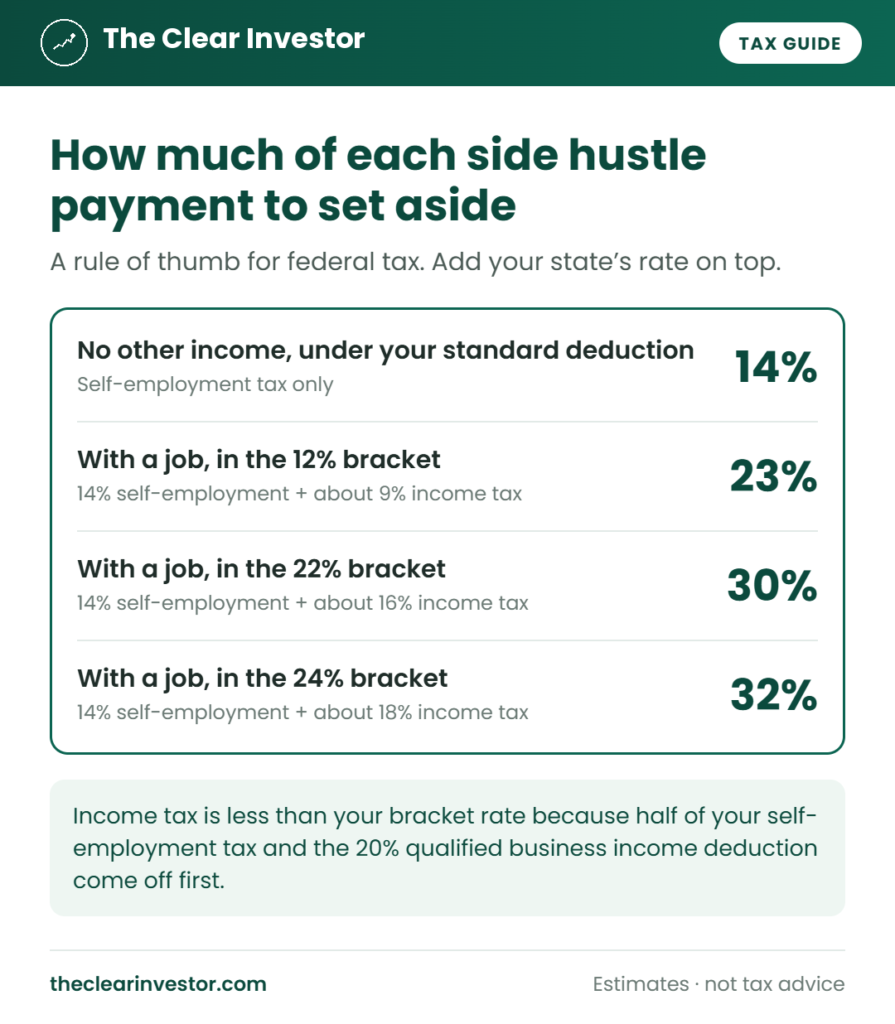
| Your situation | Set aside about |
|---|---|
| Under $433 of gig profit, no other income | 0% |
| Under $433, with a job in the 12% bracket | 10% |
| Over $433, no other income (under your standard deduction) | 14% |
| With a job in the 12% bracket | 23% |
| With a job in the 22% bracket | 30% |
| With a job in the 24% bracket | 32% |
| Rewards (gift cards), with a job | Your bracket: 10%, 12% or 22% |
Then add your state. Nine states have no income tax on wages: Alaska, Florida, Nevada, New Hampshire, South Dakota, Tennessee, Texas, Washington and Wyoming. In most other states, side income adds a few percent more, and in Oregon and California it can add about 9%.
The easiest way to stay ahead of side hustle taxes is to move that percentage into a separate savings account every time you cash out, so the tax money is never mixed in with your spending money. My platform calculators give you one percentage for your own situation, state included.
Do You Need to Pay Side Hustle Taxes Quarterly?
You only need to pay side hustle taxes quarterly if you expect to owe $1,000 or more when you file, after any withholding. The IRS calls these estimated tax payments. With no other income, it takes about $7,100 of profit to owe $1,000. With a job in the 12% bracket, it takes about $4,300, since your side income gets income tax too.
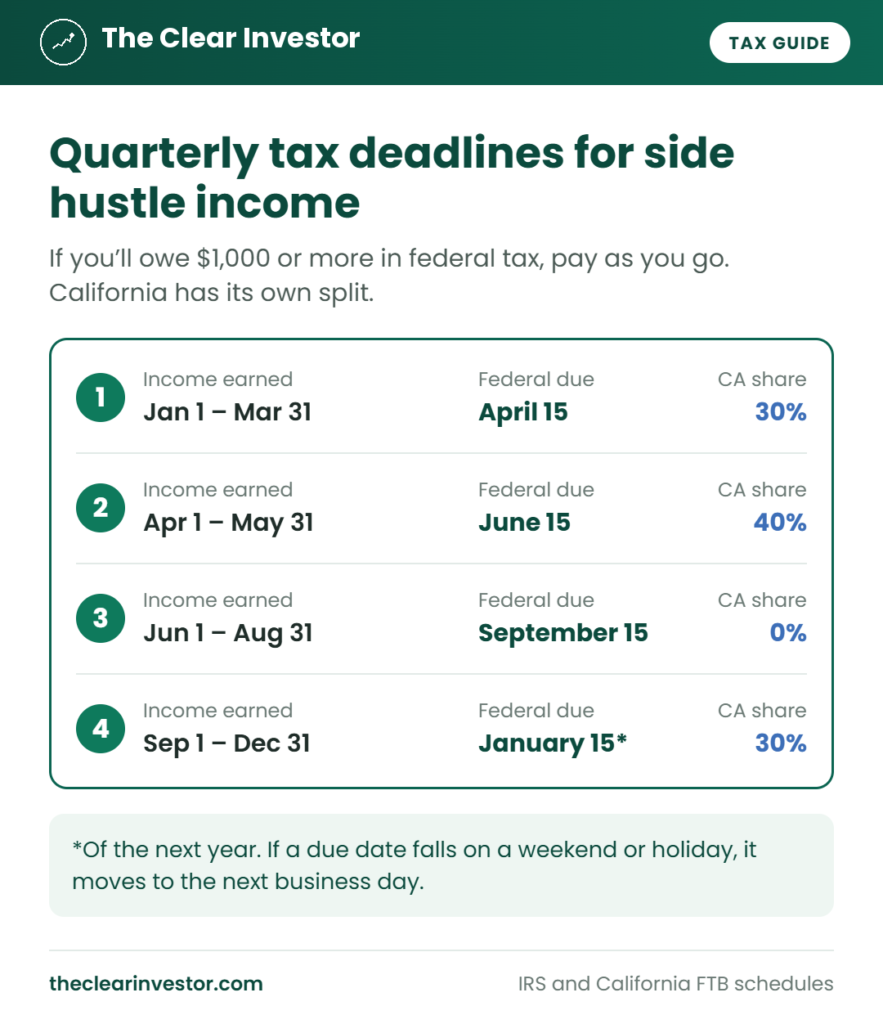
The four “quarters” aren’t even. Here’s when each payment is due:
| Income earned | Federal payment due |
|---|---|
| January 1 to March 31 | April 15 |
| April 1 to May 31 | June 15 |
| June 1 to August 31 | September 15 |
| September 1 to December 31 | January 15 of the next year |
If a due date falls on a weekend or holiday, it moves to the next business day. You can skip the January payment if you file your return and pay everything you owe by January 31.
How to avoid the underpayment penalty
The penalty works like interest on what you paid late, at a rate the IRS sets each quarter (Topic 306). You can avoid it entirely if any of these is true:
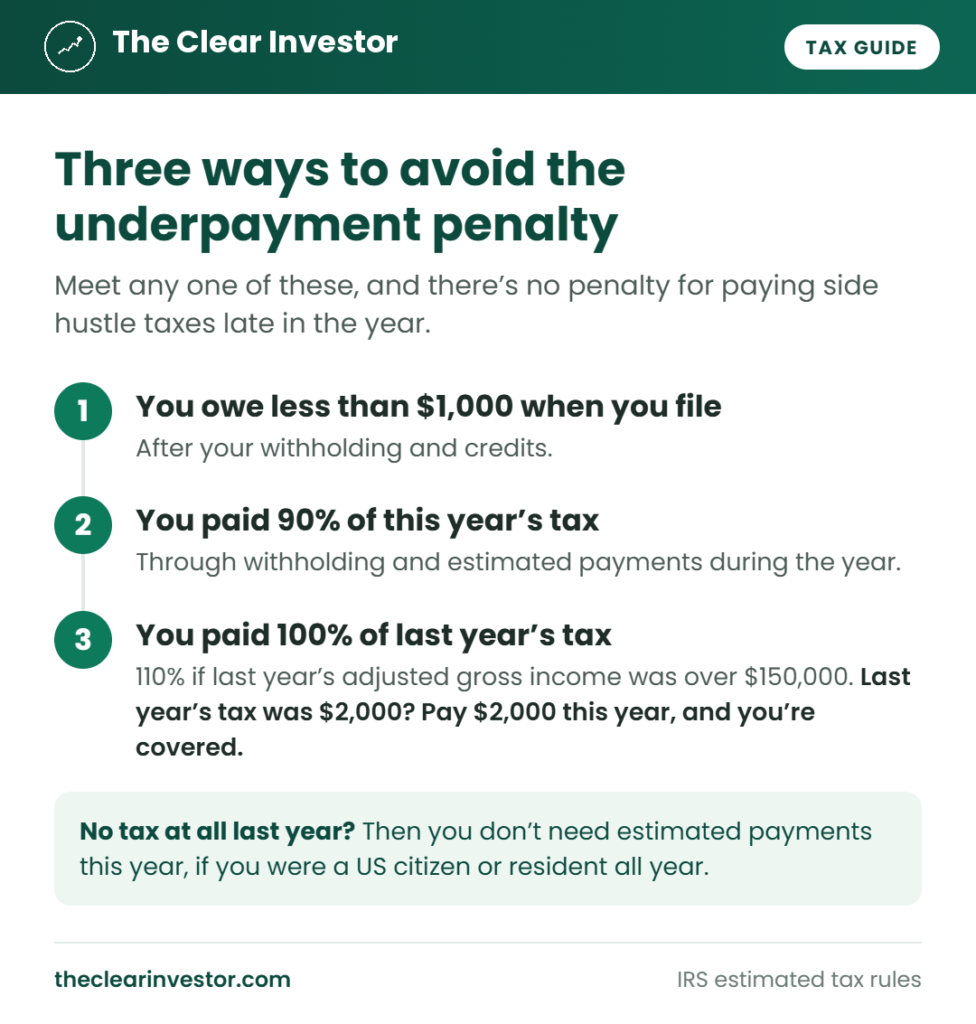
- You owe less than $1,000 when you file, after withholding and credits.
- You paid at least 90% of this year’s tax through withholding and estimated payments.
- You paid at least 100% of last year’s total tax. That’s 110% if your adjusted gross income last year was over $150,000 ($75,000 if married filing separately).
The last one is the safe harbor that helps side hustlers most, because you already know last year’s number. If your total tax last year was $2,000, paying $2,000 this year through withholding and estimates means no penalty, even if you end up owing more when you file.
Had no tax at all last year? Then you don’t need estimated payments this year, as long as you were a US citizen or resident all year. A student whose first side hustle year is this year often fits.
Most of your income came late in the year? You don’t have to pay four equal amounts. The annualized income method on Form 2210 matches each payment to when you actually earned the money.
Use your W-4 instead
If you have a job, you can skip estimated payments and have a bit more withheld from each paycheck. Step 4(c) of Form W-4 lets you add a flat extra amount per paycheck. The $1,153 in the example above, spread over 26 paychecks, is about $45 each.
There’s a bonus: withholding counts as paid evenly through the year, no matter when it came out of your check (Publication 505). So a bigger withholding in the fall can cover the earlier quarters too. Estimated payments don’t work that way.
How to pay estimated tax
You can pay online through IRS Direct Pay or your IRS online account, by debit or credit card for a fee, or by check with a Form 1040-ES voucher. Tax software like TaxAct, which I use, can also print next year’s vouchers when you file.
Most states with an income tax want estimated payments too, and they don’t always follow the IRS split. California wants 30%, 40%, 0% and 30% of the year’s tax at the four deadlines, so there’s no September payment at all.
Free tax tracker + deadline reminders
Get my free side income tax tracker
Sign up and I’ll send you my Google Sheets tracker that shows how much of each payout to set aside. You’ll also get an email before each quarterly tax deadline (Jan 15, Apr 15, Jun 15 and Sep 15), plus my new guides. Unsubscribe anytime.
Earn on several platforms or drive for work? Get the full 1099 Side Income Tracker ($12) →
Deductions That Lower Side Hustle Taxes
Deductions are the part of side hustle taxes you have the most control over. If your side hustle is a business, expenses come off your profit before either tax is figured. Each $100 of expenses saves about $14 of self-employment tax, and about $23 in total with a job in the 12% bracket.
The usual side hustle deductions:
- Fees the platform takes out of your pay, if your income is reported before the fee.
- The business share of your phone and internet. If 20% of your internet use is for gig work, deduct 20% of the bill.
- Equipment like a laptop, headset, microphone or camera. Items that cost $2,500 or less can usually be deducted in full the year you buy them.
- Business miles for driving gigs. The IRS standard mileage rate covers gas, wear and depreciation. For 2026, the IRS raised it midyear: 72.5 cents a mile through June 30 and 76 cents from July 1. 1,000 business miles in the fall is a $760 deduction.
- A home office you use regularly and only for your gig work. The simplified method is $5 per square foot, up to 300 square feet.
- Software and subscriptions you need for the work.
- Retirement savings. Money you put in a SEP IRA or solo 401(k) (retirement plans for self-employed people) lowers your income tax, though not your self-employment tax.
What you can’t deduct: the personal share of anything, expenses against rewards or hobby income, and your own time.
If Your Side Hustle Earns Tips
From 2025 through 2028, there’s a new deduction of up to $25,000 a year for qualified tips. It covers occupations on the IRS list, which includes app-based delivery drivers, rideshare drivers and digital content creators (IRS guidance on tipped occupations).
The key rules:
- Only voluntary tips count. A payment someone has to make, like a paid membership to see your content, is regular income.
- It can’t be more than your profit from the work you were tipped for, if you’re self-employed.
- It lowers income tax only. You still pay self-employment tax on your tips.
- It phases out above $150,000 of modified adjusted gross income ($300,000 married filing jointly). You need a Social Security number, and married couples have to file jointly.
For drivers and creators who earn tips, this can lower side hustle taxes noticeably. My calculators don’t take this deduction yet, so if you earn tips, your real income tax can be lower than they show.
How to Report Side Hustle Income
Here’s the order I’d go in when it’s time to file your side hustle taxes:
- Gather your numbers. Every 1099 you got, plus each platform’s earnings history for the year. Your records count even when there’s no form.
- Add up each business. File one Schedule C per type of business. Similar work across platforms, like three AI training sites, usually goes on one. Very different work, like AI training and food delivery, gets its own.
- Subtract your expenses in Part II of Schedule C. What’s left is your profit.
- Figure self-employment tax on Schedule SE once your combined net earnings are $400 or more. One Schedule SE covers all of your Schedule Cs.
- Take the qualified business income deduction. Tax software figures it for you.
- Put rewards on Schedule 1 as other income, and hobby income on its own hobby line there.
I file with TaxAct. You enter each platform as self-employment income, and it fills in Schedule C, Schedule SE and the qualified business income deduction for you.
Do you even have to file? Once your net self-employment earnings are $400 or more, you have to file a federal return, even with no other income. Below that, the usual filing rules apply. If someone can claim you as a dependent, your standard deduction is smaller (Publication 501), and the $400 rule still applies to you.
Records to Keep for Side Hustle Taxes
Good records make side hustle taxes easy to prove. Platforms change, lock accounts and shut down, so don’t count on your history being there in three years. At the end of each year, I’d save:
- Every 1099 you got.
- Each platform’s earnings history. A download if it has one, or screenshots of your payouts if it doesn’t.
- Receipts for anything you deduct, and a note of the business share you used for your phone or internet.
- A mileage log if you drive: date, miles and what the trip was for.
- Your estimated tax payment confirmations.
The IRS says to keep records for 3 years after you file in most cases.
Common Side Hustle Tax Mistakes
These are the side hustle tax mistakes I’d watch for:
- Thinking under $600 (or $2,000) means no tax. Those limits are about forms. All of it is income.
- Waiting for a 1099 that never comes. Use your own records.
- Forgetting self-employment tax. You can owe it with no income tax at all.
- Reporting the 1099-K total without checking it. It can include refunds and personal transfers.
- Spending the whole payout. Set aside your percentage every time.
- Skipping deductions, especially mileage, which adds up fast.
- Calling a business a hobby to skip self-employment tax. If you’re trying to make money, it’s a business.
- Forgetting state estimated payments if your state has an income tax.
Side Hustle Tax Guides for Each Platform
Side hustle taxes follow the same rules everywhere, but each platform has its own twist: how it pays you, which form it sends and what counts as income. Here’s every platform I’ve covered so far, with its guide and calculator:
| Platform | Kind of income | Tax form to expect | Calculator |
|---|---|---|---|
| Prolific | Business | None (UK company, pays mostly in pounds) | Prolific |
| CloudResearch Connect | Business | Usually none | Connect |
| UserCrowd | Business | None (run from Australia) | UserCrowd |
| Outlier AI | Business | A 1099 at $2,000 or more (I got one) | Outlier AI |
| Handshake AI | Business | 1099-NEC on your dashboard | Handshake AI |
| DataAnnotation | Business | Usually none (paid through PayPal) | DataAnnotation |
| Alignerr | Business | Depends on how you’re paid | Alignerr |
| Mercor | Business | 1099-NEC through Stripe | Mercor |
| Mindrift | Business | Usually none (Dutch company) | Mindrift |
| Datavio | Business | Usually none (paid through PayPal) | Datavio |
| Neevo AI | Business | Usually none (paid through PayPal) | Neevo AI |
| Qmee | Rewards | None (run from the UK) | Qmee |
| Crowdtap | Rewards | None | Crowdtap |
| Amazon Shopper Panel | Rewards | None | Shopper Panel |
| YouTube | Business or hobby | 1099-MISC (royalties) | YouTube |
| TikTok | Business or hobby | 1099-MISC (royalties) or 1099-NEC | TikTok |
| TikTok Shop affiliate | Business | Likely a 1099-NEC at $2,000 or more | TikTok Shop affiliate |
| TikTok Shop seller | Business | 1099-K once sales pass $20,000 in 200+ orders | TikTok Shop seller |
| Amazon Flex | Business | 1099-NEC at $2,000 or more | Amazon Flex |
| DoorDash | Business | 1099-NEC at $2,000 or more | DoorDash |
Here’s how my tax calculators work, with every number and source.
My Verdict on Side Hustle Taxes
Side hustle taxes come down to a few lines. Under about $433 of profit with no other income, you owe nothing. Past $433, you owe about 14% in self-employment tax. With a job, add income tax at a bit less than your bracket, and add your state on top. Set that percentage aside from every payout, pay quarterly once you’ll owe $1,000, and keep your own records, since the 1099 often never comes.
Want to see which platforms are worth your time in the first place? Here’s how I make money online, with every platform I’ve used and what each one paid me.
FAQ
Do I have to pay taxes on a side hustle if I made less than $600?
Usually, yes. The $600 limit, now $2,000, is for tax forms, not tax. You owe self-employment tax once your gig profit is about $433, and income tax once your total income is over your standard deduction.
How much should I set aside for side hustle taxes?
About 14% with no other income, 23% with a job in the 12% bracket and 30% in the 22% bracket, plus your state’s rate.
Do I have to report side hustle income without a 1099?
Yes. The IRS says all gig income has to be reported, whether or not you get a form. Side hustle taxes are based on what you earned, not on what a form says.
Do I need an LLC for my side hustle?
Not for taxes. A single-member LLC is taxed the same way as you on your own, on Schedule C.
Is side hustle income taxed more than a job?
It feels that way because you pay both halves of Social Security and Medicare, 15.3% instead of 7.65%. Your income tax rate is the same, and the qualified business income deduction lowers it a bit.
What happens if I don’t pay side hustle taxes quarterly?
You’ll owe an underpayment penalty, which works like interest on the late amount. You avoid it if you owe under $1,000 when you file, or if you paid at least last year’s total tax (110% at higher incomes) during the year.
Can I deduct expenses from rewards apps?
No. Rewards from survey and receipt apps are other income, and other income has no place for expenses. Only a business can deduct them.
I’m not a licensed financial advisor or tax professional. This article is for educational purposes and isn’t tax advice. Tax rules change, so check the IRS links above or talk to a tax professional about your situation.