TikTok taxes work the same way whether your money comes from Creator Rewards, LIVE gifts or a brand deal: nothing is withheld, and it’s all taxable. If you run your account as a business, your TikTok profit is self-employment income, so you owe income tax on it and, once it passes about $433, 15.3% self-employment tax as well.
I’ve set up my TikTok account but haven’t started posting yet, so I haven’t earned anything from TikTok or gotten a 1099 from them. I have filed my own taxes on 1099 income from Outlier and Clickworker, and everything in this guide comes from TikTok’s own terms, IRS rules and my TikTok tax calculator, so you can check each piece yourself.
TikTok taxes, the short answer:
- Is TikTok income taxable? Yes. Creator Rewards, LIVE gifts, Subscriptions, Series, brand deals and even gifted products all count.
- Does TikTok take out taxes? No. TikTok asks for your tax info when you set up payouts, then pays you in full.
- Does TikTok send a 1099? Yes, for what it pays you through its creator programs. Creators have reported a 1099-MISC with their earnings in box 2, Royalties, which is reported from just $10.
- Where does it go on your return? On Schedule C if you run your account as a business, not Schedule E, which is where tax software tends to put royalties.
- Do LIVE gifts get a tax break? They can. LIVE gifts can count as tips for the new federal tips deduction, which lowers your income tax, but not your self-employment tax.
- How much should you set aside? About 14% with no other income, and about 23% with a job in the 12% bracket. Add your state’s rate on top.
- Do you need quarterly payments? Once you’ll owe $1,000 or more in federal tax. With no other income, that’s about $7,100 of profit.
Table of Contents
Do You Have to Pay Taxes on TikTok Money?
Yes. There’s no TikTok-specific minimum, and the money doesn’t have to hit your bank first. Most creators start earning through the Creator Rewards Program, which needs you to be 18 or older, with at least 10,000 followers and 100,000 video views in the last 30 days. It pays for qualified views on original videos longer than one minute.
If you run your account as a business, TikTok taxes come down to two federal taxes:
- Self-employment tax. You owe it when your net earnings from self-employment are $400 or more. Net earnings are 92.35% of your profit, so the line is about $433 of profit. The rate is 15.3%: 12.4% for Social Security and 2.9% for Medicare. W-2 workers split that with their employer, but creators pay both halves.
- Income tax. Only on income above your standard deduction, which is over $16,000 for single filers, over $32,000 for married couples filing jointly and over $24,000 for heads of household. It goes up with inflation each year. With a job, the standard deduction is usually used up already, so every TikTok dollar gets income tax.
If you post just for fun, the hobby rules apply instead, which I cover below.
What Counts as TikTok Income?
For TikTok taxes, every way TikTok or a brand pays you counts:
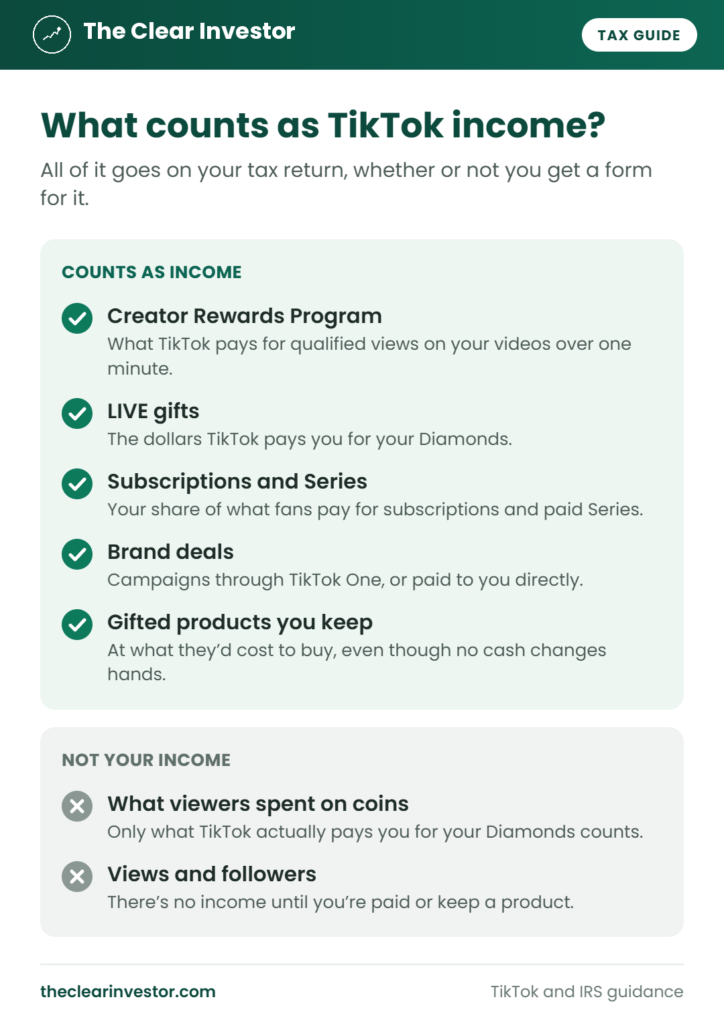
| Income | Who pays you | Tax form you may get |
|---|---|---|
| Creator Rewards Program | TikTok | A 1099 from TikTok |
| LIVE gifts | TikTok, for your Diamonds | A 1099 from TikTok |
| Subscriptions and Series | TikTok | A 1099 from TikTok |
| TikTok One campaigns | TikTok, not the brand | Depends on how you’re paid |
| Brand deals paid directly | The brand or its agency | Form 1099-NEC at $2,000 or more |
| Gifted products you keep | The brand, in products instead of cash | Usually none |
TikTok One pays you, not the brand. The TikTok One Creator Program Terms say you can’t “seek payment directly from” the brand, and payouts through the platform go through Stripe.
Gifted products count too. A product a brand sends you to feature is a payment in products instead of cash. The IRS treats that like bartering, where the fair market value of what you receive is income. So a $300 ring light you got for a review is $300 of income. If the brand wants it back and you return it, there’s nothing to report.
TikTok Shop is different. Affiliate commissions and free samples from TikTok Shop have their own rules, so I cover them in my TikTok Shop affiliate tax guide.
How TikTok LIVE Gifts Are Taxed
LIVE gifts are the most confusing part of TikTok taxes, because the money goes through three different “currencies” before it reaches you:
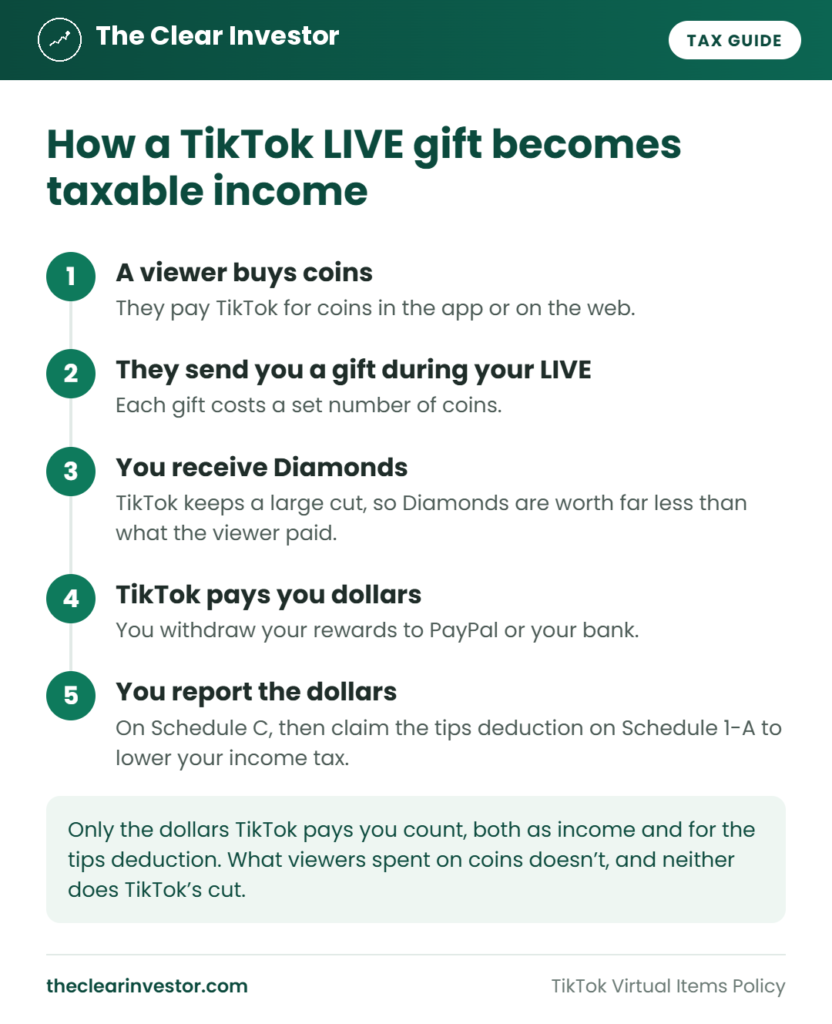
- A viewer buys coins from TikTok.
- They spend coins to send you a gift during your LIVE.
- You receive Diamonds, and TikTok keeps a large cut.
- TikTok pays out your rewards in dollars, which you withdraw to PayPal or your bank.
Only the dollars count. Your income is what TikTok pays you for your Diamonds, not what viewers spent on coins. TikTok’s cut was never yours, so there’s nothing to deduct for it either.
Refunds can come back out. TikTok’s Virtual Items Policy lets it take back a gift’s payout if the viewer gets their coins refunded. If that happens, count only what you kept.
LIVE gifts can get a tax break. The new deduction for tips covers digital content creators, which the IRS lists as a tipped job, streamers included. Under the IRS’s final rules, voluntary payments on a free stream are qualified tips, and that’s what a LIVE gift is: a viewer chooses to send it, and nobody has to pay to watch. The rules don’t name virtual gifts, so keep TikTok’s records of what you were paid for them. Subscriptions and Series don’t count, since viewers pay them for access.
The deduction is up to $25,000 a year from 2025 through 2028, but no more than your TikTok profit, and it shrinks by $100 for every $1,000 of income over $150,000 ($300,000 married filing jointly). It lowers federal income tax only. You still owe self-employment tax on your gifts, and you claim the deduction on Schedule 1-A with a Social Security number. With a $40,000 job, $4,000 of LIVE gifts gets about $480 off your federal income tax.
One open question: the law leaves out tips earned in certain service fields, like the performing arts, and the IRS hasn’t written those rules yet. Until it does, it treats people in listed tipped jobs as eligible.
Does TikTok Send a 1099?
Yes, for money TikTok pays you itself, and it’s the part of TikTok taxes creators ask about most. Here’s what to know.
The form type isn’t spelled out. TikTok’s help pages don’t say which form it uses. Creators have reported getting a 1099-MISC from TikTok, Inc. with their earnings in box 2, Royalties, and some tax guides mention a 1099-NEC instead. Check which form and box yours uses when it arrives.
The threshold depends on the box. Royalties in box 2 are reported from just $10, while most other 1099 payments are only required once a company pays you $2,000 or more in a year. Either way, nearly every paid creator should expect a form.
Nothing is withheld. TikTok asks for your tax info (a Form W-9 for US creators) when you set up payouts. Once it’s on file, you’re paid in full, and the tax is up to you. TikTok’s terms say creators are responsible for their own taxes.
Brands send their own forms. A brand or agency that pays you $2,000 or more directly in a year sends a Form 1099-NEC. Under that, you may not get anything.
No form doesn’t mean no tax. The IRS says income has to be reported even if you don’t get a 1099.
Schedule C, Schedule E or a Hobby: Where TikTok Taxes Go
If your 1099 says “royalties,” your tax software will likely steer you to Schedule E. TaxAct’s help page says box 2 royalties are “generally reported on Schedule E,” and you’ll find forum answers telling TikTok creators the same thing, or to list it as other income on Schedule 1. Both of those skip self-employment tax.
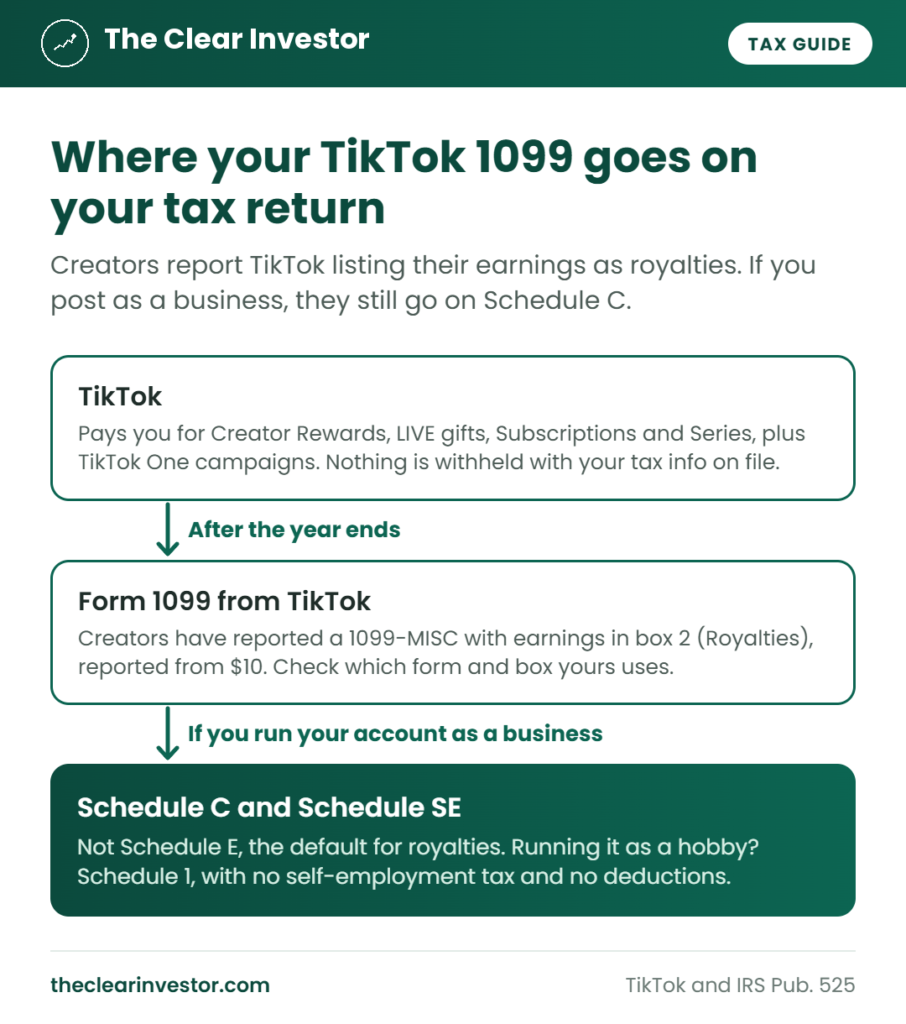
IRS Publication 525 makes an exception for creators. As TaxAct’s royalties summary quotes it, royalties usually go on Schedule E, “however, if you… are in business as a self-employed writer, inventor, artist, etc., report your income and expenses on Schedule C.” If you make your own videos to earn money, that’s you, so your TikTok income goes on Schedule C, with self-employment tax.
The real alternative is a hobby. If you don’t run your account to make a profit, your TikTok income goes on Schedule 1 as “activity not engaged in for profit” income. There’s no self-employment tax, but you can’t deduct any expenses either. The IRS weighs things like whether you run it in a businesslike way, put in regular time, keep records, and change what you do to make it profitable.
| Business (Schedule C) | Hobby (Schedule 1) | |
|---|---|---|
| Who it’s for | Creators running an account to make money | Accounts not run for profit |
| Self-employment tax | Yes, once profit is about $433 | No |
| Creator expenses | Deductible | Not deductible |
| Qualified business income deduction | Yes | No |
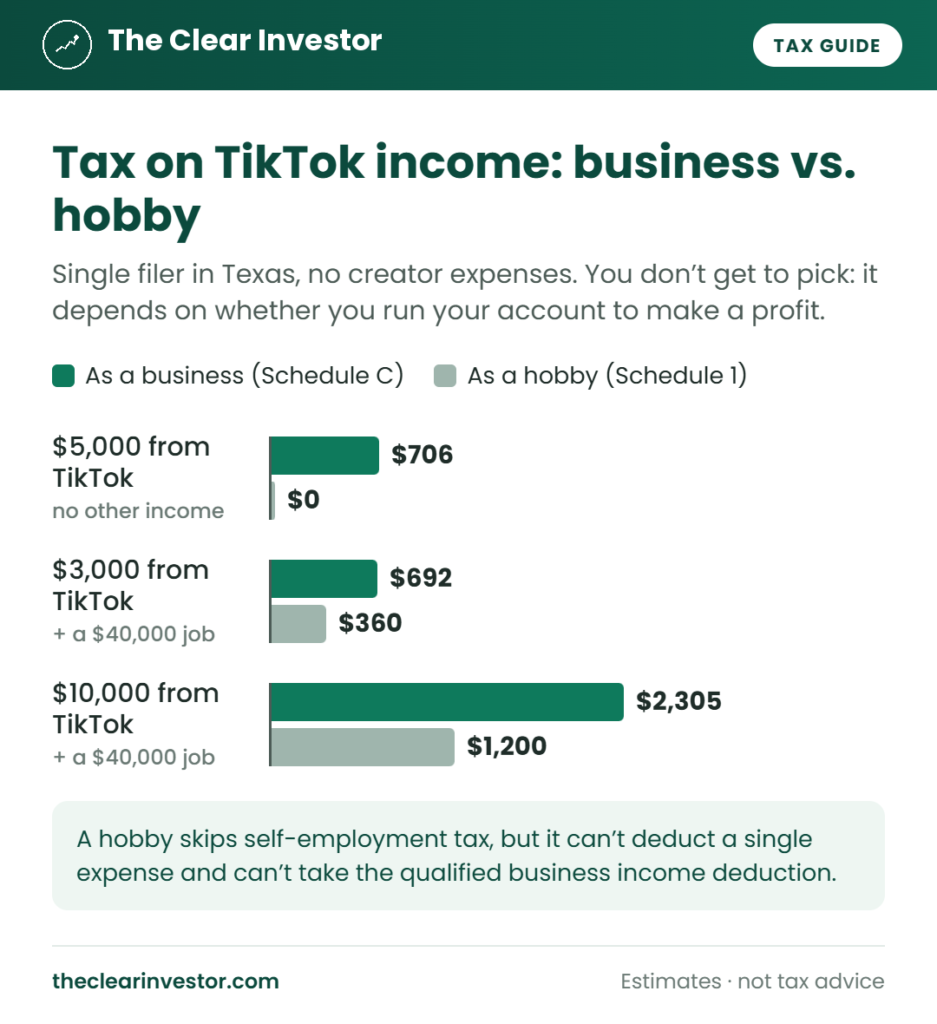
A hobby can look cheaper on paper, but you can’t choose it just to save tax. And once you spend money on your content, a business usually comes out ahead: with $3,000 from Creator Rewards, $2,500 of gear and a $40,000 job, my calculator shows $115 of tax as a business vs. $360 as a hobby.
How Much Tax Will You Owe on TikTok Income?
Here’s what TikTok taxes look like for a single filer in Texas, which has no state income tax, running the account as a business with no expenses:
| TikTok income | No other income | With a $40,000 W-2 job | With a $90,000 W-2 job |
|---|---|---|---|
| $3,000 | $424 | $692 | $915 |
| $5,000 | $706 | $1,153 | $1,524 |
| $10,000 | $1,413 | $2,305 | $3,049 |
| $15,000 | $2,119 | $3,458 | $4,573 |
With no other income, it’s about 14%, all self-employment tax, until your income passes your standard deduction. A $40,000 job puts every TikTok dollar in the 12% bracket, so it’s about 23%. A $90,000 job puts it in the 22% bracket, so it’s about 30%. LIVE gifts come out lower, thanks to the tips deduction: in California, $4,000 of LIVE gifts on top of a $40,000 job comes to about $591, or 15%, state tax included. Without the deduction, it would be about $1,071.
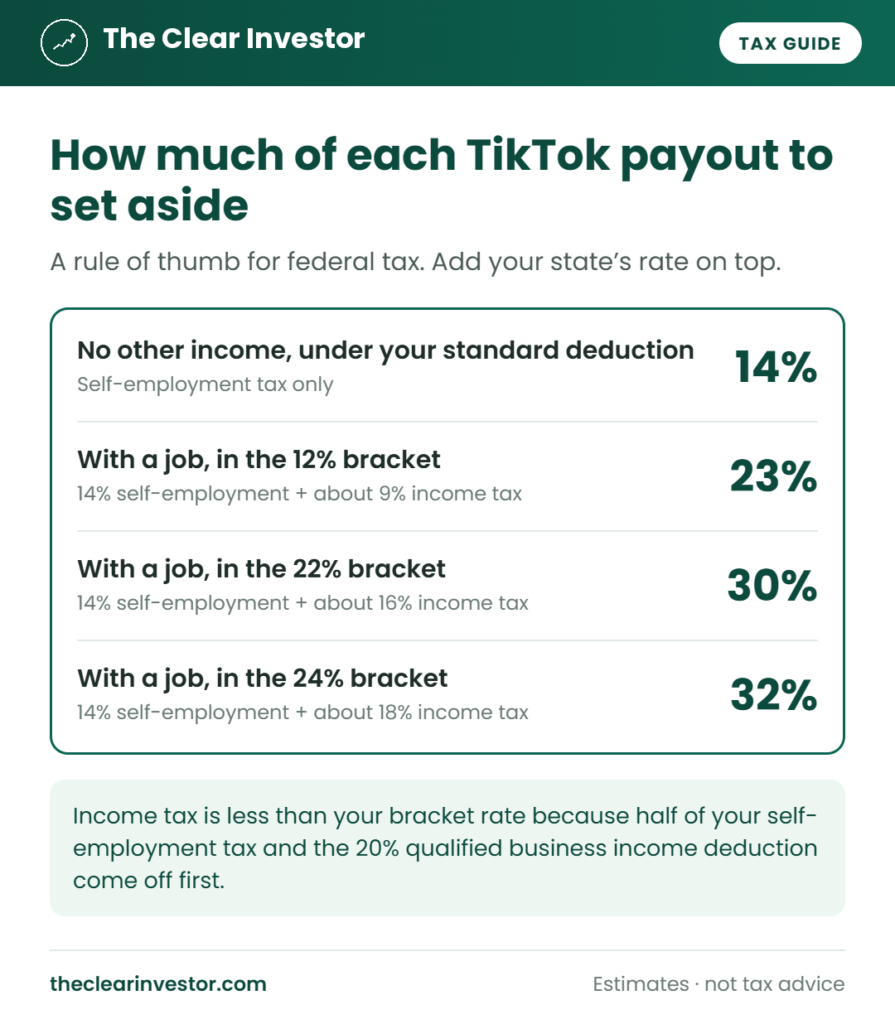
So, from each payout, set aside:
| Your situation | Federal tax to set aside |
|---|---|
| No other income, under your standard deduction | About 14% |
| A job in the 12% bracket | About 23% |
| A job in the 22% bracket | About 30% |
| A job in the 24% bracket | About 32% |
Add your state’s rate on top. Gifted products push it higher, since there’s no cash to set the tax aside from: $400 of products with a $40,000 job adds about $92. Creator expenses bring it down. The TikTok tax calculator puts it all together and gives you one percentage, state included.
Do You Need to Pay TikTok Taxes Quarterly?
Once you’re earning steadily, probably. The IRS expects estimated tax payments when you’ll owe $1,000 or more when you file. With no other income, self-employment tax alone hits $1,000 at about $7,100 of profit.
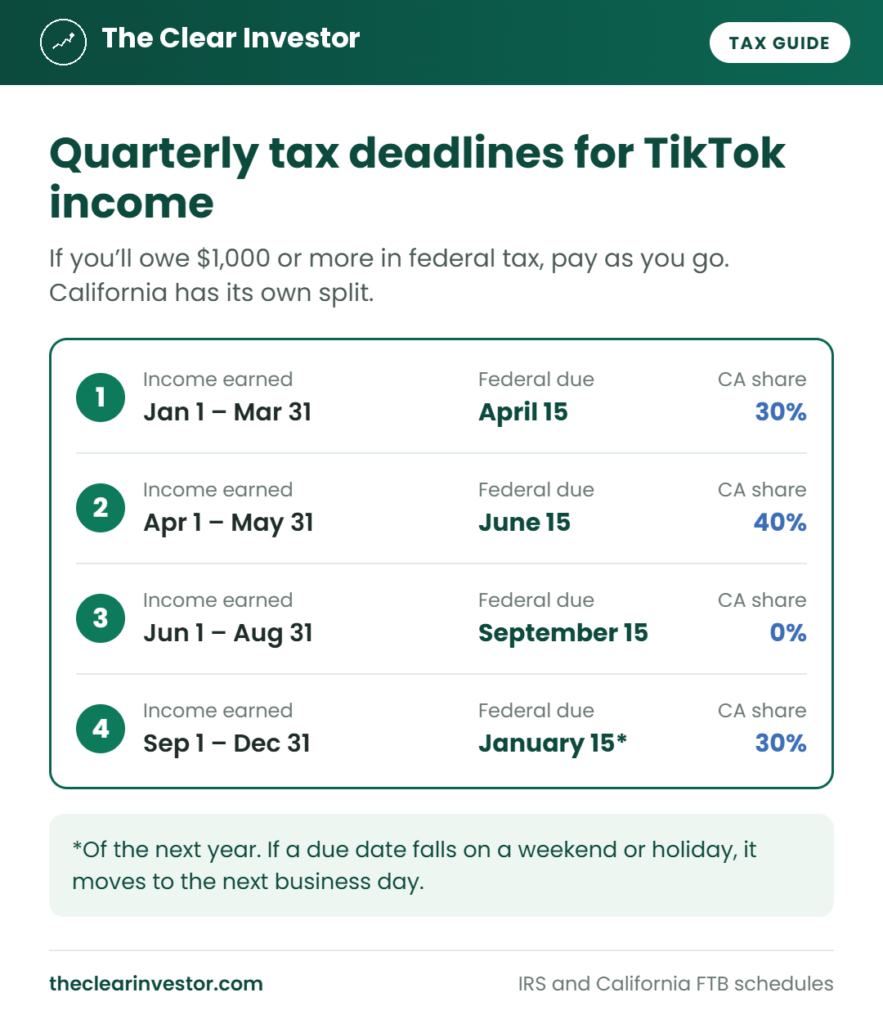
Leaving money in your TikTok balance doesn’t delay the tax. Under the IRS’s constructive receipt rule, income that’s credited to you and available to withdraw generally counts for the year it’s credited, even if you wait to cash it out.
If a video or LIVE takes off, your income can spike in one quarter. The annualized method on Form 2210 can lower or remove a penalty for the quarters when you earned less.
The safe harbor that keeps you penalty-free, and how to raise your W-4 withholding instead if you have a job, are in how quarterly payments work. If you’re in California, note that the state splits its payments differently.
Free tax tracker + deadline reminders
Get my free side income tax tracker
Sign up and I’ll send you my Google Sheets tracker that shows how much of each payout to set aside. You’ll also get an email before each quarterly tax deadline (Jan 15, Apr 15, Jun 15 and Sep 15), plus my new guides. Unsubscribe anytime.
Earn on several platforms or drive for work? Get the full 1099 Side Income Tracker ($12) →
Deductions That Lower Your TikTok Taxes
As a business, your creator costs come off your profit before either tax is figured, so they lower your TikTok taxes directly. Common ones:
- Your phone, for the share you use for TikTok, plus the business share of your phone plan.
- Ring lights, microphones, tripods and cameras. Under the IRS’s de minimis safe harbor, items that cost $2,500 or less each can usually be deducted in full the year you buy them. Pricier gear can often still be written off right away with Section 179 or bonus depreciation.
- Editing apps, music and stock footage.
- Editors and other freelancers. If you pay one person $2,000 or more in a year, you may need to send them a Form 1099-NEC.
- Props, and costumes you couldn’t wear day to day. Regular clothes don’t count, even if you wear them on camera.
- Promoting your posts, like TikTok Promote.
- Travel to film somewhere other than home.
- A home office you use regularly and only for content. The IRS’s simplified option is $5 per square foot, up to 300 square feet.
- The business share of your internet.
Two more come automatically: half of your self-employment tax comes off your income, and the qualified business income deduction takes up to 20% of your profit off your taxable income. None of these apply if your account is a hobby. Here are more deductions that lower side hustle taxes.
TikTok Taxes: How to Report Your Earnings
- Get your 1099 from TikTok and check it against the rewards you were paid during the year.
- Add everything without a form: brand deals under $2,000 and gifted products at what they’d cost to buy.
- Report the total on Schedule C, and assign TikTok’s 1099 to it, not to Schedule E or Schedule 1. Expenses go in Part II, and self-employment tax goes on Schedule SE. Here’s how reporting side hustle income works, step by step.
- Claim the tips deduction for your LIVE gifts on Schedule 1-A.
- Subtract any estimated payments you made, and any tax withheld in box 4 of a 1099.
I file with TaxAct. Add a Schedule C for your content business first, then enter TikTok’s 1099, type in the amount from its box, and assign the form to that Schedule C, as TaxAct’s 1099-MISC help page describes. If you also post on YouTube, that’s the same line of work, so both can usually go on the same Schedule C.
Special Situations
A few situations change your TikTok taxes.
If you’re not earning from TikTok yet
That’s me right now. Until TikTok pays you or you keep a gifted product, there’s no TikTok income to report. If you’re building your account as a business, your costs can create a loss that lowers the tax on your other income. For example, $300 of LIVE gifts, $1,500 of gear and a $40,000 job in California saves about $192 in tax. The IRS looks harder at accounts that lose money year after year, so keep receipts and treat it like a business.
If you’re also on YouTube
All of your content income goes on the same Schedule C, and the $433 line and the $1,000 quarterly rule count it all together. Your YouTube Super Chats can count as tips too, and the $25,000 cap covers both. YouTube has its own quirks, which I cover in how YouTube taxes work.
If you’re under 18
Creator Rewards, LIVE gifts and withdrawals all require you to be 18 or older, so most teen creators can’t earn from TikTok’s programs yet. Brand deals and gifted products still count as income, and IRS Publication 501 covers when a dependent has to file.
If you live outside the US
TikTok’s programs, payouts and tax rules vary by country. This guide and my calculator cover US creators only.
Common TikTok Tax Mistakes
These are the TikTok tax mistakes I’d watch for:
- Putting royalties on Schedule E or Schedule 1. If you post as a business, it belongs on Schedule C, with self-employment tax.
- Counting coins instead of dollars. Report what TikTok paid you for your Diamonds, not what viewers spent.
- Missing the tips deduction. LIVE gifts can lower your federal income tax, but only if you claim it on Schedule 1-A.
- Forgetting gifted products. Products you keep are income at what they’d cost to buy.
- Leaving out brand deals with no form. Under $2,000, you may not get a 1099-NEC, but it’s still income.
- Waiting to withdraw to put off the tax. Rewards available in your balance generally count for the year they’re credited.
- Spending every payout. Set aside your percentage each time you withdraw.
- Not keeping records. Save your rewards history, brand contracts and receipts. The IRS says to keep records for 3 years after you file in most cases.
My Verdict: Do You Have to Pay Taxes on TikTok?
Yes. TikTok taxes start once your profit passes about $433, and with a job, from the first dollar. Creator Rewards, LIVE gifts, Subscriptions, Series, brand deals and gifted products all count, and TikTok doesn’t take anything out. Even if your 1099 calls it royalties, it goes on Schedule C with self-employment tax if you post as a business. Deduct your creator costs, claim the tips deduction for your LIVE gifts, and set aside about 14% of every payout with no other income, or about 23% with a job in the 12% bracket, plus your state’s rate.
The rules every side hustle shares, like quarterly payments, deductions and when you have to file, are in my side hustle taxes guide.
Want to earn while you grow? See every platform I’ve used in How I make money online, or read my honest Outlier AI review.
FAQ
Do small TikTokers have to pay taxes?
Yes, once you’re paid. With no other income, you owe nothing until your profit passes about $433. With a job, every dollar is taxed.
Does TikTok take out taxes?
No. TikTok collects your tax info and pays you in full, so setting money aside is up to you.
Does TikTok send a 1099?
Yes, for what it pays you through its creator programs. Creators have reported a 1099-MISC with earnings in box 2 (Royalties), which is reported from just $10.
Are TikTok LIVE gifts taxable?
Yes. You report the dollars TikTok pays you for your Diamonds, not what viewers spent on coins. But they can count as qualified tips, which lowers your federal income tax.
Do TikTok Subscriptions count as tips?
No. Subscribers pay for access to perks, so it’s regular income with no tips deduction.
Is TikTok income self-employment income?
Yes, if you run your account as a business. If it’s truly a hobby, it goes on Schedule 1 instead, with no self-employment tax and no deductions.
Are gifted products from brands taxable?
Yes. Products you keep are income at what they’d cost to buy, usually with no form.
How much should I set aside for TikTok taxes?
About 14% if it’s your only income, and about 23% with a job in the 12% bracket, plus your state’s rate.
Can I deduct my phone?
Yes, the share you use for TikTok, if you run your account as a business. The same goes for your phone plan.
Do I owe taxes if I’m not in the Creator Rewards Program?
Only if you earned some other way, like LIVE gifts, brand deals or gifted products. With no income, there’s nothing to report.
I’m not a licensed financial advisor or tax professional. This guide is based on TikTok’s terms and help pages, IRS rules and my own experience filing 1099 income. It’s for educational purposes and isn’t tax advice. Tax rules change, so check the links above or talk to a tax professional about your situation. I’m not affiliated with TikTok or TaxAct.