Updated November 6, 2026
DataAnnotation taxes add up faster than most side gigs. Your pay is self-employment income, nothing is taken out, and when I checked, general work started at $25 an hour. At that rate, you pass the self-employment tax line in about 18 hours of work, and it doesn’t take long before the IRS expects quarterly payments.
I haven’t worked on DataAnnotation, but I’ve done the same kind of AI training work on Outlier and Handshake AI, and I’ve filed taxes on both. Everything in this guide comes from DataAnnotation’s own site, IRS rules and my DataAnnotation tax calculator, so you can check each piece yourself.
DataAnnotation taxes, the short answer:
- Is DataAnnotation income taxable? Yes. It’s a contractor role, so your pay is self-employment income.
- Does DataAnnotation take out taxes? No. Nothing is withheld.
- Does DataAnnotation send a 1099? Don’t expect a 1099-NEC. It pays through PayPal, and PayPal only sends a 1099-K above $20,000 and 200 payments a year.
- How much should you set aside? About 14% with no other income. With a job in the 12% bracket, about 23%. Add your state’s rate on top.
- Do you need quarterly payments? Once you’ll owe $1,000 or more in federal tax. With no other income, that’s about $7,100 of profit.
Table of Contents
Do You Have to Pay Taxes on DataAnnotation?
Yes. DataAnnotation’s site calls the work “a flexible, task-based contractor role.” Contractors aren’t employees, so there’s no W-2 and no withholding. Your pay is self-employment income, and paying the tax on it is up to you.
That brings two federal taxes:
- Self-employment tax. You owe it when your net earnings from self-employment are $400 or more. Net earnings are 92.35% of your profit, so the line is about $433 of profit. The rate is 15.3%: 12.4% for Social Security and 2.9% for Medicare. An employer would normally pay half of that. As a contractor, you pay both halves.
- Income tax. Only on income above your standard deduction, which is over $16,000 for single filers, over $32,000 for married couples filing jointly and over $24,000 for heads of household. It goes up with inflation each year.
The order matters. Self-employment tax starts at about $433 of profit and applies even when you owe no income tax at all. So if DataAnnotation is your only income, the first tax you’ll owe is self-employment tax, and it comes to about 14% of your pay.
At $25 an hour, here’s what that looks like over a year:

These numbers come from the law, not the tax year, so they don’t change from year to year. Income tax and state tax come on top once your total income passes your standard deduction.
How DataAnnotation Pays, and Why It Matters
DataAnnotation’s FAQ says: “We send payments via PayPal. Deposits will be delivered within a few days after you request them.” When I checked, it listed these starting rates by type of work:
| Type of work | Starting rate (per DataAnnotation) |
|---|---|
| General: evaluating chatbot responses, comparing AI outputs | $25 to $50 an hour |
| Multilingual: translation and localization | $25 to $40 an hour |
| Coding: code evaluation and debugging | $40 to $150+ an hour |
| STEM: work needing a master’s or PhD | $40 to $125+ an hour |
| Professional: law, finance or medicine credentials | $40 to $125+ an hour |
Three things here affect your DataAnnotation taxes:
- You choose when to transfer. Your pay counts as income once it’s yours to take, not when you finally move it to PayPal. If you leave a balance in DataAnnotation on December 31, it still belongs to that year.
- PayPal is the middleman. That decides which tax form you could get, if any. More on that below.
- The rates are high for a side gig. At $40 or $100 an hour, part-time hours can add up to a full-time income. That’s when quarterly payments, deductions and retirement accounts start to matter.
Does DataAnnotation Send a 1099?
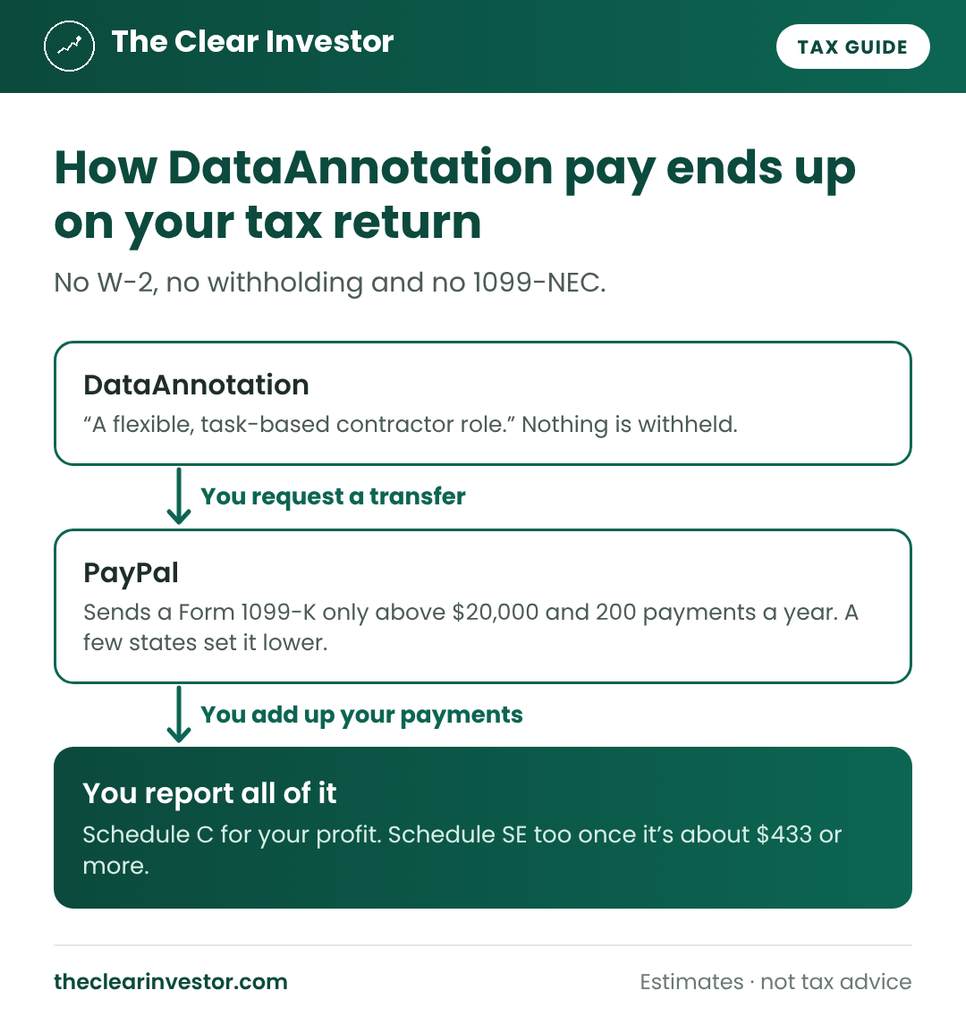
Don’t expect a 1099-NEC. DataAnnotation pays through PayPal, and the IRS says payments made through a third-party network like PayPal go on Form 1099-K from the payment company, not on a 1099-NEC. DataAnnotation’s FAQ doesn’t mention tax forms at all.
So the only form you’re likely to see is PayPal’s Form 1099-K. PayPal sends one when you get more than $20,000 in more than 200 payments in a year. At $25 an hour, $20,000 is about 15 hours a week for a full year. But you’d also need more than 200 payments, which means transferring more often than every other day. A few states set the bar lower, like Maryland, Massachusetts, Vermont, Virginia and Illinois.
Here’s the whole path from DataAnnotation to your tax return:
Two things to know if a form does show up:
- A 1099-K counts every business payment to your PayPal, not only DataAnnotation. If it includes money that isn’t income, like a friend’s share of a dinner bill, the IRS says to contact the issuer for a corrected form.
- If DataAnnotation ever sends a 1099-NEC too, don’t count the same pay twice. Report your real total once, and keep your PayPal records in case the IRS asks how you got it.
No 1099 doesn’t mean no tax. The IRS says gig income has to be reported even if you don’t get a 1099-K, 1099-MISC or W-2.
DataAnnotation vs. Outlier vs. Handshake AI: How the Tax Forms Differ
This is where my own experience comes in. All three are AI training work, and DataAnnotation taxes work the same way as the other two: Schedule C, plus self-employment tax. What’s different is how they pay you, and so which form shows up:
| DataAnnotation | Outlier | Handshake AI | |
|---|---|---|---|
| How you get paid | PayPal, when you request it | Weekly direct deposit (my experience) | Weekly direct deposit (my experience) |
| Tax form | Form 1099-K, only above PayPal’s thresholds | A 1099 (I got one) | Form 1099-NEC, on the Payments tab |
| Who sends it | PayPal | Outlier | Handshake |
| How it’s taxed | Self-employment income | Self-employment income | Self-employment income |
So if you’ve done Outlier or Handshake AI and got a form every year, don’t wait for one from DataAnnotation. And if you work on more than one, the $433 line and the $1,000 quarterly rule count all your gig income together. Here’s how Outlier AI taxes work and how Handshake AI taxes work.
How Much Tax Will You Owe on DataAnnotation?
Here’s what DataAnnotation taxes look like at a few pay levels, for a single filer in Texas, which has no state income tax:
- 5 hours a week at $25 ($6,500 a year), no other income: about $918, all self-employment tax.
- 10 hours a week ($13,000 a year), no other income: about $1,837, still all self-employment tax. The standard deduction covers your income tax.
- The same $13,000 with a $40,000 W-2 job: about $2,997, or 23%. That’s $1,160 of federal income tax and $1,837 of self-employment tax.
- 20 hours a week ($26,000 a year), no other income: $3,674 of self-employment tax, plus a few hundred dollars of income tax, since $26,000 is past your standard deduction.
Why does a job add so much? Your W-2 pay already uses up the standard deduction and the 10% bracket, so every DataAnnotation dollar lands in the 12% bracket. The income tax comes to a bit less than 12% of your pay, because half of your self-employment tax and the 20% qualified business income deduction come off first.
So how much to set aside depends mostly on your other income:
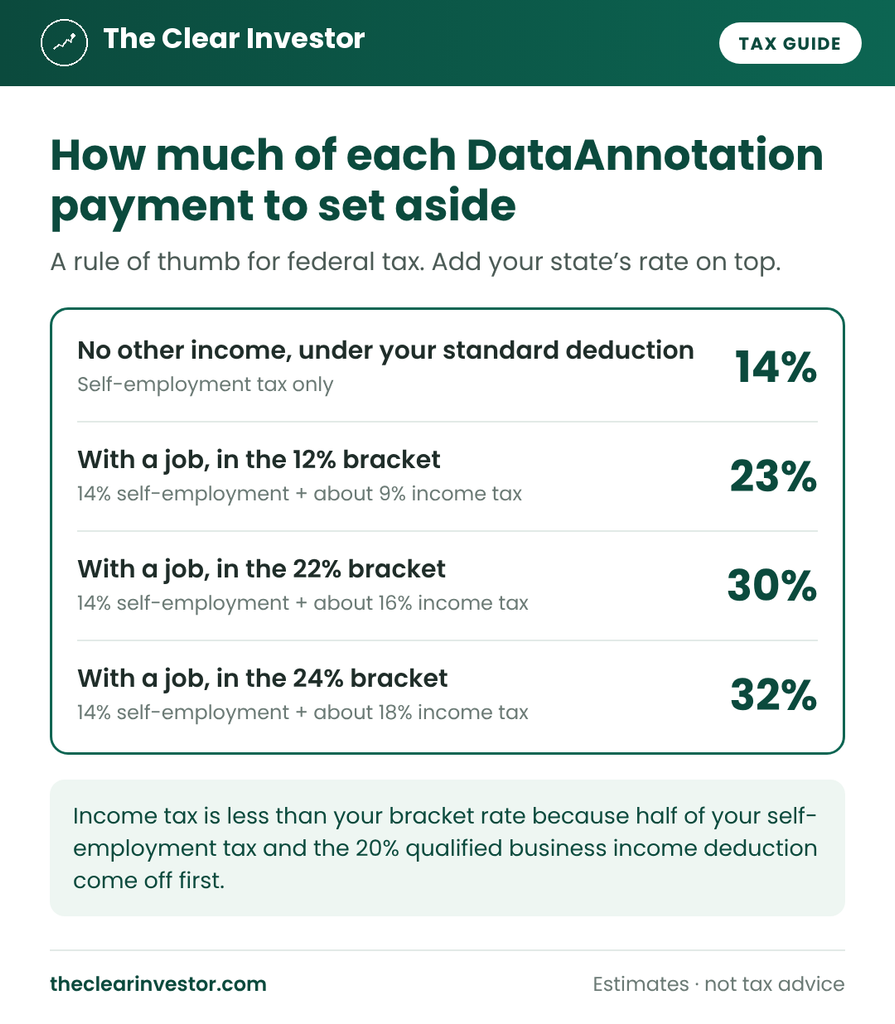
Add your state’s rate on top. In a state with a 5% income tax, someone in the 12% bracket would set aside about 28%. The DataAnnotation tax calculator gives you one percentage for your situation, state included.
Do You Need to Pay DataAnnotation Taxes Quarterly?
Probably, if DataAnnotation is a real side income. The IRS expects estimated tax payments when you’ll owe $1,000 or more when you file. With no other income, self-employment tax alone reaches $1,000 at about $7,100 of profit. At 10 hours a week and $25 an hour, that’s about seven months of work.
The year is split into four periods, each with its own due date:
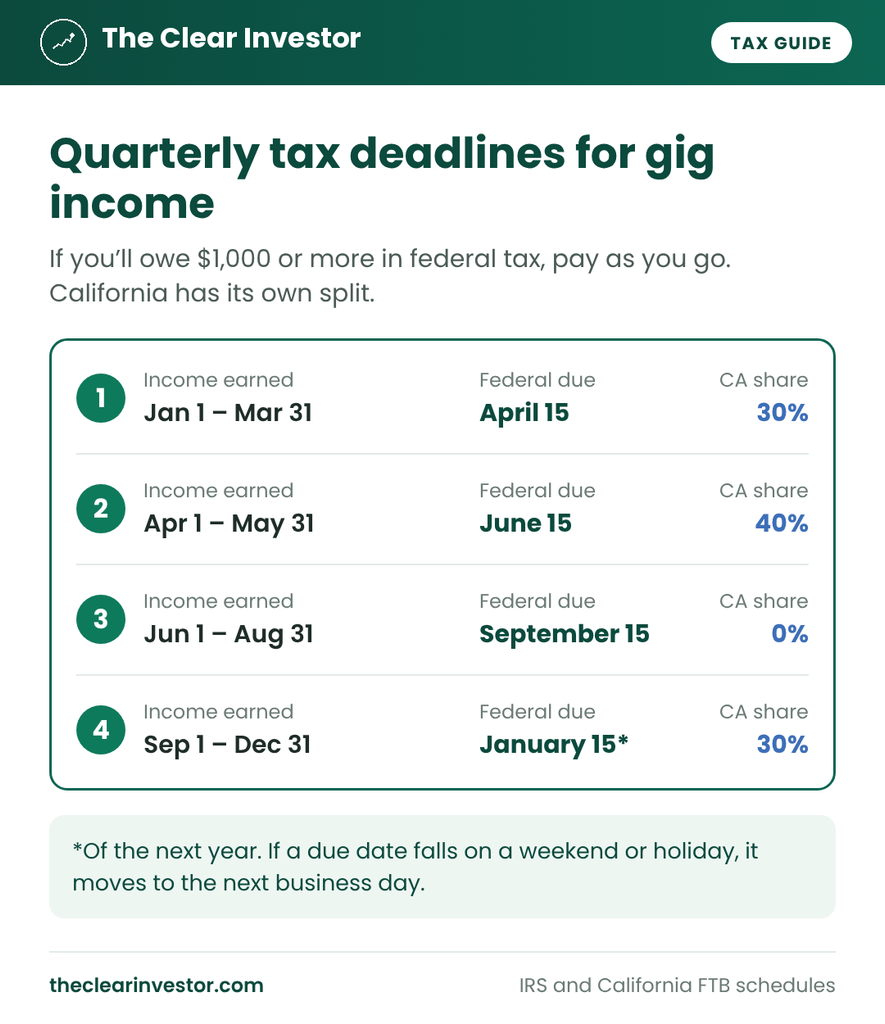
With a job in the 12% bracket, you reach that $1,000 line sooner, at about $4,300 of DataAnnotation pay. The due dates, the safe harbor that keeps you penalty-free, and how to raise your W-4 withholding instead are all in how quarterly payments work. If you’re in California, note that the state splits its payments differently.
Free tax tracker + deadline reminders
Get my free side income tax tracker
Sign up and I’ll send you my Google Sheets tracker that shows how much of each payout to set aside. You’ll also get an email before each quarterly tax deadline (Jan 15, Apr 15, Jun 15 and Sep 15), plus my new guides. Unsubscribe anytime.
Earn on several platforms or drive for work? Get the full 1099 Side Income Tracker ($12) →
Deductions That Lower Your DataAnnotation Taxes
Because you’re self-employed, business expenses come off your profit before either tax is figured. That lowers both of your DataAnnotation taxes: self-employment tax and income tax. Common ones for this kind of work:
- The business share of your internet and phone. If you use your internet half the time for DataAnnotation, half the bill is a business expense.
- A computer or monitor you use for the work, in proportion to how much you use it for business.
- A home office. If you use part of your home regularly and only for this work, the IRS’s simplified option is $5 per square foot, up to 300 square feet. A 100-square-foot office is a $500 deduction.
- Software or subscriptions you need for projects.
Half of your self-employment tax and the qualified business income deduction come off automatically. At DataAnnotation’s higher rates, a SEP IRA or solo 401(k) can lower your income tax a lot too. Here are more deductions that lower side hustle taxes.
DataAnnotation Taxes: How to Report Your Earnings
- Find your total. Add up your DataAnnotation payments in your PayPal activity for the year, plus any balance you could have transferred but didn’t. Bonuses count too.
- Report it on Schedule C, with your expenses in Part II and self-employment tax on Schedule SE. Here’s how reporting side hustle income works, step by step.
- Subtract any estimated payments you made during the year.
I file with TaxAct. You enter your self-employment income and expenses, and it fills in Schedule C, Schedule SE and the qualified business income deduction for you. If you also do Outlier, Handshake AI or Mercor, that’s the same kind of work, so it can usually go on the same Schedule C. Here’s how Mercor taxes work.
Special Situations
A few situations change your DataAnnotation taxes.
If you earn a lot
On the coding and professional tracks, rates of $100 an hour or more are possible. Three limits matter then. Social Security tax stops once your combined wages and self-employment earnings pass the yearly Social Security wage base, which is over $180,000. An extra 0.9% Medicare tax applies above $200,000 for single filers. And the qualified business income deduction has extra limits at high incomes.
If you live outside the US
This guide and my calculator cover US taxes only. If you work on DataAnnotation from another country, your country’s rules apply.
Common DataAnnotation Tax Mistakes
These are the mistakes I’d watch for with DataAnnotation taxes:
- Spending every PayPal payment. Nothing is withheld, so the tax comes due all at once in April. Move your set-aside percentage to savings as each payment lands.
- Waiting for a 1099-NEC. It likely won’t come. Track your PayPal payments yourself.
- Forgetting the balance you didn’t transfer. It counts in the year you earned it.
- Trusting a 1099-K total blindly. It can include PayPal payments that aren’t DataAnnotation pay or aren’t income at all.
- Not keeping records. Save your PayPal statements and expense receipts. The IRS says to keep records for 3 years after you file in most cases.
My Verdict: Do You Owe Taxes on DataAnnotation?
Yes. DataAnnotation taxes apply on almost any real amount. Plan for about 14% of every payment with no other income, and about 23% with a job in the 12% bracket, plus your state’s rate. Once you’ll owe $1,000 or more, pay quarterly or raise your W-4 withholding. DataAnnotation won’t send a 1099-NEC, and PayPal’s 1099-K only shows up at high volume, so track your payments yourself and report them on Schedule C.
The rules every side hustle shares, like quarterly payments, deductions and when you have to file, are in my side hustle taxes guide.
Doing AI training work elsewhere too? Read my honest Outlier AI review and my Handshake AI review. See every platform I’ve used: How I make money online.
FAQ
Is DataAnnotation income taxable?
Yes. It’s a contractor role, so your pay is self-employment income.
Does DataAnnotation take out taxes?
No. Nothing is withheld, so you pay the tax yourself.
Does DataAnnotation send a 1099?
Don’t expect a 1099-NEC. It pays through PayPal, and those payments go on PayPal’s Form 1099-K, which only comes above $20,000 and 200 payments in most states.
Does DataAnnotation send a W-2?
No. Contractors don’t get a W-2.
How much should I set aside for DataAnnotation taxes?
About 14% if it’s your only income, and about 23% with a job in the 12% bracket, plus your state’s rate. The calculator gives you a percentage for your situation.
Does my DataAnnotation balance count if I haven’t transferred it?
Yes. Pay you can transfer counts in the year you earn it, even if you leave it in DataAnnotation.
What if I live outside the US?
This guide and the calculator cover US taxes only. Outside the US, your country’s rules apply.
Is coding-track pay taxed differently?
No. Coding and professional projects pay more, but it’s the same self-employment income on the same Schedule C. The higher pay just lands in a higher bracket.
I’m not a licensed financial advisor or tax professional. I haven’t worked on DataAnnotation, so this guide is based on its public site, IRS rules and my experience with similar AI training work. It’s for educational purposes and isn’t tax advice. Tax rules change, so check the IRS links above or talk to a tax professional about your situation. I’m not affiliated with DataAnnotation or PayPal.