
This 1099 tax calculator shows how much tax you’ll owe on your 1099 income in 2026: self-employment tax, federal income tax and state tax. It also shows what each deduction saves you, which tax forms to expect and what to pay each quarter. Want to know how 1099 income is taxed first? Read my 1099 tax guide.
I’ve filed my own taxes with TaxAct every year since 2022, with 1099s from Outlier, Clickworker and Amazon Flex, and I file two side gigs on their own Schedule Cs. My other tax calculators are each built around one platform’s fees and forms. This one is for everyone else: freelancers, contractors and consultants paid by their own clients. I’ve also taken the home office deduction for my Outlier work. Since I’m not a full-time freelancer, the parts I haven’t used myself, like the health insurance and SEP IRA rules, come straight from the IRS’s forms and publications.
1099 Tax Calculator
See how much self-employment tax, federal income tax and state tax you’ll owe on your 1099 income in 2026, what your deductions save you, and what to pay each quarter.
1Your 2026 1099 income
2Your business expenses
3Home office and car
4Health insurance and retirement
5Your other income
6Tax you’ve already paid
7About you
Your 1099 profit (Schedule C)
What your deductions save you
| Deduction | Amount | Tax it saves |
|---|
Your quarterly payments
| Due | For income earned | To avoid a penalty | To cover all of it |
|---|
Your tax forms
| Form | From | Amount |
|---|
Your total 2026 tax: before vs. after deductions
| Before deductions | After deductions |
|---|
How your taxable income is worked out
How this is calculated
- Your 1099 income = what clients paid you on 1099-NEC, by card or payment app (before the payment company’s fees), and with no form. It all counts, form or not.
- Your 1099 profit = 1099 income − business expenses − home office − mileage, parking and tolls. Only 50% of business meals counts. The simplified home office is $5 a square foot for up to 300 square feet; the regular method is your office’s share of your home’s size times your yearly home costs. Either way, it can’t be more than your profit before it. Mileage is business miles from January through June × 72.5¢ + July through December × 76¢, the 2026 IRS rates.
- Self-employment tax is 15.3% (12.4% Social Security and 2.9% Medicare) on 92.35% of your profit. You only owe it when that comes to $400 or more, which means about $433 of profit. Social Security tax stops at $184,500 of combined W-2 pay and self-employment earnings, and an extra 0.9% Medicare tax applies above $200,000 ($250,000 married filing jointly, $125,000 separately). Half of the 15.3% is deductible.
- Health insurance you paid for comes off your income for income tax, up to your profit after half your self-employment tax and your retirement contributions. It doesn’t lower self-employment tax.
- Retirement: a SEP IRA takes up to 20% of your profit after half your self-employment tax, up to $72,000. A solo 401(k) adds up to $24,500 as the employee ($32,500 at 50 or older, $35,750 at 60 to 63) on top of that 20%, up to $72,000 plus catch-up, and never more than that profit. The calculator uses the smaller of what you enter and the limit.
- Federal income tax uses the 2026 brackets and standard deduction ($16,100 single or married filing separately, $32,200 married filing jointly, $24,150 head of household), plus $2,050 for each single or head of household filer 65 or older and $1,650 for each married person 65 or older. Married filing separately uses the single brackets, except that the 37% rate starts at $384,350.
- Qualified business income deduction: 20% of your profit after half your self-employment tax, health insurance and retirement deductions, capped at 20% of your taxable income, and at least $400 when that profit is $1,000 or more. Above $201,750 of taxable income ($403,500 married filing jointly), it phases out over the next $75,000 ($150,000 jointly), faster for specified services. The calculator assumes you pay no employees and own little business property.
- Senior deduction (2025 to 2028): $6,000 for each person 65 or older, minus 6% of income over $75,000 ($150,000 married filing jointly). Not for married filing separately.
- Tips deduction (2025 to 2028): qualified tips up to $25,000, no more than your profit, minus $100 for each $1,000 of income over $150,000 ($300,000 jointly). Not for married filing separately. It lowers federal income tax only.
- Child tax credit is $2,200 per child under 17. Up to $1,700 per child can be paid to you as a refund, based on 15% of your earned income over $2,500.
- State income tax uses 2026 rates, brackets, standard deductions and exemptions from the Tax Foundation, updated for the 2026 cuts in Arkansas, Georgia, South Carolina, Utah and West Virginia, and for the higher 2026 standard deductions in Arizona and Maine. A few states (like California) hadn’t published 2026 bracket amounts, so their 2025 amounts are used. Head of household and married filing separately use single brackets. The tips deduction comes off state tax only in Arizona and Michigan, which follow it for 2026. Arizona also takes off the senior deduction and $2,100 for each person 65 or older. Age-based breaks in other states are left out.
- Tax on your 1099 income = your total tax minus what your total tax would be without it, so your job and other income count. The set-aside percentage is that tax divided by what reached you after payment fees.
- Quarterly payments: your 2026 federal income tax and self-employment tax, minus what’s withheld from your paychecks. If you leave withholding blank, the calculator assumes it covers the tax on your job. To avoid a penalty you have to pay the smaller of 90% of this year’s tax or 100% of last year’s (110% if your 2025 AGI was over $150,000), in four equal payments due April 15, June 15, Sept. 15 and Jan. 15. No payments are needed if you’ll owe less than $1,000 after withholding.
- Tax forms: clients send a 1099-NEC once they pay you $2,000 or more in 2026. Payment companies send a 1099-K once card or app payments top $20,000 and 200 payments, or at lower lines in some states: $600 in DC, Maryland, Massachusetts, Montana and Virginia, $1,000 in New Jersey, $1,000 and 4 payments in Illinois, $2,000 in Vermont and $2,500 in Arkansas.
Not included: actual car expenses instead of the mileage rate, home depreciation under the regular home office method, depreciation of equipment over several years, employees’ wages and business property for the qualified business income deduction, the premium tax credit, a traditional IRA, hobby income, the earned income tax credit, itemized deductions, city and county income taxes (like New York City or Maryland counties), state low-income credits and the underpayment penalty itself. Your real tax can be different.
Free tax tracker + deadline reminders
Get my free side income tax tracker
Sign up and I’ll send you my Google Sheets tracker that shows how much of each payout to set aside. You’ll also get an email before each quarterly tax deadline (Jan 15, Apr 15, Jun 15 and Sep 15), plus my new guides. Unsubscribe anytime.
Earn on several platforms or drive for work? Get the full 1099 Side Income Tracker ($12) →
Table of Contents
How to Use the 1099 Tax Calculator
- Add up what you were paid in 2026: what clients paid you directly (that’s your 1099-NEC income), what came in by card or payment app before the payment company’s fees, and anything no form will show. It all counts, form or not.
- Enter your business expenses: payment fees, software and equipment, the business share of your phone and internet, marketing and insurance, travel and meals. Enter your full meal costs, and the calculator halves them.
- Add your home office and car: pick the simplified or regular home office method, then split your business miles at June, since the IRS raised the rate on July 1.
- Add health insurance you paid for and your retirement plan, if you have a SEP IRA or solo 401(k).
- Add your other income and tax already paid: a W-2 job, a pension, withholding and estimated payments. Last year’s tax is optional, but it can lower what you need to pay each quarter.
- Tell it about you: filing status, kids, state, age and kind of work.
Who This Calculator Is For
- Freelancers and independent contractors paid on a 1099-NEC: designers, writers, developers, tutors, photographers and the trades.
- Consultants, coaches and other professionals, whose deduction for business income shrinks faster at high incomes.
- People with a job and a side business, to see how much more tax the 1099 work adds.
- Self-employed people who buy their own health insurance or save in a SEP IRA or solo 401(k), to see what each one saves.
- Retirees who consult or freelance, with the bigger standard deduction and the $6,000 senior deduction at 65.
Paid through a platform? My tax calculators page has calculators built around each platform’s own fees, forms and pay, from DoorDash and Uber to Patreon and eBay.
How to Read Your Results
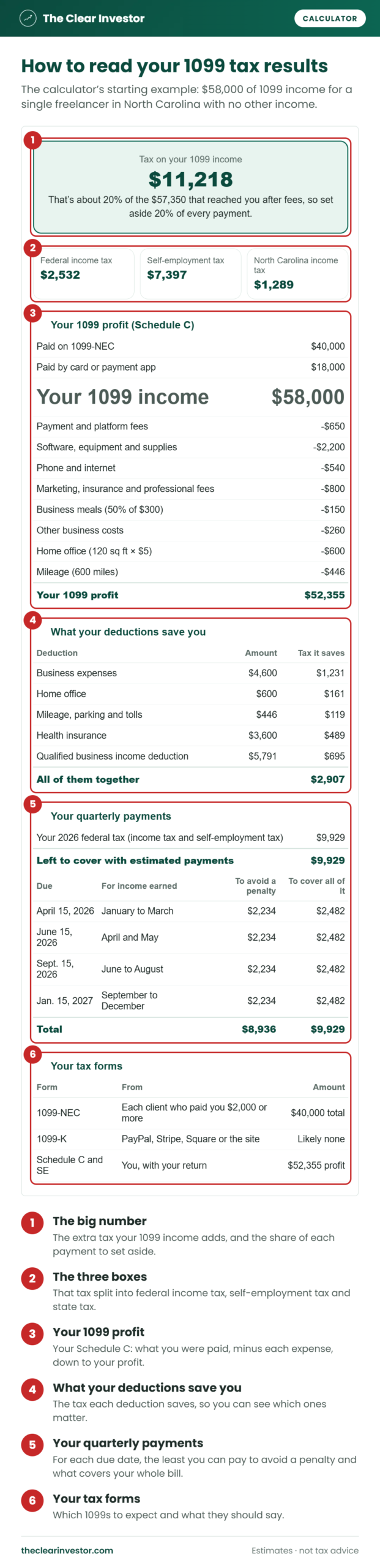
- The big number is the extra tax your 1099 income adds, and the line under it says what share of each payment to set aside.
- The three boxes split it into federal income tax, self-employment tax and state tax.
- The profit table is your Schedule C: what you were paid, minus each expense, down to your 1099 profit.
- What your deductions save you shows the tax each deduction saves, so you can see which ones matter.
- Your quarterly payments show two amounts for each due date: the least you can pay to avoid a penalty, and what covers your whole bill.
- Your tax forms show which 1099s to expect and what they should say.
Below them, the notes cover self-employment tax, the deduction for business income, your home office, mileage, health insurance, retirement and your state. Two more tables show your total tax before and after deductions, and how your taxable income is worked out.
Worked Example 1: A $58,000 Freelancer in North Carolina
This is the calculator’s starting example: a single freelancer in North Carolina with no other income. Clients paid them $40,000 directly and $18,000 through Stripe and PayPal in 60 payments, and the payment fees came to $650. They spent $2,200 on software and equipment, $540 on the business share of their phone and internet, $800 on marketing, insurance and an accountant, $300 on client meals and $260 on other costs. They work from a 120-square-foot spare room, drove 600 business miles (half of them before July) and paid $3,600 for their own health insurance.
| Step | Amount |
|---|---|
| Paid on 1099-NEC | $40,000 |
| Paid by card or payment app | $18,000 |
| Business expenses (meals at 50%) | −$4,600 |
| Home office (120 square feet × $5) | −$600 |
| Mileage (300 miles × 72.5¢ + 300 miles × 76¢) | −$446 |
| 1099 profit | $52,355 |
| Federal income tax | $2,532 |
| Self-employment tax | $7,397 |
| North Carolina income tax | $1,289 |
| Tax on their 1099 income | $11,218 |
That’s about 20% of the $57,350 that reached them after fees, so the calculator says to set aside 20% of every payment. Self-employment tax is the biggest part. Federal income tax is small because three deductions come off first: half their self-employment tax ($3,699), their health insurance ($3,600) and the qualified business income deduction ($5,791). To cover their whole federal bill, they’d pay $2,482 each quarter, or $2,234 to just avoid a penalty. The calculator also points out that a SEP IRA could take up to $9,731 this year and cut their tax by about $1,322.
Worked Example 2: A Writer With a $65,000 Job in California
This single writer has a $65,000 job with $5,700 of federal tax withheld. On the side, they made $14,000 writing for three clients, each of whom sends a 1099-NEC. They spent $900 on software, $360 on the business share of their phone and internet and $150 on professional fees. They write at the kitchen table, so there’s no home office.
| Step | Amount |
|---|---|
| Paid on 1099-NEC | $14,000 |
| Business expenses | −$1,410 |
| 1099 profit | $12,590 |
| Federal income tax | $1,909 |
| Self-employment tax | $1,779 |
| California income tax | $936 |
| Tax on their 1099 income | $4,624 |
Their job pushes most of their writing income into the 22% bracket, so it costs a lot more than the same profit would on its own. The calculator says to set aside 34% of every payment. Their paycheck withholding covers the tax on their job but not the $3,608 of federal tax the writing adds. They could pay $902 each quarter, or add about $139 to each of 26 paychecks with a new Form W-4, which counts as paid evenly through the year. California wants its own estimated payments, with nothing due in September.
Worked Example 3: A $280,000 Consultant in New York, With and Without a SEP IRA
This single consultant in New York was paid $280,000 on 1099-NECs. They spent $12,000 on business costs ($4,000 of software and equipment, $1,200 of phone and internet, $3,500 of insurance and professional fees, $2,500 of travel, $1,000 of meals and $300 of other costs), work from a 150-square-foot home office, drove 800 business miles and paid $7,200 for health insurance. Consulting is a specified service, so their deduction for business income shrinks above $201,750 of taxable income.
| No retirement plan | $50,329 in a SEP IRA | |
|---|---|---|
| 1099 profit | $266,656 | $266,656 |
| SEP IRA contribution | $0 | −$50,329 |
| Qualified business income deduction | $20,363 | $35,603 |
| Federal income tax | $43,011 | $26,777 |
| Self-employment tax | $30,436 | $30,436 |
| New York income tax | $13,582 | $10,413 |
| Tax on their 1099 income | $87,028 | $67,626 |
Without a retirement plan, their taxable income lands in the range where a consultant’s deduction for business income phases out, so they get only $20,363 of it. Putting the most they can, $50,329, into a SEP IRA does two things. It comes off their income directly, and it drops their taxable income below $201,750, so the deduction rises to $35,603. Together, that saves about $19,400 this year. Self-employment tax doesn’t change, and it includes $416 of extra 0.9% Medicare tax on earnings over $200,000. New York City residents would owe city tax on top.
Worked Example 4: A 66-Year-Old Retiree Consulting in Florida
This single retiree is 66 and has a $30,000 pension with no tax withheld. They made $36,000 consulting for their old industry on 1099-NECs. They spent $1,200 on travel, $800 on software, $400 on professional fees, $300 on the business share of their phone and $200 on client meals, and they have a 100-square-foot home office and drove 1,000 business miles.
| Step | Amount |
|---|---|
| Paid on 1099-NEC | $36,000 |
| Business expenses (meals at 50%) | −$2,800 |
| Home office (100 square feet × $5) | −$500 |
| Mileage (500 miles × 72.5¢ + 500 miles × 76¢) | −$743 |
| 1099 profit | $31,958 |
| Federal income tax | $2,720 |
| Self-employment tax | $4,515 |
| Florida income tax | $0 |
| Tax on their 1099 income | $7,236 |
Being 65 or older helps with income tax. Their standard deduction is $18,150 instead of $16,100, and the new senior deduction takes off another $6,000, saving $720, since their income is under $75,000. It doesn’t help with self-employment tax, which you pay at any age. Florida has no income tax. With nothing withheld from the pension, they’d pay $1,955 each quarter to cover the year. If they pay Medicare premiums, those can count as self-employed health insurance too.
More Example Results
Here’s the tax on different amounts of 1099 profit for a single filer in Texas, which has no income tax, with no other income and with a $60,000 job:
| 1099 profit | Tax, no other income | Set aside | Tax with a $60,000 job | Set aside |
|---|---|---|---|---|
| $10,000 | $1,413 | 15% | $2,399 | 24% |
| $25,000 | $4,103 | 17% | $6,972 | 28% |
| $50,000 | $9,732 | 20% | $14,593 | 30% |
| $75,000 | $15,495 | 21% | $22,215 | 30% |
| $100,000 | $22,365 | 23% | $30,087 | 31% |
| $150,000 | $37,608 | 26% | $44,502 | 30% |
| $250,000 | $66,360 | 27% | $85,552 | 35% |
With no other income, the share climbs slowly, from 15% to 27%, since your standard deduction and lower brackets cover the first part of your profit. A job uses those up, so the same profit costs more. With a job, the share stays near 30% from $50,000 to $150,000, since Social Security tax stops at $184,500 of combined pay. At $250,000, the 32% and 35% brackets, the extra 0.9% Medicare tax and a shrinking deduction for business income push it to 35%.
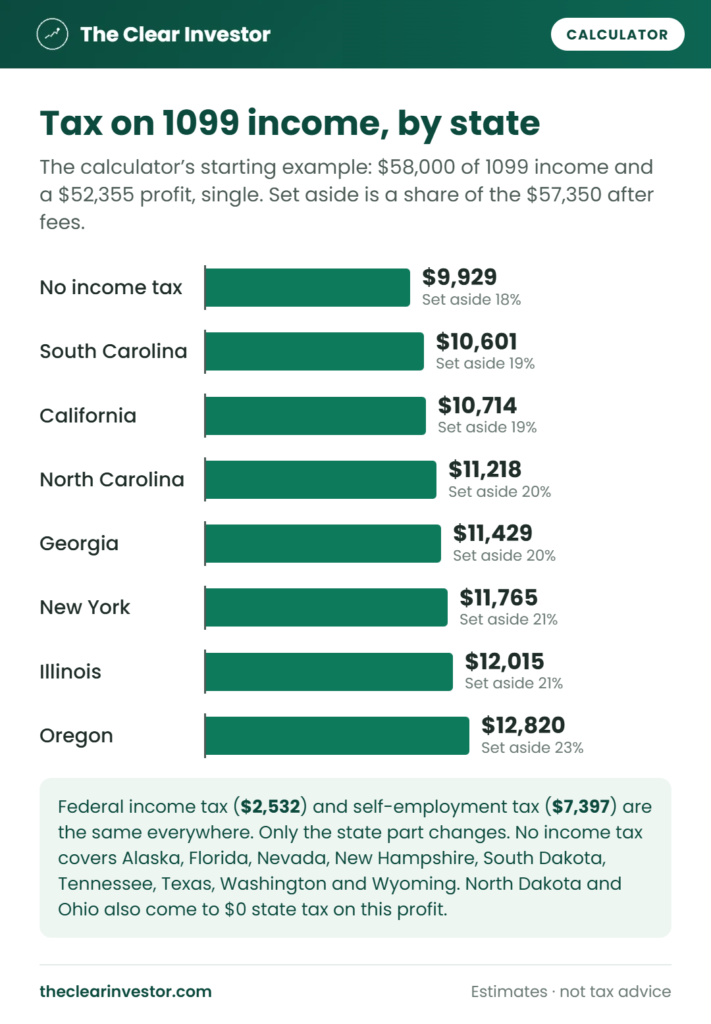
Your state matters too. The freelancer in Example 1 pays $9,929 in states with no tax on this income, like Florida, Texas and Washington, and up to $12,820 in Oregon:
How the 1099 Tax Calculator Works
- Your 1099 income: everything clients paid you, whether or not you get a form. The IRS says you report all of it, even without a form, and card or app payments count before the payment company’s fees.
- Your 1099 profit: income minus business expenses on Schedule C, with only 50% of meals. The home office is the simplified method ($5 a square foot, up to 300) or your office’s share of your home costs, and it can’t be more than your profit before it.
- Mileage: 72.5 cents a mile through June 2026 and 76 cents from July, the IRS standard mileage rates.
- Self-employment tax: 15.3% on 92.35% of your profit once that’s $400 or more, per the IRS. Social Security stops at $184,500 of combined pay, and an extra 0.9% Medicare tax starts at $200,000 ($250,000 married filing jointly).
- Health insurance: the self-employed health insurance deduction, only for months you couldn’t get a subsidized plan through your job or your spouse’s, and no more than your profit after half your self-employment tax and retirement contributions.
- Retirement: a SEP IRA takes up to 20% of your profit after half your self-employment tax, up to $72,000 (IRS SEP limits). A solo 401(k) adds up to $24,500 as the employee, plus $8,000 at 50 or older or $11,250 at 60 to 63, per IRS Publication 560.
- Income tax: the 2026 brackets and standard deduction, the qualified business income deduction (20%, at least $400 once that income is $1,000, phasing out above $201,750 of taxable income), and the senior and tips deductions for 2025 through 2028.
- Your 1099 tax: your total tax minus your tax without the 1099 income, so your job and other income count.
- Quarterly payments: your 2026 federal tax minus withholding, split over four estimated tax due dates. The penalty-free amount is the smaller of 90% of this year’s tax or 100% of last year’s (110% if your 2025 AGI was over $150,000).
- Tax forms: a 1099-NEC from each client who pays you $2,000 or more in 2026, and a 1099-K once card or app payments top $20,000 and 200 payments, or a lower line in eight states and DC.
What the Calculator Leaves Out
- Actual car expenses instead of the mileage rate, and depreciation on your home or on equipment spread over several years.
- Employees’ wages and business property, which can keep more of the deduction for business income at high incomes.
- The premium tax credit, a traditional IRA, the earned income tax credit and itemized deductions.
- Working out how much of your Social Security benefits is taxable. Enter the taxable part as other income.
- City and county income taxes, like New York City’s, and the underpayment penalty itself.
Tips for Accurate Results
- Add up your income from your own records, not just your 1099s. Clients who paid you under $2,000 don’t send one, and the income still counts.
- Enter card and app payments before fees. Your 1099-K counts the full amount, and the fees go in as an expense.
- Only count a home office you use regularly and only for work. A desk in the living room doesn’t qualify.
- Leave out health insurance for months you could get a plan at your job or your spouse’s job, even if you turned it down.
- Enter last year’s total tax from your 2025 Form 1040. It can lower the amount you need to pay each quarter to avoid a penalty.
What to Do With Your Result
- Move your set-aside percentage to a separate savings account every time a client pays you.
- Make quarterly payments if you’ll owe $1,000 or more after withholding, or raise your W-4 withholding if you have a job.
- Open a SEP IRA or solo 401(k) if the retirement note shows a big saving. A SEP can be opened and funded until your filing deadline.
- Keep receipts and a mileage log, and track which payments came by card or app so you can match your 1099-K.
- Check your 1099s against your records in January and ask the client for a corrected form if one is wrong.
1099 Tax Calculator FAQ
How much tax do I pay on 1099 income?
About 15.3% self-employment tax on 92.35% of your profit, plus federal income tax at your bracket and your state’s tax. With $10,000 to $250,000 of profit and no other income, that’s about 15% to 27% of your profit before state tax.
How much should I set aside from each 1099 payment?
About 15% to 27% with no other income and 24% to 35% with a $60,000 job, depending on your profit, before state tax. The calculator gives you one percentage for your situation.
Is this a self-employment tax calculator too?
Yes. It works out your self-employment tax on its own line, along with income tax and state tax, since you owe all three on 1099 profit.
Do I have to pay tax if I didn’t get a 1099?
Yes. A 1099 is a report to the IRS, not what makes income taxable. Income from clients who paid you under $2,000 still counts.
Why doesn’t health insurance lower my self-employment tax?
That’s how the deduction works. It comes off your income for income tax only, and so do retirement contributions and the deduction for business income.
Is a SEP IRA or a solo 401(k) better?
A solo 401(k) lets you put in more at most incomes, since you add up to $24,500 as the employee on top of the SEP’s 20%. A SEP IRA is simpler to set up and run.
Does it include state tax?
Yes. Pick your state to add its income tax. It covers all 50 states and DC.
Is my information saved?
No. Everything is worked out in your browser, and nothing is sent or stored.
What tax year does the 1099 tax calculator use?
2026: the 2026 brackets, standard deduction, self-employment tax limits, mileage rates, retirement limits and 1099 lines. I update it every year.
Estimates for educational purposes only. I’m not a licensed financial advisor or tax professional, and this isn’t tax advice.