
This eBay tax calculator shows how much tax you’ll owe on your eBay sales in 2026 and how much of each payout to set aside. It splits your sales the way the IRS does: reselling is a business, your own things sold for less than you paid aren’t taxed, and anything you sold for more than you paid is a capital gain. Want to know how eBay sales are taxed first? Read my eBay tax guide.
I built it around the numbers eBay gives you. Your 1099-K shows what buyers paid, before refunds, eBay’s fees and shipping labels, and with your clean-out sales mixed in. The calculator takes those out, works out the cost of what you sold from your inventory, and only taxes what’s left.
eBay Tax Calculator
See how much tax you’ll owe on your eBay sales in 2026: reselling profit after eBay’s fees and the cost of what you sold, personal items sold at a loss, any gain on collectibles, and how much of each payout to set aside.
Your 2026 eBay sales
Personal items in those sales
Your reselling costs
Your other income
Tax you’ve already paid
About you
Your 1099-K vs. what eBay paid out
Which sales are taxed
| Sales | Buyers paid | Taxed |
|---|
Your tax forms
| Form | From | Amount |
|---|
Your total 2026 tax: before vs. after deductions
| Before deductions | After deductions |
|---|
How your taxable income is worked out
How this is calculated
- Your sales = what buyers paid for items and shipping, the amount eBay puts on your 1099-K. It doesn’t take out refunds or fees, and it leaves out the sales tax eBay collects for the states, which isn’t your income.
- Personal items vs. reselling: things you owned and used that sold for less than you paid aren’t taxed, and the loss isn’t deductible. Things you kept for yourself that sold for more than you paid are a capital gain. Everything else counts as reselling, a business reported on Schedule C. eBay’s refunds, fees and shipping labels are split between them by sales.
- Cost of what you sold = unsold inventory on Jan. 1 + inventory you bought this year (with sales tax and shipping) − unsold inventory on Dec. 31, the way Part III of Schedule C works it out.
- Reselling profit = reselling sales − refunds − cost of what you sold − eBay’s fees − shipping labels − supplies − mileage − other costs. Mileage is business miles from January through June × 72.5¢ + July through December × 76¢, the 2026 IRS rates.
- Self-employment tax is 15.3% (12.4% Social Security and 2.9% Medicare) on 92.35% of your self-employment profit. You only owe it when that comes to $400 or more, which means about $433 of profit. Social Security tax stops at $184,500 of combined W-2 pay and self-employment earnings, and an extra 0.9% Medicare tax applies above $200,000 ($250,000 married filing jointly, $125,000 separately). Half of the 15.3% is deductible. Gains on personal items don’t count.
- Federal income tax uses the 2026 brackets and standard deduction ($16,100 single or married filing separately, $32,200 married filing jointly, $24,150 head of household). Married filing separately uses the single brackets, except that the 37% rate starts at $384,350. It includes the qualified business income deduction: 20% of your reselling and other self-employment profit after the self-employment tax deduction, capped at 20% of your taxable income minus long-term gains, and at least $400 when that profit is $1,000 or more.
- Gains: short-term gains (owned a year or less) are taxed like regular income. Long-term gains are taxed at 0% up to $49,450 of taxable income ($98,900 married filing jointly, $66,200 head of household), 15% up to $545,500 ($613,700 jointly, $579,600 head of household, $306,850 separately) and 20% above. Long-term gains on collectibles are taxed at your regular rate, but no more than 28%. Above $200,000 of income ($250,000 jointly, $125,000 separately), the 3.8% net investment income tax is added on the gain.
- Child tax credit is $2,200 per child under 17. Up to $1,700 per child can be paid to you as a refund, based on 15% of your earned income over $2,500.
- State income tax uses 2026 rates, brackets, standard deductions and exemptions from the Tax Foundation, updated for the 2026 cuts in Arkansas, Georgia, South Carolina, Utah and West Virginia, and for the higher 2026 standard deductions in Arizona and Maine. A few states (like California) hadn’t published 2026 bracket amounts, so their 2025 amounts are used. Head of household and married filing separately use single brackets. Gains are counted as regular income.
- Tax on your eBay sales = your total tax minus what your total tax would be without eBay. The set-aside percentage is that tax divided by what eBay paid out: your sales minus refunds, fees and shipping labels.
- Tax forms: eBay sends a Form 1099-K when buyers pay more than $20,000 across more than 200 transactions, or at lower lines in some states: $600 in DC, Maryland, Massachusetts, Montana and Virginia, $1,000 in New Jersey, $1,000 and 4 transactions in Illinois, $2,000 in Vermont and $2,500 in Arkansas.
- Before deductions leaves out the cost of what you sold, eBay’s fees, shipping labels, your other reselling costs, the standard deduction, the qualified business income deduction, and state deductions and exemptions, so you can see how much they save you.
Not included: hobby selling (income from an activity that isn’t a business, reported on Schedule 1), depreciation on equipment, the home office deduction, sales on other sites, state breaks for long-term gains, the earned income tax credit, city and county income taxes (like New York City or Maryland counties), state low-income credits, itemized deductions, retirement or health insurance deductions, and tax withheld from a W-2 job. Your real tax can be lower.
Free tax tracker + deadline reminders
Get my free side income tax tracker
Sign up and I’ll send you my Google Sheets tracker that shows how much of each payout to set aside. You’ll also get an email before each quarterly tax deadline (Jan 15, Apr 15, Jun 15 and Sep 15), plus my new guides. Unsubscribe anytime.
Earn on several platforms or drive for work? Get the full 1099 Side Income Tracker ($12) →
Table of Contents
How to Use the eBay Tax Calculator
- Open Seller Hub. Your 1099-K is on the Taxes page by January 31, and the Transaction report lists every sale, refund and fee. Before the year ends, run the Transaction report for the year so far.
- Copy your sales: total sales (what buyers paid for items and shipping, without sales tax), orders, refunds, eBay’s fees and shipping labels.
- Split out your personal items. Enter what buyers paid for your own things that sold for less than you paid. If something you kept for yourself sold for more than you paid, enter it with what you paid, how long you owned it and whether it’s a collectible.
- Add your reselling costs: unsold inventory on January 1, what you bought this year, unsold inventory on December 31, shipping supplies, business miles split at June and other costs.
- Add your other income, tax already paid and your state. A W-2 job raises your tax bracket, and your state adds its own tax.
Who This Calculator Is For
- Resellers and flippers who buy things to sell on eBay, part-time or full-time.
- People clearing out their closet who got a 1099-K and want to know if they owe anything.
- Collectors selling part of a collection, like coins or stamps, at a gain.
- Sellers with a day job, to see how much more tax eBay adds.
- Sellers in Arkansas, DC, Illinois, Maryland, Massachusetts, Montana, New Jersey, Vermont and Virginia, where eBay sends a 1099-K at a much lower line.
If you also sell on TikTok Shop, my TikTok Shop seller tax calculator works out that profit. Enter it here as other self-employment income, so your tax bracket counts both.
How to Read Your Results
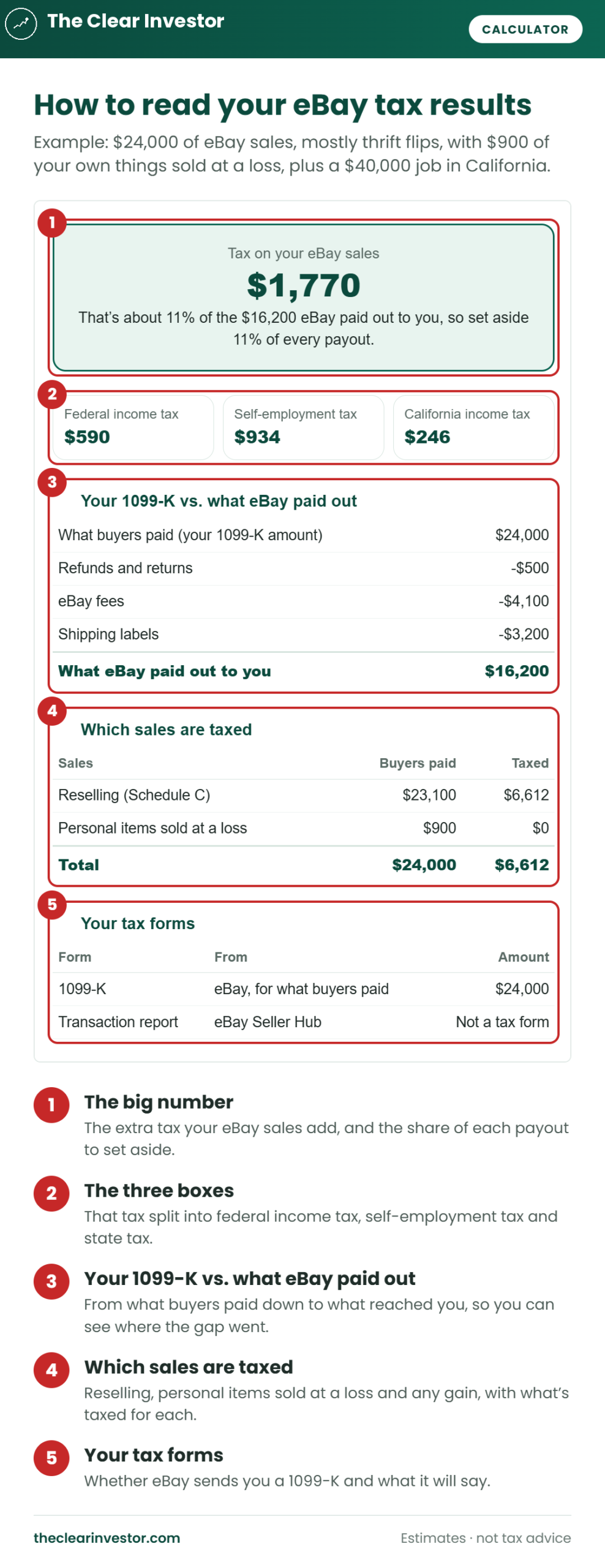
- The big number is the extra tax your eBay sales add, and the line under it says what share of each payout to set aside.
- The three boxes split it into federal income tax, self-employment tax and state tax. Tax on any gain is in the federal box.
- The 1099-K table starts with what buyers paid and ends with what eBay paid out to you, so you can see where the gap went.
- The sales table shows which part of your sales is reselling, which part is personal items sold at a loss, and which part is a gain, with what’s taxed for each.
- Your tax forms show whether eBay sends you a 1099-K and what it will say.
Below them, the notes cover eBay’s fees, the cost of what you sold, personal items, gains, sales tax, quarterly payments and your state. Two more tables show your total tax before and after deductions, and how your taxable income is worked out.
Worked Example 1: $24,000 of eBay Sales From Thrift Flipping in Texas
This is the calculator’s starting example: a single seller in Texas who flips thrift store finds and has no other income. Buyers paid $24,000 across 520 orders, and $900 of that was their own old clothes and phone, which sold for less than they paid. They refunded $500, eBay’s fees came to $4,100 and shipping labels to $3,200. They had $1,500 of unsold stock on January 1, bought $7,800 more and had $1,800 left on December 31. They also spent $350 on shipping supplies, drove 1,200 miles to thrift stores and the post office, half of them before July, and had $240 of other costs.
| Step | Amount |
|---|---|
| Sales (1099-K) | $24,000 |
| Personal items sold at a loss | −$900 |
| Refunds, reselling share | −$481 |
| Cost of what they sold ($1,500 + $7,800 − $1,800) | −$7,500 |
| eBay fees, reselling share | −$3,946 |
| Shipping labels, reselling share | −$3,080 |
| Supplies, mileage and other costs | −$1,481 |
| Reselling profit | $6,612 |
| Federal income tax | $0 |
| Self-employment tax | $934 |
| Tax on their eBay sales | $934 |
Their 1099-K says $24,000, but eBay paid out only $16,200 after refunds, fees and labels. The $934 is about 6% of that, so the calculator says to set aside 6% of every payout. There’s no federal income tax, since their $6,144 of profit after half the self-employment tax is under the $16,100 standard deduction. They get a 1099-K, since buyers paid more than $20,000 across more than 200 transactions. The $900 of personal items on it isn’t taxed, so they report it as personal items sold at a loss and it comes to zero.
Worked Example 2: Clearing Out a Closet in Massachusetts
This single seller has a $52,000 job and isn’t a reseller. They sold $2,400 of their own clothes, shoes and a game console in 35 orders, all for less than they paid. eBay’s fees were $380 and labels $310.
| Massachusetts | Texas | |
|---|---|---|
| Sales | $2,400 | $2,400 |
| eBay fees and labels | −$690 | −$690 |
| Paid out to them | $1,710 | $1,710 |
| 1099-K from eBay | $2,400 | None |
| Tax on their eBay sales | $0 | $0 |
Selling your own things for less than you paid isn’t taxed in either state. The difference is the paperwork. Massachusetts has a $600 line, so eBay sends a 1099-K for $2,400. They report it on Form 8949 with code L, the IRS’s code for a loss that isn’t deductible, so it nets to zero, or at the top of Schedule 1 as “Form 1099-K Personal Item Sold at a Loss” with the same amount subtracted in Part II. In Texas, $2,400 is under eBay’s $20,000 line, so there’s no form and nothing to report.
Worked Example 3: Selling a Coin Collection With a $60,000 Job in California
This single seller has a $60,000 job. They sold a silver coin set they’d bought in 2019 for $3,000, and buyers paid $9,000 for it. They also sold $1,000 of household things for less than they paid. All 25 orders together brought $10,000, with $1,300 of eBay fees and $150 of labels.
| Coins (collectible) | Same gain, not a collectible | |
|---|---|---|
| Sold for | $9,000 | $9,000 |
| Share of eBay’s fees and labels | −$1,305 | −$1,305 |
| What they paid | −$3,000 | −$3,000 |
| Gain | $4,695 | $4,695 |
| Federal income tax | $563 | $0 |
| California income tax | $311 | $311 |
| Tax on their eBay sales | $874 | $311 |
They owned the coins more than a year, so it’s a long-term gain, but coins are collectibles, which are taxed at your regular rate up to 28%. Their regular rate is 12%, so the gain costs $563 in federal tax. If the same gain came from something that isn’t a collectible, it would fall under the $49,450 line for the 0% long-term rate, and the federal tax would be $0. California taxes it as regular income either way. There’s no self-employment tax, since they aren’t in business. eBay doesn’t send a 1099-K for $10,000 in California, but the gain still goes on Form 8949 and Schedule D.
Worked Example 4: A Full-Time Reseller in Illinois With a Spouse’s Job
This couple files jointly, has two kids and $70,000 of W-2 pay. One of them resells on eBay full-time: $85,000 of sales across 2,900 orders, $2,100 of refunds, $14,000 of eBay fees and $9,800 of labels. They started the year with $6,000 of stock, bought $31,000 and had $8,500 left at the end. They spent $1,400 on supplies, drove 5,000 miles for sourcing and shipping (2,400 before July) and had $1,800 of other costs, like a storage unit and listing software.
| Step | Amount |
|---|---|
| Sales (1099-K) | $85,000 |
| Refunds | −$2,100 |
| Cost of what they sold ($6,000 + $31,000 − $8,500) | −$28,500 |
| eBay fees | −$14,000 |
| Shipping labels | −$9,800 |
| Supplies | −$1,400 |
| Mileage (2,400 miles × 72.5¢ + 2,600 miles × 76¢) | −$3,716 |
| Other costs | −$1,800 |
| Reselling profit | $23,684 |
| Federal income tax | $2,113 |
| Self-employment tax | $3,346 |
| Illinois income tax | $1,090 |
| Tax on their eBay sales | $6,549 |
eBay paid out $59,100 after refunds, fees and labels, and the tax is about 11% of that, so the calculator rounds up and says to set aside 12%. The $2,500 that their unsold stock grew by isn’t deductible yet: it comes off when it sells. With about $5,459 of federal tax on their eBay profit, they need quarterly payments or more withholding at the W-2 job.
More Example Results
Here’s the federal tax on a $5,000 gain from selling personal items, for a single seller with only a W-2 job in a state with no income tax:
| W-2 income | Owned over a year, not a collectible | Owned over a year, collectible | Owned a year or less |
|---|---|---|---|
| $30,000 | $0 | $600 | $600 |
| $60,000 | $0 | $600 | $600 |
| $120,000 | $750 | $1,164 | $1,164 |
| $250,000 | $940 | $1,590 | $1,790 |
Most sellers with a normal job pay 0% on a long-term gain that isn’t a collectible, since the 0% rate covers taxable income up to $49,450 for single filers. Collectibles and items owned a year or less are taxed at your regular rate, with collectibles capped at 28%. At $250,000, the 3.8% net investment income tax adds $190 to each column.
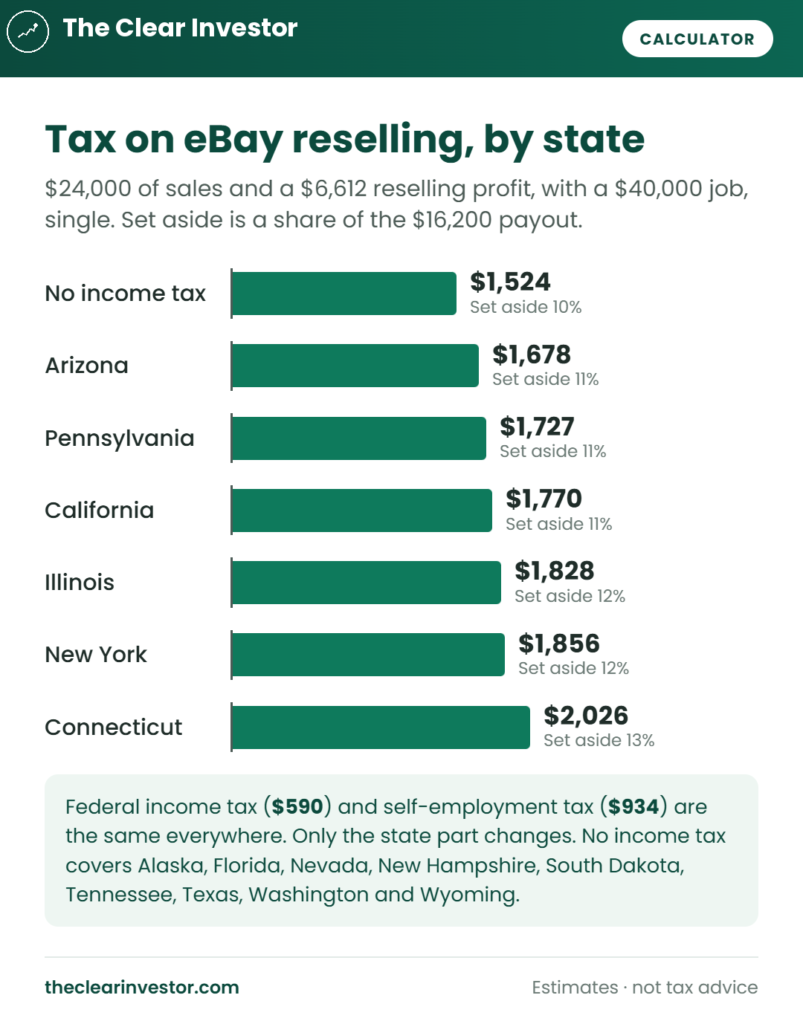
Your state matters too. Add a $40,000 job to the seller in Example 1, and the tax on their eBay sales is $1,524 in states with no income tax, like Florida, Texas and Washington, and up to $2,026 in Connecticut:
How the eBay Tax Calculator Works
- Your sales: what buyers paid for items and shipping, the amount on eBay’s Form 1099-K. eBay’s form doesn’t subtract refunds or fees and leaves out the sales tax it collects.
- Personal items: the IRS says a loss on a personal item can’t be deducted and a gain is taxable. Items sold at a loss aren’t taxed, and items sold at a gain go on Form 8949 and Schedule D.
- Reselling: everything else is business income on Schedule C, with the cost of what you sold worked out in Part III: inventory at the start of the year, plus what you bought, minus inventory at the end.
- eBay’s fees: whatever you enter from your Transaction report. The notes compare it with eBay’s standard rate of 13.6% of each sale plus 30 or 40 cents an order. Fees, refunds and labels are split between reselling and personal items by sales.
- Mileage: 72.5 cents a mile for business miles through June 2026 and 76 cents from July, the IRS standard mileage rates.
- Self-employment tax: 15.3% on 92.35% of your reselling profit once that’s $400 or more, per the IRS. Gains on personal items don’t count.
- Income tax: the 2026 brackets and $16,100 standard deduction and the qualified business income deduction. Long-term gains use the 2026 0%, 15% and 20% rates, collectibles are capped at 28% (IRS Topic 409), and the 3.8% net investment income tax applies at high incomes.
- Your eBay tax: your total tax minus your tax without eBay, so your job’s bracket counts.
- The set-aside: that tax divided by what eBay paid out after refunds, fees and labels.
- The 1099-K: more than $20,000 and more than 200 transactions, or the lower line in the states eBay lists: $600 in DC, Maryland, Massachusetts, Montana and Virginia, $1,000 in New Jersey, $1,000 and 4 transactions in Illinois, $2,000 in Vermont and $2,500 in Arkansas.
What the Calculator Leaves Out
- Selling as a hobby, which is reported differently from a business.
- Depreciation on equipment, the home office deduction, and health insurance and retirement deductions.
- Sales on other sites, unless you add their profit as other self-employment income.
- State breaks for long-term gains, which a few states give.
- City and county income taxes, the earned income tax credit and itemized deductions.
Tips for Accurate Results
- Use eBay’s reports, not your bank deposits. Payouts come after refunds, fees and labels, so they hide all three.
- Leave sales tax out of your sales. eBay collects it for the states, and it isn’t on your 1099-K.
- Count your inventory on December 31. Unsold stock comes off next year, when it sells.
- Keep personal items separate. Your old things sold at a loss aren’t taxed, but only if you can show what you paid.
- Split your miles at June, and only count trips for buying, shipping and other business errands.
What to Do With Your Result
- Move your set-aside percentage to a savings account each time eBay pays you out.
- Make quarterly payments if you’ll owe $1,000 or more in federal tax.
- Check the Taxes page in Seller Hub by Jan. 31 for your 1099-K, and match it to your Transaction report.
- Keep receipts for what you paid for inventory and for any personal item you sold.
- Fix your tax info if eBay starts backup withholding, and claim what it withheld on your return.
eBay Tax Calculator FAQ
Where do I find my eBay sales and fees?
In Seller Hub. The Transaction report lists every sale, refund and fee, and your 1099-K is on the Taxes page by January 31.
Do I pay tax on things I sold for less than I paid?
No. A loss on a personal item isn’t taxed or deductible. If it’s on a 1099-K, report it so it nets to zero, on Form 8949 with code L or at the top of Schedule 1.
Why is my 1099-K higher than what eBay paid me?
It shows what buyers paid for items and shipping, before refunds, eBay’s fees and shipping labels. You report the full amount and deduct those.
Is sales tax part of my eBay income?
No. eBay collects it from buyers and sends it to the states, and it isn’t on your 1099-K.
How do I count inventory I haven’t sold?
Only the cost of what you sold comes off this year. Enter your unsold stock on January 1 and December 31, and the calculator works out the cost of what you sold.
Are collectibles taxed differently?
Yes. A long-term gain on coins, stamps, art, antiques, gems or precious metals is taxed at your regular rate, up to 28%, instead of 0%, 15% or 20%.
Does it include state tax?
Yes. Pick your state to add its income tax. It covers all 50 states and DC.
Is my information saved?
No. Everything is worked out in your browser, and nothing is sent or stored.
What tax year does the eBay tax calculator use?
2026: the 2026 brackets, standard deduction, capital gains rates, mileage rates and 1099-K lines. I update it every year.
Estimates for educational purposes only. I’m not a licensed financial advisor or tax professional, and this isn’t tax advice. Not affiliated with eBay.