
This Airbnb tax calculator shows how much tax you’ll owe on your Airbnb income in 2026 and how much of each payout to set aside. It follows the IRS rules for short-term rentals: the 14-day rule, the split between rental and personal use, depreciation on the building, and the limits on using a rental loss to lower your other tax. Want to know how Airbnb income is taxed first? Read my Airbnb tax guide.
I built it around the numbers Airbnb gives you. Your Earnings dashboard and your 1099-K show gross earnings: what guests paid for nights and cleaning fees, before Airbnb’s service fee. The calculator takes out the fee and your hosting costs, works out how much of your mortgage interest, utilities and depreciation count as rental, and only taxes what’s left.
Airbnb Tax Calculator
See how much tax you’ll owe on your Airbnb income in 2026: after Airbnb’s fee, your hosting costs and depreciation, with the 14-day rule, the rental share when you use the place yourself, short-term rental loss rules and how much of each payout to set aside.
Your 2026 Airbnb earnings
How you rent the place
Your hosting costs
Costs only for guests (they count in full)
Costs for the whole place (the rental share counts)
Depreciation (the building wears out on paper)
Your other income
Tax you’ve already paid
About you
Your 1099-K vs. what Airbnb paid out
How the IRS sees your rental
Your tax forms
| Form | From | Amount |
|---|
Your total 2026 tax: before vs. after deductions
| Before deductions | After deductions |
|---|
How your taxable income is worked out
How this is calculated
- Rental income = your gross earnings (what guests paid for nights and cleaning fees, the 1099-K amount) minus refunds and adjustments. Occupancy taxes Airbnb collects and pays for you aren’t your income and aren’t on the 1099-K.
- 14-day rule: if the place is your home (you used it more than 14 days, and more than 10% of the nights it was rented) and you rented it fewer than 15 nights, the rent isn’t taxed and the costs aren’t deductible.
- Costs: Airbnb’s fee, occupancy taxes you paid yourself, co-host payouts, cleaning, guest supplies, other hosting costs and mileage (72.5¢ a mile January through June, 76¢ from July) count in full. Mortgage interest, property taxes, insurance, utilities, repairs, furniture and rent count by the rental share: nights rented ÷ (nights rented + days you used it), times the share of your home guests use. A room only guests use counts its full share all year.
- Depreciation = what you paid for the building ÷ 39 years when the average stay is under 30 days, or ÷ 27.5 years when it’s 30 days or more, times the rental share. In the first year it counts from the middle of the month you started renting.
- A place you also use as your home can’t show a loss from shared costs and depreciation: they’re only deductible up to the rental income left after the costs only for guests, and the rest carries forward to 2027.
- Losses: with an average stay of 7 nights or less, or hotel-style services, a loss only lowers your other tax if you put in more than 100 hours and at least as much as anyone else (or more than 500 hours). Otherwise it carries forward. With longer stays, up to $25,000 of loss can lower your other tax, reduced by half of your income over $100,000 and gone at $150,000 ($0 if married filing separately).
- Schedule E or C: rental income goes on Schedule E with no self-employment tax. With hotel-style services it’s a business on Schedule C, and self-employment tax is 15.3% (12.4% Social Security and 2.9% Medicare) on 92.35% of the profit, once that comes to $400 or more. Social Security tax stops at $184,500 of combined W-2 pay and self-employment earnings, and an extra 0.9% Medicare tax applies above $200,000 ($250,000 married filing jointly, $125,000 separately).
- Federal income tax uses the 2026 brackets and standard deduction ($16,100 single or married filing separately, $32,200 married filing jointly, $24,150 head of household). Married filing separately uses the single brackets, except that the 37% rate starts at $384,350. The qualified business income deduction is 20% of the profit (Schedule C, or Schedule E when you choose the 250-hour safe harbor), capped at 20% of taxable income. Above $201,750 of taxable income ($403,500 jointly) it’s limited to 2.5% of what you paid for the building and furniture, phased in over the next $75,000 ($150,000 jointly).
- Net investment income tax: 3.8% on rental profit once your income is over $200,000 ($250,000 jointly, $125,000 separately), unless the rental is a business you put the hours into.
- Child tax credit is $2,200 per child under 17. Up to $1,700 per child can be paid to you as a refund, based on 15% of your earned income over $2,500. Rental income on Schedule E doesn’t count as earned income.
- State income tax uses 2026 rates, brackets, standard deductions and exemptions from the Tax Foundation, updated for the 2026 cuts in Arkansas, Georgia, South Carolina, Utah and West Virginia, and for the higher 2026 standard deductions in Arizona and Maine. A few states (like California) hadn’t published 2026 bracket amounts, so their 2025 amounts are used. Head of household and married filing separately use single brackets. It’s the state you live in.
- Tax on your Airbnb income = your total tax minus what your total tax would be without Airbnb. The set-aside percentage is that tax divided by what Airbnb paid out.
- Tax forms: Airbnb sends a Form 1099-K when guests pay more than $20,000 across more than 200 reservations, or at lower lines in some states: $600 in DC, Maryland, Massachusetts, Montana and Virginia, $1,000 in New Jersey, $1,000 and 4 transactions in Illinois, $2,000 in Vermont and $2,500 in Arkansas.
- Before deductions leaves out every hosting cost, Airbnb’s fee, depreciation, the standard deduction, the qualified business income deduction, and state deductions and exemptions, so you can see how much they save you.
Not included: losses carried in from earlier years, other rentals or passive income, real estate professional status, itemized deductions (like the personal share of mortgage interest and property taxes), the tax when you sell (including depreciation recapture), city and county income taxes, taxes in a different state where the rental sits, the earned income tax credit, and tax withheld from a W-2 job. Your real tax can be lower.
Free tax tracker + deadline reminders
Get my free side income tax tracker
Sign up and I’ll send you my Google Sheets tracker that shows how much of each payout to set aside. You’ll also get an email before each quarterly tax deadline (Jan 15, Apr 15, Jun 15 and Sep 15), plus my new guides. Unsubscribe anytime.
Earn on several platforms or drive for work? Get the full 1099 Side Income Tracker ($12) →
Table of Contents
How to Use the Airbnb Tax Calculator
- Open your Earnings dashboard on Airbnb. It shows gross earnings, Airbnb’s service fee and your payouts for any date range. Your 1099-K, if you get one, is under Taxes in your account settings by January 31.
- Copy your earnings: gross earnings, reservations, nights booked and Airbnb’s fee, plus any refunds, occupancy taxes you paid yourself and payouts to a co-host.
- Say how you rent the place: the whole place or a room, the days you or family used it, what you provide during stays and roughly how many hours you put in.
- Add your hosting costs. Costs only for guests come first. Then the costs for the whole place, from your mortgage statement (Form 1098), tax bill and utility bills, and what you paid for the building, without the land.
- Add your other income, tax already paid and your state. A W-2 job raises your tax bracket, and your state adds its own tax.
Who This Calculator Is For
- Hosts who rent a whole place, like a vacation home, cabin or condo, part of the year or all year.
- Hosts who rent a room in the home they live in.
- Hosts who use the place themselves part of the year, to see how personal days change the tax.
- Hosts with a day job, to see how much more tax Airbnb adds and whether a rental loss can lower the tax on their pay.
- Hosts who offer hotel-style services, like daily cleaning or meals, which makes it self-employment income.
If you list the same place on another site too, add those bookings and fees to the same boxes. The IRS rules apply to the place, not the site.
How to Read Your Results
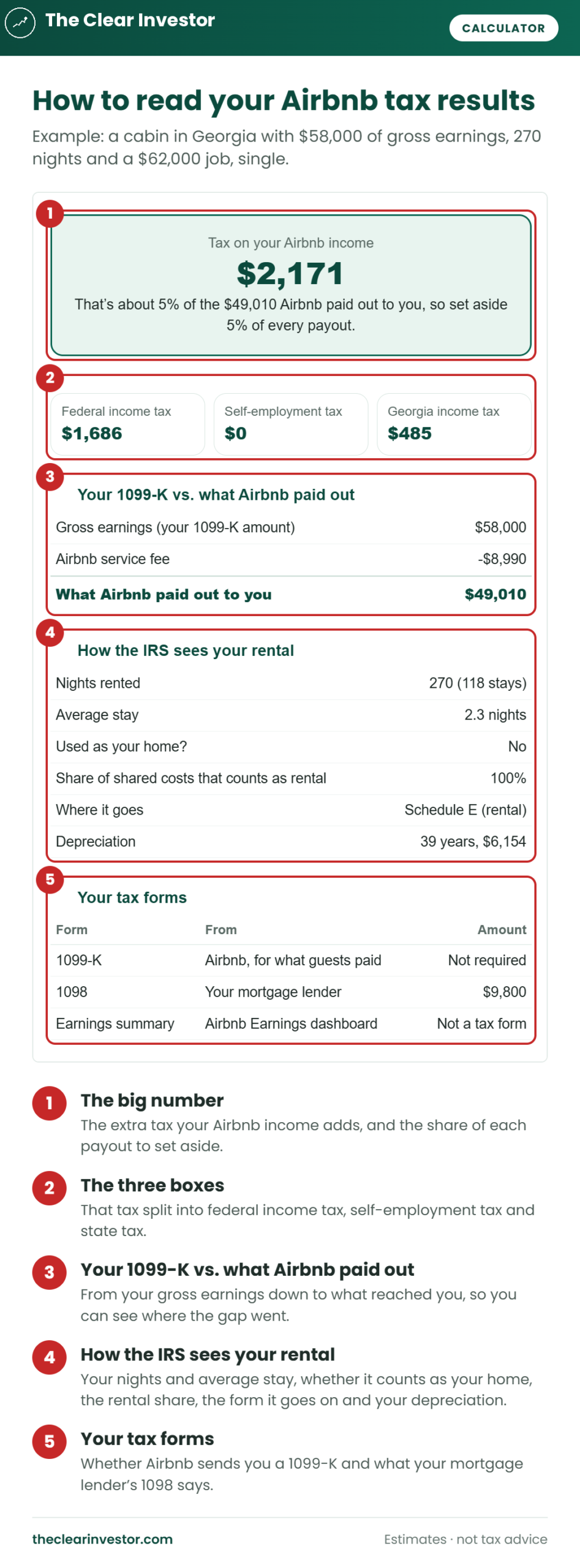
- The big number is the extra tax your Airbnb income adds, and the line under it says what share of each payout to set aside.
- The three boxes split it into federal income tax, self-employment tax and state tax. Self-employment tax only applies with hotel-style services.
- The 1099-K table starts with your gross earnings and ends with what Airbnb paid out to you.
- How the IRS sees your rental shows your nights and average stay, whether the place counts as your home, how much of your shared costs count as rental, where it goes on your return, your depreciation and anything carried forward to 2027.
- Your tax forms show whether Airbnb sends you a 1099-K and what your mortgage lender’s Form 1098 says.
Below them, the notes cover Airbnb’s fee, depreciation, a rental loss, occupancy taxes, quarterly payments and your state. Two more tables show your total tax before and after deductions, and how your taxable income is worked out.
Worked Example 1: A Georgia Cabin With $58,000 of Airbnb Earnings
This is the calculator’s starting example: a single host in Georgia with a $62,000 job who rents a cabin on Airbnb all year and never stays there. Guests paid $58,000 across 118 stays and 270 nights, and Airbnb’s 15.5% fee came to $8,990. The host paid cleaners $7,800, spent $1,600 on guest supplies and $900 on pricing software and a short-term rental permit, and drove 600 miles to check on the place. The cabin cost $9,800 in mortgage interest, $2,100 in property taxes, $2,600 for insurance, $4,300 for utilities and Wi-Fi and $2,400 for repairs, plus $1,200 for a new sofa. The building cost $240,000, not counting the land.
| Step | Amount |
|---|---|
| Gross earnings (what guests paid) | $58,000 |
| Airbnb service fee | −$8,990 |
| Cleaning and laundry | −$7,800 |
| Guest supplies and other hosting costs | −$2,500 |
| Mileage (320 miles × 72.5¢ + 280 miles × 76¢) | −$445 |
| Mortgage interest, taxes, insurance, utilities, repairs and furniture | −$22,400 |
| Depreciation ($240,000 ÷ 39 years) | −$6,154 |
| Rental profit | $9,711 |
| Federal income tax | $1,686 |
| Georgia income tax | $485 |
| Tax on their Airbnb income | $2,171 |
Airbnb paid out $49,010 after its fee, and the $2,171 is about 4.4% of that, so the calculator says to set aside 5% of every payout. Their job uses most of the 12% bracket, so $4,500 of the profit is taxed at 12% and the rest at 22%. There’s no self-employment tax: cleaning between stays and supplies are normal for a rental, so the cabin goes on Schedule E. Their stays averaged 2.3 nights, so the building is depreciated over 39 years, the period for short-stay lodging, instead of 27.5. They don’t get a 1099-K, since 118 reservations is fewer than the 200 needed, but they still report every dollar.
Worked Example 2: A Colorado Vacation Home, 30 Days vs. 14 Days of Personal Use
This married couple has $150,000 of W-2 pay and a mountain home in Colorado. Guests paid $36,000 for 160 nights across 45 stays, and Airbnb’s fee was $5,580. They paid $5,400 for cleaning, $900 for supplies and $600 for other hosting costs, and drove 960 miles to it. The home’s yearly costs are $16,000 of mortgage interest, $3,200 of property taxes, $2,200 for insurance, $3,600 for utilities and $7,200 for repairs and HOA dues, and the building cost $420,000. What changes the tax is how many days they stay there themselves.
| 30 days | 14 days, under 100 hours | 14 days, over 100 hours | |
|---|---|---|---|
| Counts as their home? | Yes | No | No |
| Share of shared costs that counts as rental | 84.2% | 92% | 92% |
| Rental profit or loss | $0 | −$16,705 | −$16,705 |
| What happens to the rest | $13,377 carried forward | Loss carried forward | Lowers their other tax |
| Tax change from Airbnb | $0 | $0 | −$4,410 |
At 30 days, they used it for more than 14 days and more than 10% of the 160 nights it was rented, so the IRS counts it as their home. Shared costs and depreciation count only for 160 of the 190 days it was used, and they can bring the rental income down to zero but not below. The $13,377 left over carries forward to 2027.
At 14 days, it isn’t their home, and the costs make a $16,705 loss. With an average stay of 3.6 nights, the IRS doesn’t treat it as a regular rental, so the loss only lowers their other tax if they put in more than 100 hours and at least as much time as anyone else, including their cleaner. If they do, it saves $3,675 in federal tax and $735 in Colorado tax. If not, the loss waits for future rental profit or for the year they sell.
Worked Example 3: Renting a Spare Room in California
This single host has an $85,000 job and rents a guest room that takes up 15% of their home. Guests paid $21,000 for 228 nights across 92 stays, and Airbnb’s fee was $3,255. They spent $600 on laundry, $1,100 on guest supplies and $350 on other hosting costs. The whole home costs $24,000 in mortgage interest, $9,000 in property taxes, $2,400 for insurance, $4,800 for utilities and $2,000 for repairs, and the building cost $560,000.
| Step | Amount |
|---|---|
| Gross earnings | $21,000 |
| Airbnb service fee | −$3,255 |
| Laundry, guest supplies and other hosting costs | −$2,050 |
| 15% of the home’s $42,200 of yearly costs | −$6,330 |
| Depreciation (15% of $560,000 ÷ 39 years) | −$2,154 |
| Rental profit | $7,211 |
| Federal income tax | $1,586 |
| California income tax | $671 |
| Tax on their Airbnb income | $2,257 |
Only paying guests use the room, so the IRS doesn’t count it as part of their home. That means 15% of the home’s costs count as rental for the whole year, and there’s no limit tied to living there. The other 85% of the mortgage interest and property taxes only helps if they itemize. The $2,257 is about 13% of the $17,745 Airbnb paid out, since their job puts the profit in the 22% bracket and California adds about 9.3%.
Worked Example 4: A Texas Condo That Lost Money in Its First Year
This married couple has $240,000 of W-2 pay. They bought a condo in Texas, furnished it for $14,000 and had it ready for guests in March 2026. Guests paid $34,000 for 220 nights across 80 stays, and Airbnb’s fee was $5,270. They paid $6,400 for cleaning, $1,800 for supplies and $1,500 for a permit, a smart lock and listing photos, and drove 500 miles. From March through December, the condo cost $19,000 in mortgage interest, $6,500 in property taxes, $5,200 for insurance, $3,800 for utilities and $1,200 for repairs and HOA dues, and the building cost $360,000.
| Step | Amount |
|---|---|
| Gross earnings | $34,000 |
| Airbnb’s fee, cleaning, supplies, other costs and mileage | −$15,343 |
| Mortgage interest, taxes, insurance, utilities and repairs | −$35,700 |
| Furniture, deducted in full | −$14,000 |
| Depreciation (from the middle of March) | −$7,308 |
| Rental loss | −$38,351 |
| Tax change if they put in under 100 hours | $0 |
| Tax change if they put in over 100 hours | −$8,437 |
Their stays averaged 2.75 nights, so the $25,000 allowance for regular rentals doesn’t apply, and at their income it would be gone anyway. If they put in more than 100 hours and at least as much as anyone else, the $38,351 loss lowers the tax on their pay by $8,437 at their 22% rate. That’s the rule people call the short-term rental loophole. If they put in less, or a manager puts in more time than they do, the loss carries forward instead. Either way, they’ll want a log of their hours, since the IRS can ask for one.
More Example Results
Here’s the federal tax on Airbnb rental profit for a single host in Texas, which has no state income tax:
| Rental profit | No other income | $60,000 job | $120,000 job | $60,000 job, hotel-style services |
|---|---|---|---|---|
| $5,000 | $0 | $600 | $1,164 | $1,153 |
| $10,000 | $0 | $1,550 | $2,364 | $2,399 |
| $20,000 | $390 | $3,750 | $4,764 | $5,447 |
| $40,000 | $2,620 | $8,150 | $9,564 | $11,544 |
Most hosts pay only income tax on their profit, so with no other income, the $16,100 standard deduction covers the first part of it. A job puts the profit in the 12%, 22% or 24% bracket. Hotel-style services make it a business on Schedule C, which adds 15.3% self-employment tax on 92.35% of the profit, partly offset by the 20% qualified business income deduction.
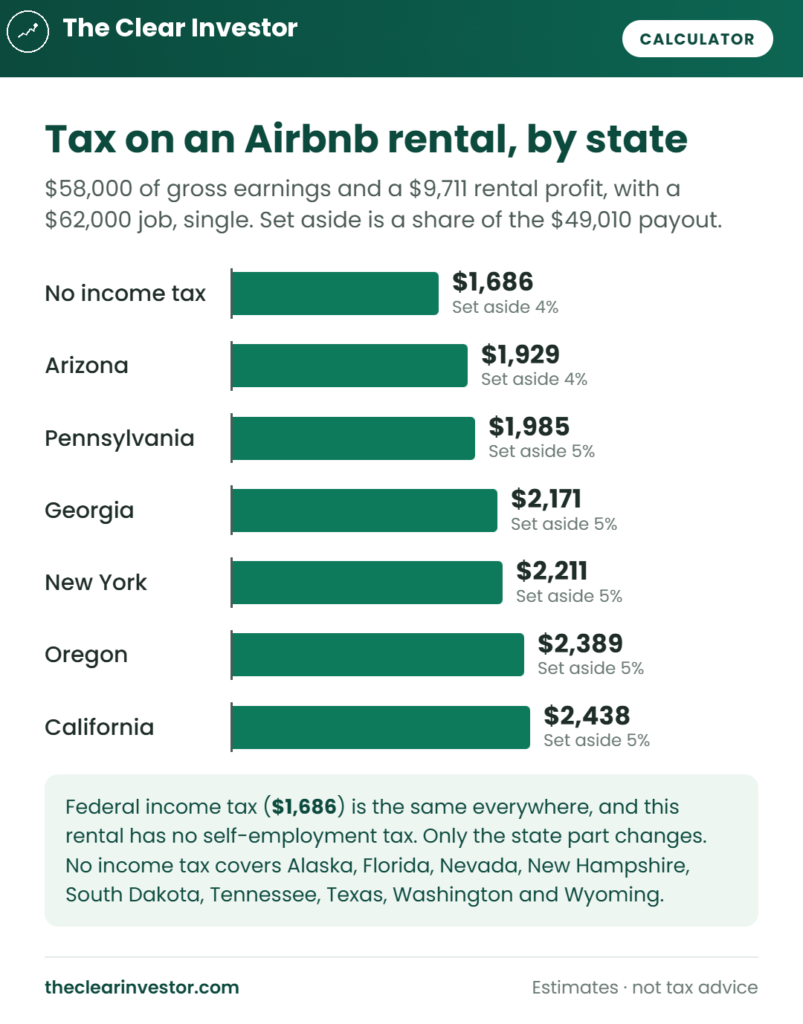
Your state matters too. The tax on the Georgia cabin in Example 1 would be $1,686 in states with no income tax, like Florida, Texas and Washington, and up to $2,438 in California:
How the Airbnb Tax Calculator Works
- Your earnings: gross earnings, the amount on Airbnb’s Form 1099-K. It’s what guests paid for nights and cleaning fees, before Airbnb’s fee, and it leaves out occupancy taxes Airbnb collects and pays. Refunds, occupancy taxes you paid yourself and co-host payouts come off.
- Airbnb’s fee: whatever you enter from your Earnings dashboard. The notes compare it with Airbnb’s single host fee of 15.5%.
- The 14-day rule: under IRS Topic 415, a place counts as your home when your personal days are more than 14, or more than 10% of the days it’s rented if that’s higher. If it’s your home and you rent it fewer than 15 days, the rent isn’t taxed and the costs aren’t deductible.
- The rental share: costs for the whole place count by nights rented ÷ (nights rented + days you used it), times the share of your home guests use, per IRS Publication 527. A room only paying guests use counts its full share all year.
- The home limit: when it’s your home, shared costs and depreciation can only bring your rental income down to zero. The rest carries forward to 2027.
- Depreciation: what you paid for the building, without the land, over 39 years when guests stay under 30 days on average and 27.5 years when they stay 30 days or more, as TurboTax explains, from the middle of the month you started renting. Furniture comes off in full, under the IRS $2,500 de minimis rule or 100% bonus depreciation.
- Schedule E or C: rentals go on Schedule E with no self-employment tax. Substantial services for guests, like regular cleaning during a stay or changing linens, make it a business on Schedule C with 15.3% self-employment tax on 92.35% of the profit.
- A rental loss: under IRS Publication 925, an average stay of 7 nights or less isn’t a regular rental, so a loss only lowers your other tax if you put in more than 100 hours and at least as much as anyone else, or more than 500 hours. With longer stays, up to $25,000 of loss counts, cut by half of your income over $100,000.
- Income tax: the 2026 brackets and $16,100 standard deduction. The 20% qualified business income deduction applies to Schedule C, or to Schedule E when you meet the IRS 250-hour safe harbor, and the 3.8% net investment income tax applies to rental profit at high incomes.
- Mileage: 72.5 cents a mile through June 2026 and 76 cents from July, the IRS standard mileage rates.
- Your Airbnb tax: your total tax minus your tax without Airbnb, so your job’s bracket counts.
- The set-aside: that tax divided by what Airbnb paid out after its fee.
- The 1099-K: more than $20,000 and more than 200 reservations, or the lower line in the states Airbnb lists: $600 in DC, Maryland, Massachusetts, Montana and Virginia, $1,000 in New Jersey, $1,000 and 4 transactions in Illinois, $2,000 in Vermont and $2,500 in Arkansas.
What the Calculator Leaves Out
- Itemized deductions, like the personal share of your mortgage interest and property taxes.
- Depreciation you started in an earlier year with a different period, improvements like a new roof, and cost segregation studies.
- Selling the place, when the depreciation you took is taxed at up to 25%.
- Other rentals, losses carried in from earlier years and real estate professional status.
- Renting to family at less than a fair price, and Airbnb Experiences or Services income.
- A rental in a different state from where you live, city and county income taxes, local occupancy tax filings and the earned income tax credit.
Tips for Accurate Results
- Use gross earnings, not your payouts. Payouts come after Airbnb’s fee and co-host splits, so they hide both.
- Count nights booked, not nights listed. A night the place sat open with no booking isn’t a rental night.
- Count every personal day, including family, friends and anyone who paid less than a fair price. Days you spent working full time on repairs don’t count.
- Take out the land. Your county’s property tax assessment shows how much of the value is land, which isn’t depreciated.
- Keep a log of your hours if you’re anywhere near 100. It decides whether a loss can lower your other tax.
What to Do With Your Result
- Move your set-aside percentage to a savings account each time Airbnb pays you out.
- Make quarterly payments if you’ll owe $1,000 or more in federal tax, or raise the withholding at your job.
- Check under Taxes in your account settings by Jan. 31 for a 1099-K or 1099-MISC, and match it to your Earnings dashboard.
- Keep your receipts, your Form 1098 and a log of personal days and hours.
- Check who handles occupancy tax where your place is. Airbnb collects it in many areas, and you file it yourself everywhere else.
Airbnb Tax Calculator FAQ
Where do I find my Airbnb earnings and fees?
In your Earnings dashboard on Airbnb. It shows gross earnings, Airbnb’s service fee and payouts for any date range, and you can download your transaction history. Your 1099-K is under Taxes in your account settings by January 31.
Do I pay tax if I rent my home for fewer than 15 nights?
No. If the place is your home and you rent it fewer than 15 nights in the year, the rent isn’t taxed and you don’t deduct any rental costs.
Is Airbnb income self-employment income?
Usually not. Most hosts report it on Schedule E with no self-employment tax. Hotel-style services, like daily cleaning or meals, make it a business on Schedule C with 15.3% self-employment tax.
Why is my 1099-K more than Airbnb paid me?
It shows what guests paid for nights and cleaning fees, before Airbnb’s service fee and any co-host payouts. You report the full amount and deduct the fee.
Can I deduct my mortgage?
You can deduct the rental share of your mortgage interest, not the principal. The building itself comes off through depreciation over 39 or 27.5 years.
Can an Airbnb loss lower my other taxes?
With an average stay of 7 nights or less, only if you put in more than 100 hours and at least as much as anyone else, or more than 500 hours. With longer stays, up to $25,000 can, if your income is under $150,000.
Does it include state tax?
Yes. Pick your state to add its income tax. It covers all 50 states and DC.
Is my information saved?
No. Everything is worked out in your browser, and nothing is sent or stored.
What tax year does the Airbnb tax calculator use?
2026: the 2026 brackets, standard deduction, mileage rates, depreciation rules and 1099-K lines. I update it every year.
Estimates for educational purposes only. I’m not a licensed financial advisor or tax professional, and this isn’t tax advice. Not affiliated with Airbnb.