
This Lyft tax calculator shows how much tax you’ll owe on your Lyft earnings in 2026 and how much of each deposit to set aside. You fill it in from your Lyft Annual Summary, and it takes off Lyft’s fees, your miles or your Express Drive rental, and your other driving costs. Want to know how Lyft money is taxed first? Read my Lyft tax guide.
I built it around the way Lyft reports your pay. Your 1099-K shows what riders paid, which is a lot more than what reached your bank, so the calculator lines the two up for you. If you rent from Express Drive, it compares the mileage rate with your rental fees and gas and uses whichever saves more, since the IRS lets you take one or the other, not both.
Lyft Tax Calculator
See how much tax you’ll owe on your Lyft earnings in 2026, straight from your Lyft Annual Summary: after Lyft’s fees, your miles or your Express Drive rental, and how much of each deposit to set aside.
Earnings on your 2026 Lyft Annual Summary
Expenses on your Annual Summary
Your car
Your other driving costs
Your other income
Tax you’ve already paid
About you
Your 1099-K vs. what reached your bank
Express Drive: mileage rate or rental costs?
| Standard mileage | Rental fees and gas |
|---|
Your tax forms
| Form | From | Amount |
|---|
Your total 2026 tax: before vs. after deductions
| Before deductions | After deductions |
|---|
How your taxable income is worked out
How this is calculated
- Lyft income = ride payments from your Annual Summary (the 1099-K amount, which includes tips, tolls, cancellation fees, Lyft’s fees and third-party fees) + non-ride earnings like bonuses, Streaks and referrals. That’s what Lyft reports to the IRS, so your return matches its forms.
- Lyft’s fees = the platform and service fees and the third-party fees and taxes in the Expenses section of your Annual Summary. Tolls and Express Pay fees from the same section count too. They all come off your income as business costs.
- Mileage = online miles from January through June × 72.5¢ + online miles from July through December × 76¢, the 2026 IRS standard mileage rates (the IRS raised the rate on July 1, 2026). The rates cover gas, insurance, repairs and wear, so those aren’t added on top. Tolls are.
- Express Drive: you can use the mileage rate, or your rental fees and gas times your business share (online miles divided by all the miles on the rental). The IRS doesn’t let you deduct both lease costs and the mileage rate, and if you use the rate for a leased car you keep it for the whole lease. With “whichever saves more”, the calculator picks the bigger deduction.
- Lyft profit = your income minus Lyft’s fees, your car deduction and your other driving costs. It’s self-employment income, reported on Schedule C.
- Self-employment tax is 15.3% (12.4% Social Security and 2.9% Medicare) on 92.35% of your self-employment profit. You only owe it when that comes to $400 or more, which means about $433 of profit. Social Security tax stops at $184,500 of combined W-2 pay and self-employment earnings, and an extra 0.9% Medicare tax applies above $200,000 ($250,000 married filing jointly, $125,000 separately). Half of the 15.3% is deductible.
- Federal income tax uses the 2026 brackets and standard deduction ($16,100 single or married filing separately, $32,200 married filing jointly, $24,150 head of household). Married filing separately uses the single brackets, except that the 37% rate starts at $384,350. It also includes the qualified business income deduction: 20% of your self-employment profit after the self-employment tax deduction, and at least $400 when that’s $1,000 or more.
- Tips deduction: rideshare drivers are on the IRS’s list of tipped occupations, so tips riders add in the app can count as qualified tips. The deduction is up to $25,000, no more than your Lyft profit, and shrinks by $100 for every $1,000 of income over $150,000 ($300,000 married filing jointly). Married couples only get it on a joint return. It lowers federal income tax only, not self-employment tax, and runs from 2025 through 2028. For 2026, the tips have to be reported to you on a 1099, so by default the calculator only counts them when Lyft sends you a 1099-K.
- Child tax credit is $2,200 per child under 17. Up to $1,700 per child can come back as a refund, based on 15% of your earned income over $2,500.
- State income tax uses 2026 rates, brackets, standard deductions and exemptions from the Tax Foundation, updated for the 2026 cuts in Arkansas, Georgia, South Carolina, Utah and West Virginia, and for the higher 2026 standard deductions in Arizona and Maine. A few states (like California) hadn’t published 2026 bracket amounts, so their 2025 amounts are used. Head of household and married filing separately use single brackets. Each state decides whether to follow the tips deduction. Arizona and Michigan do for 2026, so it comes off their state tax, and the calculator leaves it out for other states.
- Tax on your Lyft income = your total tax minus what your total tax would be without Lyft. The set-aside percentage is that tax divided by what reached your bank: your Lyft income minus Lyft’s fees, Express Pay fees and, for Express Drive, the rental fees taken from your pay.
- Tax forms: Lyft sends a Form 1099-K once ride payments reach $20,000 and you give 200 rides, or at lower lines in the states on its help page: $600 in California, Maryland, Massachusetts, Vermont and Virginia, and $1,000 in Illinois and New Jersey. Bonuses and referrals come on a 1099-NEC, and the IRS line for 2026 payments is $2,000.
- Before deductions leaves out Lyft’s fees, your car deduction, your other driving costs, the standard deduction, the qualified business income deduction, the tips deduction, and state deductions and exemptions, so you can see how much they save you.
Not included: the actual-expense method for a car you own (depreciation, repairs and insurance), car loan interest, the inclusion amount for long leases of expensive cars, Hawaii’s general excise tax (shown as a note), the home office deduction, the earned income tax credit, city and county income taxes (like New York City or Maryland counties), state low-income credits, itemized deductions, retirement or health insurance deductions, and tax withheld from a W-2 job. Your real tax can be lower.
Free tax tracker + deadline reminders
Get my free side income tax tracker
Sign up and I’ll send you my Google Sheets tracker that shows how much of each payout to set aside. You’ll also get an email before each quarterly tax deadline (Jan 15, Apr 15, Jun 15 and Sep 15), plus my new guides. Unsubscribe anytime.
Earn on several platforms or drive for work? Get the full 1099 Side Income Tracker ($12) →
Table of Contents
How to Use the Lyft Tax Calculator
- Open your Annual Summary. It’s in the Tax Center tab of your Lyft Driver Dashboard. Before the year ends, add up your weekly summaries so far.
- Copy the earnings: ride payments, rides given, tips and non-ride earnings like bonuses and Streaks.
- Copy the expenses: Lyft’s platform and service fees, third-party fees and taxes, tolls and Express Pay fees.
- Pick how you drive. Split your online miles at June: 72.5 cents a mile through June and 76 cents from July. If you rent from Express Drive, also add your rental fees, your gas and all the miles on the rental.
- Add your phone, supplies, other income, tax already paid and your state. A W-2 job raises your tax bracket, and your state adds its own tax.
Who This Calculator Is For
- Lyft drivers with their own car, full-time or part-time, whether it’s owned, financed or leased.
- Express Drive renters who want to know whether the mileage rate or the rental costs save more.
- Drivers whose 1099-K looks too high next to their deposits.
- Drivers with a day job, to see how much more tax Lyft adds.
- Drivers in California, Illinois, Maryland, Massachusetts, New Jersey, Vermont and Virginia, where Lyft sends a 1099-K at a much lower line, which decides whether the tips deduction counts.
If you also drive for Uber, enter your Uber profit as other self-employment income here, so your tax bracket counts both. My Uber tax calculator can work out that profit. Delivering too? Try my DoorDash tax calculator or Amazon Flex tax calculator.
How to Read Your Results
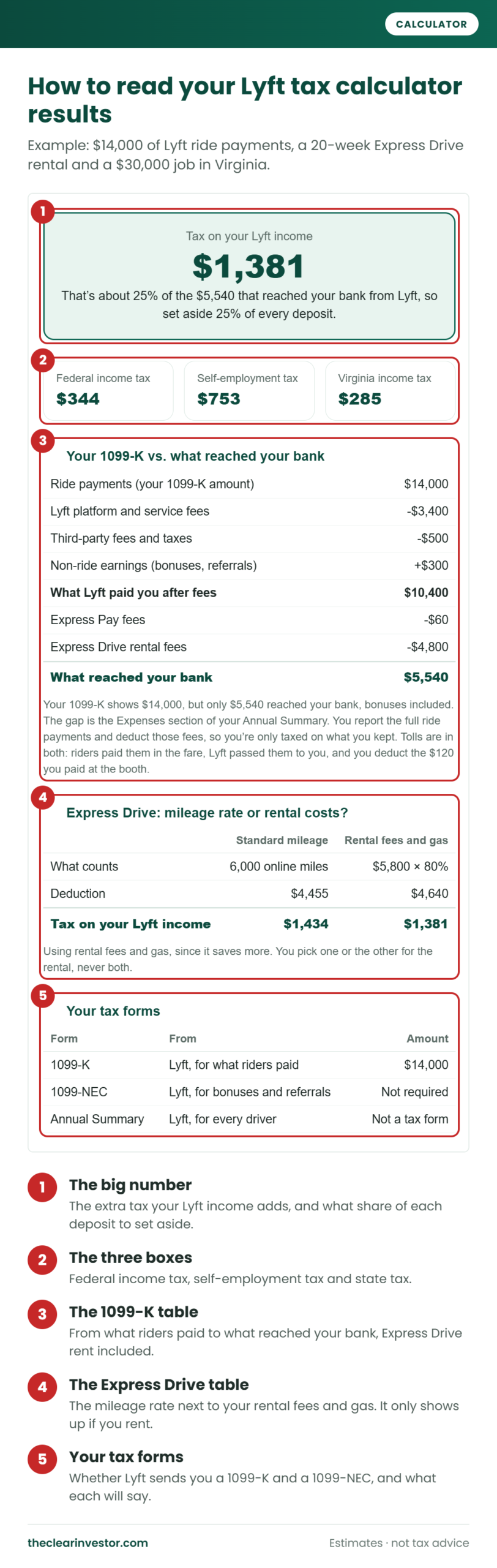
- The big number is the extra tax your Lyft income adds, and the line under it says what share of each deposit to set aside.
- The three boxes split it into federal income tax, self-employment tax and state tax.
- The 1099-K table starts with what riders paid and ends with what reached your bank, so you can see where the gap went.
- The Express Drive table shows up if you rent, and compares the mileage rate with your rental fees and gas.
- Your tax forms show whether Lyft sends you a 1099-K and a 1099-NEC, and what each will say.
Below them, the notes cover Lyft’s fees, the tips deduction, your car, quarterly payments and your state. Two more tables show your total tax before and after deductions, and how your taxable income is worked out.
Worked Example 1: $28,000 of Lyft Rides in Florida
This is the calculator’s starting example: a single driver in Florida with their own car and no other income. Their Annual Summary shows $28,000 of ride payments from 1,400 rides, $2,100 of it tips, plus $900 of bonuses. Lyft kept $6,700 in platform and service fees, and $1,000 went to third-party fees and taxes. They drove 8,400 online miles, half of them before July, and had $250 of tolls, $45 of Express Pay fees, $300 for their phone and $100 for rider supplies.
| Step | Amount |
|---|---|
| Ride payments (1099-K) | $28,000 |
| Non-ride earnings | $900 |
| Lyft platform and service fees | −$6,700 |
| Third-party fees and taxes | −$1,000 |
| Mileage (4,200 miles × 72.5¢ + 4,200 miles × 76¢) | −$6,237 |
| Tolls, Express Pay fees, phone and supplies | −$695 |
| Lyft profit | $14,268 |
| Federal income tax | $0 |
| Self-employment tax | $2,016 |
| Tax on their Lyft income | $2,016 |
Their 1099-K says $28,000, but only $21,155 reached their bank after Lyft’s fees and the Express Pay fees. The $2,016 is about 10% of that, so the calculator says to set aside 10% of every deposit. There’s no federal income tax, since their $13,260 of profit after half the self-employment tax is under the $16,100 standard deduction. They get a 1099-K, since they’re over $20,000 and 200 rides, but no 1099-NEC, since $900 of bonuses is under the $2,000 line.
Worked Example 2: A Full-Time Express Drive Renter in Texas
This single driver rented an Express Drive car all year at $240 a week, $12,480 in all, and bought $4,400 of gas. The odometer went up 33,000 miles while they had it, 30,000 of them online, so 90.9% of the rental was for business. Their Annual Summary shows $52,000 of ride payments from 2,600 rides, $3,600 of it tips, plus $2,400 of bonuses. Lyft’s fees came to $12,500 and third-party fees to $2,000. They also had $600 of tolls, $150 of Express Pay fees, $480 for their phone and $200 for supplies.
| Standard mileage | Rental fees and gas | |
|---|---|---|
| Ride payments and bonuses | $54,400 | $54,400 |
| Lyft’s fees and third-party fees | −$14,500 | −$14,500 |
| Car deduction | −$22,275 | −$15,345 |
| Tolls, Express Pay fees, phone and supplies | −$1,430 | −$1,430 |
| Lyft profit | $16,195 | $23,125 |
| Federal income tax | $0 | $139 |
| Self-employment tax | $2,288 | $3,267 |
| Tax on their Lyft income | $2,288 | $3,406 |
The mileage rate on 30,000 online miles ($22,275) beats their rental fees and gas times 90.9% ($15,345), and saves them $1,118 in tax. The IRS doesn’t let them take both, and once they use the mileage rate for the rental, they keep it for the whole rental, renewals included. Lyft took the rent out of their earnings each week, so only $27,270 reached their bank, and $2,288 is about 9% of that. They get a 1099-K for $52,000 and a 1099-NEC for $2,400, and with $2,288 of federal tax, they should make quarterly payments.
Worked Example 3: Part-Time Express Drive and a $30,000 Job in Virginia
This single driver has a $30,000 job and rented an Express Drive car for 20 weeks at $240 a week, $4,800 in all, plus $1,000 of gas. They drove 7,500 miles in it, 6,000 of them online, so 80% was business. Their Annual Summary shows $14,000 of ride payments from 700 rides, $1,100 of it tips, plus $300 of bonuses, with $3,400 of Lyft’s fees and $500 of third-party fees. They also had $120 of tolls, $60 of Express Pay fees and $250 for their phone and supplies.
| Step | Amount |
|---|---|
| Ride payments (1099-K) | $14,000 |
| Non-ride earnings | $300 |
| Lyft’s fees and third-party fees | −$3,900 |
| Rental fees and gas ($5,800 × 80%) | −$4,640 |
| Tolls, Express Pay fees, phone and supplies | −$430 |
| Lyft profit | $5,330 |
| Federal income tax | $344 |
| Self-employment tax | $753 |
| Virginia income tax | $285 |
| Tax on their Lyft income | $1,381 |
Here rental fees and gas beat the mileage rate ($4,640 vs. $4,455), since 20 weeks of rent went into only 6,000 online miles. The gap is small, about $53 of tax. The bigger surprise is the set-aside. Lyft took the $4,800 of rent out of their earnings first, so only $5,540 reached their bank, and the tax is 25% of that. Virginia’s $600 line means they get a 1099-K for $14,000, so the tips deduction counts and saves about $132. With $1,097 of federal tax on their Lyft income, they need quarterly payments or more withholding at their job.
Worked Example 4: The Same Part-Time Driving in California and Texas
This single driver has a $45,000 job and drives their own car part-time: $9,000 of ride payments from 450 rides, $800 of it tips, $2,200 of Lyft’s fees, $450 of third-party fees, 3,200 online miles split evenly and $250 for their phone and supplies. Their Lyft profit is $3,724 in either state.
| California | Texas | |
|---|---|---|
| 1099-K from Lyft | $9,000 | None |
| Tips deduction | $800 | $0 |
| Federal income tax | $236 | $332 |
| Self-employment tax | $526 | $526 |
| State income tax | $164 | $0 |
| Tax on their Lyft income | $927 | $858 |
Lyft sends a 1099-K at $600 in California, so the $800 of tips is on a 1099 and the tips deduction saves $96 of federal tax. In Texas, $9,000 is under Lyft’s $20,000 line, so there’s no 1099-K and, for 2026, no tips deduction. That’s why their federal tax is higher in Texas, even though California adds its own state tax. If Lyft did report their tips on a 1099 in Texas, switching the tips box to yes would drop the total to $762.
More Example Results
Here’s how the two Express Drive deductions compare for a full year of renting at $240 a week ($12,480), with gas at 14 cents a mile on every mile driven, 90% of the miles online and half of them before July:
| Online miles a year | Standard mileage | Rental fees and gas | Bigger deduction |
|---|---|---|---|
| 10,000 | $7,425 | $12,633 | Rental fees and gas |
| 20,000 | $14,850 | $14,032 | Standard mileage |
| 30,000 | $22,275 | $15,432 | Standard mileage |
| 40,000 | $29,700 | $16,832 | Standard mileage |
The line falls at about 18,600 online miles a year, or about 360 a week. Below it, a full-year renter usually saves more with rental fees and gas. Above it, the mileage rate wins, and the gap grows with every mile. Your own rent, gas and miles move the line, so check yours in the calculator.
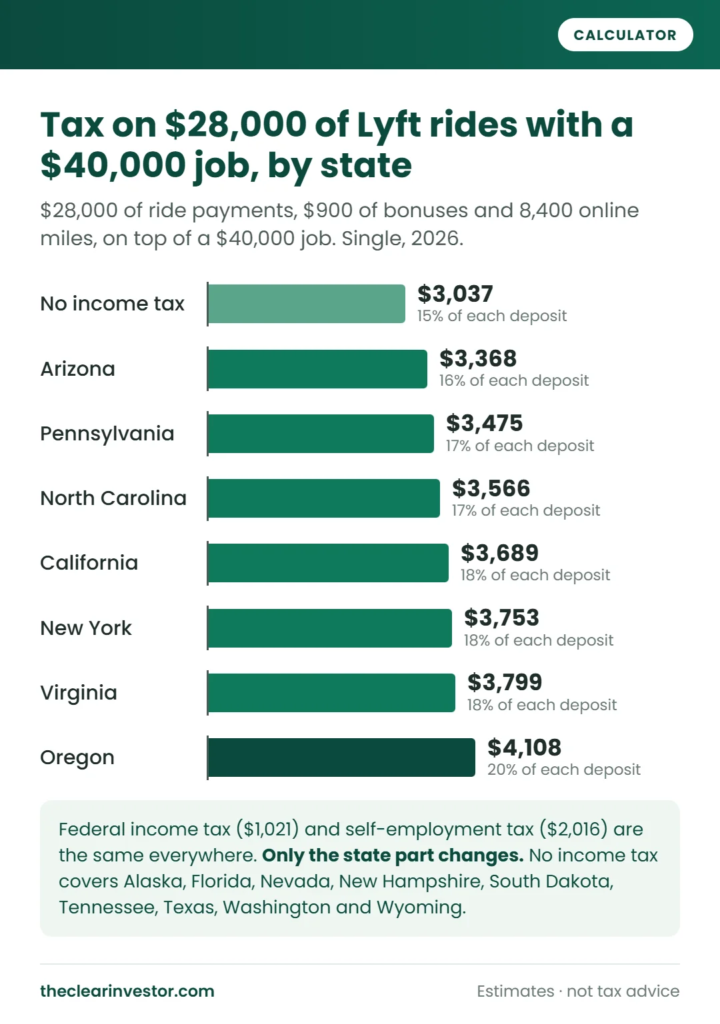
Your state matters too. Add a $40,000 job to the driver in Example 1, and the tax on their Lyft income is $3,037 in states with no income tax, like Florida, Texas and Washington, and up to $4,108 in Oregon:
How the Lyft Tax Calculator Works
- Income: ride payments from your Annual Summary, which is the 1099-K amount, plus non-ride earnings like bonuses, Streaks and referrals. That’s how Lyft lays them out in its tax information for drivers.
- Lyft’s fees: the platform and service fees, third-party fees and taxes, tolls and Express Pay fees from the Expenses section, all deducted as business costs.
- Your car: 72.5 cents a mile for online miles through June 2026 and 76 cents from July, the IRS standard mileage rates. For Express Drive, it can use the business share of your rental fees and gas instead, since the IRS says you can’t deduct both lease costs and the standard mileage rate.
- Profit: income minus fees, your car and your other costs, reported on Schedule C.
- Self-employment tax: 15.3% on 92.35% of your profit once that’s $400 or more, per the IRS.
- Income tax: the 2026 brackets and $16,100 standard deduction, the qualified business income deduction and the tips deduction. Rideshare drivers are on the IRS’s list of tipped occupations.
- Your Lyft tax: your total tax minus your tax without Lyft, so your job’s bracket counts.
- The set-aside: that tax divided by what reached your bank, after Lyft’s fees, Express Pay fees and any Express Drive rent Lyft took from your earnings.
- The 1099-K: $20,000 and 200 rides, or $600 or $1,000 of ride payments in the states on Lyft’s list.
- The 70% check: your share of rider fares next to Lyft’s earnings commitment.
- Hawaii: a note estimating the general excise tax, based on Hawaii’s 2025 guidance for rideshare drivers.
What the Calculator Leaves Out
- The actual-expense method for a car you own, and car loan interest.
- Your Express Drive deposit, since it’s refundable and not a cost.
- The home office deduction, and health insurance and retirement deductions.
- City and county income taxes, the earned income tax credit and itemized deductions.
- Hawaii’s general excise tax, which shows as a note but isn’t in the total.
Tips for Accurate Results
- Use your Annual Summary, not your deposits. Deposits come after Lyft’s fees and any Express Drive rent, so they hide both.
- Enter ride payments in full. They already include tips, tolls and fees, so don’t add tips or tolls on top.
- Split your online miles at June. Use your mileage log if you keep one, or split them by the weeks you drove.
- Write down the odometer when you pick up and return an Express Drive car, so you know all the miles on it.
- Count each mile once if you run Lyft and another app at the same time.
- Only count the driving share of your phone bill.
What to Do With Your Result
- Move your set-aside percentage to a savings account each time Lyft pays you.
- Make quarterly payments if you’ll owe $1,000 or more in federal tax.
- Check the Tax Center by Jan. 31 for your 1099-K and 1099-NEC, and match them to your Annual Summary.
- Fix a B notice right away if Lyft starts backup withholding, and claim the tax it held on your return.
- Keep your Annual Summary and your mileage log with your tax records.
Lyft Tax Calculator FAQ
Where do I find my Lyft Annual Summary?
In the Tax Center tab of your Lyft Driver Dashboard, with your 1099 forms. It lists your ride payments, tips, non-ride earnings, Lyft’s fees, tolls and online miles.
Is the Annual Summary a tax form?
No. Lyft says it isn’t an official tax document, but it has every number this calculator asks for, including the fees you deduct.
Why is my 1099-K higher than what Lyft paid me?
Your 1099-K shows what riders paid, before Lyft’s fees, third-party fees and any Express Drive rent. You report the full amount and deduct the fees.
Can I deduct my Express Drive rental?
Yes. Deduct the business share of your rental fees and gas, or use the standard mileage rate on your online miles. You can’t take both.
Does Lyft take out taxes?
No. Lyft only holds back 24% if you get a B notice and don’t fix your tax ID, so most drivers pay with quarterly estimated payments.
Do my Lyft tips count for the tips deduction?
They can. For 2026, tips have to be reported to you on a 1099, so the calculator counts them when Lyft sends you a 1099-K. Check that it shows your tips.
Does it include state tax?
Yes. Pick your state to add its income tax. It covers all 50 states and DC.
Is my information saved?
No. Everything is worked out in your browser, and nothing is sent or stored.
What tax year does the Lyft tax calculator use?
2026: the 2026 brackets, standard deduction, mileage rates, 1099 lines and the tips deduction. I update it every year.
Estimates for educational purposes only. I’m not a licensed financial advisor or tax professional, and this isn’t tax advice. Not affiliated with Lyft.