Lyft taxes come down to one document most drivers skim past: the Annual Summary. Lyft’s 1099-K only shows what riders paid, Lyft’s own fees included, so it’s always more than what reached your bank. The Annual Summary shows the rest: Lyft’s fees, tolls, Express Pay fees, any Express Drive rent and your online miles. You report the 1099-K amount, deduct those costs, and pay income tax and 15.3% self-employment tax on what’s left. Lyft doesn’t take any of it out.
I haven’t driven for Lyft, but I drove Amazon Flex in California for about 18 months, nearly every day, and put more than 25,000 miles on my car in 2025 alone. I deducted standard mileage and part of my phone bill on Schedule C, the same setup Lyft drivers use. Everything Lyft-specific here comes from Lyft’s tax information for drivers, IRS rules and my Lyft tax calculator, so you can check each piece yourself.
Lyft taxes, the short answer:
- Do you pay taxes on Lyft? Yes, on your profit: what riders paid, minus Lyft’s fees, your car costs and your other driving costs.
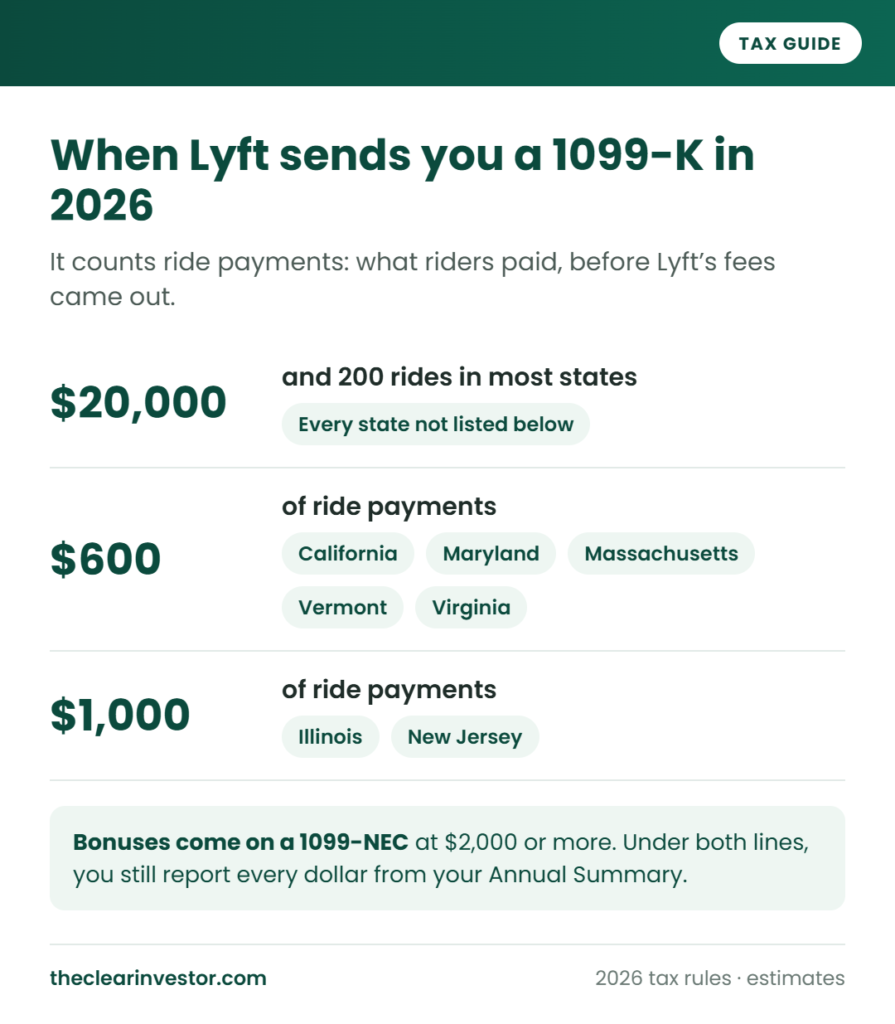
- Does Lyft send a 1099? A 1099-K for ride payments once you reach $20,000 and 200 rides, or $600 or $1,000 in seven states, and a 1099-NEC for bonuses of $2,000 or more. Both are in the Tax Center of your Driver Dashboard by January 31.
- Why is my 1099-K more than I made? It counts what riders paid before Lyft took its fees and third-party fees. Your Annual Summary lists those fees, and you deduct them.
- Does Lyft take out taxes? No, unless your tax info doesn’t match IRS records and Lyft starts backup withholding.
- Can I deduct my Express Drive rental? Yes: the business share of your rental fees and gas, or the standard mileage rate, but not both.
- Is there no tax on Lyft tips? Up to $25,000 of tips can come off your income for federal income tax, but only if they’re reported on a 1099 for 2026, and you still pay self-employment tax on them.
- How much should you set aside? About 10% of each deposit with no other income and about 15% with a job, if you deduct your miles. Add your state’s rate on top.
Table of Contents
Do You Pay Taxes on Lyft?
Yes. Lyft drivers are independent contractors, so your Lyft profit is self-employment income. It goes on Schedule C, and two taxes come out of it:
- Self-employment tax: 15.3% on 92.35% of your profit, once that comes to $400. That’s about $433 of profit. It’s your Social Security and Medicare, and you owe it even when you owe no income tax.
- Income tax: only on income above your standard deduction, $16,100 for single filers in 2026. With a W-2 job, your job usually uses that up, so Lyft profit is taxed from the first dollar.
The rules every 1099 side hustle shares are in my side hustle taxes guide. This guide covers what’s different about Lyft.
Your Lyft Annual Summary, Section by Section
Lyft gives every driver with earnings an Annual Summary in the Tax Center tab of the Driver Dashboard. Lyft says it isn’t an official tax document, but it’s the one you’ll use most, because it holds every deduction the 1099-K leaves out.
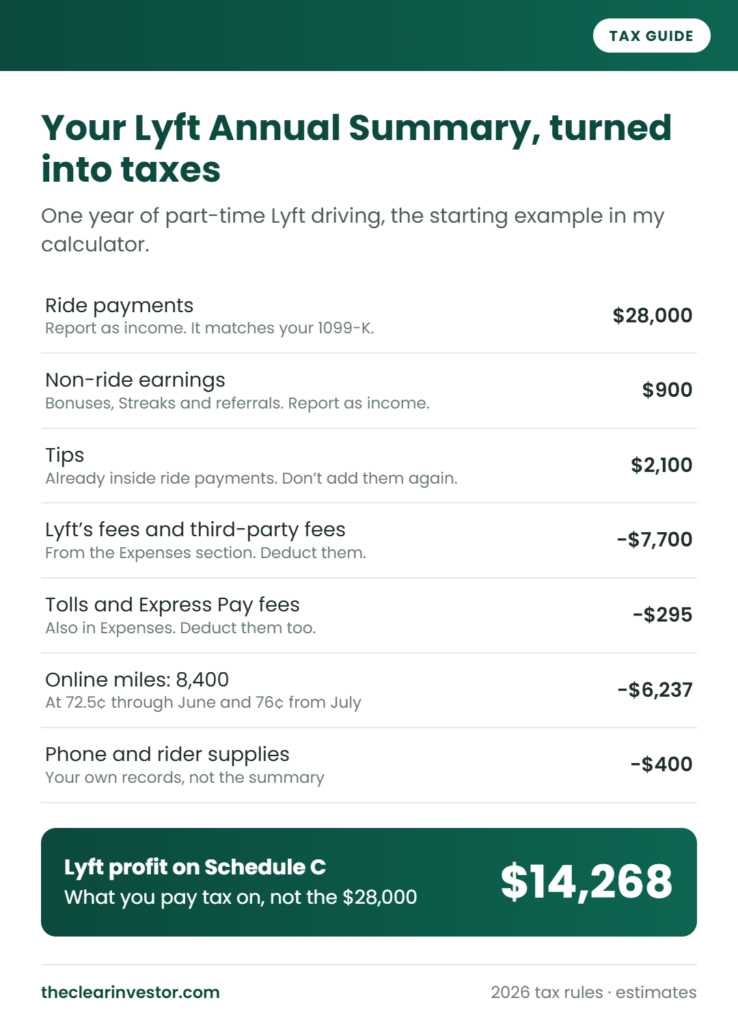
| Section | What’s in it | What you do with it |
|---|---|---|
| Ride payments | Everything riders paid, including tips, tolls, cancellation fees, Lyft’s fees and third-party fees | Report it as income. It matches your 1099-K. |
| Non-ride earnings | Bonuses, Streaks, ride challenges and referrals | Report it as income, with or without a 1099-NEC. |
| Tips | Your tips total, already inside ride payments | Use it for the tips deduction. Don’t add it again. |
| Expenses | Lyft’s platform and service fees, third-party fees and taxes, tolls, Express Pay fees and Express Drive rental fees | Deduct them as business costs. |
| Totals | Rides given and online miles | Online miles start your mileage deduction. Rides decide your 1099-K. |
Lyft’s help page says it plainly: your ride payments are usually higher than what you got in your bank account. The Expenses section is the reason.
Why Your Lyft 1099-K Is More Than Your Deposits
Box 1 of Lyft’s 1099-K is what riders paid for your rides that year. Before any of it reached you, Lyft kept its platform and service fees, and airport, city and state fees went to whoever charges them. Here’s how it works out for the starting example in my calculator:
| Step | Amount |
|---|---|
| Ride payments (1099-K) | $28,000 |
| Lyft platform and service fees | −$6,700 |
| Third-party fees and taxes | −$1,000 |
| Non-ride earnings | +$900 |
| Express Pay fees | −$45 |
| What reached the bank | $21,155 |
- Report the full $28,000 and the $900, then deduct the fees. Your profit comes out the same as if you reported deposits, and your return matches what the IRS sees.
- With Express Drive, the gap is bigger. Lyft takes your rental charges out of your earnings each week before paying you, so your deposits can be half of your 1099-K or less.
- No 1099-K doesn’t mean no tax. Under the line, you report every dollar from your Annual Summary anyway.
Lyft Tax Forms: What You’ll Get and When
| From Lyft | What it shows | When you get it |
|---|---|---|
| Form 1099-K | Ride payments: what riders paid, fees and tips included, but no bonuses | $20,000 and 200 rides, or less in seven states |
| Form 1099-NEC | Bonuses, Streaks, referrals and other non-ride pay | $2,000 or more for 2026 |
| Annual Summary | Earnings, expenses, tips, rides and online miles | Every driver with earnings |
All of them land in the Tax Center tab of your Driver Dashboard by January 31, and they stay there even if your account is deactivated. A few Lyft rules decide what you get:
- Lyft uses a lower 1099-K line in seven states: $600 of ride payments in California, Maryland, Massachusetts, Vermont and Virginia, and $1,000 in Illinois and New Jersey. Arkansas, DC and Montana set their own lower lines too, but they aren’t on Lyft’s list, so check your Tax Center either way.
- The 1099-NEC line went up. Lyft’s help page still shows $600, but for payments made in 2026 the IRS line is $2,000. Bonuses under it are still income.
- Puerto Rico drivers get different forms: a Form 480.6G for ride payments of $500 or more, and a 480.6SP for non-ride earnings of $500 or more.
- Backup withholding is the exception to “no taxes taken out.” If your name and taxpayer number don’t match IRS records, Lyft sends a B notice. If it isn’t fixed, Lyft holds back 24% of your pay under backup withholding, and Express Pay and Lyft Direct stay off until it is. You get a 1099-K whatever you made, with the tax in Box 4, and you claim it as tax already paid.
Lyft’s Fees, Tolls and Express Pay Fees Are Deductible
Everything in the Expenses section of your Annual Summary is a business cost:
- Lyft’s platform and service fees, the part of each fare Lyft kept.
- Third-party fees and taxes, like airport and city fees riders paid that went to someone else.
- Tolls. Riders pay them in the fare and Lyft passes them to you, so they’re already in your ride payments. Deducting them evens it out, and they count on top of the mileage rate.
- Express Pay fees, what Lyft charged you to cash out instantly instead of waiting for weekly pay.
- Express Drive rental fees, but only if you use rental costs instead of the mileage rate. More on that below.
In my calculator’s example, deducting Lyft’s fees and third-party fees cuts the tax from $3,281 to $2,016. The fees also give you a quick check on your pay. Lyft says drivers earn at least 70% of rider fares each week after external fees, and pays the difference when they don’t. My calculator shows your share, so you can see where you landed.
Is There No Tax on Lyft Tips?
Partly. From 2025 through 2028, you can deduct up to $25,000 a year of qualified tips, and rideshare drivers are on the IRS’s list of tipped occupations. Here’s what that means for Lyft drivers:
- For 2026, your tips have to be reported to you on a 1099. Lyft’s 1099-K includes your tips in ride payments, but its help page doesn’t say whether the form lists them separately or offer a way to get one under the line. Check your 1099-K when it comes, and keep your Annual Summary, which shows your tips total.
- Where you live can decide it. A part-time driver with $9,000 of ride payments gets a 1099-K in California, where Lyft’s line is $600, but not in Texas. In my calculator’s example, that’s $96 of federal tax the California driver saves and the Texas driver doesn’t.
- It lowers federal income tax only. You still pay 15.3% self-employment tax on every tip, and each state decides whether to follow it.
- It can’t be more than your Lyft profit, and it shrinks by $100 for every $1,000 of income over $150,000 ($300,000 married filing jointly). Married couples have to file jointly. You claim it on Schedule 1-A without itemizing.
With $2,100 of tips and a $40,000 job, the tips deduction saves about $252. With no other income, it saves nothing, since the standard deduction already covers the income tax.
Lyft Mileage: Online Miles and the 2026 Rates
If you drive your own car, miles are usually your biggest deduction. The IRS standard mileage rate is 72.5 cents a mile for January through June 2026 and 76 cents from July 1, after the IRS raised it midyear. It covers gas, insurance, repairs and wear, so you don’t deduct those on top.
- Online miles are your starting point. They’re in the Totals section of your Annual Summary: the miles you drove with the app on, waiting for a ride, heading to the pickup and on the ride itself.
- Split them at June. The Annual Summary gives one number for the year, so you need your own log, or a fair split by when you drove, to use both rates.
- Miles with the app off are a gray area. Driving to a busy area before you go online can count as commuting, which the IRS treats as personal. If those miles add up, keep a log and ask a tax pro.
- Count each mile once. If you run Lyft and Uber at the same time, the same mile shows up in both apps.
For my Flex driving, I kept a row for every day in a spreadsheet, with the miles I drove, what I earned and what I spent on gas. That log was the proof behind a mileage deduction of more than $17,500 for 2025. Here’s what miles are worth in my calculator’s example of 8,400 online miles:
| Miles deducted | Miles not deducted | |
|---|---|---|
| Mileage deduction | $6,237 | $0 |
| Tax, no other income | $2,016 | $2,943 |
| Tax with a $40,000 job | $3,037 | $4,475 |
You can deduct the business share of your car’s real costs instead, with every receipt. For a car you own, the IRS says you have to use the standard rate in the first year you use the car for business if you ever want to use it. The business share of car loan interest counts on top of the standard rate when you’re self-employed, according to IRS Topic 510.
Express Drive Taxes: Mileage Rate or Rental Costs?
If you rent a car through Lyft’s Express Drive, you have two ways to deduct it, and the IRS says you can’t deduct both lease costs and the standard mileage rate:
- The standard mileage rate on your online miles, the same as with your own car.
- Rental costs: your rental fees and the gas you bought, times your business share. Your business share is your online miles divided by all the miles you put on the rental, personal driving included.
Pick carefully. The IRS says that if you use the mileage rate for a leased car, you keep it for the whole lease, renewals included, so treat your first choice for an Express Drive rental as the one you’ll stick with. Insurance and standard maintenance come with Express Drive, so there’s nothing else to add for the car either way. Tolls, Express Pay fees and your phone count on top of both.
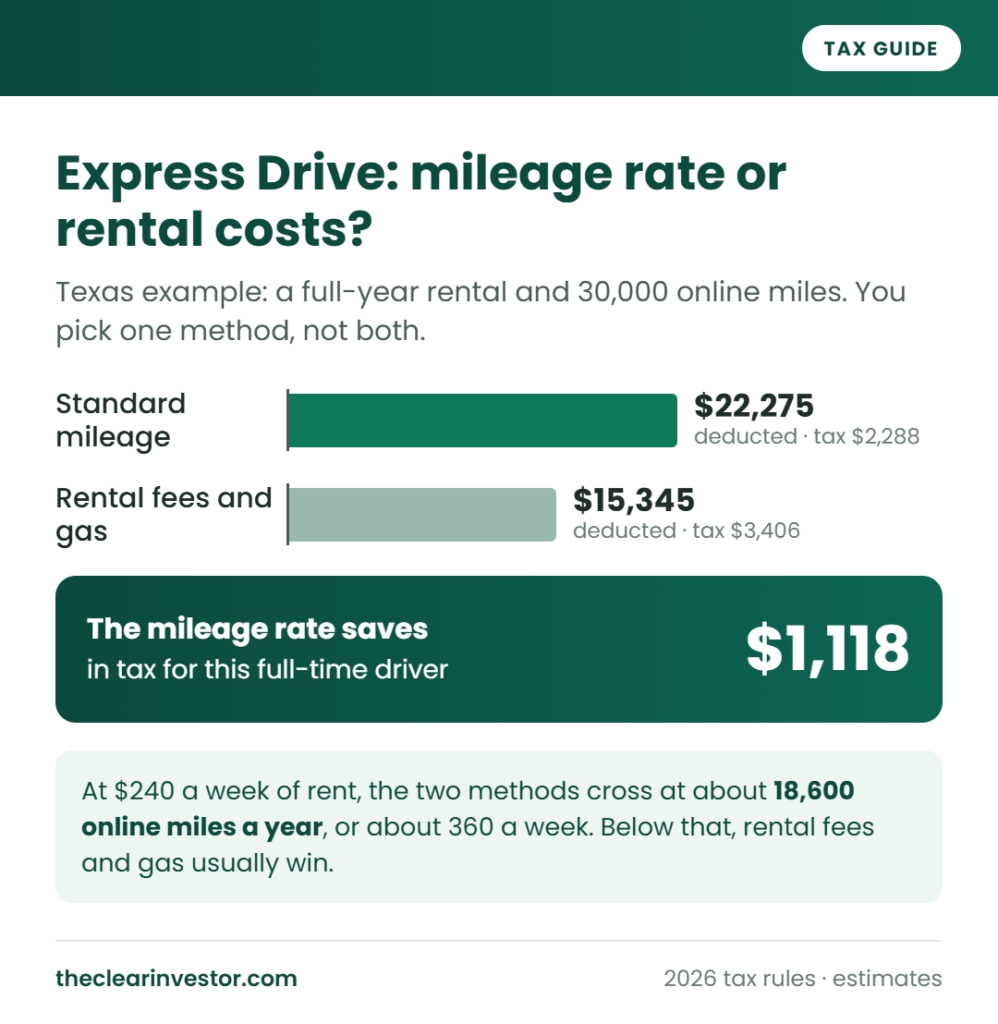
For a full year of renting at $240 a week, with gas at 14 cents a mile and 90% of the miles online, the two methods cross at about 18,600 online miles a year, or about 360 a week:
| Online miles a year | Standard mileage | Rental fees and gas |
|---|---|---|
| 10,000 | $7,425 | $12,633 |
| 20,000 | $14,850 | $14,032 |
| 30,000 | $22,275 | $15,432 |
| 40,000 | $29,700 | $16,832 |
A full-time renter usually does better with the mileage rate. In my calculator’s Texas example, 30,000 online miles were worth $22,275 at the mileage rate and $15,345 in rental costs, a difference of $1,118 in tax. A part-time renter is closer to a coin flip.
The set-aside catches Express Drive renters out. Lyft takes the rent from your earnings before paying you, but your tax is on your whole profit. A part-time renter in my calculator’s Virginia example had only $5,540 reach their bank from $14,000 of ride payments, and needed to set aside 25% of each deposit.
Other Lyft Expenses You Can Deduct
- Your phone and plan, the share you use for driving.
- Water, mints and chargers for riders.
- A phone mount, a dash cam and a city rideshare permit.
- Parking while you’re working, on top of the mileage rate.
Gas, oil changes, repairs and insurance aren’t separate deductions when you use the mileage rate, and parking tickets and your own meals never are. Here are more deductions that lower side hustle taxes.
How Much Tax Will You Owe on Lyft?
Here’s what Lyft taxes look like for a single driver in a state with no income tax. The own-car rows assume Lyft’s fees take 24% of ride payments, third-party fees 4%, tips are 7.5% of ride payments, and there are 3 online miles for every $10, split evenly across the year. The Express Drive row is the Texas example from my calculator.
| Situation | Ride payments | Reached the bank | Tax on Lyft | Set aside |
|---|---|---|---|---|
| Part-time, own car | $10,000 | $7,200 | $703 | 10% |
| Part-time, own car, $50,000 job | $10,000 | $7,200 | $1,146 | 16% |
| Full-time, own car | $40,000 | $28,800 | $2,810 | 10% |
| Full-time, own car, $50,000 job | $40,000 | $28,800 | $4,225 | 15% |
| Full-time, Express Drive | $52,000 | $27,270 | $2,288 | 9% |
With no other income, it’s about 10% of what reaches your bank, nearly all of it self-employment tax. With a job, it’s about 15%. Add your state’s rate on top. My Lyft tax calculator works out yours, with your own fees, miles or rental, tips and state.
Do You Need to Pay Lyft Taxes Quarterly?
If you drive much, yes. The IRS expects estimated tax payments when you’ll owe $1,000 or more at tax time. With no other income, a driver like the ones in my table gets there at about $14,250 of ride payments.
Your weekly summaries make it easy: add up the weeks since your last payment, set aside your percentage and pay by April 15, June 15, September 15 and January 15. With a job, you can raise your Form W-4 withholding instead. The safe harbor that keeps you penalty-free is in how quarterly payments work.
Free tax tracker + deadline reminders
Get my free side income tax tracker
Sign up and I’ll send you my Google Sheets tracker that shows how much of each payout to set aside. You’ll also get an email before each quarterly tax deadline (Jan 15, Apr 15, Jun 15 and Sep 15), plus my new guides. Unsubscribe anytime.
Earn on several platforms or drive for work? Get the full 1099 Side Income Tracker ($12) →
Lyft Taxes: How to File
- Download your 1099s and Annual Summary from the Tax Center tab of your Driver Dashboard.
- Report your ride payments and non-ride earnings on line 1 of Schedule C, whether or not you got a 1099.
- Deduct Lyft’s fees and third-party fees on line 10, commissions and fees.
- Enter your car costs. With the mileage rate, your mileage and tolls go on line 9, with the questions about your car in Part IV. With Express Drive rental costs, the business share of your rent goes on line 20a and your gas on line 9.
- Add your other costs where they fit: supplies on line 22, and Express Pay fees and your phone in Part V.
- Pay self-employment tax on Schedule SE, claim the tips deduction on Schedule 1-A, and subtract any estimated payments and Box 4 withholding.
I file with TaxAct. I add a Schedule C for the driving work first, then enter each 1099 and assign it to that Schedule C, so the IRS sees the income and the costs together.
Special Situations
If you drive in Hawaii
Lyft reminds Hawaii drivers they may owe general excise tax on top of income tax. Under Hawaii’s 2025 guidance, drivers pay 0.5% on ride income and 4% plus the 0.5% county surcharge on tips. Hawaii’s own example counts everything the rider paid, fees included, as the driver’s ride income. My calculator estimates it as a note.
If you also drive for Uber
Each app sends its own forms, and both go on one Schedule C, since it’s the same kind of work. Count each mile once. My Uber tax guide covers Uber’s side, including how its 1099-K lists tips.
If your account was deactivated
Your forms and Annual Summary stay in the Tax Center, and the income still goes on your return.
If you drove at a loss
If Lyft’s fees and your driving costs are more than riders paid, the loss lowers the tax on your other income. Keep your Annual Summary and mileage log in case the IRS asks.
Common Lyft Tax Mistakes
These are the Lyft tax mistakes I’d watch for:
- Reporting only your deposits. Report the 1099-K amount and deduct Lyft’s fees, so your return matches the form.
- Skipping the Expenses section. In my calculator’s example, leaving out Lyft’s fees raises the tax from $2,016 to $3,281.
- Adding tips or tolls on top of ride payments. They’re already in there.
- Taking both the mileage rate and Express Drive rent. It’s one or the other.
- Using one mileage rate for the whole year. Split your miles at June.
- Leaving out bonuses under $2,000. No 1099-NEC doesn’t make them tax-free.
- Spending every deposit. Nothing is withheld, so part of it is tax.
My Verdict: Use the Annual Summary, Not Your Deposits
Lyft taxes are simpler than the 1099-K makes them look. Report the ride payments and bonuses Lyft shows, then deduct everything in the Expenses section of your Annual Summary and your online miles at 72.5 cents through June 2026 and 76 cents from July. If you rent from Express Drive, compare the mileage rate with your rental costs and pick the bigger deduction.
The tips deduction can wipe out the federal income tax on your tips if they’re on a 1099, but not the 15.3% self-employment tax. Set aside about 10% of each deposit with no other income, or about 15% with a job, plus your state’s rate. My Lyft tax calculator works out your number from your Annual Summary in a minute.
Want more ways to earn? See every platform I’ve used in How I make money online.
FAQ
Do I have to pay taxes on Lyft?
Yes, on your profit: what riders paid, minus Lyft’s fees, your car costs and your other driving costs. You owe self-employment tax once your profit passes about $433.
Where do I find my Lyft tax forms?
In the Tax Center tab of your Lyft Driver Dashboard, by January 31, along with your Annual Summary. They stay there even if your account is deactivated.
Is the Lyft Annual Summary a tax form?
No. Lyft says it isn’t an official tax document, but it lists the fees, tolls, tips and online miles you need for your return.
Why is my Lyft 1099-K more than I made?
It shows what riders paid, including Lyft’s fees, third-party fees, tips and tolls. Report that total and deduct the fees from your Annual Summary.
Does Lyft send a 1099 if I made less than $20,000?
Only in some states. Lyft sends a 1099-K at $600 of ride payments in California, Maryland, Massachusetts, Vermont and Virginia, and $1,000 in Illinois and New Jersey.
Can I deduct Express Drive rental fees?
Yes. Deduct the business share of your rental fees and gas, or use the standard mileage rate on your online miles, but not both.
Are Lyft tips taxable?
Yes. Through 2028, up to $25,000 of qualified tips comes off your income for federal income tax if they’re reported on a 1099, but you still pay self-employment tax on them.
How much should I set aside for Lyft taxes?
About 10% of each deposit with no other income, or about 15% with a job, if you deduct your miles. Add your state’s rate.
I’m not a licensed financial advisor or tax professional. This guide is based on Lyft’s tax pages for drivers, IRS rules and my own experience with 1099 income and mileage. It’s for educational purposes and isn’t tax advice. Tax rules change, so check the links above or talk to a tax professional about your situation. I’m not affiliated with Lyft or TaxAct.