
This Whatnot tax calculator shows how much tax you’ll owe on your Whatnot sales in 2026, how much of each payout to set aside, and what you keep per order and per hour once Whatnot’s fees, your stock and the tax come off. It splits your reselling from anything you sold out of your own collection, and it taxes a gain on old cards, coins or comics the way the IRS taxes collectibles. Want to know how Whatnot sellers are taxed first? Read my Whatnot tax guide.
I haven’t sold on Whatnot, but I file my own taxes with TaxAct and keep each side gig on its own Schedule C, which is where Whatnot reselling goes.
Whatnot makes a few things harder than other side gigs. Its 2.9% processing fee is charged on the shipping and sales tax buyers pay, money that never reaches you, per its fee page. You pay the shipping on every giveaway. Grading fees wait until the card sells. And a lot of sellers start by selling their own collection, where a gain on cards you’ve owned for years doesn’t get the low long-term rates. So this calculator estimates Whatnot’s fees from your sales, counts giveaways, grading and tips, and keeps your own collection out of your profit.
Whatnot Tax Calculator
See how much tax you’ll owe on your Whatnot sales in 2026: your profit after Whatnot’s commission and processing fees, what your cards and other stock cost, grading, giveaway shipping and tips, your own collection sold at a loss or a gain, and how much of each payout to set aside.
Your 2026 Whatnot sales
Your own collection in those sales
Your reselling costs
Your other income
About you
What buyers paid vs. what Whatnot paid you
Which sales are taxed
| Sales | Item sales | Taxed |
|---|
What you keep
Your tax forms
| Form | From | Amount |
|---|
Your total 2026 tax: before vs. after deductions
| Before deductions | After deductions |
|---|
How your taxable income is worked out
How this is calculated
- Your sales = the final sale prices of your items. Buyers also pay shipping and sales tax at checkout, but the shipping pays for the label Whatnot makes and the sales tax goes to the states, so neither is your income. Tips are income, and Whatnot takes no commission on them.
- Whatnot’s fees (estimate) = your commission rate (8% for most categories and 4% for Coins & Money, lower once a shop’s sales pass $15,000 in four weeks) on the item price of the orders you kept, plus 2.9% of the item price, shipping and sales tax + 30¢ a checkout for payment processing. Refunded orders are left out of the estimate. Tax Whatnot charges on its fees in a few states isn’t in the estimate.
- What Whatnot paid you = item sales − refunds − fees − shipping you paid (giveaways, free or reduced shipping and label adjustments) + tips.
- Your own collection vs. reselling: things you collected for yourself and sold for less than you paid aren’t taxed, and the loss isn’t deductible. Things you kept for yourself that sold for more than you paid are a capital gain. Everything else counts as reselling, a business on Schedule C. Refunds, Whatnot’s fees and the shipping you paid are split between them by item sales.
- Cost of what you sold = unsold stock on Jan. 1 + stock you bought this year (with sales tax and shipping) − unsold stock on Dec. 31, the way Part III of Schedule C works it out, plus grading fees on the cards that sold. Cards you give away leave your stock, so their cost is in here too.
- Reselling profit = reselling sales − refunds + tips − cost of what you sold − Whatnot’s fees − shipping you paid − supplies − streaming gear − mileage − other costs. Streaming gear comes off all at once. Mileage is business miles from January through June × 72.5¢ + July through December × 76¢, the 2026 IRS rates.
- Self-employment tax is 15.3% (12.4% Social Security and 2.9% Medicare) on 92.35% of your self-employment profit. You only owe it when that comes to $400 or more, which means about $433 of profit. Social Security tax stops at $184,500 of combined W-2 pay and self-employment earnings, and an extra 0.9% Medicare tax applies above $200,000 ($250,000 married filing jointly, $125,000 separately). Half of the 15.3% is deductible.
- Federal income tax uses the 2026 brackets and standard deduction ($16,100 single or married filing separately, $32,200 married filing jointly, $24,150 head of household). It includes the qualified business income deduction: 20% of your reselling and other self-employment profit after the self-employment tax deduction, capped at 20% of your taxable income minus capital gains, and at least $400 when that profit is $1,000 or more.
- Gains on your own collection: owned a year or less, taxed like regular income. Other things owned more than a year get the long-term rates: 0% up to $49,450 of taxable income ($98,900 married filing jointly, $66,200 head of household), 15% up to $545,500 and 20% above. Collectibles owned more than a year, like cards, coins, comics and art, are taxed at your regular rate while your taxable income stays in the brackets through 24%, and at 28% above that, the way the Schedule D Tax Worksheet does it. The 3.8% net investment income tax applies above $200,000 of income ($250,000 jointly).
- Child tax credit is $2,200 per child under 17. Up to $1,700 per child can be paid to you as a refund, based on 15% of your earned income over $2,500.
- State income tax uses 2026 rates, brackets, standard deductions and exemptions from the Tax Foundation, updated for the 2026 cuts in Arkansas, Georgia, South Carolina, Utah and West Virginia, and for the higher 2026 standard deductions in Arizona and Maine. A few states (like California) hadn’t published 2026 bracket amounts, so their 2025 amounts are used. Gains are counted as regular income.
- Tax on your Whatnot sales = your total tax minus what your total tax would be without Whatnot. The set-aside percentage is that tax divided by what Whatnot paid you.
- Tax forms: Whatnot sends a Form 1099-K through Stripe when sales are over $20,000 with more than 200 transactions, or over a lower state line from Whatnot’s and Stripe’s lists: $600 in DC, Maryland, Massachusetts, Montana and Virginia, $1,000 in New Jersey, $1,000 with 4 transactions in Illinois, $2,000 in Vermont and $2,500 in Arkansas. Where the two lists differ, the calculator uses the lower line. It’s in Seller Hub by January 31.
Not included: hobby selling (income from an activity that isn’t a business, reported on Schedule 1), spreading equipment over several years, the home office deduction, the earned income tax credit, city and county income taxes, itemized deductions, capital loss carryovers, and tax withheld from a W-2 job. Your real tax can be lower.
Free tax tracker + deadline reminders
Get my free side income tax tracker
Sign up and I’ll send you my Google Sheets tracker that shows how much of each payout to set aside. You’ll also get an email before each quarterly tax deadline (Jan 15, Apr 15, Jun 15 and Sep 15), plus my new guides. Unsubscribe anytime.
Earn on several platforms or drive for work? Get the full 1099 Side Income Tracker ($12) →
Table of Contents
How to Use the Whatnot Tax Calculator
- Open your seller statements in Whatnot’s Seller Hub. They list your sales, Whatnot’s fees and any shipping you paid, order by order.
- Enter your item sales, orders, shipping, sales tax, refunds and tips. Item sales are the final sale prices of what you sold, without the shipping and sales tax buyers paid on top.
- Choose how to count Whatnot’s fees. Let the calculator estimate them from your commission rate (8% for most categories and 4% for Coins & Money, or the lower tier rate Seller Hub shows once your sales pass $15,000 in four weeks), or enter the total from your statements. Then enter what Whatnot took out for giveaway shipping and any free or reduced shipping you offered.
- Enter anything from your own collection you sold. Things you collected for yourself and sold for less than you paid aren’t taxed. Things you kept and sold for more than you paid are a gain, and collectibles owned over a year are taxed at up to 28%.
- Add your stock, grading fees, supplies, streaming gear, miles, other costs and hours, then your other income, filing status and state.
Who This Calculator Is For
- Card sellers and breakers who sell singles, slabs and box breaks live.
- Collectors selling their own collection, to see what a gain on old cards, coins or comics costs in tax.
- Sellers in other categories, like coins, comics, toys, sneakers or vintage clothing.
- Sellers with a W-2 job, to see how much more tax Whatnot adds.
- Shops under $20,000 in sales, which may not get a 1099-K but still owe tax on their profit.
If you also sell on eBay or Depop, enter that profit as other self-employment profit, so your tax bracket counts both. My eBay tax calculator and Depop tax calculator can work out that profit, and my 1099 tax calculator covers any other 1099 work.
How to Read Your Results
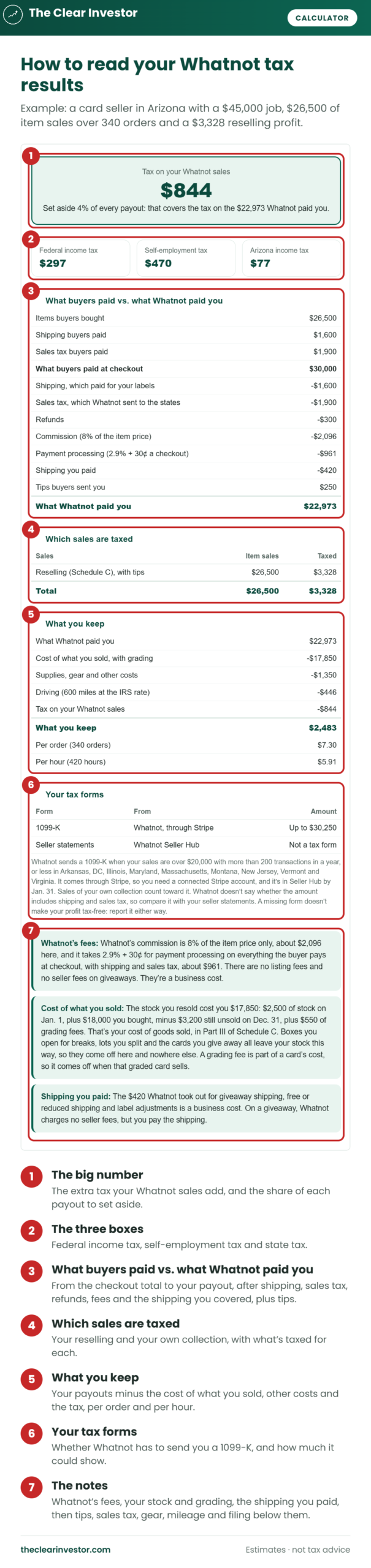
- The big number is the extra tax your Whatnot sales add, and the line under it says what share of each payout to set aside.
- The three boxes split it into federal income tax, self-employment tax and state tax.
- What buyers paid vs. what Whatnot paid you starts from the checkout total and takes off the shipping and sales tax that went elsewhere, refunds, Whatnot’s fees and the shipping you covered, then adds tips.
- Which sales are taxed splits your reselling from your own collection, with what’s taxed for each.
- What you keep takes the cost of what you sold, your other costs and the tax off your payouts, per order and per hour.
- Your tax forms shows whether Whatnot has to send you a 1099-K.
- The notes cover fees, stock and grading, giveaways, tips, gains on your collection, sales tax, mileage, filing and quarterly payments.
Below them, tables show your tax before and after deductions and how your taxable income is worked out.
Worked Example 1: A Card Seller With a $45,000 Job in Arizona
This is the calculator’s starting example. This seller works full time for $45,000, files single and sells sports and trading cards on Whatnot on nights and weekends. Over 340 checkouts, buyers bid $26,500 for items and paid $1,600 for shipping and $1,900 in sales tax. They refunded $300, and buyers tipped them $250. Whatnot took $420 for giveaway shipping and a few free-shipping shows.
They had $2,500 of cards on January 1, bought $18,000 more in singles, lots and sealed boxes, and had $3,200 left on December 31. They paid $550 to grade cards that sold, $650 for sleeves, top loaders and mailers, $400 for lights and a phone mount, and $300 for card show tables, and drove 600 miles to card shows and the post office, over about 420 hours.
| Step | Amount |
|---|---|
| Item sales | $26,500 |
| Refunds | −$300 |
| Tips | $250 |
| Cards in what they sold ($2,500 + $18,000 − $3,200) | −$17,300 |
| Grading fees on cards that sold | −$550 |
| Whatnot’s fees (8% commission, 2.9% + 30¢ processing) | −$3,057 |
| Shipping they paid | −$420 |
| Supplies, gear, mileage and other costs | −$1,795 |
| Reselling profit | $3,328 |
| Federal income tax | $297 |
| Self-employment tax | $470 |
| Arizona income tax | $77 |
| Tax on their Whatnot sales | $844 |
The commission is $2,096, 8% of the $26,200 of items they kept. The processing fee is $961, because it’s 2.9% of everything buyers paid at checkout, with the shipping and sales tax, plus 30¢ a checkout. Whatnot paid them $22,973, so the calculator says to set aside 4% of every payout.
They get a 1099-K: their sales are over $20,000 with more than 200 transactions. It could show up to $30,250 if it counts shipping, sales tax and tips, more than nine times their $3,328 profit. Their job uses up the standard deduction, so the profit is taxed at 12% after a $618 qualified business income deduction. Cards are a thin-margin business: after what they spent and the tax, they keep $2,483, about $7.30 an order or $5.91 an hour.
Worked Example 2: Selling a Childhood Card Collection in Florida
This seller works for $58,000 and files single. They sold the Pokémon cards they’d collected since they were a kid: $9,000 of cards that cost them $600 years ago, and $1,000 of newer cards that sold for less than they paid. Over 120 checkouts, buyers also paid $700 for shipping and $650 in sales tax. They don’t resell, so there’s no business and no self-employment tax.
| Step | Amount |
|---|---|
| Cards that went up in value | $9,000 |
| Their share of Whatnot’s fees (90%) | −$1,049 |
| What they paid for those cards | −$600 |
| Collectibles gain | $7,351 |
| Cards sold for less than they paid | $0 taxed |
| Tax on their Whatnot sales | $882 |
Owned for years, the cards are a long-term gain, but collectibles like cards, coins and comics don’t get the 0%, 15% or 20% long-term rates. They’re taxed at your regular rate, up to 28%. This seller’s income sits in the 12% bracket, so the gain costs $882. The same gain on stocks would cost $0, because their taxable income of $49,251 is under the $49,450 line for the 0% rate.
Whatnot’s fees were $1,165, and it paid them $8,835. They’re under the $20,000 line and Florida doesn’t have a lower one, so there’s no 1099-K, but the gain still goes on Form 8949 and Schedule D. The $1,000 of cards sold at a loss isn’t taxed, and the loss isn’t deductible either.
Worked Example 3: A Full-Time Breaker Couple in Georgia
This couple files jointly with two kids. One spouse earns $62,000 at a W-2 job, and the other runs box breaks and sells singles on Whatnot full time. Over 2,600 checkouts, buyers bid $140,000 for spots and items and paid $9,500 for shipping and $10,000 in sales tax. They refunded $1,500, got $1,800 in tips and paid $2,400 for giveaway shipping. They had $8,000 of sealed product and singles on January 1, bought $98,000 more and had $9,000 left on December 31. They spent $2,800 on supplies, $1,900 on cameras, lights and a break table, $1,800 on other costs and drove 2,700 miles, over about 1,500 hours, and they’ve sent $6,000 in estimated payments.
| Step | Amount |
|---|---|
| Item sales | $140,000 |
| Refunds | −$1,500 |
| Tips | $1,800 |
| Stock in what they sold ($8,000 + $98,000 − $9,000) | −$97,000 |
| Whatnot’s fees | −$16,428 |
| Shipping they paid | −$2,400 |
| Supplies, gear, mileage and other costs | −$8,510 |
| Reselling profit | $15,962 |
| Federal income tax | $1,424 |
| Self-employment tax | $2,255 |
| Georgia income tax | $740 |
| Tax on their Whatnot sales | $4,420 |
Without Whatnot, their $4,400 child tax credit is more than their income tax, and $1,320 of it comes to them as a refund. The breaks’ profit uses up that room, which is most of the $1,424 of federal tax. Their 1099-K could show up to $161,300, ten times their profit, so they’ll need their seller statements and a full year of purchase records to show what they really made.
Their sales average about $10,700 every four weeks, under the $15,000 that unlocks Whatnot’s lower commission tiers, so the calculator uses 8%. Whatnot paid them $121,472, so they set aside 4% of every payout. The $6,000 they’ve already sent covers the tax. After the stock, costs and tax, they keep $11,543, about $4.44 an order or $7.70 an hour.
Worked Example 4: A Coin Seller in New Jersey
This seller works for $70,000, files single and sells coins in Whatnot’s Coins & Money category, where the commission is 4%. Over 95 checkouts, buyers paid $7,800 for coins, $500 for shipping and $300 in sales tax, and tipped them $60. Whatnot took $50 for giveaway shipping. They had $1,000 of coins on January 1, bought $5,600 more and had $1,700 left on December 31, and paid $200 to grade coins that sold. They spent $90 on supplies and $120 on other costs and drove 300 miles to coin shows, over about 160 hours.
| Step | Amount |
|---|---|
| Item sales | $7,800 |
| Tips | $60 |
| Coins in what they sold, with grading | −$5,100 |
| Whatnot’s fees (4% commission, 2.9% + 30¢ processing) | −$590 |
| Shipping, supplies, mileage and other costs | −$483 |
| Reselling profit | $1,687 |
| Federal income tax | $257 |
| Self-employment tax | $238 |
| New Jersey income tax | $87 |
| Tax on their Whatnot sales | $582 |
New Jersey is one of the states on Whatnot’s list with a lower line, $1,000, so they get a 1099-K for up to $8,660 even though they’re far under $20,000. Their profit is taxed at 22% after the qualified business income deduction, which is the $400 minimum here, since 20% of their profit would be less. Whatnot paid them $7,220, so they set aside 9% of every payout and keep $1,105, about $11.63 an order or $6.91 an hour.
More Example Results
Here’s how a W-2 job changes the tax for the card seller in Example 1 ($3,328 of reselling profit, 340 orders, 420 hours, in Arizona):
| W-2 job | Tax on Whatnot | Set aside | You keep per hour |
|---|---|---|---|
| None | $470 | 3% | $6.80 |
| $15,000 | $688 | 3% | $6.28 |
| $30,000 | $844 | 4% | $5.91 |
| $45,000 | $844 | 4% | $5.91 |
| $75,000 | $1,092 | 5% | $5.32 |
| $120,000 | $1,105 | 5% | $5.29 |
The $470 of self-employment tax is on every row, because it depends only on the Whatnot profit. With no job, the standard deduction covers the whole profit, so there’s no income tax. From there the profit is taxed at 10%, then 12% and then 22%, and with a $120,000 job part of it reaches 24%.
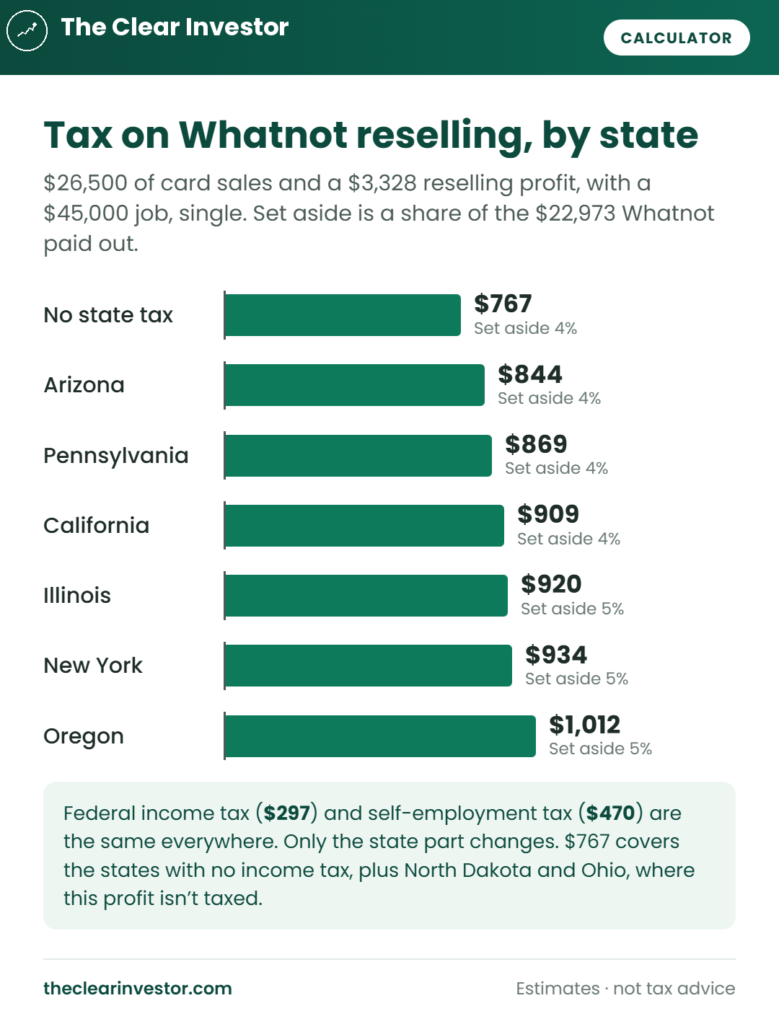
Your state matters too. The same seller would owe $767 in states with no income tax, like Florida, Texas and Tennessee, and up to $1,012 in Oregon:
How the Whatnot Tax Calculator Works
- Sales: the final sale prices of your items. Buyers pay shipping and sales tax on top, but the shipping pays for the label Whatnot makes and the sales tax goes to the states, per Whatnot’s shipping setup page and sales tax page.
- Whatnot’s fees: a commission of 8% of the item price for most categories and 4% for Coins & Money, not charged on shipping or sales tax, plus 2.9% + 30¢ for payment processing on the whole checkout, per Whatnot’s fee page. Since September 21, 2026, shops whose sales reach $15,000 in a four-week period pay a lower tiered rate for the next four weeks, which you can enter as your commission rate. Whatnot also charges no commission on the part of a card, comic, toy or coin price over $1,500 as a limited-time offer, so enter your fees from your statements if that applies. In a few states, Whatnot also charges tax on its fees and takes it from your earnings, per its tax on fees page.
- Giveaways and shipping you pay: Whatnot charges no seller fees on giveaways, but you pay their shipping, and any free or reduced shipping you offer comes out of your earnings.
- Tips: sellers get 100% of a tip, and Whatnot charges no commission on it, per its tips page. Tips are income.
- Your own collection: a loss on a personal item can’t be deducted and a gain is taxable. Refunds, fees and the shipping you paid are split between reselling and your own things by item sales.
- Collectibles: the IRS Schedule D instructions count art, antiques, metals, gems, stamps, coins and “certain other tangible property” as collectibles, and cards, comics and memorabilia are generally treated the same way. A long-term gain on them is taxed at your regular rate while your taxable income stays in the brackets through 24%, and at 28% above that, never at 0% or 15%, per IRS Topic 409 and the Schedule D Tax Worksheet.
- Stock and grading: the cost of goods sold from Part III of Schedule C: what you had on January 1, plus what you bought, minus what’s left on December 31, plus grading fees on the cards that sold.
- Streaming gear: deducted all at once, with 100% bonus depreciation for equipment bought after January 19, 2025, or the de minimis rule for items of $2,500 or less.
- Mileage: 72.5¢ a mile through June 2026 and 76¢ from July, the IRS standard mileage rates.
- Self-employment tax: 15.3% on 92.35% of your profit once that’s $400 or more, per the IRS.
- Income tax: the 2026 brackets and standard deduction, the qualified business income deduction (at least $400 once your business income is $1,000 or more), long-term gain rates and the child tax credit.
- Your 1099-K: over $20,000 with more than 200 transactions, or the lower lines in Arkansas, DC, Illinois, Maryland, Massachusetts, Montana, New Jersey, Vermont and Virginia, from Whatnot’s 1099-K page and Stripe’s state table. Where they differ (Maryland and Montana), the calculator uses the lower line.
- State tax: your state’s 2026 rates and deductions.
- Your Whatnot tax: your total tax minus your tax without Whatnot, so your job’s bracket counts.
- The set-aside: that tax divided by what Whatnot paid you, rounded up.
- Per order and per hour: what Whatnot paid you minus the cost of what you sold, your supplies, gear and other costs, your car at the mileage rate and the tax, divided by your orders and hours.
What the Calculator Leaves Out
- Commission discounts: the $1,500 limit and short promotions. Enter your fees from your statements to include them. A lower tier rate can go in the commission rate box.
- Tax Whatnot charges on its fees in a few states, unless you enter your fees from your statements.
- Hobby selling, spreading equipment over several years, the home office deduction and the actual-expense method for your car.
- Capital loss carryovers and state rules that tax long-term gains less.
- Sales outside Whatnot, like card shows or other apps. Add their profit as other self-employment profit.
- Health insurance and retirement deductions, the earned income tax credit, city and county income taxes, and itemized deductions.
Tips for Accurate Results
- Use your seller statements, not your bank deposits. Whatnot takes its fees and any shipping you cover out first, and your earnings wait until delivery is confirmed.
- Count your stock on December 31. Write down what you paid for every card, slab and sealed box you haven’t sold. Without that count, you can’t work out the cost of what you sold.
- Keep your collection separate. List what you sold from your own collection, and keep anything that shows what you paid and when you got it.
- Track grading by card. A grading fee belongs to the card it was for, so it comes off the year that card sells.
- Count your giveaways’ shipping. It comes out of your earnings, so it’s in your statements, and it’s a business cost.
What to Do With Your Result
- Set aside your percentage of every payout in a savings account when Whatnot pays you.
- Make quarterly payments if you’ll owe $1,000 or more in federal tax, or raise the withholding at your job.
- Connect your Stripe account and confirm your tax info, so your 1099-K has the right name and number.
- Look for your 1099-K in Seller Hub by January 31, 2027, if you passed the federal line or your state’s.
- Compare the form with your statements and take out anything on it that never reached you.
Whatnot Tax Calculator FAQ
Where do I find my Whatnot sales for taxes?
In your seller statements in Whatnot’s Seller Hub. They list each sale, the fees Whatnot took and any shipping you paid, so you can add up the year.
Does Whatnot send a 1099-K?
Yes, through Stripe, when your sales are over $20,000 with more than 200 transactions, or over a lower line in Arkansas, DC, Illinois, Maryland, Massachusetts, Montana, New Jersey, Vermont or Virginia. You need a connected Stripe account to get it.
Why is my Whatnot 1099-K more than I made?
It counts your sales before refunds and Whatnot’s fees, and it may include the shipping and sales tax buyers paid. You report it, then take out what never reached you, the fees and the cost of what you sold.
Do I pay tax on giveaways?
You don’t owe tax for giving something away. The card’s cost is already in your cost of goods sold, and the shipping you pay on a giveaway is a business cost.
Are Whatnot tips taxable?
Yes. Tips are income, taxed with your Whatnot profit. Whatnot charges you no commission on them.
Is selling my own card collection taxed?
Only if it sold for more than you paid. Owned over a year, that gain is taxed as a collectible: at your regular rate, up to 28%. Cards sold for less than you paid aren’t taxed.
Does Whatnot take out taxes?
No. Whatnot collects sales tax from buyers, but it doesn’t take income tax out of your payouts, so set aside part of each one.
Does it include state tax?
Yes. Pick your state and it adds your state’s 2026 income tax. City and county taxes aren’t included.
Is my information saved?
No. Everything runs in your browser. Nothing you enter is sent anywhere or stored.
What tax year does the Whatnot tax calculator use?
2026: the 2026 brackets, standard deductions, mileage rates, 1099-K lines and Whatnot’s US fees as of November 2026. I update it every year.
Estimates for educational purposes only. I’m not a licensed financial advisor or tax professional, and this isn’t tax advice. Not affiliated with Whatnot.