Whatnot taxes depend on what you sold. Cards, coins and anything else you bought to resell are a business: you owe income tax and 15.3% self-employment tax on the profit, and Whatnot doesn’t take any of it out of your payouts. Your own collection is different. Things that sold for less than you paid aren’t taxed, and a gain on cards, coins or comics you’ve owned for years is taxed as a collectible, at up to 28%.
Three things make Whatnot different from other selling apps. Its 2.9% processing fee is charged on the shipping and sales tax buyers pay, not only on your price. You pay the shipping on every giveaway, and a grading fee doesn’t come off until that card sells. And a lot of sellers start by selling their own collection, where a long-term gain doesn’t get the 0% or 15% rate it would get on stocks.
I haven’t sold on Whatnot. I’ve filed my own taxes with TaxAct every year since 2022, I file two side gigs on their own Schedule Cs, and I took the home office deduction for my Outlier work, which are the same forms and rules Whatnot resellers use. Everything Whatnot-specific here comes from Whatnot’s 1099-K help page, its fee, tip and sales tax pages, the IRS and my Whatnot tax calculator, and each piece links to its source so you can check it yourself.
Whatnot taxes, the short answer:
- Do you pay taxes on Whatnot sales? On reselling, yes: on your profit after the cost of what you sold, grading, Whatnot’s fees, the shipping you paid and other costs. On your own collection, only when something sold for more than you paid.
- Does Whatnot send a 1099-K? For 2026, when your sales are over $20,000 with more than 200 transactions, or over a lower line in eight states and DC. It comes through Stripe, only if you cash out with Stripe, and it’s in Seller Hub by January 31.
- Why is my 1099-K more than I made? It counts your sales before refunds, Whatnot’s fees and the cost of your cards, and it may include the shipping, sales tax and tips buyers paid.
- Is a gain on my old cards taxed? Yes. Owned over a year, cards, coins and comics are taxed as collectibles: at your regular rate, up to 28%, never at the 0% or 15% rate stocks get.
- How much should you set aside? About 14% of your profit with no other income, or about 23% with a job in the 12% bracket, plus your state’s rate. For the card seller in my calculator’s starting example, that’s 4% of every payout.
Table of Contents
Do Whatnot Sellers Pay Taxes?
If you resell, yes. The IRS treats buying cards, sealed boxes or anything else to sell for a profit as a business, even one you run a couple of nights a week, and that changes how the tax works:
- Nothing is withheld. Whatnot pays your earnings once delivery is confirmed, minus its fees and any shipping you covered, and doesn’t take out income tax, so part of every payout is tax you’ll owe later.
- You report it as a business. Your sales, Whatnot’s fees and your costs go on Schedule C, and only the profit is taxed.
- Self-employment tax is 15.3% on 92.35% of your profit once it’s $400 or more. It’s your Social Security and Medicare, and you owe it even when you owe no income tax.
- Income tax only applies to income above your standard deduction, $16,100 for single filers in 2026. With a job, your pay usually uses that up, so your Whatnot profit is taxed at your bracket.
If all you did was sell part of your own collection, there’s no business and no self-employment tax, but a gain is still taxed. The rules every 1099 side hustle shares are in my side hustle taxes guide. This guide covers what’s different about Whatnot.
Your Own Collection vs. Reselling
Whatnot mixes two very different kinds of sales, and the IRS taxes them differently:
- Your own collection sold for less than you paid isn’t taxed, and the loss isn’t deductible, per the IRS. That covers most cards you bought near the top of the market and packs you opened for fun.
- Your own collection sold for more than you paid is a capital gain on Form 8949 and Schedule D. There’s no self-employment tax on it. Owned a year or less, it’s taxed at your regular rate. Owned longer, cards, coins and comics are collectibles, taxed at up to 28% (more on that below).
- Things you bought to resell, like singles, lots, sealed boxes for breaks and coins from a dealer, are a business on Schedule C, even if they sat in a binder for a while first.
Keep the two apart from the start. Note which sales came out of your own collection, and keep old receipts, order emails or bank statements that show what you paid and when you got it. When your own collection is on a 1099-K, you report it so the part sold at a loss comes to zero (more on that below).
Your Whatnot 1099-K: When It Comes and What It Shows
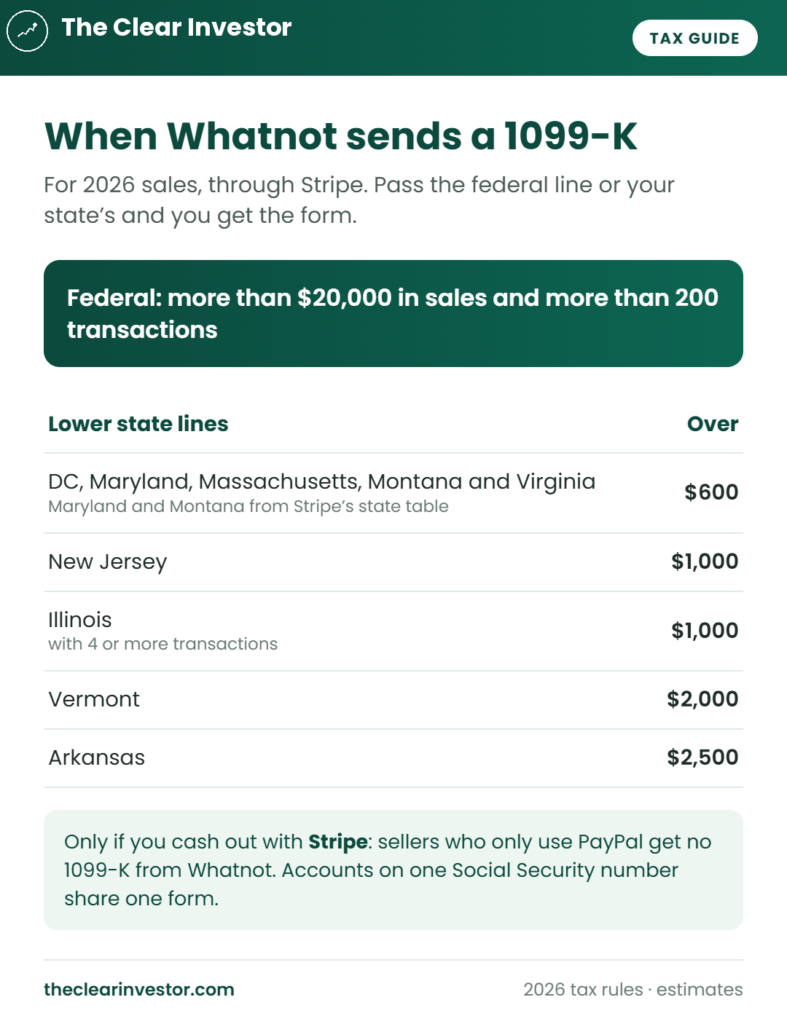
Whatnot sends a Form 1099-K through Stripe for any year you pass the federal line or your state’s, according to its 1099-K help page:
- The federal line for 2026 is more than $20,000 in sales and more than 200 transactions. You need both.
- Lower state lines. Whatnot and Stripe, which files the forms, list these for 2026, and some states’ rules may still change:
| State | Whatnot may send a 1099-K over |
|---|---|
| Arkansas | $2,500 |
| District of Columbia | $600 |
| Illinois | $1,000 and 4 transactions |
| Maryland | $600 |
| Massachusetts | $600 |
| Montana | $600 |
| New Jersey | $1,000 |
| Vermont | $2,000 |
| Virginia | $600 |
- Maryland and Montana: Whatnot’s page lists Maryland at $2,000 and leaves Montana out, but Stripe’s state table lists both at $600, so I’ve used the lower line. California and North Carolina follow the federal line.
- You need a connected Stripe account. If you’ve only cashed out with PayPal, Whatnot doesn’t send you a 1099-K, though PayPal may send its own. If you used both, you may get one from each.
- One form for all your accounts. Whatnot accounts under the same Social Security number or EIN are combined on one 1099-K.
- What it counts: Whatnot says the form reports all your Whatnot earnings for the year, and sales from your own collection count toward the line. Its page doesn’t say whether the amount includes the shipping, sales tax and tips buyers paid, so compare the form with your annual seller statement.
- Where to find it: from mid-November, Whatnot emails sellers who pass a line to confirm their tax info and choose paperless delivery. The form is in Seller Hub by January 31, 2027.
Under the line you may get no form at all, but your profit is still taxable. Whatnot gives every seller monthly and annual seller statements that break down your income and fees, whether or not you get a 1099-K.
Why Your Whatnot 1099-K Is More Than You Made
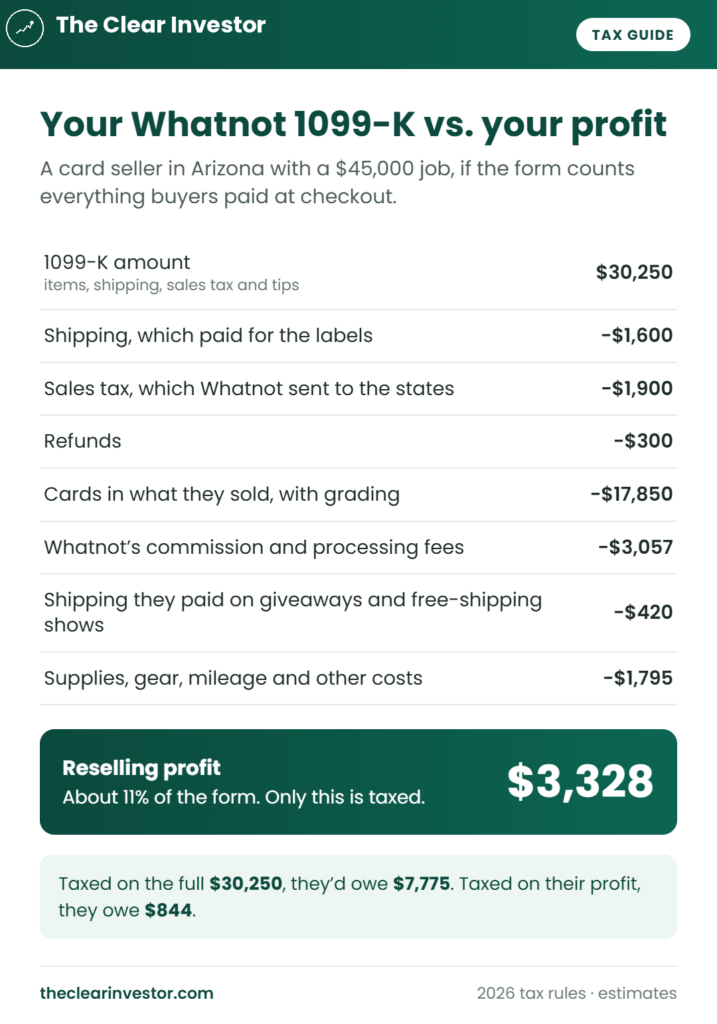
Your 1099-K is a record of what buyers paid, not of what you earned. Here’s how it works out for the card seller with a $45,000 job in my calculator’s starting example, if their form counts everything buyers paid:
| Step | Amount |
|---|---|
| 1099-K amount (items, shipping, sales tax and tips) | $30,250 |
| Shipping, which paid for the labels | −$1,600 |
| Sales tax, which Whatnot sent to the states | −$1,900 |
| Refunds | −$300 |
| Cards in what they sold, with grading | −$17,850 |
| Whatnot’s commission and processing fees | −$3,057 |
| Shipping they paid on giveaways and free-shipping shows | −$420 |
| Supplies, gear, mileage and other costs | −$1,795 |
| Reselling profit | $3,328 |
Their profit is about 11% of the form. Taxed on the full $30,250, they’d owe $7,775. Taxed on the $3,328, they owe $844. Cards are a thin-margin business: most of what buyers pay goes into the next box or lot, so the form can be nine times your profit.
The shipping buyers pay covers the label Whatnot makes for you, per its shipping setup page. The sales tax isn’t your income either: Whatnot collects it and sends it to the states, so you never charge it yourself, per its sales tax page. If either one is on your 1099-K, take it out on your return.
Whatnot’s Fees: Every One Comes Off
Whatnot charges two fees on every checkout and nothing to list, per its fee page:
| Fee | What it costs |
|---|---|
| Commission | 8% of the final sale price for most categories and 4% for Coins & Money, lower once your sales pass $15,000 in four weeks; not charged on shipping or sales tax |
| Payment processing | 2.9% of everything the buyer pays at checkout, with shipping and sales tax, plus 30¢ |
| Giveaways | No seller fees, but you pay the shipping |
| Free or reduced shipping | Whatever you cover comes out of your earnings |
| Tips | No commission, and buyers pay the processing fee |
| Tax on fees | Charged in some states and taken from your earnings |
Since September 21, 2026, the commission drops in tiers as you sell more. When your sales in a four-week period reach $15,000, you pay a lower rate for the next four weeks, and the rate depends on the category: sports cards and trading card games drop to 7.75% at that first tier, for example. For cards, comics, toys, coins and a few other categories, Whatnot also charges no commission on the part of a sale price over $1,500, as a limited-time offer, and it runs short promotions with lower commission. So use the fees on your seller statements, not a fee chart. Fees are charged per checkout, even when a buyer’s purchases ship together.
In a few states, Whatnot also charges sales tax on its fees: on the commission in DC, Hawaii, New Mexico and West Virginia, and on the processing fee in Connecticut, Hawaii, New Mexico, Ohio, South Dakota, Texas and West Virginia, per its tax on fees page. A resale certificate doesn’t cover it. It’s part of what the fee costs you, so it comes off with the fee.
For the card seller in my calculator’s first example, the commission was $2,096 and processing was $961, or $3,057 on $26,500 of items, about 12%. About $100 of the processing fee was charged on the shipping and sales tax buyers paid, money that never reached them.
Tips are income, and they go on Schedule C with your sales. Whatnot takes no commission on them and buyers pay the processing fee, per its tips terms, so all of a tip reaches you.
Cards, Breaks, Grading and Giveaways: Your Cost of Goods Sold
What you paid for the cards and other things you resold comes off your sales, but only for what actually sold this year. Part III of Schedule C works it out:
| Step | Card seller (Example 1) |
|---|---|
| Stock on hand January 1 | $2,500 |
| Plus stock you bought (with sales tax and shipping) | $18,000 |
| Minus stock still unsold December 31 | −$3,200 |
| Plus grading fees on cards that sold | $550 |
| Cost of what you sold | $17,850 |
Here’s how the parts of a Whatnot shop fit into it:
- Breaks: the spots buyers pay for are your sales, and the sealed boxes you open are stock. Once a box is opened and its cards go out, its cost is part of what you sold.
- Grading: a grading fee is part of that card’s cost. It comes off the year the card sells, not the year you sent it in. A slab still unsold on December 31 goes in your ending stock with its grading fee.
- Giveaways: a card you give away leaves your stock, so its cost is already in your cost of goods sold. Don’t deduct it a second time. The shipping you pay on it is a business cost of its own, per Whatnot’s giveaway page.
- Your December 31 count: write down what you paid for every single, slab and sealed box you haven’t sold. A $400 box you bought in December isn’t a $400 deduction this year if it’s still sealed.
Keep a record of every buy: receipts, order emails, or a log of the date, seller and amount for cash deals at card shows.
Other Whatnot Deductions
- Shipping supplies: penny sleeves, top loaders, team bags, bubble mailers, boxes and tape.
- Streaming gear: a phone or camera, lights, a mic, a tripod, a break table or card displays. With 100% bonus depreciation, equipment bought after January 19, 2025, comes off all at once.
- Show promotion and boost fees, if you pay Whatnot to promote a show or a listing.
- Mileage: 72.5¢ a mile through June 2026 and 76¢ from July, the IRS standard mileage rates, for card shows, buying trips and post office runs. Driving to a regular job doesn’t count.
- Card show tables and travel, plus the share of your phone and internet you use for the shop.
- A home office, if you use a space regularly and only for your shows, and storage space for your stock has a looser rule in IRS Publication 587. My 1099 taxes guide explains both ways to figure it.
These only count for reselling. On your own collection, Whatnot’s fees on those sales come off your gain, but your other costs don’t come off anything.
The 28% Collectibles Rate on Your Own Collection
This is the part most Whatnot tax guides skip. When you sell cards, coins or comics from your own collection for more than you paid, and you’ve owned them more than a year, the gain doesn’t get the 0%, 15% or 20% long-term rates that stocks get. Here’s how it works, per IRS Topic 409 and the Schedule D instructions:
- Collectibles include art, antiques, metals, gems, stamps, coins and certain other tangible property. Cards, comics and memorabilia are generally treated the same way.
- The rate is your regular rate while your taxable income stays in the brackets through 24%, and 28% above that. A collectibles gain never gets 0% or 15%.
- Owned a year or less, any gain is short-term and taxed at your regular rate anyway.
- There’s no self-employment tax on it, because selling your own collection isn’t a business.
- Over $200,000 of income ($250,000 married filing jointly), the 3.8% net investment income tax applies too.
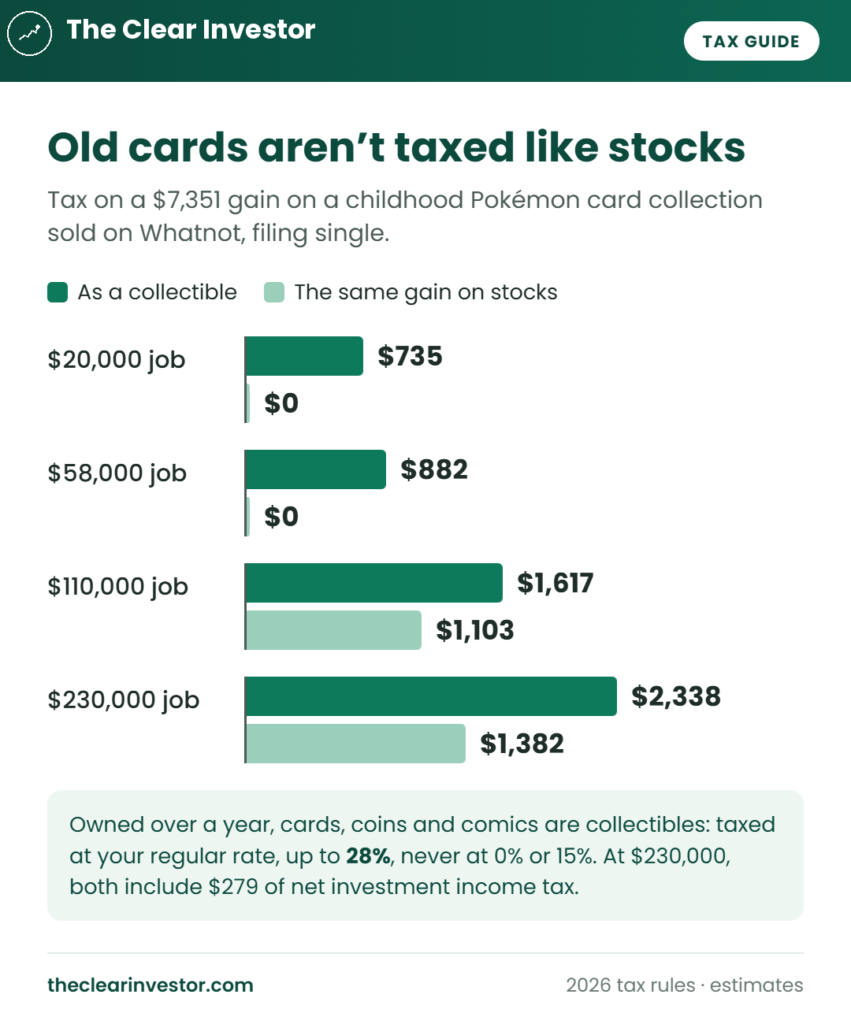
Here’s the collector in my calculator’s second example: a $7,351 gain on Pokémon cards they’d had since they were a kid, at four different incomes, filing single:
| W-2 job | Tax on the gain as a collectible | The same gain on stocks |
|---|---|---|
| $20,000 | $735 | $0 |
| $58,000 | $882 | $0 |
| $110,000 | $1,617 | $1,103 |
| $230,000 | $2,338 | $1,382 |
At $58,000, the same gain on stocks would cost nothing, because their taxable income of $49,251 is under the $49,450 line for the 0% rate. As a collectible, it costs $882. At $230,000, both columns include $279 of net investment income tax.
Cards you collected for fun that sold for less than you paid aren’t deductible. If you bought cards or coins only as an investment, a loss can be a capital loss instead, so talk to a tax professional about that one.
How Much Tax Will You Owe on Whatnot?
Here’s what Whatnot taxes look like for a single seller in a state with no income tax, by reselling profit after every cost:
| Whatnot profit | No other income | With a $30,000 job |
|---|---|---|
| $1,000 | $141 | $231 |
| $3,000 | $424 | $692 |
| $5,000 | $706 | $1,153 |
| $10,000 | $1,413 | $2,305 |
| $20,000 | $3,025 | $4,610 |
| $40,000 | $7,427 | $9,221 |
With no other income, the standard deduction covers your income tax until your profit passes about $17,000, so you pay about 14% of your profit, all of it self-employment tax. With a job in the 12% bracket, it’s about 23% of your profit. Add your state’s rate on top. In payout terms it depends on your margins: the card seller in my calculator keeps about 14% of their payouts as profit, so they set aside 4% of every payout. My Whatnot tax calculator works out yours, along with what you keep per order and per hour.
Do You Need to Pay Whatnot Taxes Quarterly?
If your shop does well, yes. The IRS expects estimated tax payments when you’ll owe $1,000 or more at tax time. With no other income, you get there at about $7,100 of profit. A big sale from your own collection counts too.
Set aside your percentage of each payout when Whatnot pays you, then pay by April 15, June 15, September 15 and January 15. With a job, you can raise your Form W-4 withholding instead. The safe harbor that keeps you penalty-free is in how quarterly payments work.
Free tax tracker + deadline reminders
Get my free side income tax tracker
Sign up and I’ll send you my Google Sheets tracker that shows how much of each payout to set aside. You’ll also get an email before each quarterly tax deadline (Jan 15, Apr 15, Jun 15 and Sep 15), plus my new guides. Unsubscribe anytime.
Earn on several platforms or drive for work? Get the full 1099 Side Income Tracker ($12) →
Whatnot Taxes: How to File
- Download your annual seller statement from Whatnot, plus your 1099-K from Seller Hub if you got one.
- Split your own collection from your reselling. Things you sold at a loss go on Form 8949 with code L, or at the top of Schedule 1 as “Form 1099-K Personal Item Sold at a Loss” with the same amount subtracted in Part II, so they come to zero. A gain goes on Form 8949 and Schedule D, as a collectible if you owned it more than a year.
- Report your reselling sales and tips on line 1 of Schedule C, whether or not you got a 1099-K, and refunds on line 2. If your 1099-K includes the shipping and sales tax buyers paid, take them off again as costs so they net to zero, and keep your seller statement to show it.
- Work out the cost of what you sold in Part III, with grading on the cards that sold, and carry it to line 4. Then add Whatnot’s fees on line 10, mileage on line 9, supplies on line 22, and the shipping you paid and other costs in Part V.
- Pay self-employment tax on Schedule SE, claim the qualified business income deduction on Form 8995, and subtract any estimated payments.
I file with TaxAct. I keep a separate Schedule C for each kind of work and attach each 1099 to the one it belongs to, so the income and costs for that work stay together.
Special Situations
If you only sold your own collection
There’s no business and no self-employment tax. Things sold at a loss aren’t taxed, and if they’re on a 1099-K, you report them so they come to zero. A gain goes on Form 8949 and Schedule D, at the collectibles rate if you owned it more than a year. That’s the collector in my calculator’s second example.
If you cash out with PayPal
Whatnot only sends a 1099-K through Stripe, so you won’t get one from Whatnot. PayPal may send its own, which can include your other PayPal and Venmo payments. Your income is the same either way, so make sure no sale gets counted twice.
If you have more than one Whatnot account
Stripe combines every account under the same Social Security number or EIN on one 1099-K. Accounts that sell the same kind of thing can share a Schedule C.
If your shop is a single-member LLC
The 1099-K goes under your own Social Security number, because the IRS ignores a single-member LLC for income tax by default. Only if you chose to have it taxed as a corporation does the form go under its EIN.
If you also sell on eBay or at card shows
eBay sends its own 1099-K once you pass its line, and cash sales at card shows are income too. All your reselling can go on one Schedule C if it’s the same business. My eBay tax guide covers eBay’s side.
If your shop lost money
The loss lowers the tax on your other income, like a W-2 job. Several loss years in a row can make the IRS ask whether you’re really trying to make a profit, so keep your records and price to make money.
If you sold under the 1099-K line
You may not get a form, but your reselling profit is still taxable, and self-employment tax starts once it reaches about $433.
Common Whatnot Tax Mistakes
These are the Whatnot tax mistakes I’d watch for:
- Paying tax on the 1099-K total. For the card seller in my calculator, that’s $7,775 instead of $844.
- Leaving the shipping and sales tax buyers paid in your income. If they’re on your 1099-K, leaving them in costs that same seller $888.
- Forgetting Whatnot’s fees and the shipping you paid. Whatnot takes them out before it pays you, so they’re easy to miss when you start from the 1099-K. Leaving them out costs the card seller $883.
- Using the 0% or 15% rate on old cards. A long-term gain on cards, coins or comics is a collectible. The collector in my calculator would report $0 and still owe $882.
- Deducting every box you bought. Only what sold this year comes off, so count your stock on December 31.
- Deducting a giveaway twice. The card’s cost is already in your cost of goods sold. Only the shipping comes off on its own.
- Spending every payout. Nothing is withheld, so part of each one is tax.
My Verdict: Keep Your Collection and Your Stock Apart
Whatnot taxes come down to two lists. Your reselling is a business, taxed on the profit after your cards, grading, Whatnot’s fees and the shipping you pay, not on a 1099-K that may hold the shipping and sales tax too. Your own collection is taxed only on a gain, but an old card that went up in value is a collectible, taxed at up to 28% instead of the 0% or 15% you might expect.
Set aside about 14% of your reselling profit with no other income, or about 23% with a job, plus your state’s rate. My Whatnot tax calculator works out your number, splits your collection from your reselling, taxes a gain as a collectible and shows what you keep per order and per hour.
Want more ways to earn? See every platform I’ve used in How I make money online.
FAQ
Do I have to pay taxes on Whatnot sales?
On reselling, yes: on your profit after the cost of what you sold, grading, Whatnot’s fees, the shipping you paid and other costs. Things from your own collection that sold for less than you paid aren’t taxed.
Does Whatnot send a 1099-K?
For 2026, when your sales are over $20,000 with more than 200 transactions, or over a lower line in Arkansas, DC, Illinois, Maryland, Massachusetts, Montana, New Jersey, Vermont or Virginia. It comes through Stripe.
Where do I find my Whatnot 1099-K?
In Whatnot’s Seller Hub, by January 31, 2027. From mid-November, Whatnot emails sellers who pass a line to confirm their tax info. If you’ve only cashed out with PayPal, Whatnot doesn’t send one.
Why is my Whatnot 1099-K more than I made?
It counts your sales before refunds and fees, and it may include the shipping, sales tax and tips buyers paid. You report it, then take out what never reached you, the fees and the cost of what you sold.
Is selling my card collection on Whatnot taxed?
Only if it sold for more than you paid. Owned over a year, cards, coins and comics are collectibles, taxed at your regular rate up to 28%, with no self-employment tax.
Are Whatnot tips taxable?
Yes. Tips are income, taxed with your Whatnot profit. Whatnot takes no commission on them.
Do I pay tax on Whatnot giveaways?
No. The card’s cost is already in your cost of goods sold, and the shipping you pay on a giveaway is a business cost.
How much should I set aside for Whatnot taxes?
About 14% of your reselling profit with no other income, or about 23% with a job in the 12% bracket. Add your state’s rate.
I’m not a licensed financial advisor or tax professional. This guide is based on Whatnot’s and Stripe’s help pages for sellers, IRS rules and my own experience filing 1099 income on Schedule C. It’s for educational purposes and isn’t tax advice. Tax rules change, so check the links above or talk to a tax professional about your situation. I’m not affiliated with Whatnot, Stripe or TaxAct.