Turo taxes work like a small business. If you run your cars yourself, you owe income tax and 15.3% self-employment tax on your profit after Turo’s fees and your car costs, and Turo doesn’t take any of it out of your payouts. The big decision is how to deduct the car: the standard mileage rate or your actual costs with depreciation. You make that choice in the car’s first year on Turo, and it decides what you can do in every year after.
Three things make Turo different from other side gigs. Turo reports your gross earnings, before the 10% to 30% it keeps. The miles guests drive count as your business miles, so the mileage deduction can be huge. And Turo’s own tax guide says that on the standard mileage rate you deduct only about 70% of Turo’s fees, because part of the fee pays for protection that the rate already covers.
I haven’t hosted on Turo. I’ve filed my own taxes with TaxAct every year since 2022, I file two side gigs on their own Schedule Cs, and I drove for Amazon Flex in California for about 18 months, logging every day’s miles in an Excel sheet and deducting them at the standard mileage rate. Everything Turo-specific here comes from Turo’s tax page for hosts, its tax guide for US hosts written with EY, the IRS and my Turo tax calculator, and each piece links to its source so you can check it yourself.
Turo taxes, the short answer:
- Do Turo hosts pay taxes? Yes, on your profit after Turo’s fees, your car costs and your other costs. If you run your cars yourself, that includes self-employment tax.
- Does Turo send a 1099-K? Turo’s tax page says you get one with more than 200 transactions and over $20,000 in gross earnings, or if you live in a state with a lower line. It’s on your Tax information page by January 31.
- Standard mileage rate or actual costs? Run both in a car’s first year. The standard rate often wins for a car with lots of guest miles. Actual costs often win in the first year of a car you bought to rent out, but then that car can’t use the standard rate again.
- Can you deduct Turo’s fees? Yes. All of them with actual costs, and about 70% with the standard mileage rate, per Turo’s tax guide.
- How much should you set aside? About 14% of your profit with no other income, or about 23% with a job in the 12% bracket, plus your state’s rate. For the host in my calculator’s starting example, that’s 12% of every payout.
Table of Contents
Do Turo Hosts Pay Taxes?
Yes. When you rent your car out on Turo to make money, the IRS taxes the profit, and for most hosts that works like a business:
- Nothing is withheld. Turo pays you your share of each trip and keeps its fee, but it doesn’t take out income tax, so part of every payout is tax you’ll owe later.
- You report it as a business. Your gross earnings, Turo’s fees and your car costs go on Schedule C, and only the profit is taxed.
- Self-employment tax is 15.3% on 92.35% of your profit once it’s $400 or more. It’s your Social Security and Medicare, and you owe it even when you owe no income tax.
- Income tax only applies to income above your standard deduction, $16,100 for single filers in 2026. With a job, your pay usually uses that up, so your Turo profit is taxed at your bracket.
Turo also says every US host has to submit tax information, and it may pause your payments until you do. The rules every 1099 side hustle shares are in my side hustle taxes guide. This guide covers what’s different about Turo.
Schedule C, Schedule 1 or Schedule E?
Hosts often expect Turo to work like Airbnb, where rentals usually go on Schedule E. It doesn’t. Schedule E is for real estate, and a car is personal property. Turo’s tax guide gives two places for your Turo income:
- Schedule C, line 1, for hosts who materially participate, which means taking a real part in running the rentals. The IRS has seven tests in Publication 925. Doing substantially all the work yourself passes one, and so does spending more than 100 hours on it and no less than anyone else. Most hosts who handle their own trips, messages, cleaning and deliveries are here, and they pay self-employment tax.
- Schedule 1, line 8l, with expenses on line 24b, for hosts who don’t. There’s no self-employment tax there, but losses are harder to use.
Short trips matter here too. Under the passive activity rules, renting out property isn’t a “rental activity” when the average period of customer use is seven days or less. So if your average Turo trip is seven days or less and you run the cars yourself, Turo is an active business, and a loss can lower the tax on your other income. If someone else runs your cars, ask a tax professional how the passive activity rules apply to you.
Your Turo 1099-K: When It Comes and What It Shows
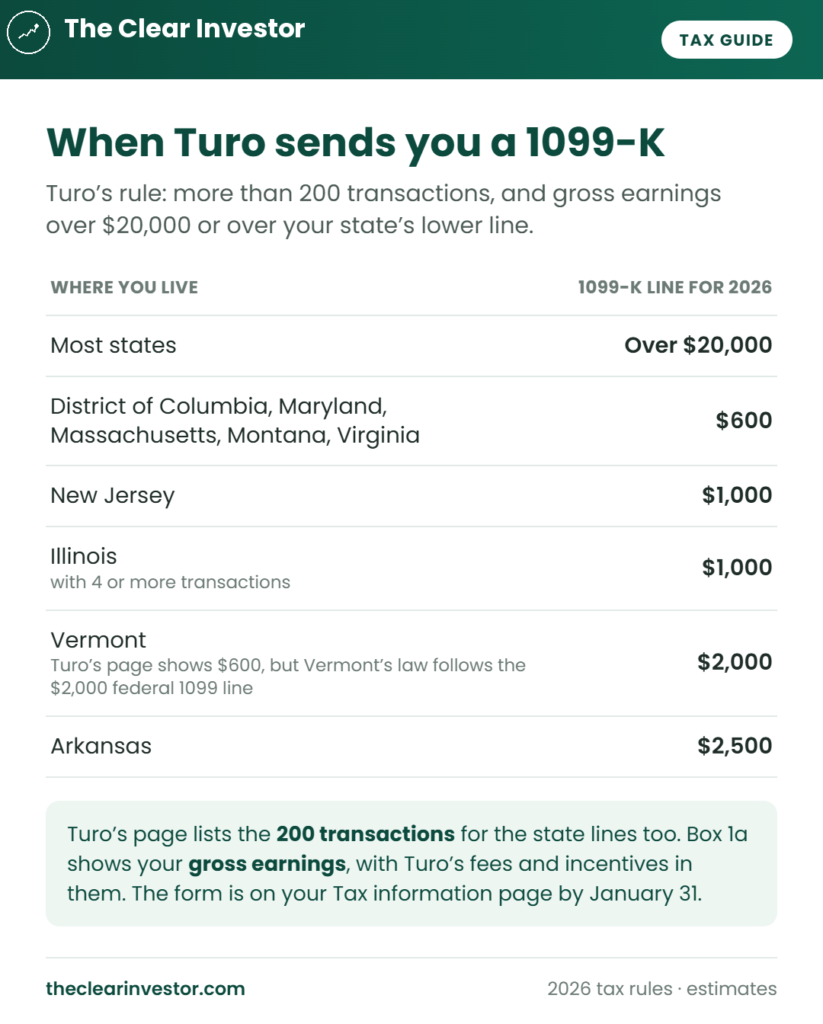
Turo sends a Form 1099-K when you pass the federal line or your state’s. Its tax page for hosts says you get one if you had more than 200 transactions during the year and either earned more than $20,000 in gross earnings or live in a state with a lower line:
| State | 1099-K line |
|---|---|
| Arkansas | $2,500 |
| District of Columbia | $600 |
| Illinois | $1,000 and 4 transactions |
| Maryland | $600 |
| Massachusetts | $600 |
| Montana | $600 |
| New Jersey | $1,000 |
| Vermont | $2,000 for 2026 (Turo’s page shows $600) |
| Virginia | $600 |
- Vermont: Turo’s page shows $600, but Vermont’s law ties its line to the federal line for other 1099 forms (32 V.S.A. § 5862d), which is $2,000 for payments made in 2026 (IRS). If Turo still sends a form at $600, report it the same way.
- The 200 transactions: the way Turo’s page is worded, it applies to the state lines too, so a host in one of those states with fewer trips may or may not get a form. Check your Tax information page either way.
- What box 1a shows: your gross earnings, which Turo says include trip earnings, Turo fees, host incentives and host fees. They don’t include reimbursements or sales tax. Your gross earnings on the Tax information page should match box 1a.
- Where to find it: on the Tax information page on Turo, which also has your annual earnings breakdown. Turo emails you when it’s ready, by January 31.
- Your tax info: if you haven’t submitted it, Turo may pause your payouts until you do.
Under the line you may get no form at all, but your profit is still taxable, and the earnings breakdown on the Tax information page has the numbers you need.
Why Your Gross Earnings Are More Than You Made
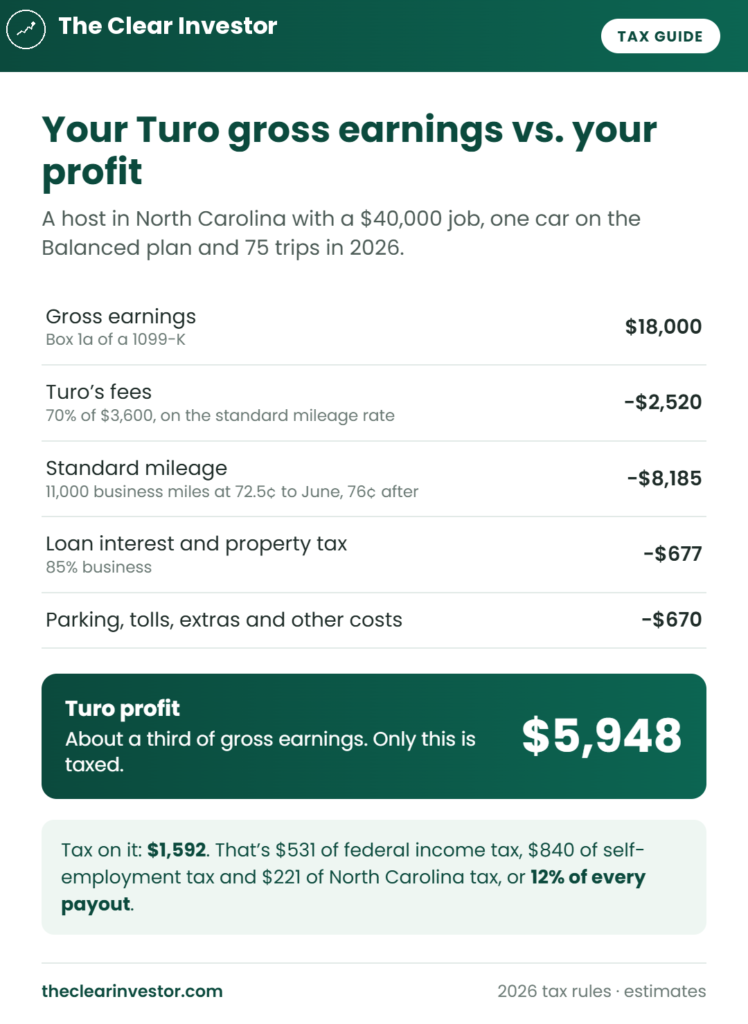
Your gross earnings include the fees Turo kept and everything your car cost you to run. Here’s how it works out for the host with a $40,000 job in my calculator’s starting example, who has rented one car on Turo for a few years on the standard mileage rate:
| Step | Amount |
|---|---|
| Gross earnings (box 1a) | $18,000 |
| Turo’s fees on the Balanced plan: 70% of $3,600 | −$2,520 |
| Standard mileage on 11,000 business miles | −$8,185 |
| Loan interest and property tax (85% business) | −$677 |
| Parking, tolls, extras and other costs | −$670 |
| Turo profit | $5,948 |
Their profit is about a third of their gross earnings. Taxed on the full $18,000, they’d owe $4,817 more than with no Turo at all. Taxed on the $5,948, they owe $1,592. The other 30% of Turo’s fees, $1,080, doesn’t come off on its own, because the standard rate already covers it.
Turo’s Fees and Earnings Plans
Turo keeps part of every trip, and how much depends on your earnings plan. In 2026, Turo renamed its protection plans as earnings plans, with the same 90%, 80% and 70% shares. Per its earnings plans page:
| Earnings plan | You keep | Your damage responsibility |
|---|---|---|
| More earnings | 90% | $2,750 |
| Balanced | 80% | $1,500 |
| More peace of mind | 70% | $250 |
Your share is a percentage of the trip price, delivery fees and Extras. Every plan includes up to $750,000 of third-party liability coverage. In Austin, Dallas, Detroit, Las Vegas, Maui, Philadelphia, Phoenix, San Diego and Seattle, your share depends on how far ahead guests book, so use the fees on your Tax information page.
How much of the fee you deduct depends on how you deduct your car. Turo’s tax guide says part of the fee pays for protecting your car during trips, which works like insurance. The standard mileage rate already covers insurance, so hosts on the standard rate deduct only part of the fees, and it calls 70% a reasonable estimate. Hosts on actual costs deduct all of them. For the host in Example 1, that’s $2,520 of their $3,600 in fees.
The guide was written for the 2022 tax year, before the plans got their new names, but the reasoning hasn’t changed: the fee still pays for protection, and the standard rate still covers insurance.
Standard Mileage Rate or Actual Costs?
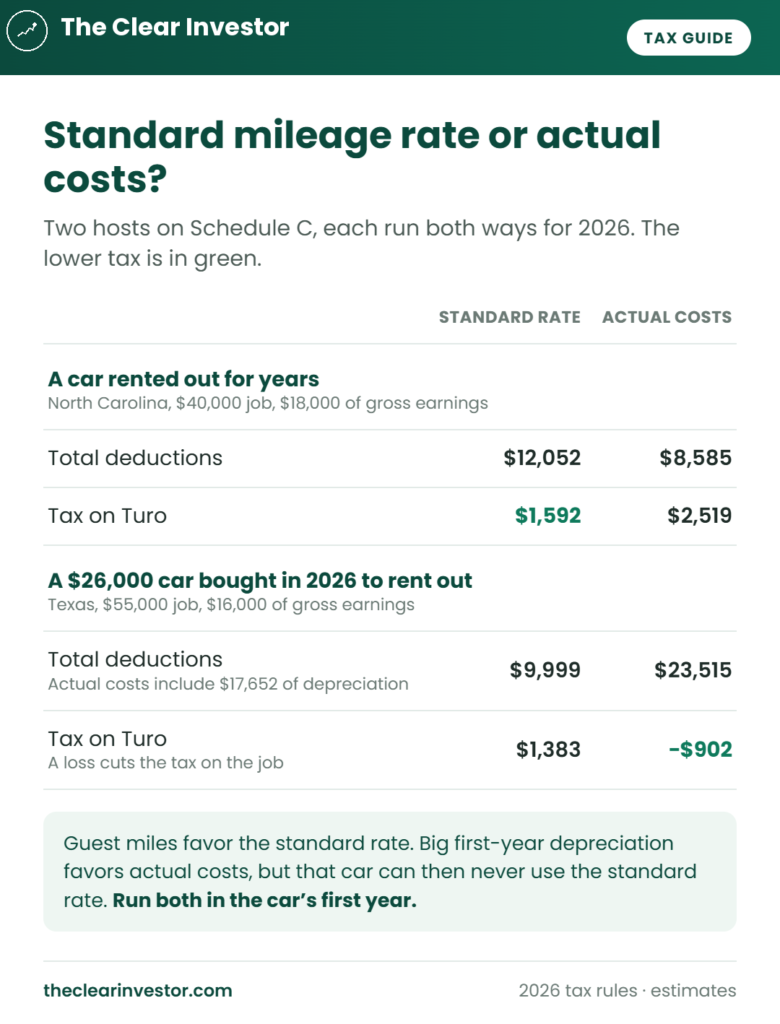
This is the biggest Turo tax decision. Per Revenue Procedure 2019-46, which still sets the rules:
- The standard mileage rate is 72.5¢ a business mile through June 2026 and 76¢ from July, per the IRS. It covers depreciation, maintenance and repairs, tires, gas, oil, insurance and registration. Parking, tolls, car loan interest and personal property tax come off on top.
- Actual costs are the business share of everything the car costs you: gas, insurance, repairs, tires, registration, loan interest and property tax, plus depreciation.
- Your business miles are the miles guests drive on trips plus your own drives for Turo, like deliveries, gas runs, washes and repairs. Turo’s tax guide counts the miles the car is out on rentals as business miles, and it says Turo doesn’t track your business and personal miles for you.
- Your business share is your business miles divided by all the miles on the car. If the car is only for Turo, it can be close to 100%.
The rules decide when you can pick:
- The first year counts. For a car you own, you have to use the standard rate in the first year the car is used for business to use it at all, per the IRS. After that, you can switch to actual costs, with straight-line depreciation.
- Once you depreciate, you’re locked in. After you take bonus depreciation, Section 179 or regular depreciation on a car, you can’t use the standard rate for it again.
- Five cars ends it. With five or more cars in use at the same time, the IRS doesn’t allow the standard rate.
Here’s the host from Example 1, whose car has been on the standard rate for a few years:
| Standard mileage | Actual costs | |
|---|---|---|
| Car deduction | $8,185 (11,000 miles) | $3,638 (85% of $4,300) |
| Turo’s fees | $2,520 (70%) | $3,600 |
| Interest, parking, tolls and other costs | $1,347 | $1,347 |
| Total deductions | $12,052 | $8,585 |
| Tax on their Turo earnings | $1,592 | $2,519 |
Guests put a lot of miles on a Turo car, and the standard rate pays for every one of them. Actual costs only catch up when depreciation is big, which is usually the first year of a car you bought to rent out.
Depreciation on a Turo Car
Depreciation only counts with actual costs. Here’s how it works for a car you start renting out in 2026:
- Your starting point is what you paid, or the car’s value when you started renting it out if that’s lower, per IRS Publication 946. A car you’ve been driving for years is usually worth less than you paid.
- Business use over 50%: a car bought after January 19, 2025, gets 100% bonus depreciation, but the IRS caps how much of a car you can deduct each year.
- Business use of 50% or less: no bonus. The car is depreciated straight-line over five years, which is 10% of its value in the first year.
- Every cap and percentage is multiplied by your business share.
The caps for a car placed in service in 2026, per Revenue Procedure 2026-15:
| Year | With bonus depreciation | Without |
|---|---|---|
| Year 1 | $20,300 | $12,300 |
| Year 2 | $19,800 | $19,800 |
| Year 3 | $11,900 | $11,900 |
| Each year after | $7,160 | $7,160 |
Here’s the new host in my calculator’s second example. They bought a $26,000 car in 2026 to rent out, it’s 87% business, and they have a $55,000 job in Texas. With actual costs, depreciation is 87% of the $20,300 cap, $17,652, and their first year on Turo is a $7,515 loss that cuts the tax on their job by $902. With the standard rate, they’d owe $1,383. Actual costs save them $2,285 this year.
The trade-off comes later. That car can never use the standard rate again, and with most of its cost already deducted, there’s little depreciation left for the next years, so the deduction will mostly be running costs.
Two more things to know:
- The caps don’t apply to someone regularly in the business of leasing cars. The IRS rules say that takes renting out cars with some frequency over time, and that someone leasing only one car isn’t. If you rent out several cars all year, ask a tax professional whether you qualify.
- Depreciation comes back when you sell. It lowers the car’s tax basis, and if you sell it for more than that, the gain is taxable, as regular income up to the depreciation you took. The standard rate counts too: 35¢ of every 2026 business mile is depreciation, per Notice 2026-10, and it lowers the car’s basis the same way.
Other Turo Host Deductions
- Parking and tolls Turo didn’t repay, like airport parking and tolls on a delivery. They come off with either method. Turo’s tax guide also lists unreimbursed parking and tolls during a guest’s trip. To get tolls and tickets from a trip repaid, Turo gives you 90 days to submit them.
- Car loan interest and personal property tax, for the business share, with either method.
- Extras and supplies for guests, like child seats, phone chargers and coolers.
- Car washes, detailing and cleaning supplies. Turo’s tax guide lists them with gas, repairs and tires, so my calculator counts them only with actual costs, to be safe.
- Your phone, a mileage app and tax help, for the share you use for Turo.
What doesn’t come off: anything Turo or a guest repaid you, the personal share of your car costs, and traffic tickets you pay yourself, since fines aren’t deductible. If Turo’s protection pays for a repair, only the part you paid yourself counts, and only with actual costs.
How Much Tax Will You Owe on Turo?
Here’s what Turo taxes look like for a single host in a state with no income tax, by profit after every cost:
| Turo profit | No other income | With a $30,000 job |
|---|---|---|
| $1,000 | $141 | $231 |
| $3,000 | $424 | $692 |
| $5,000 | $706 | $1,153 |
| $10,000 | $1,413 | $2,305 |
| $20,000 | $3,025 | $4,610 |
| $40,000 | $7,427 | $9,221 |
With no other income, the standard deduction covers your income tax until your profit passes about $17,000, so you pay about 14% of your profit, all of it self-employment tax. With a job in the 12% bracket, it’s about 23% of your profit. Add your state’s rate on top. In payout terms it depends on your car: the host in my calculator’s starting example keeps about 41% of their payouts as profit, so they set aside 12% of every payout. My Turo tax calculator works out yours, with both car methods side by side.
Do You Need to Pay Turo Taxes Quarterly?
If your cars earn a profit, probably. The IRS expects estimated tax payments when you’ll owe $1,000 or more at tax time. With no other income, you get there at about $7,100 of profit.
Set aside your percentage of each payout when Turo pays you, then pay by April 15, June 15, September 15 and January 15. With a job, you can raise your Form W-4 withholding instead. The safe harbor that keeps you penalty-free is in how quarterly payments work. A first year with a big depreciation loss may mean you owe nothing extra at all.
Free tax tracker + deadline reminders
Get my free side income tax tracker
Sign up and I’ll send you my Google Sheets tracker that shows how much of each payout to set aside. You’ll also get an email before each quarterly tax deadline (Jan 15, Apr 15, Jun 15 and Sep 15), plus my new guides. Unsubscribe anytime.
Earn on several platforms or drive for work? Get the full 1099 Side Income Tracker ($12) →
Turo Taxes: How to File
- Download your annual earnings breakdown from the Tax information page, plus your 1099-K if you got one.
- Report your gross earnings on line 1 of Schedule C, whether or not you got a 1099-K.
- Deduct Turo’s fees on line 10: all of them with actual costs, or about 70% with the standard rate.
- Deduct your car on line 9: the standard mileage amount, or the business share of gas, insurance, repairs and registration, plus parking and tolls either way. Depreciation goes on line 13 with Form 4562, the business share of your loan interest on line 16b, and the business share of personal property tax on line 23.
- Answer the vehicle questions, with your business, commuting and other miles: in Part IV of Schedule C, or on Form 4562 if you take depreciation.
- Pay self-employment tax on Schedule SE, claim the qualified business income deduction on Form 8995, and subtract any estimated payments.
I file with TaxAct. I keep a separate Schedule C for each kind of work and attach each 1099 to the one it belongs to, so the income and costs for that work stay together.
Special Situations
If you have several cars
Each car gets its own method. You can keep an older car on the standard rate and put a new one on actual costs. Once you have five or more on Turo at the same time, the standard rate is gone for all of them.
If you drive your Turo car yourself too
Your personal miles lower the business share of your actual costs and your depreciation. Below 50% business use, there’s no bonus depreciation. The couple of hundred miles of a weekend trip add up, so log them.
If you started renting out a car you already owned
Your starting point for depreciation is the lower of what you paid or what the car was worth when you started renting it out. If you bought it before January 20, 2025, the 100% bonus doesn’t apply, so let your tax software work out the first year.
If Turo’s protection pays for damage
A repair Turo’s protection pays for isn’t your cost. With actual costs, deduct only the part you paid yourself, like your damage responsibility under your plan.
If you also drive for Uber or Lyft
Miles can only count once. Driving guests on a rideshare app in your own car is a different business on its own Schedule C. My Lyft tax guide covers that side.
If you sell a Turo car
Depreciation lowers the car’s basis, including the 35¢ a mile built into the standard rate for 2026. If you sell for more than that basis, the gain is taxable.
If you earned under the 1099-K line
You may not get a form, but your profit is still taxable, and self-employment tax starts once it reaches about $433.
Common Turo Tax Mistakes
These are the Turo tax mistakes I’d watch for:
- Paying tax on your gross earnings. For the host in my calculator’s starting example, that’s $4,817 instead of $1,592.
- Forgetting Turo’s fees. Turo keeps them before it pays you, so they’re easy to miss when you start from the 1099-K. Leaving them out costs that host $674.
- Deducting all of Turo’s fees on the standard rate. Turo’s own tax guide says about 70%.
- Counting only your own driving. The miles guests drive are business miles too. If the host in Example 1 counted only 1,000 miles of their own errands, they’d owe $3,693.
- Letting the first year decide by accident. That’s the only year you can choose the standard rate for that car, so run both methods first.
- Deducting the whole price of the car. Depreciation is capped and multiplied by your business share.
- Deducting costs Turo repaid you. Reimbursed gas, tolls and tickets aren’t income, and they aren’t deductions either.
- Spending every payout. Nothing is withheld, so part of each one is tax.
My Verdict: Pick Your Car Method in Year One
Turo taxes come down to the car. Your profit is your gross earnings minus Turo’s fees and what the car costs you, and the way you count the car can change your tax by thousands. The standard mileage rate pays for every mile guests drive and keeps your options open. Actual costs with depreciation can turn a new car’s first year into a loss, but they lock that car in.
Set aside about 14% of your Turo profit with no other income, or about 23% with a job, plus your state’s rate. My Turo tax calculator works out your number, runs both car methods side by side, handles first-year depreciation and shows what you keep per trip and per hour.
Want more ways to earn? See every platform I’ve used in How I make money online.
FAQ
Do I have to pay taxes on Turo income?
Yes, on your profit after Turo’s fees and your car costs. If you run your cars yourself as a business, that includes 15.3% self-employment tax.
Does Turo send a 1099-K?
Turo’s tax page says you get one with more than 200 transactions and over $20,000 in gross earnings, or if you live in a state with a lower line: Arkansas, DC, Illinois, Maryland, Massachusetts, Montana, New Jersey, Vermont or Virginia.
Where do I find my Turo 1099-K?
On the Tax information page on Turo, by January 31. It also has your annual earnings breakdown, which has your gross earnings and Turo’s fees even if you don’t get a form.
Do Turo hosts file Schedule C or Schedule E?
Not Schedule E, which is for real estate. Turo’s tax guide puts hosts who take part in running their rentals on Schedule C, and hosts who don’t on Schedule 1.
Can I use the standard mileage rate for a Turo car?
Yes, if you use it in the car’s first year on Turo, have fewer than five cars on Turo at the same time and haven’t depreciated the car. The miles guests drive count as business miles.
Can I deduct Turo’s fees?
Yes. All of them with actual costs. With the standard mileage rate, Turo’s tax guide says about 70%, because part of the fee pays for protection, and the rate already covers insurance.
Can I depreciate my Turo car?
Yes, with actual costs. A car bought after January 19, 2025, with over 50% business use gets 100% bonus depreciation, capped at $20,300 in the first year for 2026, times your business share.
How much should I set aside for Turo taxes?
About 14% of your profit with no other income, or about 23% with a job in the 12% bracket. Add your state’s rate.
I’m not a licensed financial advisor or tax professional. This guide is based on Turo’s tax pages and tax guide for hosts, IRS rules and my own experience filing 1099 income and mileage on Schedule C. It’s for educational purposes and isn’t tax advice. Tax rules change, so check the links above or talk to a tax professional about your situation. I’m not affiliated with Turo, EY or TaxAct.