Spark driver taxes work like most delivery gigs: you’re self-employed, so you owe income tax and 15.3% self-employment tax on your profit, and Walmart doesn’t take any of it out of your trip earnings. Two things make Spark different. Walmart doesn’t give you a mileage summary, so your biggest deduction depends on a log you keep yourself. And your tips come two ways: app tips land on Walmart’s 1099 and can get the new tips deduction, while cash a customer hands you is income that probably can’t.
I haven’t driven for Spark. I delivered for Amazon Flex in California for about a year and a half, logged every day’s date, earnings, hours, fuel and miles in an Excel sheet, and filed it on its own Schedule C with the standard mileage rate and part of my phone bill, the same setup Spark drivers use. Everything Spark-specific here comes from Walmart’s 2025 tax filing FAQ for drivers, the Spark Driver help pages, the IRS and my Spark driver tax calculator, and each piece links to its source so you can check it yourself.
Spark driver taxes, the short answer:
- Do Spark drivers pay taxes? Yes. You’re an independent contractor, so you owe income tax and self-employment tax on your profit, and Walmart doesn’t withhold any.
- Does Walmart send a 1099? A 1099-NEC once it pays you $2,000 or more for 2026, up from $600 through 2025. It’s in the Spark Driver app under Account, then Tax Documents.
- Are Spark tips taxable? Yes, all of them. App tips on your 1099 can get the tips deduction, which lowers the federal income tax on them. Cash tips probably can’t.
- Does Walmart track your miles? No. Keep your own log: 72.5 cents a mile through June 2026 and 76 cents from July.
- What else can you deduct? Parking, tolls, part of your phone bill, and bags and supplies.
- How much should you set aside? About 9% of each payout with no other income, or about 11% with a job, if you log your miles and your tips are app tips. Add your state’s rate.
Table of Contents
Do Spark Drivers Pay Taxes?
Yes. The Spark Driver FAQ says drivers work as independent contractors, free to drive for any other delivery app too. That changes how the tax works:
- Nothing is withheld. Walmart’s earnings FAQ answers “Are taxes withheld?” with a plain no, so part of every payout is tax you’ll owe later.
- You report it as a business. Everything Spark paid you goes on Schedule C, and your costs come off before any tax is worked out.
- Self-employment tax is 15.3% on 92.35% of your profit once it’s $400 or more. It’s your Social Security and Medicare, and you owe it even when you owe no income tax.
- Income tax only applies to income above your standard deduction, $16,100 for single filers in 2026. With a job, your pay usually uses that up, so your Spark profit is taxed at your bracket.
The rules every 1099 side hustle shares are in my side hustle taxes guide. This guide covers what’s different about Spark.
Your Walmart 1099-NEC for Spark: When It Comes and What It Shows
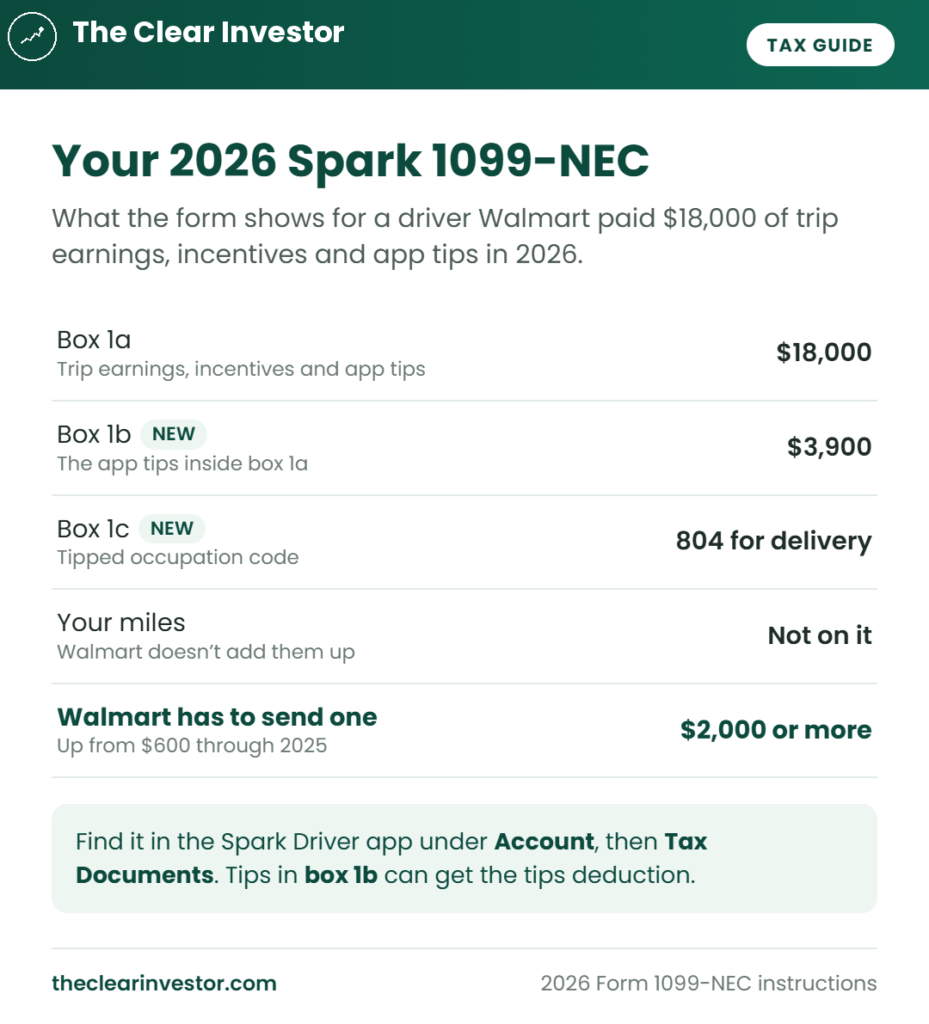
Walmart itself sends Spark drivers a Form 1099-NEC, with your Social Security number on it. For 2025, Walmart’s tax filing FAQ put the forms in the app by January 31, under Account, then Tax Documents, and mailed a paper copy to drivers who didn’t agree to electronic delivery. Here’s what to expect for 2026:
- The $2,000 line. Under the 2026 Form 1099-NEC instructions, a business only has to send a 1099-NEC once it pays you $2,000 or more in 2026, up from $600. Below that you may not get a form, but the income is still taxable.
- Box 1a shows everything Walmart paid you. Walmart says its 1099 “includes all earnings and tips”: trip earnings, incentives and app tips together.
- New box 1b shows how much of box 1a was tips, and new box 1c holds the IRS code for the tipped job. App-based delivery is code 804.
- No miles. Walmart says it “doesn’t provide drivers with mileage summaries,” so nothing on the form or in the app adds up your driving.
Boxes 1b and 1c matter because, for 2026, the tips deduction needs your tips reported to you on a 1099. When your form arrives, check box 1a against an Earnings History report from the app and check that box 1b shows your app tips. Walmart also says it doesn’t offer tax advice, so the rest is up to you.
What Counts as Spark Income (and What Doesn’t)
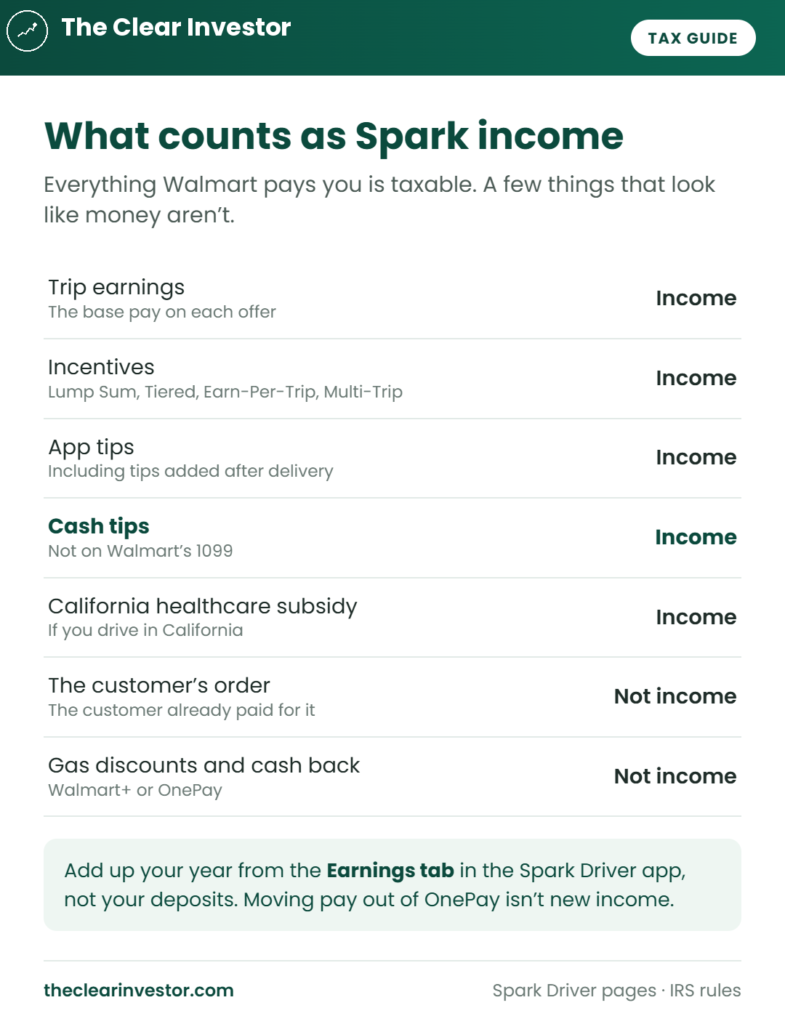
The Spark Driver FAQ lists three kinds of earnings: trip earnings, tips and incentives. All of it is taxable:
- Trip earnings, the base pay on each offer, set by distance, time, order size and extras. A batched offer with two or three drop-offs is one trip.
- Incentives: Lump Sum, Tiered and Earn-Per-Trip bonuses, and the Multi-Trip guarantee that tops you up to $200 when ten trips in seven days pay less than $180. Sapphire drivers’ extra 10% on incentives counts too.
- App tips, including tips customers add after delivery. You keep 100% of them.
- Cash tips customers hand you at the door.
- Effort-based pay for an offer canceled after you arrived.
- California’s healthcare subsidy, if you drive there. Walmart’s California driver page says it may be paid each quarter. It’s money paid to you, so count it.
Three things aren’t new income:
- The customer’s order. On shopping offers the customer has already paid, so you don’t spend your own money on their items.
- Gas discounts and cash back, like the Walmart+ gas discount some Rewards tiers include. They’re a discount on what you bought.
- Moving your pay out of OnePay to your bank. It’s the same money, so count it once.
The Earnings tab shows weekly and daily totals, trip receipts and Earnings History reports, so it’s the place to add up your year. Your deposits aren’t: trip pay, tips and incentives arrive at different times, and transfers between your own accounts can make them look bigger than they were.
No Tax on Tips for Spark Drivers: App Tips vs. Cash Tips
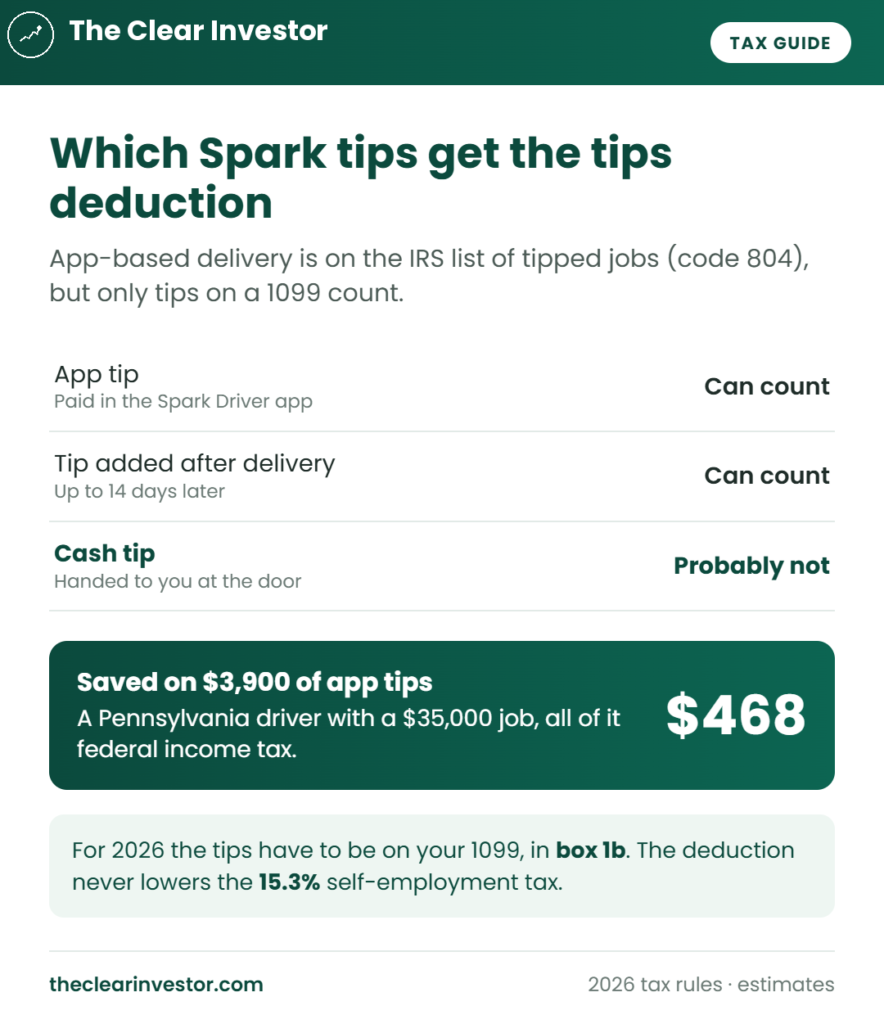
From 2025 through 2028, you can deduct up to $25,000 a year of qualified tips. App-based delivery people are on the IRS’s list of tipped occupations (code 804), so Spark tips can qualify, but how a customer tipped you matters:
| Tip | On Walmart’s 1099? | Tips deduction |
|---|---|---|
| App tip | Yes, in box 1a and box 1b | Can count (code 804) |
| Tip added after delivery | Yes, once it’s confirmed | Can count |
| Cash handed to you | No | Probably not, but it’s still income |
The reason is a reporting rule. IRS Notice 2025-69 says that for workers who aren’t employees, only tips separately accounted for on a 1099 count toward the deduction, and Walmart can’t report cash it never saw. The rest of the rules:
- For 2026, your tips have to be on a 1099. If Walmart pays you under $2,000 and sends no form, the tips deduction may not be available.
- It lowers federal income tax only. You still pay 15.3% self-employment tax on every tip. Each state decides whether to follow it. Arizona does, and so does Michigan from 2026, per its Treasury notice.
- It can’t be more than your Spark profit, and it shrinks by $100 for every $1,000 of income over $150,000 ($300,000 married filing jointly). Married couples have to file jointly. You claim it on Schedule 1-A without itemizing.
Tips can also change after a trip. Spark’s tips page says customers can lower a tip for 3 hours, raise it for 24 hours, and add one for up to 14 days if they didn’t tip at first. That’s why late-December tips can show up in January. In my calculator’s starting example, $3,900 of app tips saves a Pennsylvania driver with a $35,000 job about $468 of federal tax. In its fourth example, $600 of cash tips adds about $130 of tax and gets no deduction.
Spark Mileage: Walmart Won’t Track It for You
Miles are usually a driver’s biggest deduction. The IRS standard mileage rate is 72.5 cents a mile for January through June 2026 and 76 cents from July 1. It covers gas, insurance, repairs and wear, so you don’t deduct those on top.
- Miles that count: from the store to your customers, between drop-offs on a batched offer, from your last drop-off to the next store, return offers to the store, and trips to buy supplies.
- Miles that might not: the drive from home to your first store can be commuting, which IRS Publication 463 treats as personal. If those miles add up, keep them in your log and ask a tax pro.
- Split them at June. You need your own log, or a fair split by the weeks you drove, to use both rates.
Each offer shows its distance, but Walmart doesn’t add up your miles for the year, so the log is on you. For Flex, I kept one spreadsheet row per day with the date, earnings, hours, fuel, miles and notes, and a small Python script adds up each month. A mileage app that records your drives does the same job with less typing. If you’re starting late, my calculator can estimate your miles from your trips for planning, but an estimate isn’t a record. Here’s the gap in its third example, a Tennessee driver with 480 trips:
| Estimate (12 miles a trip) | Mileage log | |
|---|---|---|
| Miles | 5,760 | 7,100 |
| Mileage deduction | $4,277 | $5,277 |
| Tax on their Spark income | $793 | $563 |
The log caught drives the estimate missed, like moving between two stores for two offers in a row, and it’s what the IRS wants to see if it asks. You can deduct the business share of your car’s real costs instead, with every receipt. For a car you own, the IRS says you have to use the standard rate in the first year you use the car for business if you ever want to use it. The business share of car loan interest counts on top of the standard rate when you’re self-employed, according to IRS Topic 510.
Other Spark Driver Deductions
Beyond miles, these are the costs most Spark drivers have:
- Parking and tolls, on top of the mileage rate.
- Your phone, the share of your bill and data you use for the Spark Driver app.
- Supplies: insulated bags, a phone mount, a hand truck for heavy or bulky items, or a car charger.
What you can’t deduct: the customer’s order, since you never paid for it, gas when you use the mileage rate, and everyday clothes or meals.
Spark Driver Rewards, Gas Discounts and OnePay
Spark Driver Rewards has Silver, Gold and Sapphire tiers. Sapphire adds 10% to eligible incentives, and that extra pay is income like the rest of your incentives. Gold and Sapphire drivers get a month of Walmart+, which includes up to 10 cents off a gallon of gas. Spark’s OnePay account page also lists cash back on gas and on Walmart purchases, paid as points.
None of the gas savings is income. Cash back is a discount on what you bought, and since the mileage rate already stands in for gas, it doesn’t change your deduction either. I’ve used Upside for gas cash back since May 2025 (here’s my Upside review), and my gas cash back calculator shows what it adds up to with a cash back card.
The free month of Walmart+ itself is a perk with a value. Walmart’s tax FAQ doesn’t say it reports perks like that, and the rewards terms say there’s no cash in place of them. If a reward ever shows up on a 1099, count that value as income.
How Much Tax Will You Owe on Spark?
Here’s what Spark driver taxes look like for a single driver in a state with no income tax. The rows assume app tips are 22% of what Spark pays and incentives 8%, 5.5 miles for every $10 split evenly across the year, and 2.5% of pay for the phone.
| Situation | Pay and tips | Tax on Spark | Set aside |
|---|---|---|---|
| Part-time, no other income | $10,000 | $801 | 9% |
| Part-time, $50,000 job | $10,000 | $1,042 | 11% |
| Part-time, $50,000 job, no mileage log | $10,000 | $1,984 | 20% |
| Full-time, no other income | $40,000 | $3,202 | 9% |
| Full-time, $50,000 job | $40,000 | $4,169 | 11% |
With no other income, the tax is all self-employment tax, since the standard deduction and the tips deduction cover the income tax. With a job, the set-aside is about 11%, because the tips deduction still removes most of the income tax on app tips. Without a mileage log, the same $10,000 costs nearly twice as much. Add your state’s rate on top. My Spark driver tax calculator works out yours, along with what you keep per trip and per hour.
Do You Need to Pay Spark Taxes Quarterly?
If you drive much, yes. The IRS expects estimated tax payments when you’ll owe $1,000 or more at tax time. With no other income, a driver like the ones in my table gets there at about $12,500 of pay and tips.
Trip earnings land in OnePay after each delivery, so it’s easy to move your set-aside percentage as you go. Then pay by April 15, June 15, September 15 and January 15. With a job, you can raise your Form W-4 withholding instead. The safe harbor that keeps you penalty-free is in how quarterly payments work.
Free tax tracker + deadline reminders
Get my free side income tax tracker
Sign up and I’ll send you my Google Sheets tracker that shows how much of each payout to set aside. You’ll also get an email before each quarterly tax deadline (Jan 15, Apr 15, Jun 15 and Sep 15), plus my new guides. Unsubscribe anytime.
Earn on several platforms or drive for work? Get the full 1099 Side Income Tracker ($12) →
Spark Driver Taxes: How to File
- Get your 1099-NEC from the Spark Driver app and request an Earnings History report for the year to keep next to it.
- Report everything Spark paid you on line 1 of Schedule C, whether or not you got a 1099, plus your cash tips.
- Enter your car costs on line 9, your mileage plus parking and tolls, and answer the questions about your car in Part IV.
- Add your other costs where they fit: supplies on line 22 and your phone in Part V.
- Pay self-employment tax on Schedule SE, claim the tips deduction on Schedule 1-A with your box 1b tips, and subtract any estimated payments.
I file with TaxAct. I keep a separate Schedule C for each kind of work and attach each 1099 to the one it belongs to, so the income and costs for that work stay together.
Special Situations
If you also deliver for Instacart, DoorDash or Amazon Flex
Each app sends its own forms, and the work can share one Schedule C, since it’s the same kind of work. Count each mile once if you run two apps at the same time. My Instacart tax guide and Amazon Flex tax guide cover their side.
If you drive in California
Walmart’s California driver page tracks your engaged time and says a healthcare subsidy may be paid each quarter. Count the subsidy as income with the rest of your Spark pay, and check whether it’s included in your 1099’s box 1a before you add it again.
If your 1099-NEC doesn’t match your Earnings History
Compare the totals for the year, not single weeks. Tips added after December can land in a different year from the trip. If box 1a still looks wrong, or box 1b is missing tips, contact Spark Driver support before you file, since the IRS gets a copy of the same form.
If you were paid under $2,000
Walmart may not send a 1099-NEC, but the income is still taxable, and your self-employment tax starts once your profit reaches about $433. Without a 1099, your tips may not get the tips deduction for 2026.
If you drove at a loss
If your miles and costs are more than Spark paid you, the loss lowers the tax on your other income. Keep your Earnings History reports and mileage log in case the IRS asks.
Common Spark Driver Tax Mistakes
These are the Spark tax mistakes I’d watch for:
- Waiting for Walmart to count your miles. It won’t, and without miles the $10,000 driver with a job in my table pays $1,984 instead of $1,042.
- Leaving out cash tips. They’re not on the 1099, but they’re income.
- Counting cash tips toward the tips deduction. Only tips reported on a 1099 count.
- Skipping income because no 1099 came. Under $2,000 you may not get a form, but you still owe tax on it.
- Adding up deposits instead of the Earnings tab, or counting a OnePay transfer as new income.
- Using one mileage rate for the whole year. Split your miles at June.
- Spending every payout. Nothing is withheld, so part of each one is tax.
My Verdict: Start a Mileage Log Today
Spark driver taxes come down to two things Walmart leaves to you. The first is your miles: Walmart doesn’t add them up, and a log of every drive from store to customer is the biggest deduction most drivers have, at 72.5 cents through June 2026 and 76 cents from July. The second is your tips. App tips on your 1099 can get the tips deduction, though never the 15.3% self-employment tax, and cash tips are income you track yourself.
Set aside about 9% of each payout with no other income, or about 11% with a job, plus your state’s rate. My Spark driver tax calculator works out your number, and what you keep per trip and per hour.
Want more ways to earn? See every platform I’ve used in How I make money online.
FAQ
Do I have to pay taxes on Spark?
Yes, on your profit: trip earnings, incentives and tips, minus your miles and other costs. Walmart doesn’t take tax out, so you pay it with your return or through quarterly payments.
Does Walmart send a 1099 for Spark drivers?
Yes, a 1099-NEC. For 2026, Walmart has to send one once it pays you $2,000 or more. Below that, you may not get one, but the income is still taxable.
Where do I find my Spark 1099?
In the Spark Driver app, under Account, then Tax Documents. Walmart mails a paper copy if you didn’t agree to electronic delivery.
Are Spark tips taxable?
Yes. App tips and cash tips are both income, and you pay income tax and self-employment tax on them, minus any tips deduction.
Do Spark drivers get the no tax on tips deduction?
For app tips on your 1099, yes, since app-based delivery is on the IRS’s list of tipped jobs. Cash tips probably don’t qualify, because they aren’t on a 1099.
Does Walmart give Spark drivers a mileage summary?
No. Walmart says it doesn’t provide mileage summaries, so keep your own log or use a mileage app.
How much can I deduct for Spark miles?
72.5 cents a mile through June 2026 and 76 cents from July, for the miles you drive for trips. Parking and tolls count on top.
How much should I set aside for Spark taxes?
About 9% of each payout with no other income, or about 11% with a job, if you deduct your miles and your tips are app tips. Add your state’s rate.
I’m not a licensed financial advisor or tax professional. This guide is based on Walmart’s pages for Spark drivers, IRS rules and my own experience with 1099 income and mileage. It’s for educational purposes and isn’t tax advice. Tax rules change, so check the links above or talk to a tax professional about your situation. I’m not affiliated with Walmart, Spark Driver, Upside or TaxAct.