
This Turo tax calculator shows how much tax you’ll owe on your Turo earnings in 2026, how much of each payout to set aside, and what you keep per trip and per hour once Turo’s fees, your car costs and the tax come off. It puts the standard mileage rate and actual car costs side by side, works out first-year depreciation on your car, and picks the one that saves you more. Want to know how Turo hosts are taxed first? Read my Turo tax guide.
I haven’t hosted on Turo, but I drove for Amazon Flex in California for about 18 months, kept every day’s miles in an Excel log, and deducted them on their own Schedule C with TaxAct. Turo hosts file the same Schedule C, with a bigger car question to answer.
Turo makes a few things harder than other side gigs. Turo reports your gross earnings, before the 10% to 30% it keeps, per its tax page for hosts. The miles guests drive count as your business miles. Your car is your biggest cost, and you have to choose between the standard mileage rate and actual costs, a choice you lock in during the car’s first year on Turo. And Turo’s own tax guide for hosts, written with EY, says hosts on the standard rate deduct only about 70% of Turo’s fees. So this calculator works out both methods, with the right share of the fees in each.
Turo Tax Calculator
See how much tax you’ll owe on your Turo earnings in 2026: your profit after Turo’s fees, the standard mileage rate and actual car costs side by side, depreciation on your car, and how much of each payout to set aside.
Your 2026 Turo earnings
Your cars and miles
Your car costs
Costs you deduct either way
Your other income
About you
Standard mileage rate vs. actual costs
| Standard mileage | Actual costs |
|---|
Your gross earnings vs. what Turo paid you
What you keep
Your tax forms
| Form | From | Amount |
|---|
Your total 2026 tax: before vs. after deductions
| Before deductions | After deductions |
|---|
How your taxable income is worked out
How this is calculated
- Gross earnings are what Turo reports in box 1a of a 1099-K and on your Tax information page: trip prices, delivery, Extras and host incentives, before Turo’s fees. Reimbursements guests pay for gas, tolls, tickets and other incidentals aren’t in it, and they aren’t income.
- Turo’s fees (estimate) = gross earnings × the part your earnings plan doesn’t pay you: 10% on More earnings, 20% on Balanced and 30% on More peace of mind. Turo works your share out on the trip price, delivery and Extras, so the estimate can be a little off. Your Tax information page has the real number.
- Business use = business miles ÷ (business miles + personal miles). Business miles are the miles guests drove on trips plus your own drives for Turo, the way Turo’s tax guide counts them.
- Standard mileage rate = business miles from January through June × 72.5¢ + July through December × 76¢, the 2026 IRS rates. The rate covers gas, insurance, repairs, tires, registration and depreciation, so those don’t come off on top. Loan interest and personal property tax (business share), parking and tolls, extras and other costs still do. Turo’s tax guide says hosts on the standard rate deduct about 70% of Turo’s fees, because part of the fee pays for protection, which is insurance the rate already covers. It isn’t allowed with five or more cars on Turo at once, or for a car you’ve already depreciated with actual costs.
- Actual costs = your business share of gas, insurance, repairs, registration, loan interest and personal property tax, plus depreciation, all of Turo’s fees, and parking and tolls, extras and other costs.
- Depreciation for a car first rented out in 2026 and bought after January 19, 2025: with business use over 50%, 100% bonus depreciation, capped by the IRS at $20,300 for a car placed in service in 2026; at 50% or less, straight-line over five years, 10% of the price in the first year, capped at $12,300. Both are times your business share, per car. With more than one car, the calculator treats them as costing about the same. The cap doesn’t apply to someone regularly in the business of leasing cars, but the IRS says renting out one car isn’t enough, so the calculator always uses it.
- The method with less tax is picked unless you choose one. A tie goes to the standard mileage rate, which leaves you free to switch later.
- Turo profit = gross earnings − Turo’s fees − your car deduction − the costs you deduct either way. On Schedule C it’s self-employment income. On Schedule 1 it’s other income with no self-employment tax, and your expenses can’t bring it below zero here.
- Self-employment tax is 15.3% (12.4% Social Security and 2.9% Medicare) on 92.35% of your self-employment profit. You only owe it when that comes to $400 or more, which means about $433 of profit. Social Security tax stops at $184,500 of combined W-2 pay and self-employment earnings, and an extra 0.9% Medicare tax applies above $200,000 ($250,000 married filing jointly, $125,000 separately). Half of the 15.3% is deductible.
- Federal income tax uses the 2026 brackets and standard deduction ($16,100 single or married filing separately, $32,200 married filing jointly, $24,150 head of household). On Schedule C it includes the qualified business income deduction: 20% of your Turo and other self-employment profit after the self-employment tax deduction, capped at 20% of your taxable income, and at least $400 when that profit is $1,000 or more. On Schedule 1, Turo income counts toward the 3.8% net investment income tax above $200,000 of income ($250,000 jointly).
- Child tax credit is $2,200 per child under 17. Up to $1,700 per child can be paid to you as a refund, based on 15% of your earned income over $2,500.
- State income tax uses 2026 rates, brackets, standard deductions and exemptions from the Tax Foundation, updated for the 2026 cuts in Arkansas, Georgia, South Carolina, Utah and West Virginia, and for the higher 2026 standard deductions in Arizona and Maine. A few states (like California) hadn’t published 2026 bracket amounts, so their 2025 amounts are used.
- Tax on your Turo earnings = your total tax minus what your total tax would be without Turo. The set-aside percentage is that tax divided by what Turo paid you.
- Tax forms: Turo’s page says you get a 1099-K for 2025 if you had more than 200 transactions and over $20,000 in gross earnings, or live in a state with a lower line: $600 in DC, Maryland, Massachusetts, Montana and Virginia, $1,000 in New Jersey, $1,000 with 4 transactions in Illinois, and $2,500 in Arkansas. Turo’s page lists Vermont at $600, but Vermont’s law follows the federal line for other 1099 forms, which is $2,000 for 2026 payments, so the calculator uses $2,000.
Not included: leased cars, depreciation for a car bought before January 20, 2025 or one you sell, Section 179, the home office deduction, the passive activity rules for hosts who don’t take part in running their rentals, the earned income tax credit, city and county income taxes, itemized deductions, and tax withheld from a W-2 job. Your real tax can be lower.
Free tax tracker + deadline reminders
Get my free side income tax tracker
Sign up and I’ll send you my Google Sheets tracker that shows how much of each payout to set aside. You’ll also get an email before each quarterly tax deadline (Jan 15, Apr 15, Jun 15 and Sep 15), plus my new guides. Unsubscribe anytime.
Earn on several platforms or drive for work? Get the full 1099 Side Income Tracker ($12) →
Table of Contents
How to Use the Turo Tax Calculator
- Open the Tax information page on Turo. It has your gross earnings and Turo’s fees for the year, and your 1099-K if you got one. Your gross earnings should match box 1a.
- Enter your gross earnings, trips and earnings plan. Pick 90%, 80% or 70% to estimate Turo’s fees, or enter the fees from the Tax information page.
- Enter your cars and miles. Business miles are the miles guests drove on trips plus your own drives for Turo, split at July 1 because the IRS rate went up then. Personal miles set the business share of your car costs.
- Enter your car costs. Gas, insurance, repairs and registration only count with actual costs. Loan interest and personal property tax count either way. For a car you started renting out in 2026, enter what you paid and the calculator works out depreciation. For an older car, enter this year’s depreciation from your tax software.
- Add parking and tolls Turo didn’t repay, extras for guests, other costs and hours, then your other income, filing status and state.
Who This Calculator Is For
- New hosts deciding between the standard mileage rate and actual costs in a car’s first year.
- Hosts with a few cars who want to see what Turo adds to their tax and what each car really earns.
- Hosts who share their daily car, where personal miles shrink the business share.
- Hosts with a W-2 job, to see how much more tax Turo adds.
- Hosts under $20,000 in earnings, who may not get a 1099-K but still owe tax on their profit.
If you also drive for Lyft or rent out a place on Airbnb, enter that profit as other self-employment profit, so your tax bracket counts both. My Lyft tax calculator and Airbnb tax calculator can work out that profit, and my 1099 tax calculator covers any other 1099 work.
How to Read Your Results
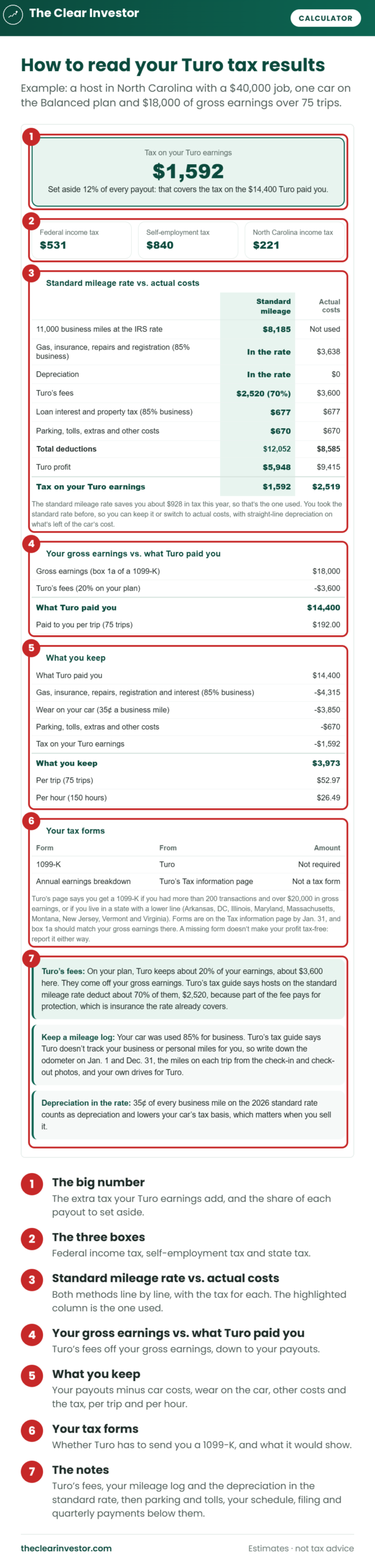
- The big number is the extra tax your Turo earnings add, and the line under it says what share of each payout to set aside.
- The three boxes split it into federal income tax, self-employment tax and state tax.
- Standard mileage rate vs. actual costs shows both methods line by line, with the tax for each. The highlighted column is the one used.
- Your gross earnings vs. what Turo paid you takes Turo’s fees off your gross earnings.
- What you keep takes your car costs, wear on the car, your other costs and the tax off your payouts, per trip and per hour.
- Your tax forms shows whether Turo has to send you a 1099-K.
- The notes cover Turo’s fees, your mileage log, depreciation, parking and tolls, which schedule you file on, filing and quarterly payments.
Below them, tables show your tax before and after deductions and how your taxable income is worked out.
Worked Example 1: A Host With a $40,000 Job in North Carolina
This is the calculator’s starting example. This host works full time for $40,000, files single and has rented one car on Turo since before 2026, on the Balanced plan, using the standard mileage rate. Over 75 trips, they made $18,000 in gross earnings. Guests and their own Turo errands put 5,000 business miles on the car from January to June and 6,000 from July to December, and they drove it 2,000 miles for themselves.
They paid $600 for gas, $1,500 for insurance, $2,000 for repairs, tires and washes, $200 for registration and $800 in loan interest and personal property tax. They also paid $120 for parking and tolls Turo didn’t repay, $250 for chargers and other extras, and $300 for their phone and a mileage app, over about 150 hours.
| Step | Amount |
|---|---|
| Gross earnings | $18,000 |
| Turo’s fees: 70% of $3,600 | −$2,520 |
| Standard mileage (5,000 miles × 72.5¢ + 6,000 × 76¢) | −$8,185 |
| Loan interest and property tax (85% business) | −$677 |
| Parking, tolls, extras and other costs | −$670 |
| Turo profit | $5,948 |
| Federal income tax | $531 |
| Self-employment tax | $840 |
| North Carolina income tax | $221 |
| Tax on their Turo earnings | $1,592 |
The 11,000 business miles are 85% of the car’s 13,000 miles, so 85% of the loan interest and property tax comes off on top of the mileage rate. Turo kept 20% on the Balanced plan, $3,600, and following Turo’s tax guide, 70% of it comes off with the standard rate.
With actual costs, they’d deduct all $3,600 of fees and 85% of their gas, insurance, repairs and registration, $3,638, for $8,585 in all. That’s $3,467 less than the standard rate, so actual costs would need more than that in depreciation to win, and they’d owe $928 more without it. Turo paid them $14,400, so they set aside 12% of every payout. They’re under the $20,000 line, so there’s no 1099-K. After car costs, $3,850 of wear on the car and the tax, they keep $3,973, about $52.97 a trip or $26.49 an hour.
Worked Example 2: A New Host Who Bought a Car in Texas
This host works for $55,000 and files single. They bought a $26,000 car in 2026 to rent out on Turo on the More earnings plan, where they keep 90%. Over 70 trips, they made $16,000 in gross earnings. They put 4,500 business miles on it through June and 5,500 after, plus 1,500 personal miles, so it’s 87% business. They paid $500 for gas, $1,700 for insurance, $900 for repairs and washes, $150 for registration, $1,100 in loan interest and property tax, and $480 for parking, tolls, extras and other costs.
| Step | Amount |
|---|---|
| Gross earnings | $16,000 |
| Turo’s fees (10%) | −$1,600 |
| Gas, insurance, repairs and registration (87% business) | −$2,826 |
| Depreciation: 87% of the $20,300 first-year cap | −$17,652 |
| Loan interest and property tax (87% business) | −$957 |
| Parking, tolls, extras and other costs | −$480 |
| Turo loss | −$7,515 |
| Change in their tax | −$902 |
This is the car’s first year on Turo, so they can pick either method. With business use over 50%, the car gets 100% bonus depreciation, but the IRS caps a car’s first-year depreciation at $20,300, times the business share. That turns their first year into a $7,515 loss, which cuts the tax on their job by $902 (Texas has no income tax). With the standard rate, they’d have a $6,001 profit and owe $1,383, so actual costs save them $2,285 this year.
There’s a catch. Once they take actual costs with depreciation, this car can’t use the standard rate again. With most of the car’s cost used up in year one, there’s little depreciation left for later years, so their deduction will mostly be running costs, where the standard rate would have kept counting every business mile. Turo paid them $14,400, and after costs and wear, they keep $6,637, about $94.82 a trip or $55.31 an hour.
Worked Example 3: A Couple With Four Cars in Florida
This couple files jointly with one child. One spouse earns $80,000 at a W-2 job, and they run four cars on Turo on the Balanced plan, all on the standard mileage rate since before 2026. Over 260 trips, they made $64,000 in gross earnings. The cars logged 21,000 business miles through June, 25,000 after and 3,000 personal miles. They paid $2,400 for gas, $7,200 for insurance, $6,500 for repairs and washes, $900 for registration and $3,200 in loan interest and property tax, plus $2,500 for parking, tolls, extras and other costs, over about 900 hours, and they’ve sent $4,000 in estimated payments.
| Step | Amount |
|---|---|
| Gross earnings | $64,000 |
| Turo’s fees: 70% of $12,800 | −$8,960 |
| Standard mileage (21,000 miles × 72.5¢ + 25,000 × 76¢) | −$34,225 |
| Loan interest and property tax (94% business) | −$3,004 |
| Parking, tolls, extras and other costs | −$2,500 |
| Turo profit | $15,311 |
| Federal income tax | $1,366 |
| Self-employment tax | $2,163 |
| Tax on their Turo earnings | $3,529 |
At 46,000 business miles, the standard rate deducts $34,225, far more than their actual gas, insurance, repairs and registration. With actual costs and no depreciation left on the cars, they’d owe $3,325 more. Four cars is as far as the standard rate goes: with five or more on Turo at the same time, the IRS doesn’t allow it.
They get a 1099-K for $64,000, since they had more than 200 trips and more than $20,000. Turo paid them $51,200, so they set aside 7% of every payout, and the $4,000 they’ve already sent covers it. After costs, wear on four cars and the tax, they keep $10,107, about $38.87 a trip or $11.23 an hour.
Worked Example 4: Sharing a Daily Car in Virginia
This host works for $60,000 and files single. They started renting out the car they drive every day in 2026, on the Balanced plan. They bought it in 2025, and it was worth $22,000 when they started renting it out, less than they paid, so that’s what it’s depreciated from. Over 32 trips, they made $7,500 in gross earnings. Guests and Turo errands put 3,000 miles on it through June and 3,500 after, and they drove it 7,500 miles themselves, so it’s only 46% business. They paid $1,400 for gas, $1,600 for insurance, $1,000 for repairs, $120 for registration, $600 in loan interest and property tax and $200 for other costs.
| Step | Amount |
|---|---|
| Gross earnings | $7,500 |
| Turo’s fees: 70% of $1,500 | −$1,050 |
| Standard mileage (3,000 miles × 72.5¢ + 3,500 × 76¢) | −$4,835 |
| Loan interest and property tax (46% business) | −$279 |
| Parking, tolls, extras and other costs | −$200 |
| Turo profit | $1,136 |
| Federal income tax | $79 |
| Self-employment tax | $161 |
| Virginia income tax | $61 |
| Tax on their Turo earnings | $300 |
At 46% business, there’s no bonus depreciation: the car is depreciated straight-line over five years, 10% of its price in the first year, times the business share, $1,021. With that, actual costs deduct $4,913, less than the standard rate’s $6,364, so the standard rate wins and saves them $435. It also leaves them free to switch to actual costs in a later year.
Virginia is on Turo’s list of states with a lower 1099-K line, $600, but Turo’s page also lists the 200 transactions for it, so with 32 trips they may or may not get one. Turo paid them $6,000, so they set aside 6% of every payout. They keep $1,034, about $32.30 a trip or $14.76 an hour.
More Example Results
Here’s how a W-2 job changes the tax for the host in Example 1 ($5,948 of Turo profit, 150 hours, in North Carolina):
| W-2 job | Tax on Turo | Set aside | You keep per hour |
|---|---|---|---|
| None | $840 | 6% | $31.49 |
| $20,000 | $1,503 | 11% | $27.08 |
| $40,000 | $1,592 | 12% | $26.49 |
| $60,000 | $1,592 | 12% | $26.49 |
| $90,000 | $2,034 | 15% | $23.54 |
| $130,000 | $2,122 | 15% | $22.95 |
The $840 of self-employment tax is on every row, because it depends only on the Turo profit. With no job, the standard deduction covers the whole profit, so there’s no income tax. From there the profit is taxed at 10% and 12%, then 22%, and with a $130,000 job, 24%.
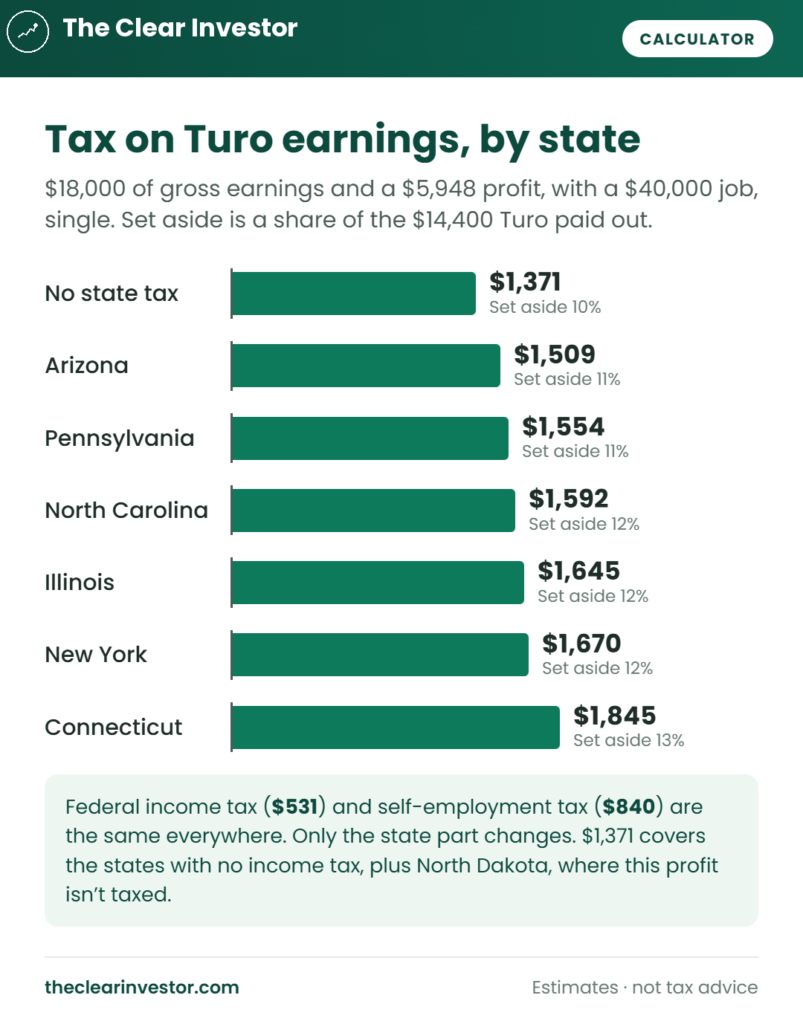
Your state matters too. The same host would owe $1,371 in states with no income tax, like Florida, Texas and Tennessee, and up to $1,845 in Connecticut:
How the Turo Tax Calculator Works
- Gross earnings: what Turo reports in box 1a of a 1099-K and on your Tax information page. Turo’s tax page says they include trip earnings, Turo fees, host incentives and host fees, but not reimbursements or sales tax.
- Turo’s fees: what your earnings plan doesn’t pay you. On the standard plans you keep 90%, 80% or 70% of the trip price, delivery and Extras, per Turo’s earnings plans page. In nine cities, your share depends on how far ahead guests book, so enter your fees from the Tax information page there.
- The 70% rule: Turo’s tax guide for hosts, written with EY, says part of the fee pays for protection, which is insurance the standard mileage rate already covers, so hosts on the standard rate deduct about 70% of the fees and hosts on actual costs deduct all of them.
- Business use: business miles divided by all the miles on your cars. Turo’s guide counts the miles your car is out on trips as business miles, and says Turo doesn’t track them for you.
- Standard mileage rate: 72.5¢ a mile through June 2026 and 76¢ from July, the IRS standard mileage rates. Per Revenue Procedure 2019-46, it covers depreciation, maintenance and repairs, tires, gas, oil, insurance and registration. Parking, tolls, loan interest and personal property tax come off on top. It isn’t allowed with five or more cars at the same time, or after you’ve depreciated the car with actual costs, and for a car you own, you have to use it in the car’s first year to use it at all.
- Actual costs: the business share of your gas, insurance, repairs and registration, loan interest and property tax, plus depreciation and all of Turo’s fees.
- Depreciation: for a car first rented out in 2026 and bought after January 19, 2025, 100% bonus depreciation when business use is over 50%, capped at $20,300 for 2026, per Revenue Procedure 2026-15. At 50% or less, straight-line over five years: 10% in the first year, capped at $12,300. Both are times your business share, per car. The caps don’t apply to someone regularly in the business of leasing cars, but the IRS rules say renting out one car isn’t enough, so the calculator always uses them.
- Wear on your car: the 35¢ of each 2026 business mile the IRS counts as depreciation in the standard rate, per Notice 2026-10, used only in what you keep.
- Self-employment tax: 15.3% on 92.35% of your profit once that’s $400 or more, per the IRS.
- Income tax: the 2026 brackets and standard deduction, the qualified business income deduction (at least $400 once your business income is $1,000 or more) and the child tax credit.
- Schedule 1: if someone else runs your rentals, Turo’s tax guide puts them on Schedule 1 instead, with no self-employment tax. The calculator then counts your Turo income as other income and doesn’t let your expenses take it below zero.
- Your 1099-K: Turo’s tax page says you get one with more than 200 transactions and over $20,000, or in a state with a lower line: Arkansas, DC, Illinois, Maryland, Massachusetts, Montana, New Jersey, Vermont and Virginia.
- State tax: your state’s 2026 rates and deductions.
- Your Turo tax: your total tax minus your tax without Turo, so your job’s bracket counts.
- The set-aside: that tax divided by what Turo paid you, rounded up.
- Per trip and per hour: what Turo paid you minus the business share of your car costs, wear on the car, your other costs and the tax, divided by your trips and hours.
What the Calculator Leaves Out
- Leased cars, which have their own rules for both methods.
- Depreciation for a car bought before January 20, 2025, or one you sell, and Section 179. Enter this year’s depreciation from your tax software instead.
- Earnings shares that change with how far ahead guests book, in Austin, Dallas, Detroit, Las Vegas, Maui, Philadelphia, Phoenix, San Diego and Seattle. Enter your fees from the Tax information page.
- The passive activity rules for hosts who don’t take part in running their rentals, and the home office deduction.
- Health insurance and retirement deductions, the earned income tax credit, city and county income taxes, and itemized deductions.
Tips for Accurate Results
- Use the Tax information page, not your bank deposits. Turo pays you after its fees, but it reports your gross earnings.
- Keep a mileage log. Write down each car’s odometer on January 1 and December 31, the miles on each trip, and your own drives for Turo. Turo doesn’t track your business and personal miles for you.
- Run both methods in a car’s first year. That’s the only year you can pick the standard rate for that car, and it decides what you can do later.
- Keep your purchase papers. You need the price and the date the car started on Turo for depreciation, and again when you sell it.
- Leave out what Turo repaid you. Reimbursed gas, tolls and tickets aren’t income, and the costs they cover aren’t deductible.
What to Do With Your Result
- Set aside your percentage of every payout in a savings account when Turo pays you.
- Make quarterly payments if you’ll owe $1,000 or more in federal tax, or raise the withholding at your job.
- Submit your tax info to Turo, or it may pause your payments, per its tax page.
- Look for your 1099-K on the Tax information page by January 31, 2027, if you passed the federal line or your state’s.
- Pick your car method on purpose in a car’s first year, and note it in your records.
Turo Tax Calculator FAQ
Where do I find my Turo earnings for taxes?
On the Tax information page on Turo. It has your annual earnings breakdown, with gross earnings and Turo’s fees, and your 1099-K if you got one.
Does Turo send a 1099-K?
Turo’s tax page says you get one with more than 200 transactions and over $20,000 in gross earnings, or if you live in a state with a lower line: Arkansas, DC, Illinois, Maryland, Massachusetts, Montana, New Jersey, Vermont or Virginia.
Why is my Turo 1099-K more than Turo paid me?
It shows your gross earnings, before Turo’s fees. You report the gross, then deduct the fees and your car costs.
Should I use the standard mileage rate or actual costs on Turo?
Run both. The standard rate often wins for a car with lots of guest miles and low costs. Actual costs often win in the first year of a car you bought to rent out, because of depreciation, but then that car can’t use the standard rate again.
Can I deduct all of Turo’s fees?
With actual costs, yes. With the standard mileage rate, Turo’s tax guide says to deduct about 70% of them, because part of the fee pays for protection that works like insurance, and the rate already covers insurance.
Do Turo hosts pay self-employment tax?
Yes, if you run your cars yourself as a business on Schedule C. Turo’s tax guide puts hosts who don’t take part in running their rentals on Schedule 1, without self-employment tax.
Does Turo take out taxes?
No. Turo doesn’t take income tax out of your payouts, so set aside part of each one.
Does it include state tax?
Yes. Pick your state and it adds your state’s 2026 income tax. City and county taxes aren’t included.
Is my information saved?
No. Everything runs in your browser. Nothing you enter is sent anywhere or stored.
What tax year does the Turo tax calculator use?
2026: the 2026 brackets, standard deductions, mileage rates, depreciation caps, 1099-K lines and Turo’s earnings plans as of November 2026. I update it every year.
Estimates for educational purposes only. I’m not a licensed financial advisor or tax professional, and this isn’t tax advice. Not affiliated with Turo.