
This Spark driver tax calculator shows how much tax you’ll owe on your Walmart Spark trip earnings, incentives and tips in 2026, how much of each payout to set aside, and what you keep per trip and per hour once your car, your costs and the tax come off. Want to know how Spark drivers are taxed first? Read my Spark Driver tax guide.
I haven’t driven for Spark, but I delivered for Amazon Flex and logged every day’s miles, hours and earnings in an Excel sheet, because the miles were my biggest deduction and nobody else was going to count them. Spark drivers are in the same spot: Walmart says it doesn’t provide drivers with mileage summaries. So this calculator takes your miles from your log, or estimates them from your trips if you don’t have one yet, and keeps app tips apart from cash tips, since only one of them can get the tips deduction.
Spark Driver Tax Calculator
See how much tax you’ll owe on your Walmart Spark trip earnings, incentives and tips in 2026, after your miles and the tips deduction, what you keep per trip and per hour, and how much of each payout to set aside.
Your 2026 Spark earnings
How much you drove
Your other driving costs
Your other income
Tax you’ve already paid
About you
What you keep per trip and per hour
| For the year | Per trip | Per hour |
|---|
Your tax forms
| Form | What it shows | Amount |
|---|
Your total 2026 tax: before vs. after deductions
| Before deductions | After deductions |
|---|
How your taxable income is worked out
How this is calculated
- Spark income = trip earnings + incentives + app tips + cash tips. Walmart’s 1099-NEC covers the first three. Cash tips customers hand you aren’t on any form, but they’re still income.
- Mileage = miles from January through June × 72.5¢ + miles from July through December × 76¢, the 2026 IRS standard mileage rates (the IRS raised the rate on July 1, 2026). If you estimate from your trips, the miles are your trips × your average miles per trip, split evenly between the two rates. The rates cover gas, insurance, repairs and wear, so those aren’t added on top. Parking and tolls are.
- Spark profit = your income minus your mileage, parking and tolls, the Spark share of your phone bill, and bags and other supplies. It’s self-employment income, reported on Schedule C.
- Self-employment tax is 15.3% (12.4% Social Security and 2.9% Medicare) on 92.35% of your self-employment profit. You only owe it when that comes to $400 or more, which means about $433 of profit. Social Security tax stops at $184,500 of combined W-2 pay and self-employment earnings, and an extra 0.9% Medicare tax applies above $200,000 ($250,000 married filing jointly, $125,000 separately). Half of the 15.3% is deductible.
- Federal income tax uses the 2026 brackets and standard deduction ($16,100 single or married filing separately, $32,200 married filing jointly, $24,150 head of household). Married filing separately uses the single brackets, except that the 37% rate starts at $384,350. It also includes the qualified business income deduction: 20% of your self-employment profit after the self-employment tax deduction, and at least $400 when that’s $1,000 or more.
- Tips deduction: the IRS’s list of tipped occupations names app-based delivery people (code 804), so your app tips can count as qualified tips. For self-employed people, only tips reported on a 1099 count, so cash tips are left out. The deduction is up to $25,000, no more than your Spark profit, and shrinks by $100 for every $1,000 of income over $150,000 ($300,000 married filing jointly). Married couples only get it on a joint return. It lowers federal income tax only, not self-employment tax, and runs from 2025 through 2028. By default the calculator only counts it when Walmart has to send you a 1099-NEC.
- Child tax credit is $2,200 per child under 17. Up to $1,700 per child can be paid to you as a refund, based on 15% of your earned income over $2,500.
- State income tax uses 2026 rates, brackets, standard deductions and exemptions from the Tax Foundation, updated for the 2026 cuts in Arkansas, Georgia, South Carolina, Utah and West Virginia and the 2026 standard deductions in Arizona and Maine. A few states (like California) hadn’t published 2026 bracket amounts, so their 2025 amounts are used. Head of household and married filing separately use single brackets. Arizona and Michigan follow the federal tips deduction, so it’s included in their tax. Other states’ tax here leaves it out, since each state decides whether to follow it.
- Tax on your Spark income = your total tax minus what your total tax would be without Spark. The set-aside percentage is that tax divided by your Spark income.
- Per trip and per hour = your Spark income, your costs (mileage at the IRS rate stands in for what the car costs you) and the tax on your Spark income, divided by your trips and hours.
- Tax forms: for 2026, a business has to send a Form 1099-NEC once it pays you $2,000 or more. The 2026 form adds box 1b for the tips included in box 1a and box 1c for the tipped occupation code.
- Before deductions leaves out your mileage and other costs, the standard deduction, the qualified business income deduction, the tips deduction, and state deductions and exemptions, so you can see how much they save you.
Not included: the actual-expense method for your car (gas, repairs, insurance and depreciation), car loan interest, the home office deduction, the earned income tax credit, city and county income taxes (like Pennsylvania local earned income tax or New York City), state low-income credits, itemized deductions, retirement or health insurance deductions, and tax withheld from a W-2 job. Your real tax can be lower.
Free tax tracker + deadline reminders
Get my free side income tax tracker
Sign up and I’ll send you my Google Sheets tracker that shows how much of each payout to set aside. You’ll also get an email before each quarterly tax deadline (Jan 15, Apr 15, Jun 15 and Sep 15), plus my new guides. Unsubscribe anytime.
Earn on several platforms or drive for work? Get the full 1099 Side Income Tracker ($12) →
Table of Contents
How to Use the Spark Driver Tax Calculator
- Open the Earnings tab in the Spark Driver app. It has weekly and daily totals and trip receipts, and you can request an Earnings History report. Your 2026 1099-NEC, if you get one, shows up in the app under Account, then Tax Documents.
- Enter your trip earnings, incentives and app tips. Incentives are the Lump Sum, Tiered, Earn-Per-Trip and Multi-Trip bonuses. App tips are the confirmed tips in the app.
- Add any cash tips customers handed you, and pick whether to count the tips deduction.
- Add your trips, hours and miles. Use your mileage log if you have one, split at June: 72.5 cents a mile through June and 76 cents from July. No log? Choose the estimate and enter your average miles per trip.
- Add your other costs, other income, tax already paid and your state. A W-2 job raises your tax bracket, and your state adds its own tax.
Who This Calculator Is For
- Part-time Spark drivers with a day job, to see how much more tax Spark adds.
- Full-time Spark drivers, including parents whose child tax credit changes with their Spark income.
- Drivers without a mileage log yet, who need a planning number before they start one.
- Drivers who get cash tips, which are income but aren’t on Walmart’s 1099.
- New drivers under $2,000, who may not get a 1099-NEC at all.
If you also deliver for Instacart, DoorDash or Amazon Flex, enter that profit as other self-employment income, so your tax bracket counts both. My Instacart tax calculator and Amazon Flex tax calculator can work out that profit, and my 1099 tax calculator covers any other 1099 work.
How to Read Your Results
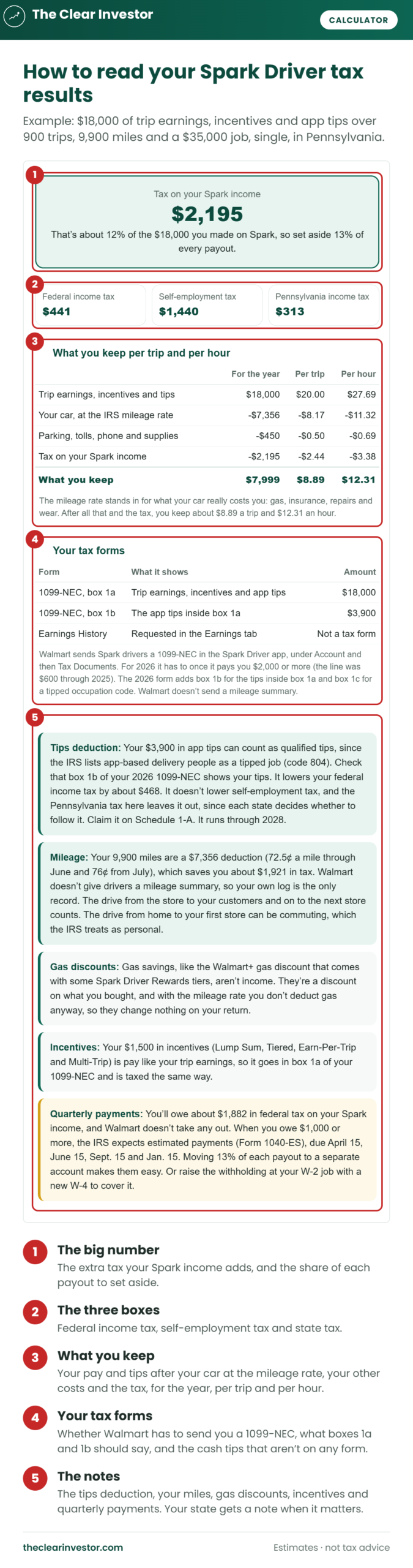
- The big number is the extra tax your Spark income adds, and the line under it says what share of each payout to set aside.
- The three boxes split it into federal income tax, self-employment tax and state tax.
- What you keep per trip and per hour starts with your pay and tips and takes off your car at the IRS mileage rate, your other costs and the tax.
- Your tax forms show whether Walmart has to send you a 1099-NEC, what boxes 1a and 1b should say, and the cash tips that aren’t on any form.
- The notes cover the tips deduction, your miles (logged or estimated), gas discounts, incentives, quarterly payments and your state.
Below them, two more tables show your total tax before and after deductions, and how your taxable income is worked out.
Worked Example 1: $18,000 From Spark and a $35,000 Job in Pennsylvania
This is the calculator’s starting example: a single driver in Pennsylvania with a $35,000 job who takes Spark offers after work and on weekends. Their Earnings tab shows $12,600 of trip earnings, $1,500 of incentives and $3,900 of app tips over 900 trips and about 650 hours. Their mileage app logged 9,900 miles, 4,800 of them before July, and they paid $60 for parking, $300 for the Spark share of their phone and $90 for insulated bags.
| Step | Amount |
|---|---|
| Trip earnings, incentives and app tips (1099-NEC box 1a) | $18,000 |
| Mileage (4,800 miles × 72.5¢ + 5,100 miles × 76¢) | −$7,356 |
| Parking, phone and bags | −$450 |
| Spark profit | $10,194 |
| Federal income tax | $441 |
| Self-employment tax | $1,440 |
| Pennsylvania income tax | $313 |
| Tax on their Spark income | $2,195 |
The $2,195 is about 12% of the $18,000 Spark paid them, so the calculator rounds up and says to set aside 13% of every payout. Their federal income tax is low because two deductions keep most of the profit out of taxable income: the $3,900 tips deduction and the $1,895 qualified business income deduction. The tips deduction alone saves them about $468, and without it they’d owe $2,663. Pennsylvania taxes the profit at its flat 3.07% with no standard deduction, which is the $313. After their car at the mileage rate, their other costs and the tax, they keep $7,999, about $8.89 a trip or $12.31 an hour.
Worked Example 2: A Full-Time Spark Driver in Georgia With Two Kids
This driver files as head of household with two children under 17 and has no other job. They made $30,500 of trip earnings, $4,200 of incentives and $9,300 of app tips over 2,300 trips and about 1,700 hours. They drove 24,500 miles, 12,000 of them before July, and paid $480 for their phone and $150 for supplies.
| Step | Amount |
|---|---|
| Trip earnings, incentives and app tips | $44,000 |
| Mileage (12,000 miles × 72.5¢ + 12,500 miles × 76¢) | −$18,200 |
| Phone and supplies | −$630 |
| Spark profit | $25,170 |
| Self-employment tax | $3,556 |
| Federal income tax (a bigger refundable child tax credit) | −$3,134 |
| Georgia income tax | $0 |
| Tax on their Spark income | $423 |
After half of the self-employment tax comes off, their adjusted gross income is $23,392, which is under the $24,150 head of household standard deduction. So their federal taxable income is $0, and the $9,300 tips deduction doesn’t save them anything this year. They still owe $3,556 of self-employment tax, since that’s owed on profit even when income tax isn’t. What pulls the total down to $423 is the child tax credit: without any earned income they’d get no refundable part, and their Spark profit unlocks $3,134 of it (15% of earned income over $2,500). Georgia’s standard deduction and its $5,000 exemption for each child cover their whole income. They keep $24,747, about $10.76 a trip or $14.56 an hour.
Worked Example 3: Estimated Miles vs. a Mileage Log in Tennessee
A single driver in Tennessee with a $42,000 job made $6,300 of trip earnings, $700 of incentives and $2,000 of app tips over 480 trips and about 360 hours, and paid $180 for their phone and $60 for supplies. Early in the year they hadn’t kept a log, so they estimated 12 miles a trip from the distances on their offers. Then they rebuilt the year from their phone’s location history and a mileage app.
| Estimate from trips | Mileage log | |
|---|---|---|
| Miles | 5,760 (480 × 12) | 7,100 (3,400 before July) |
| Mileage deduction | $4,277 | $5,277 |
| Spark profit | $4,483 | $3,483 |
| Federal income tax | $160 | $71 |
| Self-employment tax | $633 | $492 |
| Tax on their Spark income | $793 | $563 |
The log found 1,340 more miles than the estimate, mostly drives between two stores for two offers in a row and the extra stops on batched offers. That cuts their tax by $230 and their set-aside from 9% to 7%. Tennessee has no income tax, so it’s all federal. The bigger point is the record: an estimate is fine for planning, but if the IRS asks how you got your miles, it wants a log you kept as you drove, with the date, the miles and where you went.
Worked Example 4: A Married Driver in Nevada With Cash Tips
This driver files jointly with a spouse who earns $52,000 at a W-2 job, and they have one child under 17. The driver made $14,000 of trip earnings, $1,800 of incentives and $4,200 of app tips over 1,050 trips and about 780 hours, and customers also handed them $600 in cash tips. They drove 11,500 miles, 5,600 of them before July, and paid $40 for parking, $360 for their phone and $120 for supplies.
| Step | Amount |
|---|---|
| Trip earnings, incentives and app tips (1099-NEC box 1a) | $20,000 |
| Cash tips (not on any form) | $600 |
| Mileage (5,600 miles × 72.5¢ + 5,900 miles × 76¢) | −$8,544 |
| Parking, phone and supplies | −$520 |
| Spark profit | $11,536 |
| Federal income tax | $438 |
| Self-employment tax | $1,630 |
| Tax on their Spark income | $2,068 |
Their 1099-NEC should show $20,000 in box 1a and $4,200 of tips in box 1b. The $4,200 of app tips gets the tips deduction, which saves about $492. The $600 of cash tips is still income, so it’s part of their profit, but it isn’t on the 1099, and for self-employed people only tips reported on a 1099 count toward the deduction, so it adds about $130 of tax. Nevada has no income tax. They set aside 11% of every payout and keep $9,468, about $9.02 a trip or $12.14 an hour.
More Example Results
Here’s how a W-2 job changes the tax on the same Spark driving, for the driver in Example 1 (900 trips, 650 hours, $18,000 of pay and tips, 9,900 miles, single, in Pennsylvania):
| W-2 job | Tax on Spark income | Set aside | You keep per trip | You keep per hour |
|---|---|---|---|---|
| None | $1,753 | 10% | $9.38 | $12.99 |
| $20,000 | $2,121 | 12% | $8.97 | $12.42 |
| $35,000 | $2,195 | 13% | $8.89 | $12.31 |
| $60,000 | $2,195 | 13% | $8.89 | $12.31 |
| $90,000 | $2,563 | 15% | $8.48 | $11.74 |
With no job, the standard deduction soaks up most of the profit, so it’s almost all self-employment tax. A job fills the low brackets first, which pushes the Spark profit into the 12% bracket and then the 22% bracket. Between about $35,000 and $60,000, both sit in the 12% bracket, so the tax doesn’t change. The self-employment tax is $1,440 on every row, because it depends only on your Spark profit.
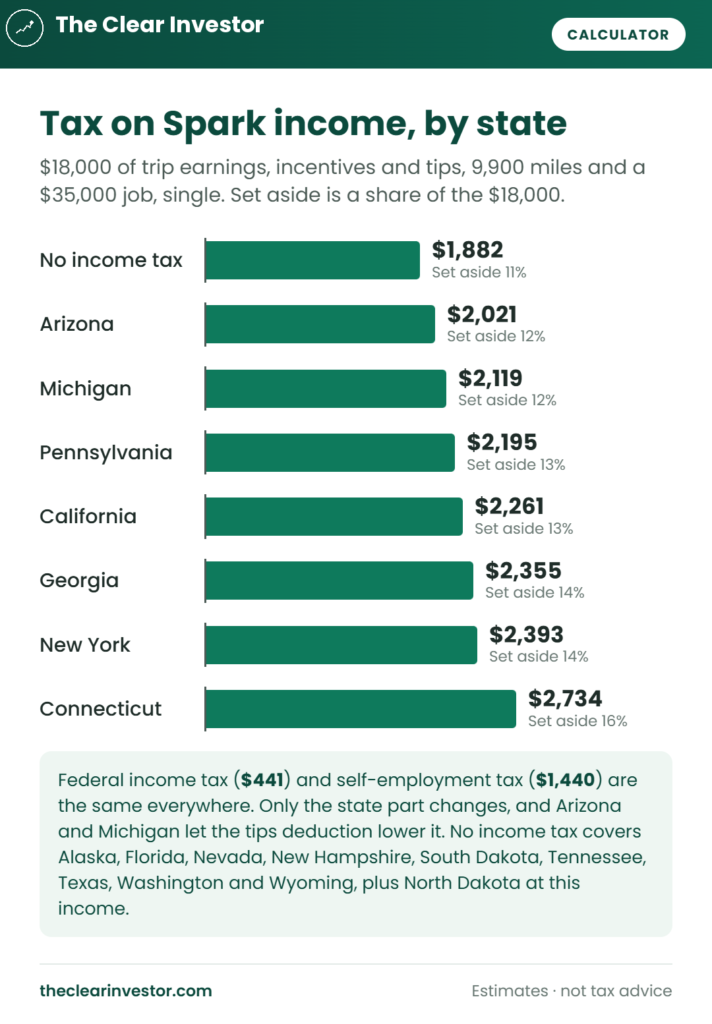
Your state matters too. The tax on the driver in Example 1 would be $1,882 in states with no income tax, like Florida, Texas and Tennessee, and up to $2,734 in Connecticut:
How the Spark Driver Tax Calculator Works
- Income: trip earnings, incentives and tips, the three parts of Spark pay in the Spark Driver FAQ, plus cash tips. You keep 100% of tips, and Walmart’s 1099 includes all earnings and tips. Customers prepay shopping orders, so you never spend your own money on their items.
- Your car: 72.5 cents a mile through June 2026 and 76 cents from July, the IRS standard mileage rates. An estimate multiplies your trips by your average miles per trip and splits them evenly between the two rates. Driving from home to your first store can be commuting, which IRS Publication 463 treats as personal.
- Profit: income minus your mileage, parking and tolls, the Spark share of your phone bill, and bags and supplies, reported on Schedule C.
- Self-employment tax: 15.3% on 92.35% of your profit once that’s $400 or more, per the IRS.
- Income tax: the 2026 brackets and $16,100 standard deduction, the qualified business income deduction (at least $400 once your business income is $1,000 or more) and the tips deduction.
- The tips deduction: app-based delivery people are on the IRS’s list of tipped occupations (code 804), so app tips count. For self-employed people, only tips reported on a 1099 count, per IRS Notice 2025-69, so cash tips are left out. The deduction is up to $25,000 and no more than your Spark profit.
- Your tax forms: the $2,000 line and the new boxes 1b (tips) and 1c (tipped occupation code) from the 2026 Form 1099-NEC instructions.
- State tax: your state’s 2026 rates and deductions. Arizona and Michigan follow the tips deduction (Michigan from 2026, per its Treasury notice), so it’s included there. Other states’ tax leaves it out.
- Your Spark tax: your total tax minus your tax without Spark, so your job’s bracket counts.
- The set-aside: that tax divided by your Spark income, rounded up.
- Per trip and per hour: your pay and tips minus your car at the mileage rate, your other costs and the tax, divided by your trips and hours.
What the Calculator Leaves Out
- The actual-expense method for your car, and car loan interest.
- The home office deduction, and health insurance and retirement deductions.
- The earned income tax credit, city and county income taxes (like Pennsylvania’s local earned income tax), and itemized deductions.
- State tips deductions other than Arizona’s and Michigan’s.
- The value of Spark Driver Rewards perks, like a free month of Walmart+, unless one shows up on a 1099.
Tips for Accurate Results
- Use your Earnings tab, not your bank deposits. Deposits can come as separate trip, tip and incentive payments, and moving money out of OnePay isn’t new income.
- Wait for late tips before you total December. Customers can add a tip for up to 14 days after a trip, so year-end tips can change in early January.
- Count cash tips yourself. Walmart never sees them, so they’re only in your own records.
- Keep a mileage log. Walmart doesn’t track miles for you, and the IRS can ask how you got your number.
- Count each mile once if you run Spark and another app at the same time.
What to Do With Your Result
- Move your set-aside percentage to a savings account each time Spark pays you.
- Make quarterly payments if you’ll owe $1,000 or more in federal tax.
- Check the Spark Driver app in early 2027 for your 1099-NEC, and make sure box 1b shows your app tips.
- Request an Earnings History report for the year and keep it with your mileage log.
- Use the per-hour number to decide which offers and hours are worth your time.
Spark Driver Tax Calculator FAQ
Where do I find my Spark earnings for taxes?
In the Earnings tab of the Spark Driver app. It shows weekly and daily totals and trip receipts, and you can request an Earnings History report. Your 1099-NEC is under Account, then Tax Documents.
Does Walmart send a 1099 for Spark?
Yes, a 1099-NEC. For 2026, Walmart has to send one once it pays you $2,000 or more, up from $600 through 2025. It includes your trip earnings, incentives and tips.
Are Spark tips taxed?
Yes. App tips and cash tips are both income. App tips reported on your 1099 can get the tips deduction, which lowers your federal income tax but not your self-employment tax.
Do cash tips count for the tips deduction?
Probably not. For self-employed people, only tips reported on a 1099 count, and Walmart’s 1099 can’t include cash it never saw. They’re still income, so report them.
Does Walmart track my miles?
No. Walmart says it doesn’t provide mileage summaries, so keep your own log or use a mileage app. The calculator can estimate your miles from your trips until you have one.
Does Spark take out taxes?
No. Walmart doesn’t withhold anything from your Spark pay, so set aside part of each payout for tax.
Does it include state tax?
Yes. Pick your state and it adds your state’s 2026 income tax on your Spark profit. City and county taxes aren’t included.
Is my information saved?
No. Everything runs in your browser. Nothing you enter is sent anywhere or stored.
What tax year does the Spark driver tax calculator use?
2026: the 2026 brackets, standard deduction, mileage rates, the $2,000 1099-NEC line and the tips deduction. I update it every year.
Estimates for educational purposes only. I’m not a licensed financial advisor or tax professional, and this isn’t tax advice. Not affiliated with Walmart or Spark Driver.