Instagram taxes catch creators off guard because the money comes from so many places. Meta pays you for gifts, badges and subscriptions, brands pay you for sponsored posts, affiliate programs pay commissions, and PR packages show up with no cash at all. All of it is taxable. Once you post to make money, it’s self-employment income: you owe income tax on your profit and, once it passes about $433, 15.3% self-employment tax too.
Brand deals are 1099-NEC work, the same form I’ve gotten from Amazon Flex. Everything Instagram-specific in this guide comes from Meta’s help pages, IRS rules and my Instagram tax calculator, so you can check each piece yourself.
Instagram taxes, the short answer:
- Is Instagram income taxable? Yes. Gifts, badges, subscriptions, bonuses, brand deals, affiliate commissions and PR packages you keep all count.
- Does Instagram send a 1099? Meta sends one for its own payouts once they reach $2,000 for 2026. Brands and affiliate programs send their own.
- Does Instagram take out taxes? No, and neither do brands. Every payment comes to you in full.
- Are PR packages taxable? Yes, if you keep them, at what they’d cost to buy.
- Can you deduct clothes and makeup? Only if you couldn’t wear them day to day.
- How much should you set aside? About 13% with no other income, about 18% with a job in the 12% bracket and about 23% in the 22% bracket. Add your state’s rate on top.
Table of Contents
Do You Pay Taxes on Instagram Money?
Yes, and there’s no Instagram-specific minimum. Once you post to make money, Instagram taxes come down to two federal taxes:
- Self-employment tax. You owe it when your net earnings from self-employment are $400 or more. Net earnings are 92.35% of your profit, so the line is about $433 of profit. The rate is 15.3%, for Social Security and Medicare. An employer pays half of that for a W-2 worker, but a creator pays all of it, on gifts and PR packages too.
- Income tax. Only on income above your standard deduction: over $16,000 for single filers, over $32,000 for married couples filing jointly and over $24,000 for heads of household. If you have a job, the job usually uses it up, so your Instagram profit is taxed from the first dollar.
If you post for fun and a brand sends you something once, that may be a hobby instead. You’d skip self-employment tax but couldn’t deduct any costs. The IRS tests are in my YouTube tax guide, and they work the same way for Instagram.
What Counts as Instagram Income?
Everything your account earns, from Meta and from everyone else. Here’s who pays you for each kind, and how it’s reported:
| Income | Who pays you | Tax form you may get | Can count as tips? |
|---|---|---|---|
| Gifts on reels | Meta | Meta’s 1099, at $2,000 or more | Yes |
| Badges in Live | Meta | Meta’s 1099, at $2,000 or more | Yes |
| Subscriptions | Meta | Meta’s 1099, at $2,000 or more | No |
| Bonuses | Meta | Meta’s 1099, at $2,000 or more | No |
| Sponsored posts, reels and stories | The brand or its agency | 1099-NEC, at $2,000 or more | No |
| Affiliate commissions (LTK, ShopMy, Amazon) | Each program | A 1099, at $2,000 or more | No |
| Brand payments through PayPal or Venmo | The app | 1099-K, only above $20,000 and 200 payments | No |
| PR packages you keep | Nobody, it’s products | Usually none | No |
Only what reaches you counts. Viewers buy Stars to send gifts, and Instagram pays you 1 cent for every Star. Apple, Google and Meta take their share when the Stars are bought, so you report what Meta pays you, not what fans spent.
Count Meta’s payouts when they’re paid. Meta pays around the 21st of each month for the previous month’s balance, once a US creator has $5 or more. December’s gifts and subscriptions land in January, so they count next year.
Brand deals are paid outside Instagram. Even when a deal comes through Meta’s creator marketplace, Meta says the payment is agreed directly between you and the brand and isn’t added to Meta’s invoice. So that income comes from the brand, and so does its 1099.
Getting paid in products counts. The IRS treats being paid in goods like bartering, so a PR package you keep is income at what it would cost to buy. More on that below.
Who Sends Your Instagram 1099s?
Every company that pays you sends its own form, so a creator with five brands and two affiliate programs can get eight 1099s for one year.
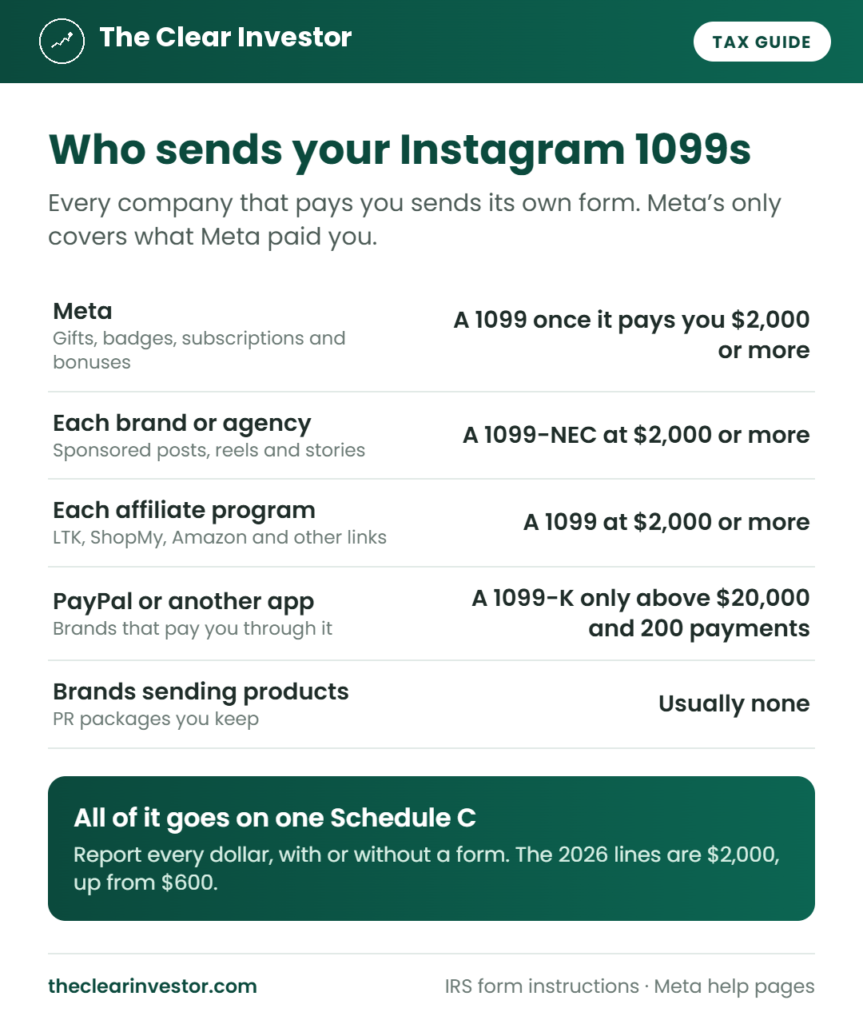
- Meta, for its own payouts. Meta asks for your SSN or EIN when you set up a payout account, and the name on your account has to match it. Its help pages don’t say which kind of 1099 creators get, so look for a 1099-NEC or a 1099-MISC. For 2026 payments, the line for either is $2,000, up from $600.
- Each brand that pays you $2,000 or more sends a 1099-NEC, usually after asking for your W-9. If an agency collects the money and pays you, the agency sends it instead, for your share.
- Each affiliate program sends its own form once it pays you $2,000 or more.
- PayPal, Venmo or another app sends a 1099-K instead of the brand when a brand pays you through it, but only above $20,000 and 200 payments in a year.
- Nobody sends a form for PR packages. You track those yourself.
Forms are due by January 31 (February 1 in 2027, since January 31 is a Sunday). Anything under a line comes with no form at all, but it’s still taxable, so your own invoices and payout history are the real record.
Are PR Packages Taxable?
Yes, if you keep them. A product a brand sends you is income at what it would cost to buy, the same as if the brand had paid you cash and you’d bought it. That includes packages you didn’t ask for, since they’re sent because of your account.
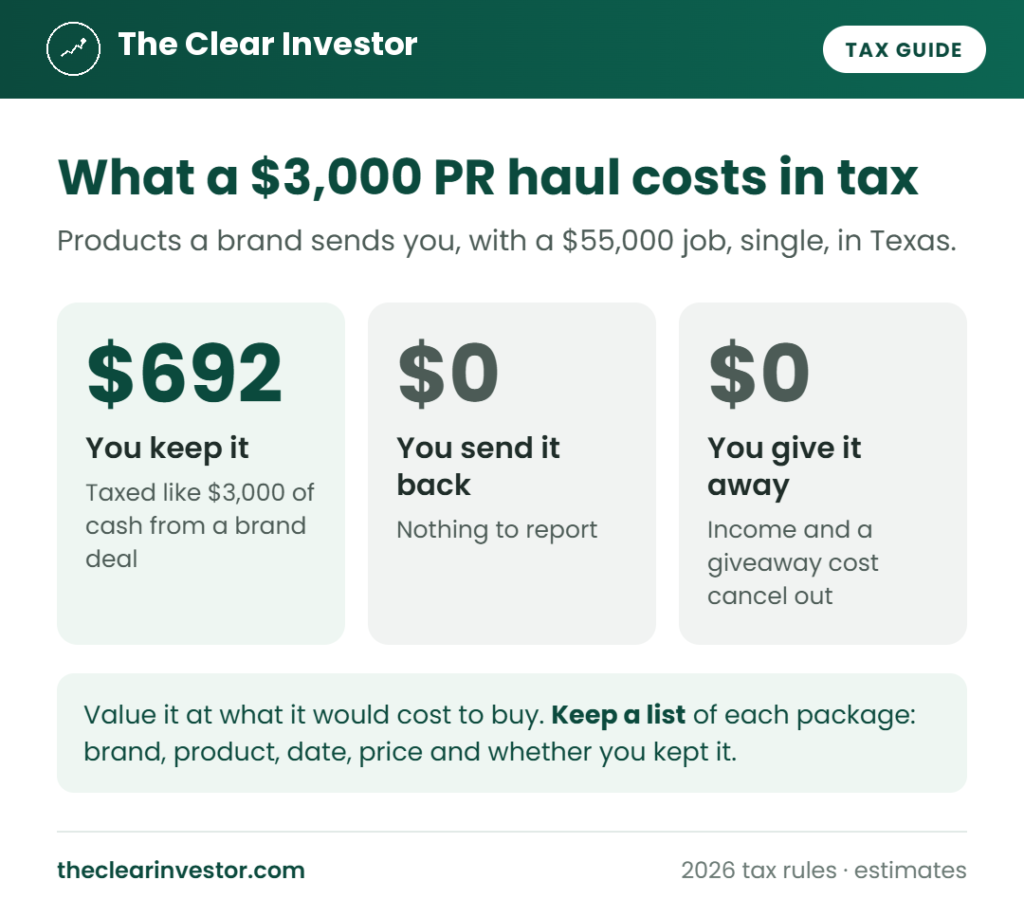
- You keep it: it’s income. With a $55,000 job in Texas, $3,000 of products you keep costs about $692 in tax, the same as a $3,000 brand deal.
- You send it back: there’s nothing to report.
- You give it away to followers: it’s income, and the giveaway is a business cost, so the two cancel out. Keep the giveaway post as proof.
Keep a simple list as packages arrive: the brand, the product, the date, what it sells for and whether you kept it. At tax time, add up what you kept and report it with the rest of your income.
Are Instagram Gifts Tax-Free? The Tips Deduction for Creators
No, but they can get a tax break that subscriptions and brand deals can’t. From 2025 through 2028, you can deduct up to $25,000 a year of qualified tips. The IRS’s list of tipped occupations includes digital content creators, and under the IRS’s final rules, voluntary payments for free content count as tips.
- What counts: gifts on your reels and badges in your Lives. Your reels and Lives are free to watch, and each viewer chooses whether to send anything.
- What doesn’t: subscriptions, since they pay for exclusive content. Bonuses, brand deals, affiliate commissions and PR packages don’t either.
- It lowers federal income tax only. You still pay 15.3% self-employment tax on every gift, and each state decides whether to follow it.
- It can’t be more than your Instagram profit, and it shrinks by $100 for every $1,000 of income over $150,000 ($300,000 married filing jointly).
- You claim it on Schedule 1-A with a valid Social Security number, and you don’t have to itemize.
Here’s what that’s worth. With a $55,000 job in Texas, $3,000 of gifts comes to about $332 of tax, while $3,000 from a brand deal or subscriptions comes to about $692. With no other income, there’s no difference, since the standard deduction already covers the income tax.
The law leaves out tips earned in certain service fields, like the performing arts, and the IRS hasn’t finished those rules. Until it does, people in listed tipped jobs are treated as eligible. Keep your gifts and badges records in case that changes.
How Much Tax Will You Owe on Instagram?
Here’s what Instagram taxes look like for a single creator in Texas, which has no state income tax. Each row assumes 60% of the income is brand deals, 10% is affiliate commissions, 15% is gifts and 15% is subscriptions, with 15% going to content costs:
| Instagram income | No other income | With a $40,000 W-2 job | With a $90,000 W-2 job |
|---|---|---|---|
| $2,500 | $300 | $444 | $564 |
| $5,000 | $601 | $890 | $1,131 |
| $10,000 | $1,201 | $1,779 | $2,261 |
| $20,000 | $2,402 | $3,559 | $4,523 |
| $40,000 | $5,564 | $7,117 | $9,045 |
With no other income, it’s about 13%, almost all of it self-employment tax, until your profit passes the standard deduction. A $40,000 job puts your Instagram profit in the 12% bracket, so it’s about 18%. A $90,000 job puts it in the 22% bracket, so it’s about 23%. More gifts lower those numbers, and PR packages raise them, since they’re taxed without paying you any cash.
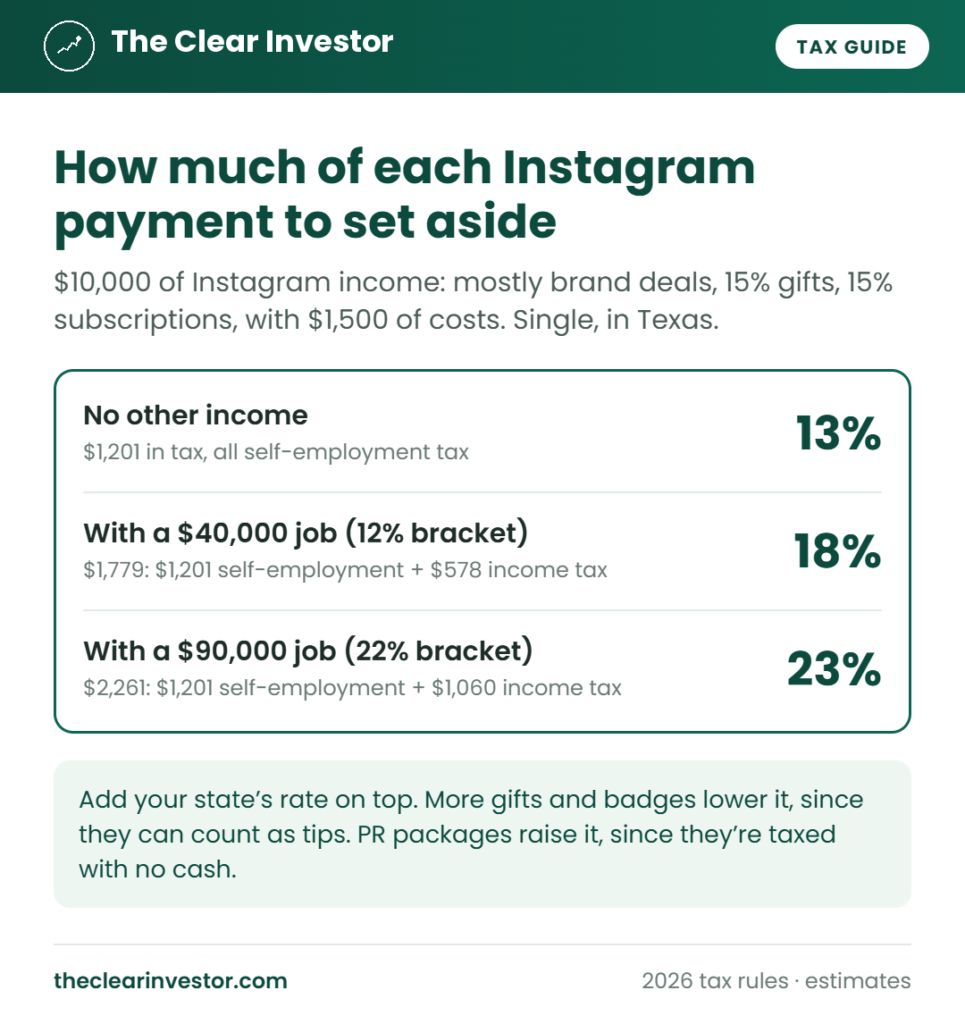
Add your state’s rate on top. The Instagram tax calculator works out yours, state included, from your own mix of brand deals, gifts and costs.
Deductions That Lower Your Instagram Taxes
Your content costs come off your profit before either tax is figured. These are the ones Instagram creators have the most of.
Your camera, phone and lights
A camera, lenses, lights, a tripod, a mic, a laptop for editing and your phone all count. Two rules decide how much:
Only the content share. A phone you also use for everything else counts only for the share you use for content. A $1,200 phone that’s 70% for content is an $840 deduction. With a $40,000 job in Texas, that cuts the tax on a $9,600 Instagram year by about $193.
Usually all at once. Items that cost $2,500 or less each can be deducted in full the year you buy them under the IRS’s de minimis safe harbor. A pricier camera can usually still be written off right away with 100% bonus depreciation, which the IRS made permanent for property bought after January 19, 2025. You can also spread it over 5 years under IRS Publication 946 if you expect to earn a lot more later.
Your manager’s or agency’s cut
If a brand pays you the full fee and your manager bills you 15%, that 15% is a business cost. If your agency collects the fee and pays you the rest, you only report what you got, so there’s nothing left to deduct. Either way, you’re taxed on the same amount:
- Brand pays you $20,000, manager bills you $3,000: report $20,000 and deduct $3,000.
- Agency collects $20,000 and pays you $17,000: report $17,000.
With a $50,000 job in Texas, both come to about $3,919 of tax, instead of $4,610 on the full $20,000. The mistake is doing both: reporting $17,000 and also deducting the $3,000.
Photographers, editors and assistants
What you pay people to shoot, edit or run your account is deductible. If you pay one person $2,000 or more in 2026 by check, bank transfer or cash, you have to send them a 1099-NEC, so get a W-9 from them before you pay. Payments by credit card or through PayPal’s goods and services are reported by the payment company instead.
Clothes, makeup and hair
This is the deduction Instagram creators get wrong most often. Clothes and makeup only count if they’re required for your work and not suitable for everyday wear. The test is whether someone could wear them day to day, not whether you do: in the classic case, Pevsner v. Commissioner, a boutique manager lost the deduction for designer clothes she only wore at work.
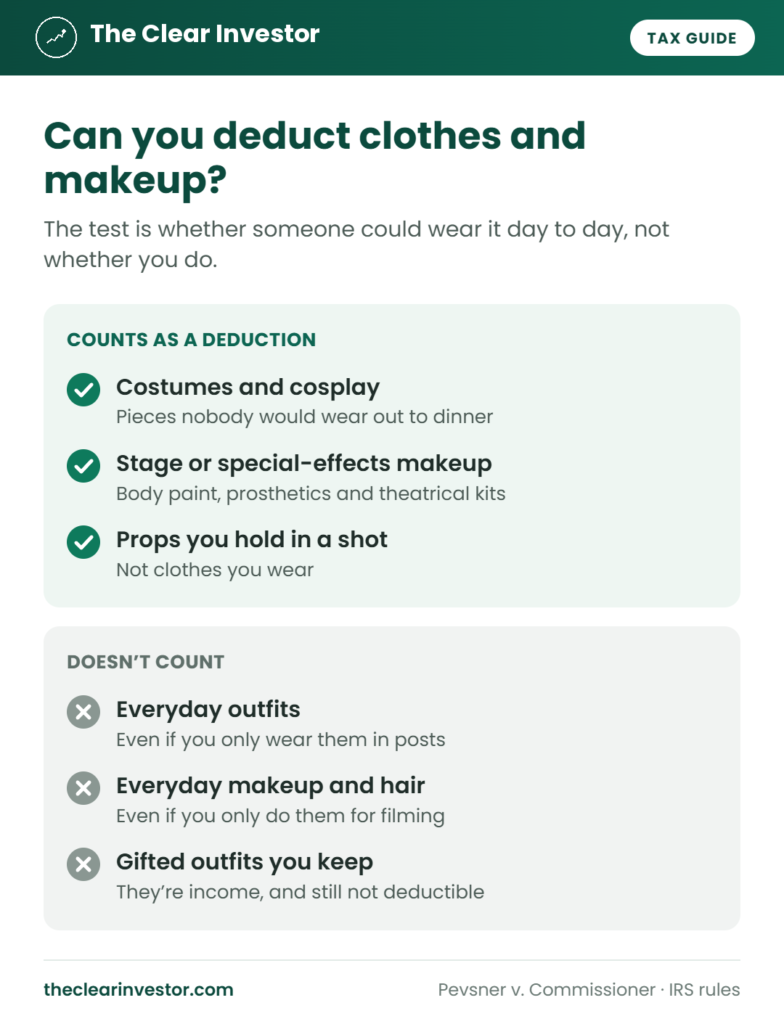
So outfits for a try-on haul, everyday makeup for a get-ready-with-me and hair appointments before a shoot usually aren’t deductible, even if you only bought them for content. Costumes, cosplay pieces, stage or special-effects makeup and props you hold in a shot are. Gifted outfits are the worst case: they’re income when you keep them, and still not deductible.
A content room
If you shoot in a room or a set you use regularly and only for content, you can deduct it with the IRS’s simplified option: $5 a square foot, up to 300 square feet. A bedroom you also sleep in or a living room the family uses doesn’t count. It also can’t be more than your Instagram profit, so it can’t create a loss.
Everything else
- Props, backdrops and products you buy to review or style. Not the ones brands send you.
- Boosted posts and ads, including what you pay Meta to promote a post.
- Apps and software: Lightroom, CapCut, Canva, scheduling tools and music.
- The content share of your phone and internet bills.
- Travel for shoots and brand events, when the trip is mainly for work.
- Shipping and giveaways you buy for followers.
Two more come automatically: half of your self-employment tax comes off your income, and the qualified business income deduction takes up to 20% of your profit off your taxable income.
Do You Need to Pay Instagram Taxes Quarterly?
Often, because brand deals come in big lumps and nobody takes tax out. The IRS expects estimated tax payments when you’ll owe $1,000 or more when you file. With no other income, self-employment tax alone gets there at about $7,100 of profit. With a job, you’ll get there sooner.
The easiest habit is to move your set-aside percentage to a savings account the day a brand pays you. The four due dates are April 15, June 15, September 15 and January 15. With a job, you can raise your Form W-4 withholding instead. The safe harbor that keeps you penalty-free is in how quarterly payments work.
Free tax tracker + deadline reminders
Get my free side income tax tracker
Sign up and I’ll send you my Google Sheets tracker that shows how much of each payout to set aside. You’ll also get an email before each quarterly tax deadline (Jan 15, Apr 15, Jun 15 and Sep 15), plus my new guides. Unsubscribe anytime.
Earn on several platforms or drive for work? Get the full 1099 Side Income Tracker ($12) →
Instagram Taxes: How to File
- Gather every 1099: Meta’s, each brand’s and each affiliate program’s. Check each one against your invoices and your payout history in the Professional dashboard.
- Add up everything without a form: brands that paid you under $2,000, affiliate programs under the line and the PR packages you kept.
- Report the total as gross receipts on line 1 of Schedule C. All of it is one line of work, so it all goes on the same Schedule C.
- Enter your costs in Part II: boosted posts on line 8, your manager’s cut on line 10, photographers and editors on line 11, and your gear, props, apps and phone on the lines that fit. The content room goes on line 30.
- Pay self-employment tax on Schedule SE, claim the tips deduction for your gifts and badges on Schedule 1-A, and subtract any estimated payments you made.
I file with TaxAct. Set up one Schedule C for your content first, and attach every 1099 to it, Meta’s and each brand’s, so the IRS can match each form to your return. Then enter the income that came without a form on the same Schedule C. If you also post on TikTok or YouTube, it’s the same business, so it goes there too.
Special Situations
If you also earn on Facebook
Facebook Stars, Facebook subscriptions and content monetization payouts are paid by Meta too, so they go on the same Schedule C. Stars work like Instagram gifts: viewers send them on free content, so they can count as tips. Content monetization is paid for views, so it can’t.
If you make UGC without posting it
User-generated content for a brand’s own account is paid the same way as a brand deal: a 1099-NEC from the brand at $2,000 or more, on Schedule C, with the same deductions. You won’t have any Meta payouts.
If you’re not monetized yet
Gifts need a professional account, 500 followers and a payout account, and you have to be 18 or older. Brand deals, affiliate commissions and PR packages don’t depend on any of that, so they count from the first dollar.
If you have a W-2 job
Your Instagram profit is taxed from the first dollar, after the tips deduction. Raising your W-4 withholding at the job is the easiest way to cover it.
If you live outside the US
Meta asks for a tax ID from your own country, and US tax forms work differently for you. This guide and my calculator cover US creators only.
Common Instagram Tax Mistakes
These are the Instagram tax mistakes I’d watch for:
- Waiting for Meta’s form to report your brand deals. Brands send their own, and Meta’s only covers what Meta paid you.
- Leaving out PR packages. No cash and no form doesn’t mean no tax.
- Deducting everyday clothes and makeup because you bought them for a post.
- Counting your manager’s cut twice, by reporting what the agency paid you and also deducting its fee.
- Claiming the tips deduction on subscriptions or brand deals. Only gifts and badges can count.
- Deducting your whole phone when you also use it for everything else.
- Forgetting the 1099-NEC for a photographer or editor you paid $2,000 or more.
- Spending the whole brand payment. Nothing is withheld, so some of it is tax.
My Verdict: Do You Pay Taxes on Instagram?
Yes, on your profit. Instagram taxes start once your profit passes about $433, and with a job, from the first dollar. Collect a 1099 from Meta and from each brand and affiliate program, add your PR packages and the payments under $2,000, and report it all on one Schedule C. Deduct your gear’s content share, your manager’s cut and the people you pay, but not clothes and makeup you could wear day to day. Claim the tips deduction for your gifts and badges. Then set aside about 13% of each payment with no other income, or about 18% with a job, plus your state’s rate.
The rules every side hustle shares, like quarterly payments, deductions and when you have to file, are in my side hustle taxes guide. Posting the same videos elsewhere? See my TikTok tax guide, my YouTube tax guide and my Twitch tax guide. Selling memberships on Patreon too? My Patreon tax guide covers its 1099-K and fees.
FAQ
Do you have to pay taxes on Instagram money?
Yes. Gifts, badges, subscriptions, bonuses, brand deals, affiliate commissions and PR packages you keep are all taxable. With no other income, you owe nothing until your profit passes about $433. With a job, every dollar of profit is taxed.
Does Instagram send you a 1099?
Meta sends one for gifts, badges, subscriptions and bonuses once they reach $2,000 for 2026. Its help pages don’t say whether it’s a 1099-NEC or a 1099-MISC, but either goes on Schedule C.
Do brands send a 1099 for sponsored posts?
Yes, each brand that pays you $2,000 or more sends a 1099-NEC. If an agency pays you, the agency sends it, and a brand that pays through PayPal leaves it to PayPal.
Are PR packages taxable?
Yes, if you keep them. They’re income at what they’d cost to buy. If you send them back, there’s nothing to report.
Are Instagram gifts taxed?
Yes. They’re income and owe self-employment tax. From 2025 through 2028, gifts and badges can count as tips, so up to $25,000 of them can come off your federal taxable income.
Can I write off clothes for Instagram?
Only clothes you couldn’t wear day to day, like costumes and cosplay. Outfits you could wear anywhere don’t count, even if you only wear them in posts.
Can I write off my phone for Instagram?
Yes, the share you use for content. A $1,200 phone that’s 70% for content is an $840 deduction, usually all in the year you buy it.
How much should I set aside for Instagram taxes?
About 13% of each payment with no other income, about 18% with a job in the 12% bracket and about 23% in the 22% bracket, plus your state’s rate.
Do I have to report Instagram income if I didn’t get a 1099?
Yes. A 1099 only shows what one company had to report. You owe tax on your profit either way.
I’m not a licensed financial advisor or tax professional. This guide is based on Meta’s help pages, IRS rules and my own experience with 1099 income. It’s for educational purposes and isn’t tax advice. Tax rules change, so check the links above or talk to a tax professional about your situation. I’m not affiliated with Instagram, Meta or TaxAct.