
This Etsy tax calculator shows how much tax you’ll owe on your Etsy shop in 2026, how much of your sales to set aside, and what you keep per order and per hour once Etsy’s fees, your materials and the tax come off. It also shows what you’d owe if the IRS called your shop a hobby. Want to know how Etsy sellers are taxed first? Read my Etsy tax guide.
I haven’t sold on Etsy, but I file my own taxes with TaxAct, keep each side gig on its own Schedule C, and took the home office deduction for my Outlier work, which is the same deduction a home studio gets. Etsy makes a few things harder than other side gigs. Its 1099-K counts what buyers paid before refunds and fees, its processing fee is charged on the sales tax too, and only the materials in what you actually sold come off this year. So this calculator estimates each Etsy fee from your sales, works out your materials from your shelf count, and adds your equipment and home studio.
Etsy Tax Calculator
See how much tax you’ll owe on your Etsy shop in 2026, after Etsy’s fees, your materials and your other costs, whether Etsy sends you a 1099-K, what changes if it’s a hobby, and how much of your sales to set aside.
Your 2026 Etsy sales
Etsy’s fees and ads
What you make your items from
Equipment, workspace and other costs
Business or hobby
Your other income
Tax you’ve already paid
About you
Your Etsy profit
What you keep per order and per hour
| For the year | Per order | Per hour |
|---|
Business or hobby: what each would cost
| Business | Hobby |
|---|
Your 1099-K
| Line | What it shows | Amount |
|---|
How your taxable income is worked out
How this is calculated
- Sales after refunds = item sales + shipping and gift wrap buyers paid − refunds. Sales tax Etsy collects and sends to the states isn’t your income, so it’s left out.
- Etsy’s fees (estimate) = 20¢ per listing, renewal or extra quantity sold + 6.5% of sales after refunds (the transaction fee covers shipping and gift wrap) + 3% of sales after refunds and the sales tax on them, plus 25¢ an order (payment processing in the US) + Offsite Ads at 15% of those sales, or 12% once your sales are $10,000 or more. When you refund an order through Shop Manager, Etsy refunds its transaction and processing fees too. Etsy Ads, subscriptions and labels are added as you enter them.
- Materials in what you sold (cost of goods sold) = materials and finished items on hand January 1 + materials and supplies bought − materials and finished items on hand December 31.
- Equipment = what you paid × the business-use share, all this year (100% bonus depreciation for equipment bought after January 19, 2025) or 14.29% this year if you spread it over 7 years.
- Home studio or storage = $5 × square feet, up to 300 square feet (the IRS simplified method), and no more than your profit before it.
- Mileage = miles from January through June × 72.5¢ + miles from July through December × 76¢, the 2026 IRS standard mileage rates.
- Etsy profit = sales after refunds − materials, Etsy’s fees and ads, labels, packaging, equipment, mileage, other costs and the home studio. As a business it goes on Schedule C. As a hobby, only the materials come off: sales after refunds − materials in what you sold, never below $0, on Schedule 1 line 8j, with no self-employment tax and no qualified business income deduction.
- Self-employment tax is 15.3% (12.4% Social Security and 2.9% Medicare) on 92.35% of your self-employment profit. You only owe it when that comes to $400 or more, which means about $433 of profit. Social Security tax stops at $184,500 of combined W-2 pay and self-employment earnings, and an extra 0.9% Medicare tax applies above $200,000 ($250,000 married filing jointly, $125,000 separately). Half of the 15.3% is deductible.
- Federal income tax uses the 2026 brackets and standard deduction ($16,100 single or married filing separately, $32,200 married filing jointly, $24,150 head of household). Married filing separately uses the single brackets, except that the 37% rate starts at $384,350. It also includes the qualified business income deduction: 20% of your self-employment profit after the self-employment tax deduction, and at least $400 when that’s $1,000 or more.
- Child tax credit is $2,200 per child under 17. Up to $1,700 per child can be paid to you as a refund, based on 15% of your earned income over $2,500. Hobby income isn’t earned income.
- State income tax uses 2026 rates, brackets, standard deductions and exemptions from the Tax Foundation, updated for the 2026 cuts in Arkansas, Georgia, South Carolina, Utah and West Virginia and the 2026 standard deductions in Arizona and Maine. A few states (like California) hadn’t published 2026 bracket amounts, so their 2025 amounts are used. Head of household and married filing separately use single brackets.
- Tax on your Etsy shop = your total tax minus what your total tax would be without Etsy. The set-aside percentage is that tax divided by your sales after refunds.
- Per order and per hour = your sales after refunds, what you paid for materials, fees, labels, packaging, equipment and other costs (mileage at the IRS rate stands in for your car), and the tax, divided by your orders and hours.
- 1099-K: Etsy sends one when you have more than $20,000 in gross sales and more than 200 sales in a year, or pass a lower line in Arkansas ($2,500), the District of Columbia ($600), Illinois ($1,000 and 4 sales), Maryland ($2,000), Massachusetts ($600), New Jersey ($1,000), Vermont ($2,000) or Virginia ($2,000). Gross sales include shipping, with no refunds or fees taken out, and leave out the sales tax Etsy collects.
Not included: the $100 cap on an Offsite Ads fee, the regular (actual expense) home office method, sales tax you collect yourself, inventory rules for big sellers, the earned income tax credit, city and county income taxes (like Pennsylvania local earned income tax or New York City), state low-income credits, itemized deductions, retirement or health insurance deductions, and tax withheld from a W-2 job. Your real tax can be lower.
Free tax tracker + deadline reminders
Get my free side income tax tracker
Sign up and I’ll send you my Google Sheets tracker that shows how much of each payout to set aside. You’ll also get an email before each quarterly tax deadline (Jan 15, Apr 15, Jun 15 and Sep 15), plus my new guides. Unsubscribe anytime.
Earn on several platforms or drive for work? Get the full 1099 Side Income Tracker ($12) →
Table of Contents
How to Use the Etsy Tax Calculator
- Open your Payment account in Shop Manager. The monthly statements under Finances list your sales, refunds and every fee. For the whole year, download the Etsy Payments Sales CSV under Settings, then Options, then Download Data.
- Enter your item sales, shipping, orders, refunds and the sales tax buyers paid. Sales tax shows as “Sales tax paid by buyer (Remitted)”. It isn’t your income, but Etsy’s processing fee is charged on it.
- Choose how to count Etsy’s fees. Let the calculator estimate them from your listings and your Offsite Ads sales, or enter the fee total from your statements. Then add Etsy Ads and any subscription.
- Add your materials, packaging, labels and equipment. Materials use your shelf count: what you had on January 1, plus what you bought, minus what’s left on December 31.
- Add your home studio, miles, other costs and hours, then your other income, filing status and state.
Who This Calculator Is For
- Makers who sell what they make, like candles, jewelry, crochet, pottery or printed shirts, where materials are a big cost.
- Digital download sellers, whose costs are mostly Etsy’s fees.
- Sellers with a day job, to see how much more tax the shop adds.
- Sellers who aren’t sure if their shop is a business or a hobby, with the tax shown both ways.
- Shops under $20,000 in sales, which may not get a 1099-K but still owe tax.
If you also sell on eBay, Depop or TikTok Shop, enter that profit as other self-employment profit, so your tax bracket counts both. My eBay tax calculator, Depop tax calculator and TikTok Shop seller tax calculator can work out that profit, and my 1099 tax calculator covers any other 1099 work.
How to Read Your Results
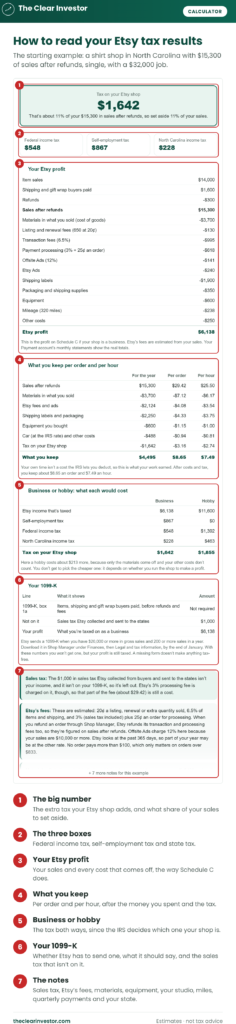
- The big number is the extra tax your Etsy shop adds, and the line under it says what share of your sales to set aside.
- The three boxes split it into federal income tax, self-employment tax and state tax.
- Your Etsy profit lists your sales and every cost that comes off, the way Schedule C does.
- What you keep per order and per hour takes the money you spent and the tax off your sales.
- Business or hobby shows the tax both ways, since the IRS decides which one your shop is.
- Your 1099-K shows whether Etsy has to send you one, what it should say, and the sales tax that isn’t on it.
- The notes cover sales tax, Etsy’s fees, materials, equipment, your home studio, miles, quarterly payments and your state.
Below them, a table shows how your taxable income is worked out.
Worked Example 1: Printed Shirts With a $32,000 Job in North Carolina
This is the calculator’s starting example: a single seller in North Carolina with a $32,000 job who prints shirts and sweatshirts on a heat press in the evenings. Over 520 orders, buyers paid $14,000 for items and $1,600 for shipping, and they refunded $300. They had $400 of blanks and ink on January 1, bought $3,800 more, and had $500 left on December 31. They made 650 listings and renewals, $1,200 of their sales came through Offsite Ads, and they spent $240 on Etsy Ads, $1,900 on labels, $350 on mailers, $600 on a heat press, 320 miles on supply runs and post office trips, and $250 on design software and other costs, over about 600 hours.
| Step | Amount |
|---|---|
| Items and shipping buyers paid | $15,600 |
| Refunds | −$300 |
| Materials in what they sold ($400 + $3,800 − $500) | −$3,700 |
| Etsy’s fees (listings, 6.5% transaction, 3% + 25¢ processing, 12% Offsite Ads) | −$1,884 |
| Etsy Ads | −$240 |
| Shipping labels and mailers | −$2,250 |
| Heat press, mileage and other costs | −$1,088 |
| Etsy profit | $6,138 |
| Federal income tax | $548 |
| Self-employment tax | $867 |
| North Carolina income tax | $228 |
| Tax on their Etsy shop | $1,642 |
The $1,642 is about 11% of the $15,300 they kept after refunds, so the calculator says to set aside 11% of their sales. Etsy’s fees and ads came to $2,124, about 14% of their sales. The $1,000 of sales tax buyers paid isn’t their income and isn’t on any form, but about $29 of the processing fee was charged on it, so that part is a cost.
Their job uses up the standard deduction, so the profit is taxed at 12% after the $1,141 qualified business income deduction. If the IRS called the shop a hobby, only the materials would come off: $11,600 would be taxed and they’d owe $1,855, $213 more, even with no self-employment tax. After the money they spent and the tax, they keep $4,495, about $8.65 an order or $7.49 an hour.
Worked Example 2: Digital Downloads in Texas With No Other Job
This seller sells printable planners and templates, files single and has no other income. Buyers paid $9,000 over 1,800 orders, about $5 each, plus $500 of sales tax, and they refunded $100. They had 300 listings and renewals, spent $300 on Etsy Ads and $400 on design software and fonts, and work from a 100-square-foot home office used only for the shop, about 300 hours a year.
| Step | Amount |
|---|---|
| Item sales | $9,000 |
| Refunds | −$100 |
| Etsy’s fees (listings, 6.5% transaction, 3% + 25¢ processing) | −$1,370 |
| Etsy Ads | −$300 |
| Design software and fonts | −$400 |
| Home office (100 sq. ft. × $5) | −$500 |
| Etsy profit | $6,330 |
| Federal income tax | $0 |
| Self-employment tax | $894 |
| Tax on their Etsy shop | $894 |
Cheap orders make the 25¢ part of the processing fee add up: 1,800 orders cost $450 in flat fees, so processing came to $732, more than the $579 transaction fee. With no job, their adjusted gross income is $5,882, under the $16,100 standard deduction, so they owe no federal income tax, and Texas has no income tax. They still owe $894 of self-employment tax, which is about 10% of their sales, so the calculator rounds up to an 11% set-aside.
The home office saves them $71. As a hobby, the $8,900 would fit under their standard deduction and cost $0, but the IRS goes by how you run the shop, not by which answer is cheaper, and 300 listings and 300 hours look like a business. They keep $5,935, about $3.30 an order or $19.78 an hour.
Worked Example 3: A Small Crochet Shop in Illinois, Business vs. Hobby
A single seller in Illinois with a $45,000 job sells crochet toys. Over 60 orders, buyers paid $2,200 for items and $300 for shipping, with $150 of sales tax on top. They had $100 of yarn on January 1, bought $1,300 more and had $300 left on December 31, and spent $420 on labels and $60 on packaging over about 250 hours, with 80 listings and renewals.
| As a business | As a hobby | |
|---|---|---|
| Income that’s taxed | $647 | $1,400 |
| Self-employment tax | $91 | $0 |
| Federal income tax | $58 | $168 |
| Illinois income tax | $30 | $69 |
| Tax on their Etsy shop | $179 | $237 |
Etsy sends this seller a 1099-K even though they’re far under the federal line, because Illinois’s line is $1,000 and 4 sales. It shows $2,500, what buyers paid for items and shipping, while their profit as a business is $647 after $1,100 of materials, $273 of Etsy fees and $480 of labels and packaging. As a hobby, only the $1,100 of materials comes off, so $1,400 is taxed at their 12% bracket and Illinois’s 4.95%, and they’d owe $58 more with no self-employment tax at all. As a business they set aside 8% of their sales. They keep $468, about $7.80 an order, but only $1.87 an hour.
Worked Example 4: A Married Laser Engraving Shop in California
This seller files jointly with a spouse who earns $70,000, and they have two children under 17. Over 1,100 orders, buyers paid $38,000 for engraved gifts and $4,000 for shipping, plus $3,000 of sales tax, and they refunded $600. They had 1,500 listings and renewals, $3,000 of Offsite Ads sales, $900 of Etsy Ads and $120 for Etsy Plus. They had $1,500 of wood, acrylic and blanks on January 1, bought $9,000 more and had $2,000 left on December 31.
They bought a $4,500 laser engraver used only for the shop, and use a 200-square-foot workshop at home. They also spent $5,200 on labels, $900 on packaging, 600 miles on supply runs and $600 on other costs, over about 1,400 hours.
| Step | Amount |
|---|---|
| Items and shipping buyers paid (1099-K box 1a) | $42,000 |
| Refunds | −$600 |
| Materials in what they sold ($1,500 + $9,000 − $2,000) | −$8,500 |
| Etsy’s fees, Etsy Ads and Etsy Plus | −$5,972 |
| Shipping labels and packaging | −$6,100 |
| Laser engraver (all this year) | −$4,500 |
| Workshop (200 sq. ft. × $5), mileage and other costs | −$2,045 |
| Etsy profit | $14,283 |
| Federal income tax | $1,274 |
| Self-employment tax | $2,018 |
| California income tax | $346 |
| Tax on their Etsy shop | $3,639 |
Their 1099-K shows $42,000, while their profit is about a third of that. The sales tax isn’t on it. With the spouse’s pay, their adjusted gross income is $83,274, and the profit is taxed in the 12% bracket after a $2,655 qualified business income deduction. The laser engraver comes off all at once with 100% bonus depreciation. Spread over 7 years, only $643 would come off this year and they’d owe $4,671, which is $1,032 more. The workshop saves them $267.
California has no qualified business income deduction and taxes the profit at 4%, but part of the family’s California exemption credits weren’t used by the spouse’s pay alone, which brings it down to $346. They set aside 9% of their sales and keep $11,644, about $10.59 an order or $8.32 an hour. As a hobby, $32,900 would be taxed, for $5,251.
More Example Results
Here’s how a W-2 job changes the tax on the same shop, for the seller in Example 1 ($15,300 of sales after refunds, 520 orders, 600 hours, $6,138 of profit, single, in North Carolina):
| W-2 job | Tax on Etsy shop | Set aside | You keep per order | You keep per hour | If it’s a hobby |
|---|---|---|---|---|---|
| None | $867 | 6% | $10.14 | $8.78 | $0 |
| $20,000 | $1,551 | 11% | $8.82 | $7.64 | $1,685 |
| $32,000 | $1,642 | 11% | $8.65 | $7.49 | $1,855 |
| $60,000 | $1,642 | 11% | $8.65 | $7.49 | $2,365 |
| $90,000 | $2,099 | 14% | $7.77 | $6.73 | $3,015 |
With no job, the standard deduction covers the profit, so the tax is all self-employment tax, and as a hobby it would be $0. A job fills the low brackets first, which pushes the profit into the 12% bracket and then the 22% bracket. Between about $32,000 and $60,000 both sit in the 12% bracket, so the tax doesn’t change. The self-employment tax is $867 on every row, because it depends only on the shop’s profit. The hobby column climbs faster, because $11,600 is taxed instead of $6,138.
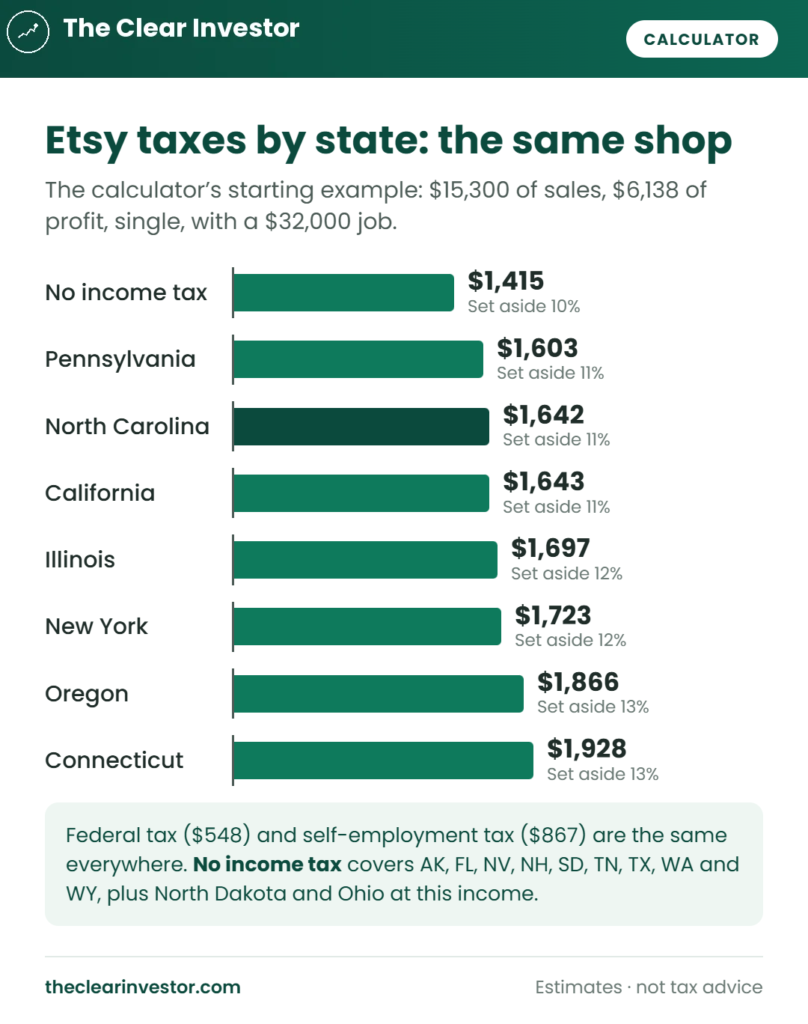
Your state matters too. The tax on the seller in Example 1 would be $1,415 in states with no income tax, like Florida, Texas and Tennessee, and up to $1,928 in Connecticut:
How the Etsy Tax Calculator Works
- Sales: what buyers paid for items, shipping and gift wrap, minus refunds. Etsy’s 1099-K page and its page on how the total is calculated say the form counts everything buyers paid, before fees and refunds, and leaves out the sales tax Etsy collected.
- Etsy’s fees: 20¢ a listing, renewal or extra quantity sold, a 6.5% transaction fee on items, shipping and gift wrap, and Offsite Ads at 15%, or 12% once you’ve made $10,000 in the past 365 days, never more than $100 an order, from Etsy’s fees page. US payment processing is 3% plus 25¢ an order, on the total including sales tax. When you refund an order through Shop Manager, Etsy refunds its transaction and processing fees too, per its refunds page.
- Sales tax: Etsy collects and sends US sales tax for you under marketplace facilitator laws, per its sales tax page, so it isn’t your income.
- Materials: the cost of goods sold from Part III of Schedule C: what you had on January 1, plus what you bought, minus what’s left on December 31. Packaging, labels, Etsy Ads and subscriptions come off as separate costs.
- Equipment: the business share all at once with 100% bonus depreciation, which the IRS says is permanent for property bought after January 19, 2025, or spread over 7 years (14.29% the first year).
- Home studio: the simplified method from IRS Publication 587, $5 a square foot up to 300 square feet, no more than your profit. Space where you store inventory doesn’t have to pass the exclusive-use test if your home is the shop’s only fixed location.
- Mileage: 72.5¢ a mile through June 2026 and 76¢ from July, the IRS standard mileage rates.
- Self-employment tax: 15.3% on 92.35% of your profit once that’s $400 or more, per the IRS.
- Income tax: the 2026 brackets and $16,100 standard deduction, the qualified business income deduction (at least $400 once your business income is $1,000 or more) and the child tax credit.
- Hobby: sales after refunds minus the materials in what you sold, on Schedule 1, line 8j, with no self-employment tax and no other deductions, per the Taxpayer Advocate Service and IRS Publication 525.
- Your 1099-K: Etsy’s federal line of $20,000 and 200 sales, and its lower lines for Arkansas, DC, Illinois, Maryland, Massachusetts, New Jersey, Vermont and Virginia.
- State tax: your state’s 2026 rates and deductions.
- Your Etsy tax: your total tax minus your tax without the shop, so your job’s bracket counts.
- The set-aside: that tax divided by your sales after refunds, rounded up.
- Per order and per hour: your sales after refunds minus what you spent (materials, Etsy’s fees and ads, labels, packaging, equipment, your car at the mileage rate and other costs) and the tax, divided by your orders and hours.
What the Calculator Leaves Out
- Whether your shop is a business or a hobby. It shows the tax both ways, and the IRS decides by how you run it.
- The regular home office method (a share of rent, utilities and depreciation), and the actual-expense method for your car.
- State depreciation rules that don’t follow 100% bonus depreciation.
- Sales outside Etsy Payments, like craft fair sales through Square or your own website. Add them to item sales and enter your fee total instead of the estimate.
- Health insurance and retirement deductions, the earned income tax credit, city and county income taxes, and itemized deductions.
- Currency conversion fees, and fees that only apply to sellers outside the US.
Tips for Accurate Results
- Use your Payment account, not your bank deposits. Etsy takes its fees, ads and labels out before it deposits, so your deposits are smaller than your sales.
- Count your supplies on December 31. Write down what’s left at what you paid for it. Without that count, you can’t work out the materials in what you sold.
- Use your fee total if you have it. Your statements list every fee, and Offsite Ads can switch between 15% and 12% during the year.
- Keep sales tax out of your sales. Etsy sends it to the states, so it was never your money.
- Split equipment you also use for personal projects by the share you use for the shop.
What to Do With Your Result
- Set aside your percentage of each month’s sales in a savings account. Your deposits are smaller than your sales, so go by your Payment account.
- Make quarterly payments if you’ll owe $1,000 or more in federal tax.
- Check your tax info in Shop Manager by December 31, 2026, so your 1099-K is right.
- Look for your 1099-K in January 2027 under Finances, then Legal and tax information.
- Use the per-hour number to check whether your prices cover your time.
Etsy Tax Calculator FAQ
Where do I find my Etsy sales for taxes?
In Shop Manager, under Finances, then Payment account. The monthly statements show your sales, refunds and fees, and the Etsy Payments Sales CSV (Settings, then Options, then Download Data) lists every sale for the year.
Does Etsy send a 1099-K?
For 2026, once you have more than $20,000 in gross sales and more than 200 sales, or pass a lower line in seven states and DC. Download it in Shop Manager under Finances, then Legal and tax information, by the end of January.
Is the sales tax Etsy collects my income?
No. Etsy collects it and sends it to the states, and it isn’t on your 1099-K. Etsy’s 3% processing fee is charged on it, though, so that part of the fee is a cost.
Can I deduct Etsy’s fees?
Yes, if your shop is a business: listing, transaction, processing and Offsite Ads fees, Etsy Ads, subscriptions and shipping labels all come off.
Is my Etsy shop a business or a hobby?
It depends on whether you run it to make a profit: records, pricing, the time you put in and whether it makes money in some years. A hobby pays no self-employment tax, but it can’t deduct anything except the materials in what it sold.
Does Etsy take out taxes?
No. Etsy doesn’t take income tax out of your deposits, so set aside part of your sales for tax.
Does it include state tax?
Yes. Pick your state and it adds your state’s 2026 income tax on your Etsy profit. City and county taxes aren’t included.
Is my information saved?
No. Everything runs in your browser. Nothing you enter is sent anywhere or stored.
What tax year does the Etsy tax calculator use?
2026: the 2026 brackets, standard deduction, mileage rates, Etsy’s 1099-K lines and Etsy’s US fees as of November 2026. I update it every year.
Estimates for educational purposes only. I’m not a licensed financial advisor or tax professional, and this isn’t tax advice. Not affiliated with Etsy.