
This Instacart tax calculator shows how much tax you’ll owe on your Instacart batch pay and tips in 2026, how much of each payout to set aside, and what you keep per batch and per hour once your car, your costs and the tax come off. Want to know how Instacart shoppers are taxed first? Read my Instacart tax guide.
I haven’t shopped for Instacart, but I delivered for Amazon Flex and filed it on its own Schedule C with the standard mileage rate, so the calculator starts from the same pieces: pay, tips, miles and a few small costs. What’s new for Instacart shoppers in 2026 is the tips. The 2026 1099-NEC has a new box for them, and only tips from Full Service and Delivery Only batches fit the IRS’s list of tipped jobs, so the calculator keeps tips from Shop Only batches apart.
Instacart Tax Calculator
See how much tax you’ll owe on your Instacart batch pay and tips in 2026, after your miles and shopping costs and the tips deduction, what you keep per batch and per hour, and how much of each payout to set aside.
Your 2026 Instacart earnings
How much you shopped
Your shopping costs
Your other income
Tax you’ve already paid
About you
What you keep per batch and per hour
| For the year | Per batch | Per hour |
|---|
Your tax forms
| Form | What it shows | Amount |
|---|
Your total 2026 tax: before vs. after deductions
| Before deductions | After deductions |
|---|
How your taxable income is worked out
How this is calculated
- Instacart income = batch pay (boosts and heavy pay included) + promotions and bonuses + customer tips + the value of any Cart Star rewards Instacart reports on a 1099. The grocery money on your Instacart payment card is the customer’s, so it’s neither income nor a cost.
- Mileage = miles for batches from January through June × 72.5¢ + miles from July through December × 76¢, the 2026 IRS standard mileage rates (the IRS raised the rate on July 1, 2026). The rates cover gas, insurance, repairs and wear, so those aren’t added on top. Parking and tolls are.
- Instacart profit = your income minus your mileage, parking and tolls, Instant Cashout fees, the shopping share of your phone bill, and bags and other supplies. It’s self-employment income, reported on Schedule C.
- Self-employment tax is 15.3% (12.4% Social Security and 2.9% Medicare) on 92.35% of your self-employment profit. You only owe it when that comes to $400 or more, which means about $433 of profit. Social Security tax stops at $184,500 of combined W-2 pay and self-employment earnings, and an extra 0.9% Medicare tax applies above $200,000 ($250,000 married filing jointly, $125,000 separately). Half of the 15.3% is deductible.
- Federal income tax uses the 2026 brackets and standard deduction ($16,100 single or married filing separately, $32,200 married filing jointly, $24,150 head of household). Married filing separately uses the single brackets, except that the 37% rate starts at $384,350. It also includes the qualified business income deduction: 20% of your self-employment profit after the self-employment tax deduction, and at least $400 when that’s $1,000 or more.
- Tips deduction: the IRS’s list of tipped occupations names grocery delivery drivers and app-based delivery people (code 804), so tips from Full Service and Delivery Only batches can count as qualified tips. The list doesn’t name in-store shopping, so the calculator leaves tips from Shop Only batches out. The deduction is up to $25,000, no more than your Instacart profit, and shrinks by $100 for every $1,000 of income over $150,000 ($300,000 married filing jointly). Married couples only get it on a joint return. It lowers federal income tax only, not self-employment tax, and runs from 2025 through 2028. For 2026, tips have to be reported to you on a 1099, so by default the calculator only counts them when Instacart has to send you a 1099-NEC.
- Child tax credit is $2,200 per child under 17. Up to $1,700 per child can be paid to you as a refund, based on 15% of your earned income over $2,500.
- State income tax uses 2026 rates, brackets, standard deductions and exemptions from the Tax Foundation, updated for the 2026 cuts in Arkansas, Georgia, South Carolina, Utah and West Virginia and the 2026 standard deductions in Arizona and Maine. A few states (like California) hadn’t published 2026 bracket amounts, so their 2025 amounts are used. Head of household and married filing separately use single brackets. Arizona and Michigan follow the federal tips deduction, so it’s included in their tax. Other states’ tax here leaves it out, since each state decides whether to follow it.
- Tax on your Instacart income = your total tax minus what your total tax would be without Instacart. The set-aside percentage is that tax divided by what Instacart paid you in cash (batch pay, promotions and tips, minus Instant Cashout fees).
- Per batch and per hour = your cash pay, your costs (mileage at the IRS rate stands in for what the car costs you) and the tax on your Instacart income, divided by your batches and hours.
- Tax forms: for 2026, a business has to send a Form 1099-NEC once it pays you $2,000 or more. The 2026 form adds box 1b for the tips included in box 1a and box 1c for the tipped occupation code.
- Before deductions leaves out your mileage and shopping costs, the standard deduction, the qualified business income deduction, the tips deduction, and state deductions and exemptions, so you can see how much they save you.
Not included: the actual-expense method for your car (gas, repairs, insurance and depreciation), car loan interest, the home office deduction, the earned income tax credit, city and county income taxes (like New York City or Maryland counties), state low-income credits, itemized deductions, retirement or health insurance deductions, and tax withheld from a W-2 job. Your real tax can be lower.
Free tax tracker + deadline reminders
Get my free side income tax tracker
Sign up and I’ll send you my Google Sheets tracker that shows how much of each payout to set aside. You’ll also get an email before each quarterly tax deadline (Jan 15, Apr 15, Jun 15 and Sep 15), plus my new guides. Unsubscribe anytime.
Earn on several platforms or drive for work? Get the full 1099 Side Income Tracker ($12) →
Table of Contents
How to Use the Instacart Tax Calculator
- Open your earnings history in the Shopper app. It lists every batch with its batch pay, promotions and tips. Your 2026 1099-NEC, if you get one, shows up in the app by Feb. 1, 2027.
- Enter your batch pay, promotions and tips. Batch pay already includes boosts and heavy pay. Leave out the grocery money on your Instacart payment card, since it paid for the customer’s order and was never yours.
- Enter the tips from Shop Only batches, if you take them, and pick whether to count the tips deduction.
- Add your batches, hours and miles. Split your miles at June: 72.5 cents a mile through June and 76 cents from July. Then add parking and tolls, Instant Cashout fees, the shopping share of your phone bill, and bags and supplies.
- Add your other income, tax already paid and your state. A W-2 job raises your tax bracket, and your state adds its own tax.
Who This Calculator Is For
- Full Service shoppers who shop and deliver, part-time or full-time.
- Shoppers who take Shop Only batches, whose tips work differently for the tips deduction.
- Shoppers with a day job, to see how much more tax Instacart adds.
- Shoppers choosing which batches are worth it, since it shows what you keep per batch and per hour after costs and tax.
- New shoppers under $2,000, who may not get a 1099-NEC at all.
If you also shop for Shipt or deliver for another app, enter that profit as other self-employment income, so your tax bracket counts both. My DoorDash tax calculator and Amazon Flex tax calculator can work out that profit, and my 1099 tax calculator covers any other 1099 work.
How to Read Your Results
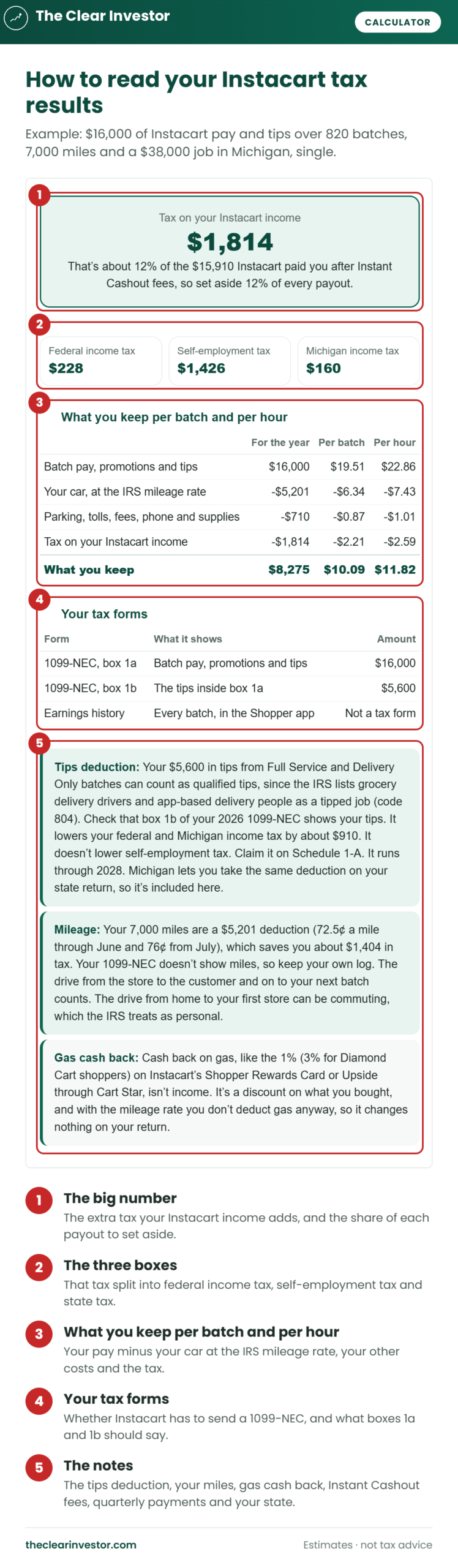
- The big number is the extra tax your Instacart income adds, and the line under it says what share of each payout to set aside.
- The three boxes split it into federal income tax, self-employment tax and state tax.
- What you keep per batch and per hour starts with your pay and takes off your car at the IRS mileage rate, your other costs and the tax.
- Your tax forms show whether Instacart has to send you a 1099-NEC, and what boxes 1a and 1b should say.
- The notes cover the tips deduction, your miles, gas cash back, Instant Cashout fees, quarterly payments and your state.
Below them, two more tables show your total tax before and after deductions, and how your taxable income is worked out.
Worked Example 1: $16,000 From Instacart and a $38,000 Job in Michigan
This is the calculator’s starting example: a single shopper in Michigan with a $38,000 job who shops evenings and weekends. Their earnings history shows $9,800 of batch pay, $600 of promotions and $5,600 of tips, all from Full Service and Delivery Only batches, over 820 batches and about 700 hours. They drove 7,000 miles for batches, 3,400 of them before July, and paid $120 for parking, $90 in Instant Cashout fees, $360 for the shopping share of their phone and $140 for bags.
| Step | Amount |
|---|---|
| Batch pay, promotions and tips (1099-NEC box 1a) | $16,000 |
| Mileage (3,400 miles × 72.5¢ + 3,600 miles × 76¢) | −$5,201 |
| Parking, Instant Cashout fees, phone and bags | −$710 |
| Instacart profit | $10,089 |
| Federal income tax | $228 |
| Self-employment tax | $1,426 |
| Michigan income tax | $160 |
| Tax on their Instacart income | $1,814 |
The $1,814 is about 11% of the $15,910 that reached them after Instant Cashout fees, so the calculator says to set aside 12% of every payout. Their federal income tax is low because two deductions keep most of the profit out of their taxable income: the $5,600 tips deduction and the $1,875 qualified business income deduction. Michigan lets them take the same tips deduction from 2026, so together it saves them about $910. Without it, they’d owe $2,724. After their car at the mileage rate, their other costs and the tax, they keep $8,275, about $10.09 a batch or $11.82 an hour.
Worked Example 2: A Full-Time Shopper in Florida With a Child
This shopper files as head of household with one child under 17 and has no other job. They took $27,000 of batch pay, $2,000 of promotions and $15,000 of tips over 2,300 batches and about 1,900 hours, all Full Service. They drove 22,500 miles, 11,000 of them before July, paid $300 for parking and tolls, $600 for their phone and $200 for supplies, and used weekly direct deposit, so they paid no Instant Cashout fees.
| Step | Amount |
|---|---|
| Batch pay, promotions and tips | $44,000 |
| Mileage (11,000 miles × 72.5¢ + 11,500 miles × 76¢) | −$16,715 |
| Parking, tolls, phone and supplies | −$1,100 |
| Instacart profit | $26,185 |
| Federal income tax | $0 |
| Child tax credit paid as a refund | −$1,700 |
| Self-employment tax | $3,700 |
| Tax on their Instacart income | $2,000 |
After half of the self-employment tax comes off, their income is $24,335, only $185 over the $24,150 head of household standard deduction. So the tips deduction only has $185 to work with, and they owe no federal income tax. Self-employment tax still applies: 15.3% on 92.35% of their profit. Their earnings also let them get up to $1,700 of the child tax credit as a refund, which brings the total down to $2,000, about 5% of what Instacart paid. They keep about $10.52 a batch and $12.73 an hour. At this income they may also qualify for the earned income tax credit, which the calculator leaves out, so their real bill could be lower.
Worked Example 3: Shop Only Batches and a $30,000 Job in Illinois
This single shopper has a $30,000 job and takes Shop Only batches at stores near home: they shop the order and hand it off to someone else to deliver. They earned $7,500 of batch pay, $300 of promotions and $2,400 of tips over 900 batches and about 650 hours, and drove 1,800 miles between stores, 1,000 of them before July. They paid $60 in Instant Cashout fees, $240 for their phone and $50 for supplies.
| Step | Amount |
|---|---|
| Batch pay, promotions and tips | $10,200 |
| Mileage (1,000 miles × 72.5¢ + 800 miles × 76¢) | −$1,333 |
| Instant Cashout fees, phone and supplies | −$350 |
| Instacart profit | $8,517 |
| Federal income tax | $760 |
| Self-employment tax | $1,203 |
| Illinois income tax | $392 |
| Tax on their Instacart income | $2,355 |
All $2,400 of their tips came from Shop Only batches. The IRS’s list of tipped jobs names grocery delivery drivers and app-based delivery people, but not in-store shopping, so the calculator leaves these tips out of the deduction. If they counted, the total would be $2,067, about $288 less. Their set-aside is 24%, the highest of these examples: their job puts all of the profit in the 12% bracket, self-employment tax and Illinois’ 4.95% come on top, and they drive too little for the mileage deduction to offset much. They keep about $6.85 a batch and $9.48 an hour. If their 1099-NEC lists a tipped occupation code in box 1c, a tax pro can tell them whether those tips count.
Worked Example 4: A Few Months of Batches in Washington, With and Without a 1099-NEC
This single shopper has a $45,000 job and tried Instacart for a few months: $1,150 of batch pay and $600 of tips from 90 Full Service batches, 800 miles split evenly before and after July, and $40 for bags. Their Instacart profit is $1,116 either way.
| No 1099-NEC | Tips on a 1099-NEC | |
|---|---|---|
| Instacart income | $1,750 | $1,750 |
| Mileage and bags | −$634 | −$634 |
| Tips deduction | $0 | $600 |
| Federal income tax | $76 | $4 |
| Self-employment tax | $158 | $158 |
| Tax on their Instacart income | $234 | $162 |
For 2026, Instacart only has to send a 1099-NEC once it pays you $2,000 or more, up from $600 through 2025. At $1,750 this shopper is under the line, and for 2026 the tips deduction needs tips reported to you on a 1099, so the calculator leaves it out by default. They still owe tax on all $1,750, form or not, and since their profit is over about $433, that includes self-employment tax. If Instacart sends them a 1099-NEC with their tips in box 1b anyway, switching the tips box to yes drops the total to $162.
More Example Results
Here’s how the miles you drive change the tax and what you keep, for the shopper in Example 1 (820 batches, 700 hours, $16,000 of pay and tips, a $38,000 job in Michigan):
| Miles per batch | Miles a year | Tax on Instacart income | Set aside | You keep per batch | You keep per hour |
|---|---|---|---|---|---|
| 4 | 3,280 | $2,561 | 17% | $12.55 | $14.71 |
| 8 | 6,560 | $1,903 | 12% | $10.39 | $12.17 |
| 12 | 9,840 | $1,246 | 8% | $8.22 | $9.63 |
| 16 | 13,120 | $597 | 4% | $6.04 | $7.07 |
Every 4 more miles a batch cuts the tax by about $650 a year, but at the mileage rate those miles cost about $2,400, so what you keep drops by about $2.17 a batch. The deduction makes up for only part of what driving costs you. A low tax bill from lots of miles isn’t a win, so compare batches by what you keep, not by the tax.
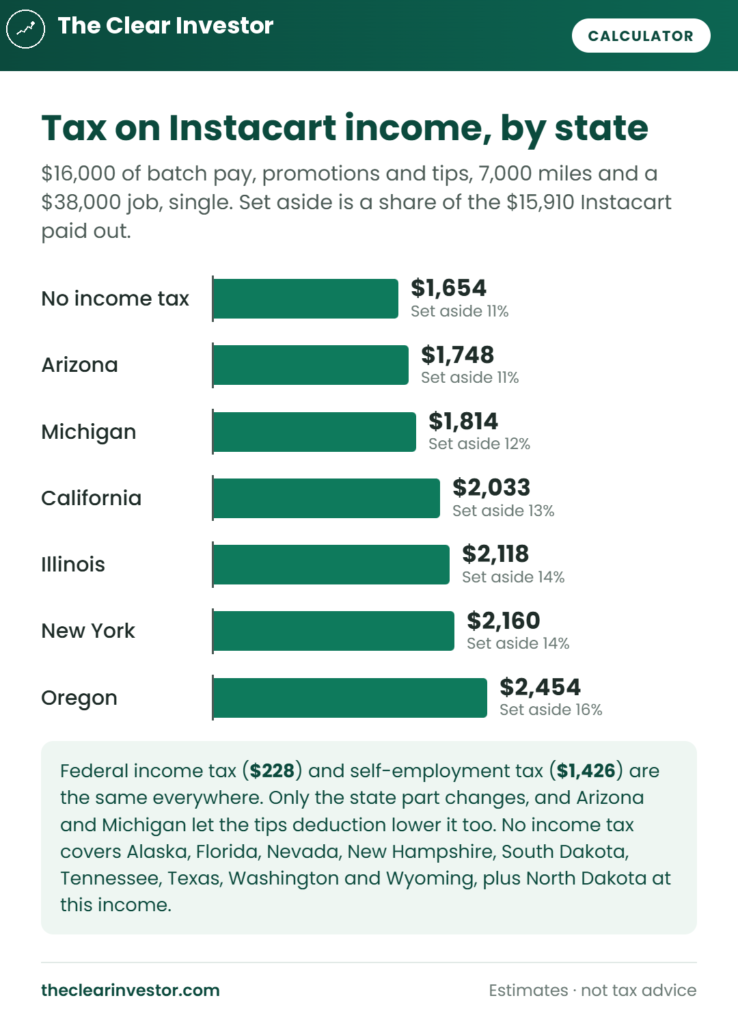
Your state matters too. The tax on the shopper in Example 1 would be $1,654 in states with no income tax, like Florida, Texas and Washington, and up to $2,454 in Oregon:
How the Instacart Tax Calculator Works
- Income: batch pay, promotions and tips, the three parts of what Instacart calls your total earnings. Batch pay includes boosts and heavy pay, and you keep 100% of your tips. The grocery money on your Instacart payment card isn’t yours, so it’s neither income nor a cost.
- Cart Star rewards: Instacart says it may issue a Form 1099 for the approximate retail value of some rewards. If it does, that value counts as income.
- Your car: 72.5 cents a mile through June 2026 and 76 cents from July, the IRS standard mileage rates. Driving from home to your first store can be commuting, which IRS Publication 463 treats as personal.
- Profit: income minus your mileage, parking and tolls, Instant Cashout fees, the shopping share of your phone bill, and bags and supplies, reported on Schedule C.
- Self-employment tax: 15.3% on 92.35% of your profit once that’s $400 or more, per the IRS.
- Income tax: the 2026 brackets and $16,100 standard deduction, the qualified business income deduction (at least $400 once your business income is $1,000 or more) and the tips deduction.
- The tips deduction: grocery delivery drivers and app-based delivery people are on the IRS’s list of tipped occupations (code 804), so tips from Full Service and Delivery Only batches count. In-store shopping isn’t on the list, so tips from Shop Only batches are left out. The deduction is up to $25,000, no more than your Instacart profit, and for 2026 only counts tips reported to you on a 1099.
- Your tax forms: the $2,000 line and the new boxes 1b (tips) and 1c (tipped occupation code) from the 2026 Form 1099-NEC instructions.
- State tax: your state’s 2026 rates and deductions. Arizona and Michigan follow the tips deduction (Michigan from 2026, per its Treasury notice), so it’s included there. Other states’ tax leaves it out.
- Your Instacart tax: your total tax minus your tax without Instacart, so your job’s bracket counts.
- The set-aside: that tax divided by what Instacart paid you in cash, after Instant Cashout fees.
- Per batch and per hour: your pay minus your car at the mileage rate, your other costs and the tax, divided by your batches and hours.
What the Calculator Leaves Out
- The actual-expense method for your car, and car loan interest.
- The home office deduction, and health insurance and retirement deductions.
- The earned income tax credit, city and county income taxes, and itemized deductions.
- State tips deductions other than Arizona’s and Michigan’s.
- Pay from Instacart as an employee (in-store shopper), which goes in W-2 income instead.
Tips for Accurate Results
- Use your earnings history, not your bank deposits. Deposits come after Instant Cashout fees and can lag a batch or a week behind.
- Leave out the customer’s grocery money. What you spend on the Instacart payment card isn’t your pay.
- Check your tips after the 14-day window. Customers can raise a tip for up to 14 days after delivery, so year-end tips can change in early January.
- Split out Shop Only tips if you take those batches, so the tips deduction only counts delivery tips.
- Keep a mileage log. Your 1099-NEC doesn’t show miles, and the IRS can ask how you got your number.
- Count each mile once if you run Instacart and another app at the same time.
What to Do With Your Result
- Move your set-aside percentage to a savings account each time Instacart pays you.
- Make quarterly payments if you’ll owe $1,000 or more in federal tax.
- Check the Shopper app by Feb. 1, 2027 for your 1099-NEC, and make sure box 1b shows your tips.
- Keep your earnings history and your mileage log with your tax records.
- Use the per-hour number to decide which batches and hours are worth your time.
Instacart Tax Calculator FAQ
Where do I find my Instacart earnings for taxes?
In the Shopper app’s earnings history, which lists batch pay, promotions and tips for every batch. Your 1099-NEC is in the Shopper app too, if Instacart has to send you one.
Does Instacart send a 1099?
For 2026, Instacart has to send full-service shoppers a 1099-NEC once it pays them $2,000 or more. You owe tax on your Instacart income either way.
Do I pay taxes on Instacart tips?
Yes. Tips are income, and they’re part of your self-employment profit. The tips deduction can lower your federal income tax on them, but not your self-employment tax.
Do Shop Only tips count for the tips deduction?
Not by default. The IRS’s list of tipped jobs names grocery delivery drivers and app-based delivery people, but not in-store shopping, so the calculator only counts tips from Full Service and Delivery Only batches.
Is the money on my Instacart payment card income?
No. That card pays for the customer’s groceries, so the money is never yours. Only your batch pay, promotions and tips count.
Does Instacart take out taxes?
No. Instacart doesn’t take tax out of your batch pay, so most shoppers set money aside and make quarterly estimated payments.
Does it include state tax?
Yes. Pick your state to add its income tax. It covers all 50 states and DC.
Is my information saved?
No. Everything is worked out in your browser, and nothing is sent or stored.
What tax year does the Instacart tax calculator use?
2026: the 2026 brackets, standard deduction, mileage rates, the $2,000 1099-NEC line and the tips deduction. I update it every year.
Estimates for educational purposes only. I’m not a licensed financial advisor or tax professional, and this isn’t tax advice. Not affiliated with Instacart.