Substack taxes catch writers off guard in two ways. Substack doesn’t take any tax out of your paid subscriptions, and the 1099-K you may get comes from Stripe, not Substack, showing what readers paid before any fees. All of it is taxable. Once you write to make money, your Substack earnings are self-employment income: you owe income tax on your profit and, once it passes about $433, 15.3% self-employment tax too.
I have a Substack myself, The Clear Investor Publication, though I use it to share my articles rather than for paid subscriptions. I’ve gotten 1099s for my own side income, from Amazon Flex and Outlier, and I report them on Schedule C every year. Everything Substack-specific in this guide comes from Substack’s and Stripe’s help pages, IRS rules and my Substack tax calculator, so you can check each piece yourself.
Substack taxes, the short answer:
- Is Substack income taxable? Yes. Monthly, annual and founding member subscriptions, iOS app subscriptions and sponsorships all count.
- Does Substack send a 1099? No. Stripe does: a 1099-K once card payments top $20,000 and 200 payments in a year, or less in some states. It shows what readers paid before fees.
- Does Substack take out taxes? No. It only takes its 10%, and Stripe takes its fees.
- Are Substack’s fees deductible? Yes, all of them: Substack’s 10%, Stripe’s processing and Billing fees, and Apple’s cut on app subscriptions.
- How much should I set aside? About 15% of each payout with no other income, or about 24% with a job, plus your state’s rate.
Table of Contents
Do You Pay Taxes on Substack Money?
Yes. Paid subscriptions are income, and Substack’s help center leaves the reporting to you: Stripe issues your tax forms, and you deduct Stripe’s and Substack’s fees yourself. Nothing is withheld, so the tax is on you.
If you write to make a profit, your Substack money is self-employment income. It goes on Schedule C, and you owe 15.3% self-employment tax on 92.35% of your profit once that comes to $400, which means about $433 of profit. You also owe income tax, but only once your total income passes the $16,100 standard deduction for 2026. With no other income, a small paid newsletter can owe self-employment tax and no income tax at all.
If you write just for fun and a few readers pay you, the IRS’s hobby rules apply instead: no self-employment tax, but no deductions either, not even Substack’s fees. Most writers who turned on paid subscriptions, publish on a schedule and want to grow are running a business.
What Counts as Substack Income?
| Substack income | Taxable? | Can count as tips? |
|---|---|---|
| Monthly subscriptions | Yes | No |
| Annual subscriptions | Yes, in the year readers pay | No |
| Founding member subscriptions | Yes, in the year readers pay | No |
| Subscriptions in the iOS app | Yes, when Substack pays you | No |
| Gift and group subscriptions | Yes | No |
| Sponsorships in your newsletter | Yes | No |
| Payments from readers who get nothing extra, since every post stays free | Yes | Yes |
| Refunds you give | They come off your income | No |
Readers pay full price, and you get less. Your income is what readers paid. Substack’s 10%, Stripe’s fees and Apple’s cut are business costs you deduct, not money you never had. That matters because Stripe’s 1099-K shows the full amount.
Sales tax isn’t your income. From Dec. 1, 2026, Substack collects sales tax on paid subscriptions where it’s required and pays it for you. For US writers it’s added on top of your price at checkout, so you don’t report it as income.
Pledges aren’t income yet. Readers who pledge before you turn on paid subscriptions haven’t paid anything. It counts once they’re charged.
Does Substack Send a 1099?
Substack doesn’t, but Stripe does. Substack runs paid subscriptions through your own Stripe account, so Stripe issues the 1099-K, and you download it from your Stripe dashboard by January 31. For 2026, Stripe sends one once your card payments top $20,000 and 200 payments in a year. Both have to be true. Some states set lower lines, according to Stripe’s state table:
- Arkansas: $2,500
- Vermont: $2,000
- Illinois: $1,000 and 4 payments
- New Jersey: $1,000
- DC, Maryland, Massachusetts, Montana and Virginia: $600
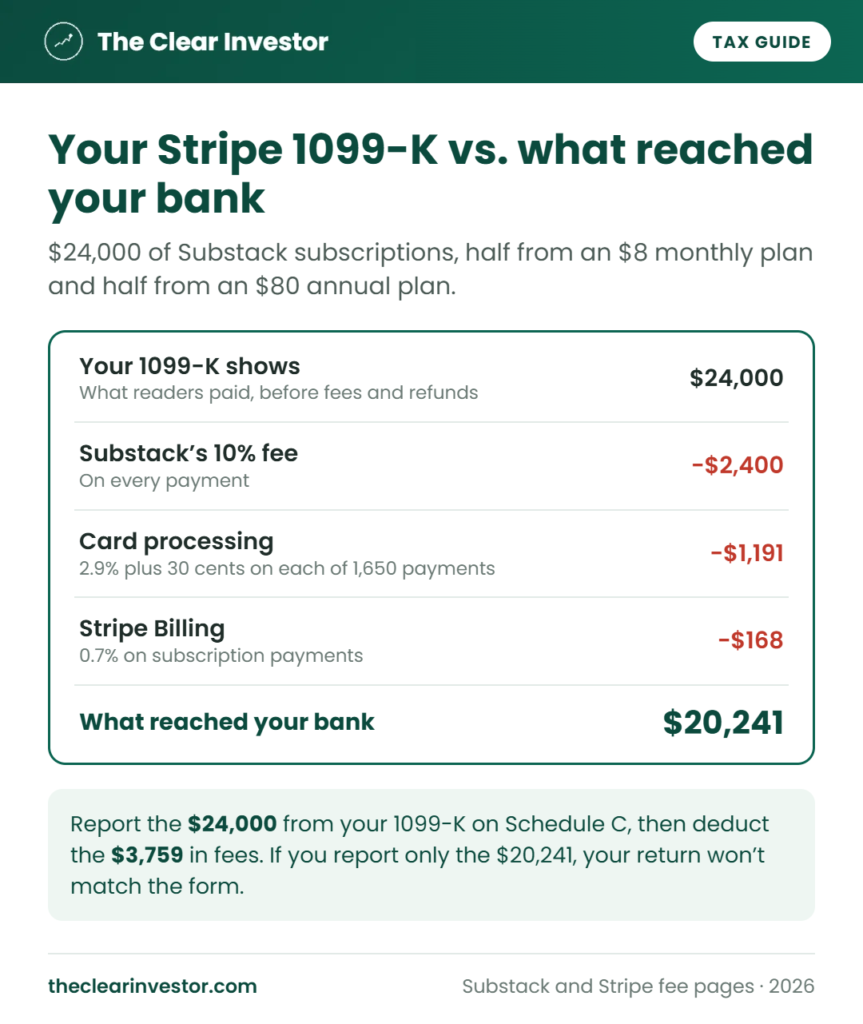
- It shows gross, not payouts. Stripe’s 1099-K reports what readers paid before Substack’s and Stripe’s fees and refunds. Report that total on Schedule C and deduct the fees, so your return matches the form.
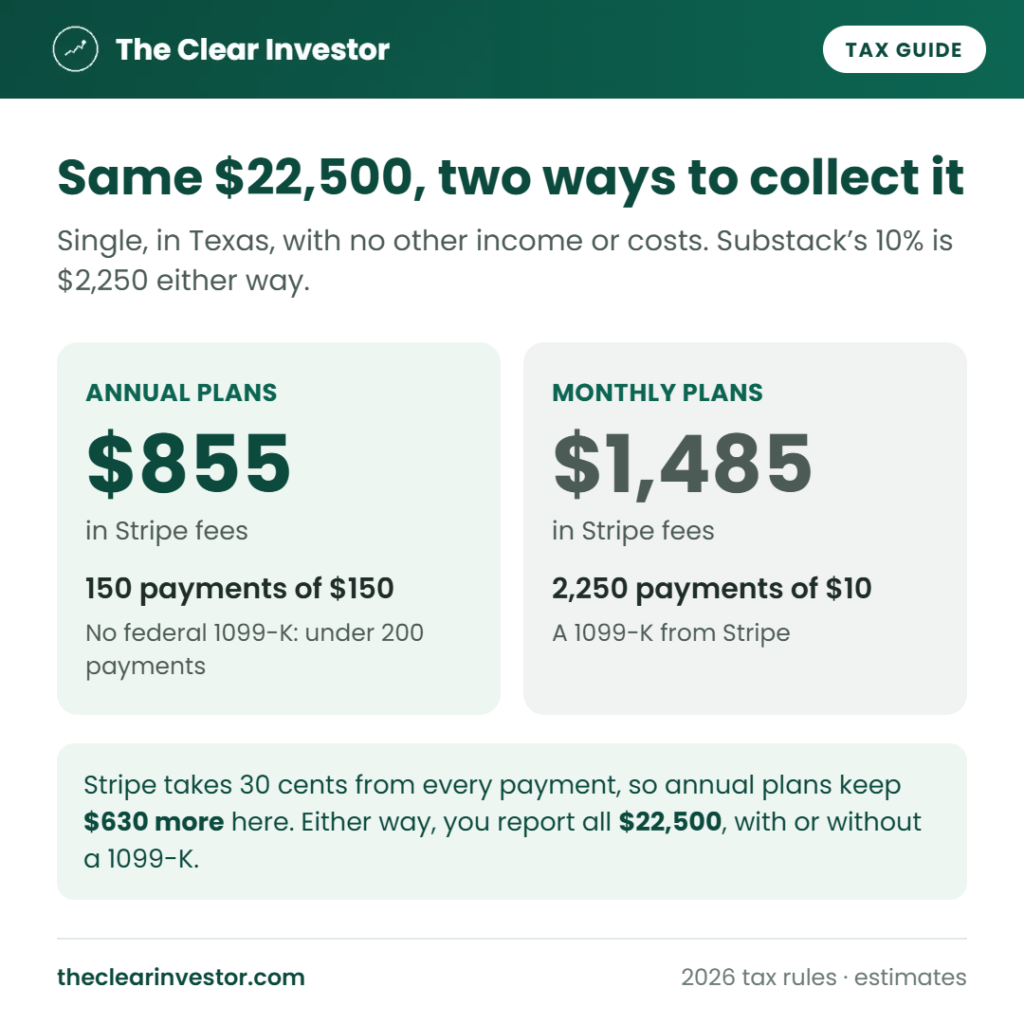
- Annual plans can keep you under the line. $22,500 of $150 annual plans is only 150 payments, under the 200-payment line, so no federal 1099-K. You still report all of it.
- iOS app money may not be on it. Readers in the app pay Apple, Apple pays Substack, and Substack pays you. Those payouts aren’t card payments, so check your Substack earnings page and report them too.
- No form doesn’t mean no tax. Under the line, you won’t get a 1099-K, but you still report every dollar.
Sponsors that pay you directly are separate. A sponsor that pays you $2,000 or more in 2026 by check or bank transfer sends a 1099-NEC. And if you pay an editor or illustrator $2,000 or more by check, bank transfer or cash, you have to send them a Form 1099-NEC, so get a W-9 from them before you pay.
Substack’s Fees Are Tax-Deductible
Every fee Substack, Stripe and Apple take is a business cost. Here’s what they charge, from Substack’s pricing page:
| Fee | What you pay |
|---|---|
| Substack’s fee | 10% of each subscription payment |
| Card processing (Stripe) | 2.9% plus 30 cents a payment, for US cards |
| Stripe Billing | 0.7% on recurring subscription payments |
| Apple’s cut on iOS app subscriptions | 30%, or 15% once a subscription passes a year |
| Currency conversion | 1% to 2% with localized pricing |
| Custom domain | $50, one time |
On $24,000 of subscriptions, half from an $8 monthly plan and half from an $80 annual plan, that comes to $3,759, about 16% of what readers paid. On Schedule C, report the $24,000 as income and the fees on the line for commissions and fees.
Monthly plans cost more to collect. Stripe’s 30 cents comes out of every payment, so an $8 monthly reader costs $7.06 a year in Stripe fees, about 7.4%, while an $80 annual reader costs $3.18, about 4%.
Does the Substack iOS App Change Your Taxes?
Readers can subscribe inside Substack’s iPhone app, and Apple takes 30% of those payments, dropping to 15% once a subscription renews past a year. Substack still takes its 10%, but of your web price, not the app price.
- Adjusted pricing: by default, Substack raises your app price to cover Apple’s cut. In Substack’s example, a $10 plan costs $14 in the app, and you keep $8.80, vs. $8.34 on the web.
- Keeping prices the same: app readers pay $10, and you keep about $6.
- Founding plans can’t be bought in the app, so those always go through Stripe.
- App money arrives late. Apple pays Substack up to 45 days after each month ends, so December’s app subscriptions reach you in February. They count in the year you get them.
The simplest way to report it: what app readers paid as income, and Apple’s cut and Substack’s 10% as fees. If your records only show what Substack paid you, report that and don’t deduct those fees again. With 30 of 100 monthly readers at $10 in the app, adjusted pricing puts about $1,008 more in your pocket over a year than keeping prices the same, and about $142 of that goes to tax.
Is Substack Money a Tip? The Tips Deduction for Writers
Usually not. From 2025 through 2028, you can deduct up to $25,000 a year of qualified tips, and the IRS’s list of tipped occupations includes digital content creators. But the IRS’s final rules draw a line that matters on Substack: payments that give someone access to your content are pay for your work, not tips. Voluntary payments for content they can already see can be tips. One more catch: the IRS describes digital content creators as people who publish entertainment and personality-driven content, and its examples are streamers, video creators, influencers and podcasters. It doesn’t name writers, so a podcast or video on Substack fits more clearly than a written newsletter.
- Paid subscriptions that unlock paid posts, the archive or comments: pay for your work. No tips deduction.
- Readers who pay only to support you, when every post stays free: voluntary, so it can count as tips.
- The fees don’t count. The part Substack, Stripe and Apple keep isn’t a tip, so only what reaches you counts.
The deduction can’t be more than your Substack profit, and it shrinks by $100 for every $1,000 of income over $150,000 ($300,000 married filing jointly). Married couples only get it on a joint return. It lowers income tax only, not self-employment tax, and you claim it on Schedule 1-A with a Social Security number. With $5,000 of support-only subscriptions and a $45,000 job in Texas, it cuts the tax on that money from $972 to $466.
How Much Tax Will You Owe on Substack?
Here’s the tax on Substack subscriptions, half from an $8 monthly plan and half from an $80 annual plan, with no other costs, for a single filer in Texas:
| Readers paid | Fees | Tax, no other income | Tax with a $50,000 job |
|---|---|---|---|
| $3,000 | $470 | $357 | $583 |
| $6,000 | $940 | $715 | $1,166 |
| $12,000 | $1,880 | $1,430 | $2,333 |
| $24,000 | $3,759 | $3,077 | $4,666 |
With no other income, almost all of it is self-employment tax. With a job, your Substack profit lands in a higher bracket, so income tax adds to it.
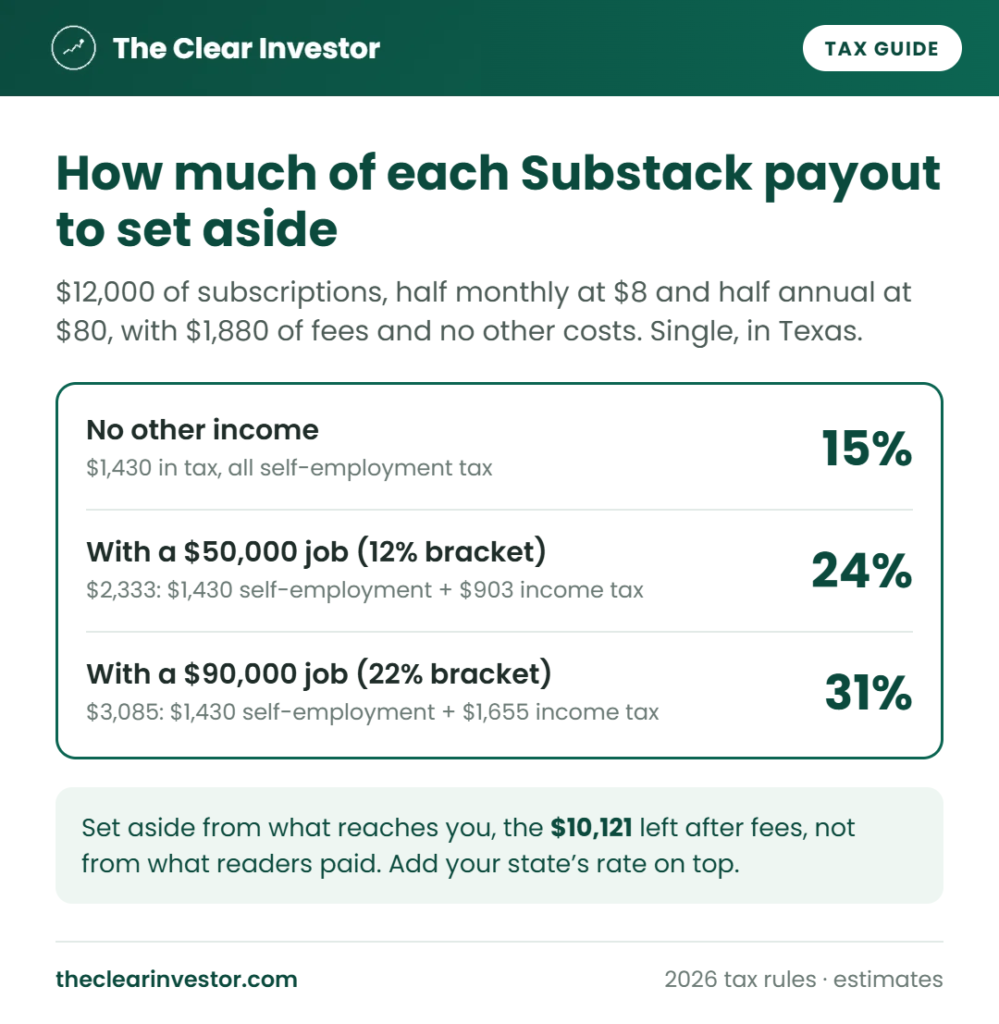
Set aside a share of what reaches you, since that’s the money you actually get. About 15% works with no other income and about 24% with a job in the 12% bracket. Add your state’s rate on top. My Substack tax calculator works out your own number, with your plans, fees, costs and state.
Deductions That Lower Your Substack Taxes
Substack’s and Stripe’s fees
Substack’s 10%, card processing, Stripe Billing, currency conversion and Apple’s cut on app subscriptions. Your Stripe dashboard lists each one, and Substack’s invoice export breaks them down by payment.
Your computer and software
A laptop you use 70% for your writing counts at 70%. Items up to $2,500 can be written off in the year you buy them under the de minimis safe harbor, and bigger ones with 100% bonus depreciation. Software like Grammarly, Canva or a podcast editor counts in full.
Research and reading
Newspaper and newsletter subscriptions, books, data and reports you buy for your writing are business costs, as long as they’re for the topics you write about.
Editors, designers and guest writers
What you pay people to edit, illustrate or write for your newsletter is deductible. Remember the 1099-NEC for anyone you paid $2,000 or more by check, bank transfer or cash.
Your custom domain and promotion
Substack’s one-time $50 custom domain fee, your yearly domain renewal, paid ads and giveaways all count.
A home office
A room or corner you use regularly and only for your writing is worth $5 a square foot, up to 300 square feet, with the simplified home office method. A kitchen table you also eat at doesn’t count.
Everything else
The work share of your internet and phone, courses, conferences and travel for your reporting. Keep the receipts.
When Does Substack Income Count?
- The year readers pay. Count what readers paid in 2026, including December’s charges.
- Annual and founding plans count all at once, in the year readers pay, even though most of the year they cover is the next one.
- iOS app money counts when Substack pays you, which can be up to 45 days after the month ends.
- Refunds come off the year you give them. Give them from Substack’s Subscribers page, not your Stripe dashboard, so Substack gives back its 10%.
Do You Need to Pay Substack Taxes Quarterly?
If you’ll owe $1,000 or more in federal tax for the year, the IRS expects estimated payments through the year, since nothing is withheld. With $12,000 of subscriptions and no other income, you’d owe about $1,430, so you’re already there.
The easiest habit is to move your set-aside percentage to a savings account each time Stripe pays you. Stripe usually pays out within two days of each payment, so a weekly transfer works well. The four due dates are April 15, June 15, September 15 and January 15. With a job, you can raise your Form W-4 withholding instead. The safe harbor that keeps you penalty-free is in how quarterly payments work.
Free tax tracker + deadline reminders
Get my free side income tax tracker
Sign up and I’ll send you my Google Sheets tracker that shows how much of each payout to set aside. You’ll also get an email before each quarterly tax deadline (Jan 15, Apr 15, Jun 15 and Sep 15), plus my new guides. Unsubscribe anytime.
Earn on several platforms or drive for work? Get the full 1099 Side Income Tracker ($12) →
Substack Taxes: How to File
- Download your 1099-K from Stripe if you got one, from the Documents section of your Stripe dashboard.
- Export your Substack invoice data: in Settings, open Payments, then Advanced, and request a report for the year. It lists each payment with its fees, currency and plan.
- Add up what readers paid in 2026: web payments, iOS app payments and founding plans, before fees. Your web total should match the 1099-K.
- Add up your refunds and fees: Substack’s 10%, Stripe’s fees and Apple’s cut.
- Fill out Schedule C: what readers paid as income, refunds as returns, the fees under commissions and fees, and your other costs on their own lines.
- Add Schedule SE for self-employment tax, and Schedule 1-A if some readers pay just to support you.
I file with TaxAct. Set up one Schedule C for your writing business first, then attach Stripe’s 1099-K to it, so the IRS can match the form to your return. If you also run a Patreon or a podcast, it’s the same business, so that income goes on the same Schedule C.
Special Situations
If you also run a Patreon or post on YouTube
All of your creator income goes on the same Schedule C, and the $433 line and the $1,000 quarterly rule count it all together. Patreon and YouTube have their own forms, which I cover in my Patreon tax guide and how YouTube taxes work.
If you get sponsorships
Sponsors pay you directly, outside Substack, so no Substack fees come out. A sponsor that pays you $2,000 or more by check or bank transfer sends a 1099-NEC. If it pays through PayPal, PayPal’s 1099-K covers it instead. Either way, report it.
If you’re not making money yet
If your costs are more than what readers paid, you have a loss, which can lower the tax on your other income, but only if you write as a business. If it’s a hobby, you can’t deduct the costs.
If you have a W-2 job
Your Substack profit is taxed at your job’s bracket, on top of self-employment tax. You can cover it with quarterly payments or by raising the withholding at your job with a new W-4.
If you live outside the US
If your Stripe account is set up outside the US, Stripe doesn’t send a 1099-K, and you report the income where you live. US citizens living abroad still report Substack on their US return.
Common Substack Tax Mistakes
- Reporting only your Stripe payouts. Stripe’s 1099-K shows what readers paid, so report that and deduct the fees.
- Forgetting the fees. Substack’s 10%, Stripe’s fees and Apple’s cut are all deductible.
- Missing your iOS app money. It comes from Substack, not Stripe, and may not be on the 1099-K.
- Pushing annual plans into next year. They count when readers pay.
- Counting sales tax as income. From Dec. 1, 2026, Substack collects it on top of your price and pays it.
- Refunding from Stripe. Refund from Substack’s Subscribers page so you get Substack’s 10% back.
- Skipping quarterly payments once you owe $1,000 or more.
My Verdict: Do You Pay Taxes on Substack?
Yes, on every paid subscription, whether or not Stripe sends you a 1099-K. The good news is that Substack’s 10%, Stripe’s fees and Apple’s cut all come off your income, so you’re only taxed on what’s left after your costs. Set aside about 15% of each payout with no other income, or about 24% with a job, plus your state’s rate. My Substack tax calculator works out your own number in a minute.
FAQ
Do you have to pay taxes on Substack money?
Yes. Paid subscriptions, app subscriptions and sponsorships are all taxable. With no other income, you owe nothing until your profit passes about $433. With a job, every dollar of profit is taxed.
Does Substack send you a 1099?
No. Stripe does: a 1099-K once your card payments top $20,000 and 200 payments in a year, or less in some states. You download it from your Stripe dashboard.
Why does my 1099-K show more than I got paid?
Stripe’s 1099-K shows what readers paid before Substack’s 10%, Stripe’s fees and refunds. Report that total and deduct the fees on Schedule C.
Are Substack’s fees tax-deductible?
Yes. Substack’s 10%, Stripe’s processing and Billing fees, currency conversion and Apple’s cut on app subscriptions are all business costs.
Do I report sales tax that Substack collects?
No. From Dec. 1, 2026, Substack collects sales tax on top of your price and pays it, so it isn’t your income.
Are Substack subscriptions tips?
Usually not. Subscriptions that unlock paid posts are pay for your work. Only payments from readers who get nothing extra can count as tips.
How much should I set aside for Substack taxes?
About 15% of each payout with no other income, or about 24% with a job in the 12% bracket, plus your state’s rate.
Do I have to report Substack income if I didn’t get a 1099?
Yes. The form only shows up above Stripe’s lines, but you report every dollar either way.
I’m not a licensed financial advisor or tax professional. This guide is based on Substack’s and Stripe’s help pages, IRS rules and my own experience with 1099 income. It’s for educational purposes and isn’t tax advice. Tax rules change, so check the links above or talk to a tax professional about your situation. I’m not affiliated with Substack, Stripe or TaxAct.