
This Substack tax calculator shows how much tax you’ll owe on your paid subscriptions in 2026, after Substack’s 10%, Stripe’s fees, Apple’s cut and your writing costs, and how much of each payout to set aside. It also shows when Stripe sends you a 1099-K and why annual plans can keep you under it. Want to know how Substack money is taxed first? Read my Substack tax guide.
It’s built around how Substack really pays writers: you enter your plan prices and how many readers pay monthly, annually or as founding members, and it works out the fees for you, including the 30 cents Stripe takes from every payment and Apple’s cut on subscriptions bought in the iOS app. All of those fees are deductible, so the calculator works out your tax from what readers paid, the same total Stripe’s 1099-K shows, and subtracts the fees for you.
Substack Tax Calculator
See how much tax you’ll owe on your paid Substack subscriptions in 2026, after Substack’s 10%, Stripe’s fees and Apple’s cut, and how much to set aside from each payout.
What paid subscribers paid you in 2026
Where they paid, refunds and other income
Your writing costs
Your other income
Tax you’ve already paid
About you
Your tax forms
| Form | From | Amount |
|---|
Your total 2026 tax: before vs. after deductions
| Before deductions | After deductions |
|---|
How your taxable income is worked out
How this is calculated
- Substack income = what readers paid for monthly, annual and founding plans on the web and in the iOS app + sponsorships and other newsletter income − refunds, before fees. Monthly payments are your monthly subscribers × 12. Count what readers paid in 2026, including annual and founding plans paid in December.
- Fees = Substack’s 10% of web payments after refunds and of the web price of app subscriptions + Stripe card processing (2.9% + $0.30 a payment) + Stripe’s 0.7% Billing fee on subscriptions + about 1.5% on payments in another currency + Apple’s 30% (15% after a year) of what readers pay in the iOS app. Adjusted in-app pricing assumes app readers pay 40% more, as in Substack’s own example of a $10 plan costing $14 in the app. Founding plans can’t be bought in the app. All of these fees are business costs.
- Substack profit = your income minus the fees and your writing costs. It’s self-employment income, reported on Schedule C.
- Gear = what you paid × the share you use for your newsletter. “All of it in 2026” deducts it in full, which the de minimis safe harbor (items up to $2,500) or 100% bonus depreciation (gear bought after Jan. 19, 2025) usually allows. “Spread it out” uses the first year of 5-year depreciation: 20%.
- Home office uses the IRS simplified method: $5 a square foot, up to 300 square feet ($1,500). It can’t be more than your Substack income minus fees and your other costs.
- Self-employment tax is 15.3% (12.4% Social Security and 2.9% Medicare) on 92.35% of your self-employment profit. You only owe it when that comes to $400 or more, which means about $433 of profit. Social Security tax stops at $184,500 of combined W-2 pay and self-employment earnings, and an extra 0.9% Medicare tax applies above $200,000 ($250,000 married filing jointly, $125,000 separately). Half of the 15.3% is deductible.
- Federal income tax uses the 2026 brackets and standard deduction ($16,100 single or married filing separately, $32,200 married filing jointly, $24,150 head of household). Married filing separately uses the single brackets, except that the 37% rate starts at $384,350. It also includes the qualified business income deduction: 20% of your self-employment profit after the self-employment tax deduction, and at least $400 when that’s $1,000 or more.
- Tips deduction: under the IRS’s final rules, payments that unlock a creator’s content are pay for services, not tips, so paid subscriptions that unlock paid posts, the archive or comments don’t count. Voluntary payments for content anyone can see do, since digital content creators are on the IRS’s list of tipped occupations. The deduction is up to $25,000, no more than your Substack profit, and shrinks by $100 for every $1,000 of income over $150,000 ($300,000 married filing jointly). Married couples only get it on a joint return. Only what reaches you counts: the part Substack, Stripe and Apple keep isn’t a tip. It lowers federal income tax only, not self-employment tax. It runs from 2025 through 2028.
- Child tax credit is $2,200 per child under 17. Up to $1,700 per child can come back as a refund, based on 15% of your earned income over $2,500.
- State income tax uses 2026 rates, brackets, standard deductions and exemptions from the Tax Foundation, updated for the 2026 cuts in Arkansas, Georgia, South Carolina, Utah and West Virginia, and for the higher 2026 standard deductions in Arizona and Maine. A few states (like California) hadn’t published 2026 bracket amounts, so their 2025 amounts are used. Head of household and married filing separately use single brackets. Each state decides whether to follow the tips deduction. Arizona and Michigan do for 2026, so it comes off their state tax, and the calculator leaves it out for other states.
- Tax on your Substack income = your total tax minus what your total tax would be without Substack. The set-aside percentage is that tax divided by what reached you after fees: your Stripe payouts, app earnings and sponsorships.
- Tax forms: Stripe, not Substack, sends a Form 1099-K once your card payments top $20,000 and 200 payments in 2026, or at lower lines in some states: $2,500 in Arkansas, $2,000 in Vermont, $1,000 and 4 payments in Illinois, $1,000 in New Jersey, and $600 in DC, Maryland, Massachusetts, Montana and Virginia. It shows payments before fees and refunds. iOS app earnings come from Substack after Apple pays it and may not be on it. A sponsor that pays you $2,000 or more by check or bank transfer sends a 1099-NEC, and you send one to each person you paid $2,000 or more.
- Before deductions leaves out the fees, your writing costs, the standard deduction, the qualified business income deduction, the tips deduction, and state deductions and exemptions, so you can see how much they save you.
Not included: sales tax (from Dec. 1, 2026, Substack collects it on top of your price, and it isn’t your income), local payment method fees in Europe, the actual-expense home office method, later years of gear depreciation, the earned income tax credit, city and county income taxes (like New York City or Maryland counties), state low-income credits, itemized deductions, retirement or health insurance deductions, and tax withheld from a W-2 job. Your real tax can be lower.
Free tax tracker + deadline reminders
Get my free side income tax tracker
Sign up and I’ll send you my Google Sheets tracker that shows how much of each payout to set aside. You’ll also get an email before each quarterly tax deadline (Jan 15, Apr 15, Jun 15 and Sep 15), plus my new guides. Unsubscribe anytime.
Earn on several platforms or drive for work? Get the full 1099 Side Income Tracker ($12) →
Table of Contents
How to Use the Substack Tax Calculator
- Enter your plan prices and how many readers pay. Monthly subscribers are your average on the monthly plan, since each one pays 12 times. Annual and founding payments are how many came in during 2026, renewals included.
- Enter the share bought in the iOS app and how your in-app pricing is set. Apple keeps 30% of those, or 15% after a year.
- Add refunds, sponsorships and support-only payments. Refunds come off your income. Money from readers who get nothing extra can count as tips.
- Add your writing costs. Your computer, software, research, editors, custom domain and internet.
- Add your other income and state. A W-2 job raises your tax bracket, and your state adds its own tax.
Who This Calculator Is For
- Writers and podcasters with paid subscriptions on Substack.
- Newsletters with monthly, annual and founding member plans, since each costs a different amount to collect.
- Writers with readers in the iOS app, where Apple keeps 30%.
- Anyone who got a 1099-K from Stripe and wants to know why it’s higher than their payouts, or why they didn’t get one.
- Writers with a day job, to see how much more tax Substack adds.
If you also run a Patreon or post on YouTube, enter that profit as other self-employment income, or use my Patreon tax calculator or YouTube tax calculator.
How to Read Your Results

- The big number is the extra tax your Substack income adds, and the line below it says how much of each payout to set aside.
- The three boxes split it into federal income tax, self-employment tax and state tax.
- Your tax forms show whether Stripe sends you a 1099-K and whether you owe anyone a 1099-NEC.
- The notes explain your fees, monthly vs. annual costs, the iOS app, the tips deduction and quarterly payments.
- The before-and-after table shows how much your deductions save you.
Worked Example 1: $8,440 From Substack, No Other Income, in Texas
This is the calculator’s starting example: a single writer in Texas with 40 readers on an $8 monthly plan, 50 annual payments at $80 and 4 founding members at $150. They bought a $1,200 laptop they use 70% for their newsletter and spent $180 on software, $120 on research and $240 on internet and phone.
| Step | Amount |
|---|---|
| Monthly plan (480 payments) | $3,840 |
| Annual plan (50 payments) | $4,000 |
| Founding members (4 payments) | $600 |
| Substack’s 10% | −$844 |
| Card processing (2.9% plus 30 cents on 534 payments) | −$405 |
| Stripe Billing (0.7%) | −$59 |
| Laptop ($1,200 × 70%) | −$840 |
| Software, research, internet and phone | −$540 |
| Substack profit | $5,752 |
| Federal income tax | $0 |
| Self-employment tax | $813 |
| Tax on their Substack income | $813 |
That’s about 12% of the $7,132 that reached them after fees, so the calculator says to set aside 12%. There’s no federal income tax, since their profit after half the self-employment tax is under the $16,100 standard deduction. They won’t get a 1099-K, since $8,440 is under Stripe’s $20,000 line, but they still report all of it.
Worked Example 2: $34,900 From Substack, Some in the iOS App, Plus a $55,000 Job in California
Readers paid this writer on a $10 monthly plan (150 readers), a $100 annual plan (120 payments) and a $250 founding plan (10 payments). A fifth of the monthly and annual subscriptions came through the iOS app with Substack’s adjusted pricing, so app readers paid about 40% more. They spent $3,510 on writing costs, including $1,200 for an editor, and have a $55,000 job in California.
| Step | Amount |
|---|---|
| Web payments (1,546 payments) | $26,500 |
| iOS app subscriptions | $8,400 |
| Substack’s 10% | −$3,250 |
| Card processing and Stripe Billing | −$1,418 |
| Apple’s 30% | −$2,520 |
| Writing costs | −$3,510 |
| Substack profit | $24,202 |
| Federal income tax | $2,809 |
| Self-employment tax | $3,420 |
| California income tax | $1,634 |
| Tax on their Substack income | $7,863 |
That’s about 29% of the $27,712 that reached them after fees, so the calculator says to set aside 29%. Their $26,500 of card payments came in 1,546 payments, over both of Stripe’s lines, so they’ll get a 1099-K for $26,500. The $8,400 from the app comes from Substack and may not be on it, but it’s still income. With about $6,228 of federal tax on their Substack income, they need quarterly payments or more withholding at their job.
Worked Example 3: Annual Plans vs. Monthly Plans and the 1099-K
Two writers each take in $22,500, single in Texas, with no other income or costs. One sells only $150 annual plans. The other sells only a $10 monthly plan.
| Annual plans | Monthly plans | |
|---|---|---|
| Payments | 150 | 2,250 |
| Substack’s 10% | $2,250 | $2,250 |
| Stripe’s fees | $855 | $1,485 |
| Federal 1099-K from Stripe | No | Yes |
| Tax | $2,893 | $2,745 |
The annual writer keeps $630 more, since Stripe charges its 30 cents 150 times instead of 2,250. Their tax is a little higher only because they keep more. They also stay under Stripe’s 200-payment line, so they won’t get a federal 1099-K for $22,500, but they report all of it anyway. In a $600 state like Massachusetts or Virginia, both would get one.
Worked Example 4: The iOS App, With and Without Adjusted Pricing
A writer has 100 readers on a $10 monthly plan, 30 of them in the iOS app, with no other income or costs, single in Texas.
| Adjusted pricing | Prices kept the same | |
|---|---|---|
| App price | $14 a month | $10 a month |
| What app readers paid | $5,040 | $3,600 |
| Apple’s 30% | $1,512 | $1,080 |
| What reached the writer | $10,174 | $9,166 |
| Tax | $1,437 | $1,295 |
Adjusted pricing, Substack’s default, puts $1,008 more in the writer’s pocket over the year, and $142 of that goes to tax. Either way, Substack’s 10% is based on the $10 web price, and Apple’s cut is a deductible fee.
More Example Results
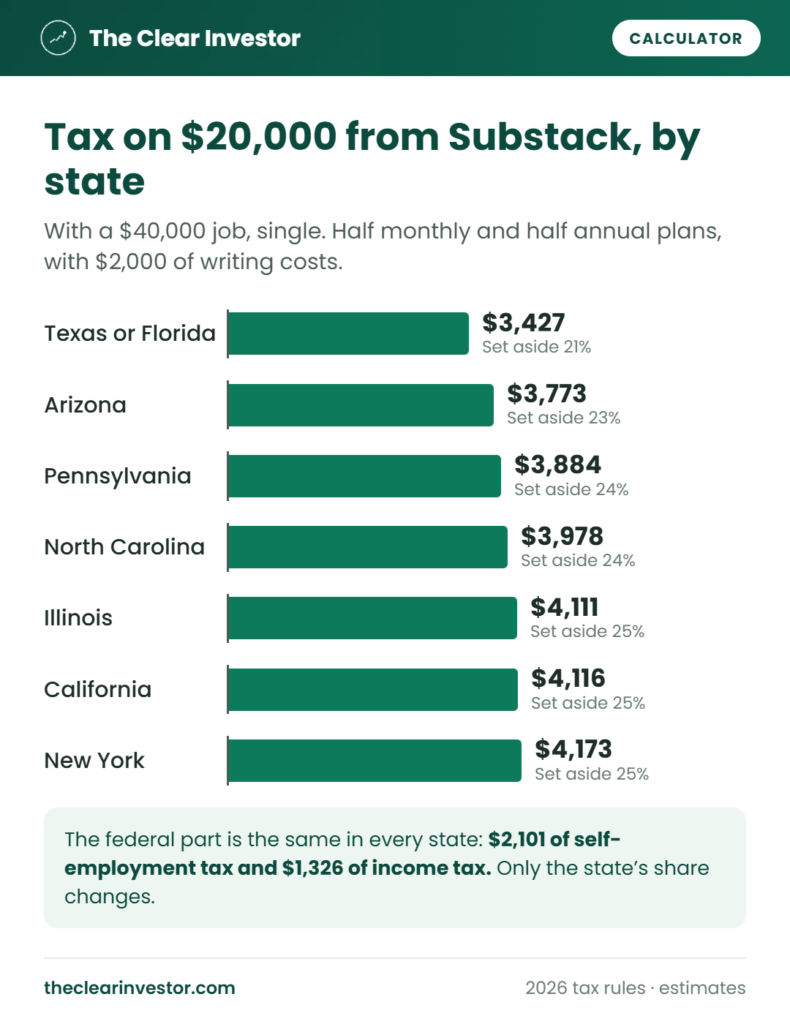
Here’s the tax on $20,000 of Substack subscriptions, half from an $8 monthly plan and half from an $80 annual plan, with $2,000 of writing costs, for a single filer in Texas:
| Other income | Tax on Substack | Set aside |
|---|---|---|
| None | $2,101 | 13% |
| $40,000 job | $3,427 | 21% |
| $60,000 job | $3,883 | 24% |
| $100,000 job | $4,533 | 27% |
The self-employment tax is $2,101 in every row. Only the income tax grows as your job pushes your Substack profit into higher brackets.
How the Substack Tax Calculator Works
- Income: what readers paid for monthly, annual and founding plans on the web and in the app, plus sponsorships, minus refunds, before fees. That’s how Stripe’s 1099-K counts web payments.
- Fees: Substack’s 10% of web payments and of the web price of app subscriptions, Stripe’s 2.9% plus 30 cents a payment and 0.7% Billing fee, about 1.5% on payments in other currencies, and Apple’s 30% or 15% on app subscriptions. The rates come from Substack’s pricing page and its iOS app FAQ.
- Profit: income minus fees and your writing costs, reported on Schedule C.
- Self-employment tax: 15.3% on 92.35% of your profit once that’s $400 or more, per the IRS.
- Income tax: the 2026 brackets and $16,100 standard deduction, the qualified business income deduction and, for support-only payments, the tips deduction.
- Your Substack tax: your total tax minus your tax without Substack, so your job’s bracket is counted.
- The 1099-K: Stripe’s $20,000-and-200-payments line, or your state’s lower line, checked against your web payments only.
What the Calculator Leaves Out
- Sales tax, which Substack collects on top of your price from Dec. 1, 2026, and isn’t your income.
- Fees for local payment methods, like SEPA Direct Debit or iDEAL for readers in Europe.
- Substack Boost discounts and coupons, unless you enter your average price after them.
- City and county income taxes, the earned income tax credit, itemized deductions and retirement contributions.
Tips for Accurate Results
- Use your average. If your monthly readers grew during the year, enter the average, or add up your monthly payments from Stripe and divide by 12.
- Count renewals. Annual and founding renewals paid in 2026 count as 2026 payments.
- Check your app share. Your Subscribers page shows who joined in the app.
- Enter prices after discounts and before sales tax.
- Only count the work share of a laptop or phone you also use day to day.
What to Do With Your Result
- Move your set-aside percentage to a savings account each time Stripe pays you.
- Make quarterly payments if you’ll owe $1,000 or more in federal tax.
- Download Stripe’s 1099-K by Jan. 31 if you qualify, and export your invoice data from Substack either way.
- Keep receipts for your laptop, software, research and anyone you paid.
Substack Tax Calculator FAQ
What should I enter for monthly subscribers?
Your average number of readers on the monthly plan in 2026. Each one pays 12 times a year, so 40 readers is 480 payments.
Why does it ask about annual and founding plans separately?
Each plan has its own price, and Stripe’s 30 cents comes out of every payment, so annual and founding plans cost less to collect per dollar.
How does it handle the iOS app?
It counts what app readers paid as income, takes out Apple’s 30% or 15% and Substack’s 10% of your web price, and leaves app money out of Stripe’s 1099-K.
Why didn’t I get a 1099-K from Stripe?
Stripe only sends one above $20,000 and 200 payments in 2026, or at a lower line in a few states. Annual plans can keep you under 200 payments. You still report all of it.
Does it include sales tax?
No. From Dec. 1, 2026, Substack collects sales tax on top of your price and pays it, so it isn’t your income.
Does it include state tax?
Yes. Pick your state to add its income tax. It covers all 50 states and DC.
Is my information saved?
No. Everything is worked out in your browser, and nothing is sent or stored.
What tax year does the Substack tax calculator use?
2026: the 2026 brackets, standard deduction, Substack’s and Stripe’s fees and the tips deduction. I update it every year.
Estimates for educational purposes only. I’m not a licensed financial advisor or tax professional, and this isn’t tax advice. Not affiliated with Substack.