DoorDash taxes are owed on your profit, not on everything DoorDash pays you. Add up your Dasher pay and tips, subtract your mileage and other dashing costs, and what’s left is self-employment income. You owe income tax on it and, once it passes about $433, 15.3% self-employment tax as well. Up to $25,000 of your tips can now come off your income for federal income tax, but not for self-employment tax.
I haven’t dashed for DoorDash myself. I drove Amazon Flex in California for about 18 months, nearly every day, and most of my blocks ran 100 miles or more, so I know how fast delivery miles add up. Everything DoorDash-specific in this guide comes from DoorDash’s own Dasher help pages, IRS rules and my DoorDash tax calculator, so you can check each piece yourself.
DoorDash taxes, the short answer:
- Do you pay taxes on DoorDash? Yes, on your profit: your pay and tips minus your mileage and other dashing costs.
- Does DoorDash send a 1099? Yes, a 1099-NEC in the Dasher app by January 31. For 2026 pay, DoorDash has to send one once it pays you $2,000 or more.
- Are tips on the 1099? For 2025, no. DoorDash left them off and emailed your tip total separately. Tips are income either way.
- Is there no tax on DoorDash tips? Not quite. From 2025 through 2028, up to $25,000 of tips comes off your income for federal income tax, but you still pay self-employment tax on them.
- What’s the mileage deduction? 72.5 cents a mile through June 2026 and 76 cents from July 1, for the miles you drive while dashing.
- Does DoorDash take out taxes? No. Nothing is withheld, so you pay it yourself.
- How much should you set aside? About 8% to 9% of each payout if you log your miles and about a third of your pay is tips. Without a mileage log, it’s more than twice that. Add your state’s rate on top.
Table of Contents
Do You Pay Taxes on DoorDash?
Yes. Dashers are independent contractors, not DoorDash employees, so DoorDash doesn’t withhold taxes and you pay them yourself. Your DoorDash taxes come down to two federal taxes:
- Self-employment tax. You owe it when your net earnings from self-employment are $400 or more. Net earnings are 92.35% of your profit, so the line is about $433 of profit. The rate is 15.3%: 12.4% for Social Security and 2.9% for Medicare. W-2 workers split that with their employer, but Dashers pay both halves, on tips too.
- Income tax. Only on income above your standard deduction, which is over $16,000 for single filers, over $32,000 for married couples filing jointly and over $24,000 for heads of household. It goes up with inflation each year. With a job, the standard deduction is usually used up already, so your profit gets income tax from the first dollar, minus the tips deduction.
How DoorDash Profit Is Figured
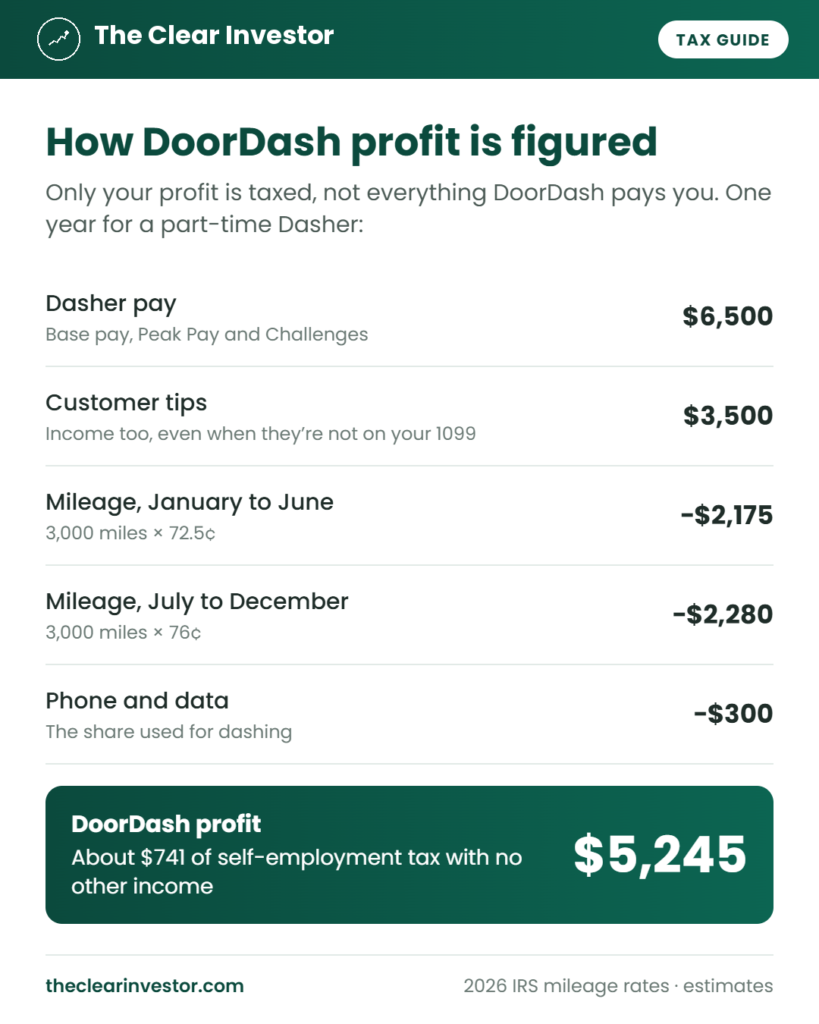
Here’s a full year for a part-time Dasher who earned $10,000:
| Step | Amount |
|---|---|
| Dasher pay (base pay, Peak Pay and Challenges) | $6,500 |
| Customer tips | $3,500 |
| Mileage, January to June (3,000 miles × 72.5¢) | −$2,175 |
| Mileage, July to December (3,000 miles × 76¢) | −$2,280 |
| Phone and data (the share used for dashing) | −$300 |
| DoorDash profit | $5,245 |
Only the $5,245 is taxed. With no other income, that’s about $741 of self-employment tax and no income tax, about 7% of what DoorDash paid. Without the mileage deduction, the same year would cost $1,371.
What Is the DoorDash 1099-NEC?
It’s the tax form DoorDash sends Dashers. Here’s what DoorDash’s Dasher guide to taxes says about it.
Where to find it. In the Dasher app, under Earnings, then View payout details, then Tax documents, by January 31. A paper copy is postmarked by January 31 too, so make sure your address in the app is right by December 31.
Who gets one. DoorDash sent a 1099-NEC for 2025 to Dashers who earned $600 or more. For payments in 2026, the line for a 1099-NEC is $2,000, so if you dashed a little, you may not get one. Every dollar still goes on your return.
What it counts. Your earnings by the date they were deposited, not the date you dashed, so a late-December dash that pays out in January lands on next year’s form. Reimbursements, like when you paid for an order with cash, aren’t on it, since DoorDash says they aren’t taxable.
Where your tips are. For 2025, DoorDash reported tips separately from the 1099 because of the new tips deduction, and emailed active Dashers their 2025 tip total by January 31. The IRS added boxes for tips to the 2026 Form 1099-NEC, so check both the form and your email next time. Either way, your tips are income.
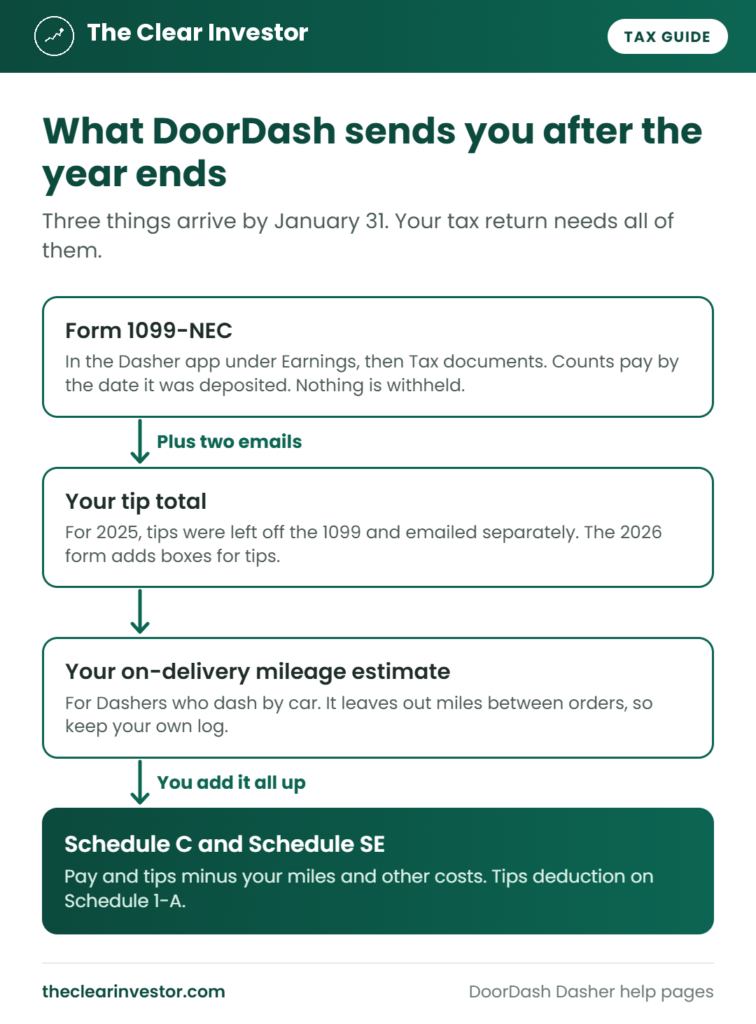
Nothing is withheld, and DoorDash sends your 1099 information to the IRS and your state. If you move to another state, tell Dasher Support so your forms go to the right one.
Is There No Tax on DoorDash Tips?
Partly. From 2025 through 2028, you can deduct up to $25,000 a year of qualified tips. The IRS’s list of tipped occupations includes “app/platform-based delivery people” under goods delivery people, so Dasher tips can count. Here’s how the tips deduction works for Dashers:
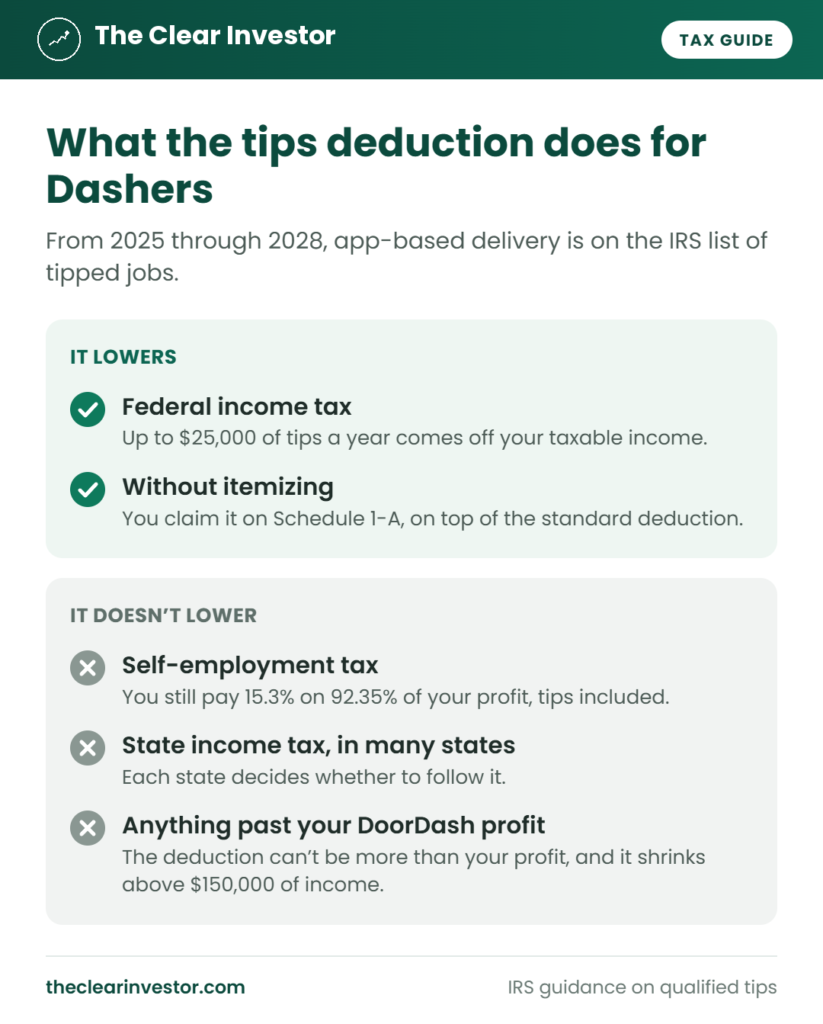
- It lowers federal income tax only. You still pay 15.3% self-employment tax on your tips, and each state decides whether to follow it.
- It can’t be more than your DoorDash profit. A Dasher with $3,500 in tips and $5,245 of profit can deduct all $3,500.
- It shrinks at higher incomes, once your income is over $150,000, or $300,000 for joint filers.
- If you’re married, you have to file jointly, and you need a valid Social Security number.
- You claim it on Schedule 1-A, and you don’t have to itemize.
For the $10,000 Dasher above, the tips deduction saves about $420 with a $40,000 job. With no other income, it saves nothing, since the standard deduction already covers the income tax.
The DoorDash Mileage Deduction
For most Dashers who drive, miles are the biggest deduction. The IRS standard mileage rate is 72.5 cents a mile for January through June 2026 and 76 cents from July 1, after the IRS raised it midyear. It covers gas, insurance, repairs and depreciation, so you don’t deduct those on top. Parking and tolls you pay while dashing do come off on top.
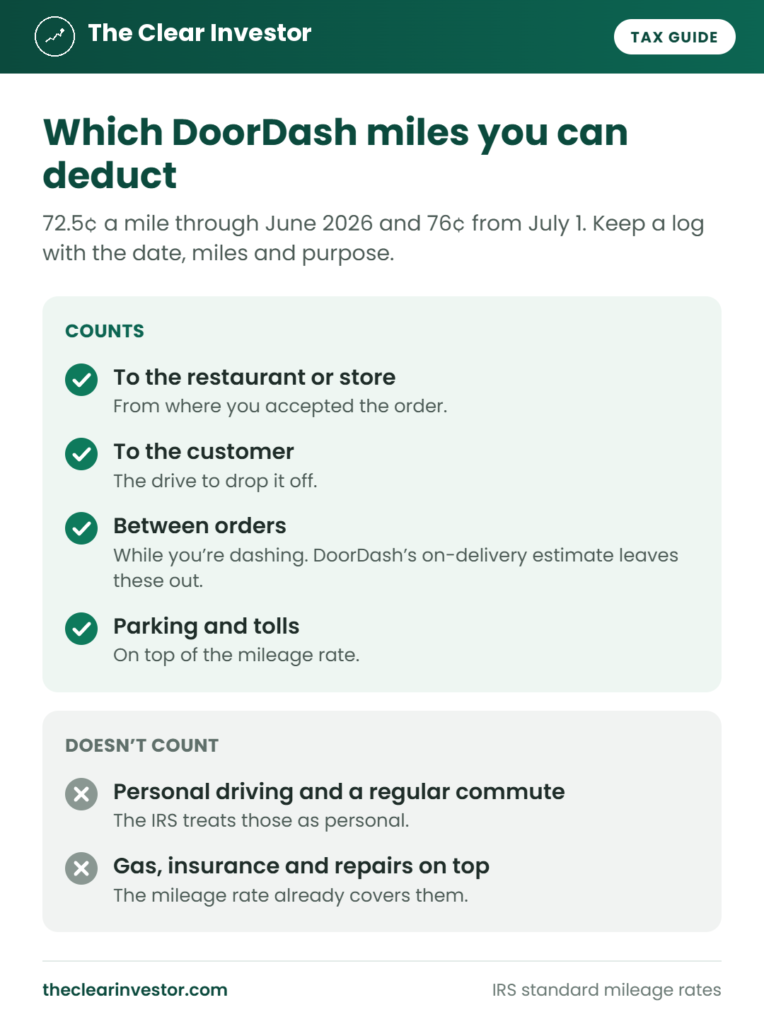
What counts. Driving to the restaurant or store, to the customer and between orders while you’re dashing.
What doesn’t. Personal driving, and the IRS treats a regular commute as personal too. If you drive a long way from home before you start dashing, ask a tax pro whether those miles count.
DoorDash’s estimate isn’t enough. DoorDash emails Dashers who dash by car an estimate of their on-delivery miles by January 31. It doesn’t count your driving between orders, so keep your own log with the date, miles and purpose. When I drove Flex, most of my blocks ran 100 miles or more. At 72.5 cents, that’s a $72.50 deduction per block, so a missing log adds up fast.
Here’s what a log is worth to the $10,000 Dasher above, with a $40,000 job in Texas:
| Miles claimed | Mileage deduction | Tax on DoorDash income |
|---|---|---|
| 6,000 (your own log) | $4,455 | $789 |
| 3,600 (on-delivery miles only) | $2,673 | $1,200 |
| None | $0 | $1,816 |
The 2,400 miles between orders are worth $411 of tax.
Standard rate or actual costs. You can deduct the business share of what your car really costs instead, but you have to keep every receipt. And for a car you own, the IRS says you have to use the standard rate in the first year you use the car for business if you ever want to use it.
On a bike, e-bike or scooter? The mileage rate is for cars. Deduct the business share of what you actually spend instead, like repairs and a battery.
Other DoorDash Expenses You Can Deduct
Every cost of dashing comes off your profit before either tax is figured:
- Parking and tolls, on top of the mileage rate.
- Your phone and plan, the share you use for dashing.
- Hot bags, a phone mount and a car charger.
- Fast Pay fees. DoorDash charges $1.99 for each Fast Pay cash-out, up to once a day. Crimson instant deposits are free.
Gas, oil changes and car repairs aren’t separate deductions when you use the mileage rate, and parking tickets and your meals never are. Here are more deductions that lower side hustle taxes.
How Much Tax Will You Owe on DoorDash?
Here’s what DoorDash taxes look like for a single filer in Texas, which has no state income tax. Each row assumes 6 miles for every $10 of pay and tips, split evenly across the year, about a third of it in tips and $300 for a phone:
| DoorDash pay and tips | No other income | With a $40,000 W-2 job | With a $90,000 W-2 job |
|---|---|---|---|
| $5,000 | $349 | $360 | $369 |
| $10,000 | $741 | $789 | $829 |
| $20,000 | $1,525 | $1,647 | $1,749 |
| $40,000 | $3,092 | $3,364 | $3,590 |
That’s about 7% to 9% of what DoorDash pays you, and most of it is self-employment tax. The mileage deduction cuts your profit to about half of your pay, and the tips deduction covers much of the income tax on what’s left.
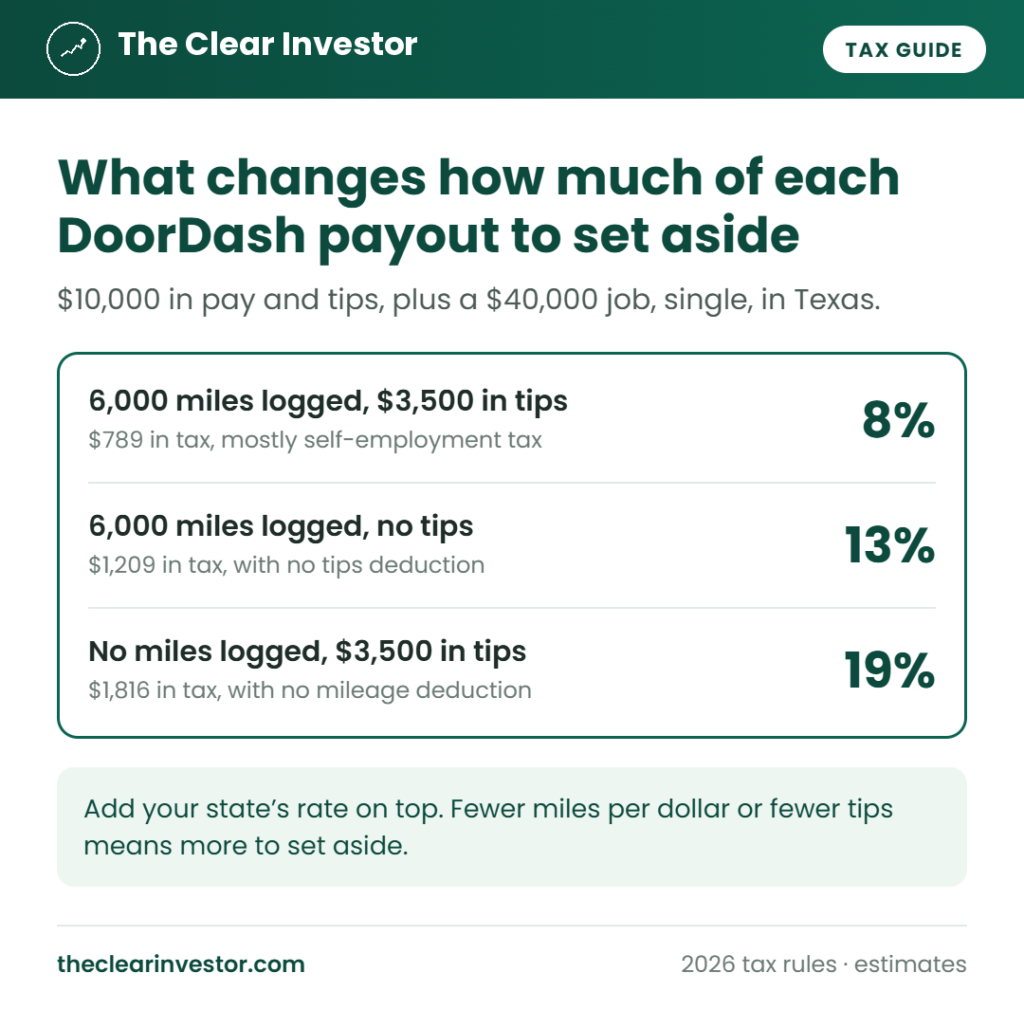
Two things push it up: fewer miles per dollar and fewer tips. Here’s the same $10,000 with a $40,000 job:
| Your situation | Tax on DoorDash income | Set aside from each payout |
|---|---|---|
| 6,000 miles logged, $3,500 in tips | $789 | 8% |
| 6,000 miles logged, no tips | $1,209 | 13% |
| No miles logged, $3,500 in tips | $1,816 | 19% |
Add your state’s rate on top. The DoorDash tax calculator works out yours, state included.
Do You Need to Pay DoorDash Taxes Quarterly?
If you dash a lot, probably. The IRS expects estimated tax payments when you’ll owe $1,000 or more when you file. With no other income, self-employment tax alone hits $1,000 at about $7,100 of profit, which is about $13,300 of pay and tips for a Dasher like the one above.
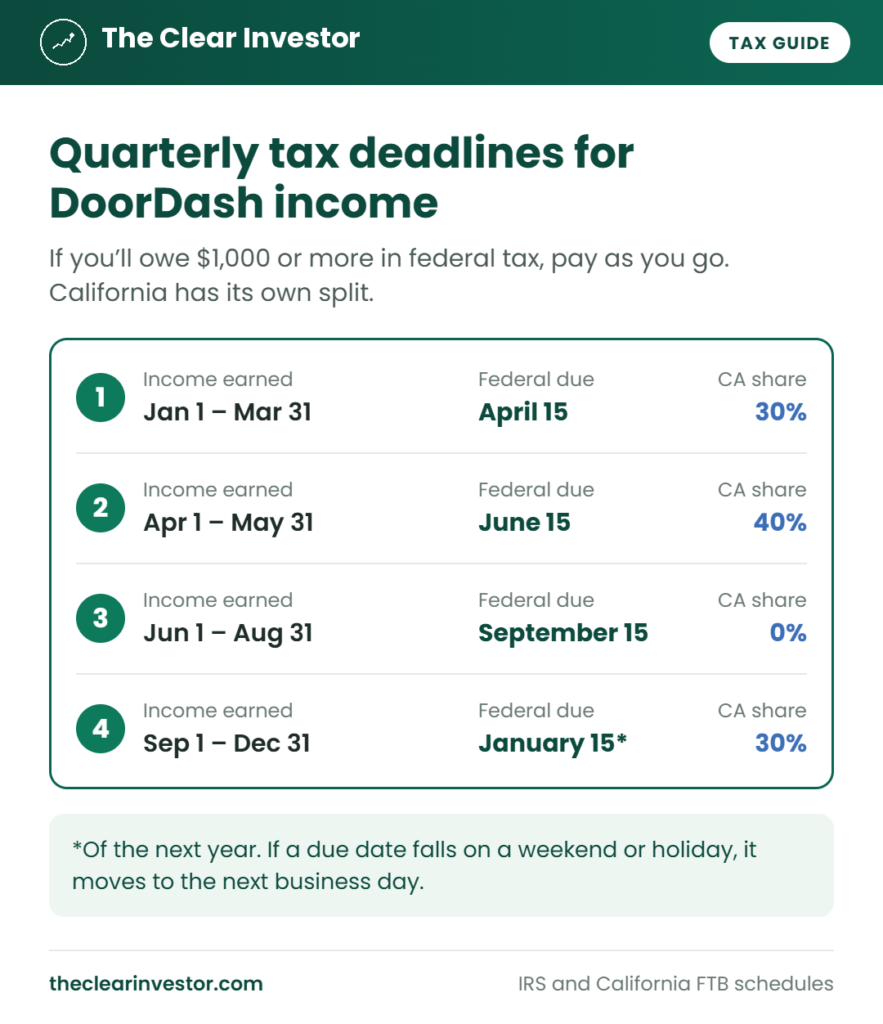
With a job, you can raise your W-4 withholding instead, so you don’t have to send payments. The safe harbor that keeps you penalty-free is in how quarterly payments work. If you’re in California, note that the state splits its payments differently.
Free tax tracker + deadline reminders
Get my free side income tax tracker
Sign up and I’ll send you my Google Sheets tracker that shows how much of each payout to set aside. You’ll also get an email before each quarterly tax deadline (Jan 15, Apr 15, Jun 15 and Sep 15), plus my new guides. Unsubscribe anytime.
Earn on several platforms or drive for work? Get the full 1099 Side Income Tracker ($12) →
DoorDash Taxes: How to File
- Download your 1099-NEC from the Dasher app, and find DoorDash’s January emails with your tip total and mileage estimate.
- Report your pay and tips on line 1 of Schedule C. If your tips aren’t on the 1099, add them to the 1099 amount.
- Enter your mileage as car and truck expenses on line 9, with your parking and tolls, and answer the questions about your car in Part IV.
- Add your phone, hot bags and other costs in Part II, on the lines that fit.
- Pay self-employment tax on Schedule SE, claim the tips deduction on Schedule 1-A and subtract any estimated payments you made. Here’s how reporting side hustle income works, step by step.
I file with TaxAct. Add a Schedule C for dashing first, then enter DoorDash’s 1099-NEC and assign it to that Schedule C, so the IRS sees your pay and your costs together. Tips that aren’t on the form still go in that Schedule C’s income.
Special Situations
A few situations change your DoorDash taxes.
If you also drive for Uber Eats, Instacart or Amazon Flex
Each app sends its own forms, and all of it goes on your return. If it’s all the same kind of delivery work, it can go on one Schedule C. Count each mile once, even when two apps are open. If you also do Flex blocks, here’s my Amazon Flex tax guide.
If you have a W-2 job
Your DoorDash profit is taxed from the first dollar, after the tips deduction. Raising your W-4 withholding at the job is the easiest way to cover it.
If DoorDash has your name or Social Security number wrong
DoorDash says to contact Dasher Support to update your name or tax ID on the 1099 after January 31.
If you dashed at a loss
It’s rare with the mileage deduction, but if your costs are more than your pay and tips, the loss lowers the tax on your other income. Keep your mileage log in case the IRS asks.
If you live outside the US
DoorDash’s pay, forms and tax rules vary by country. This guide and my calculator cover US Dashers only.
Common DoorDash Tax Mistakes
These are the DoorDash tax mistakes I’d watch for:
- Not keeping a mileage log. It’s usually your biggest deduction, and DoorDash’s estimate leaves out the miles between orders.
- Leaving out tips that weren’t on the 1099. They’re still income, and you need them on your return to take the tips deduction.
- Thinking “no tax on tips” means no tax. You still owe self-employment tax on every tip.
- Deducting gas on top of the mileage rate. The rate already covers it.
- Counting reimbursements as income. Cash you spent on an order and got back isn’t pay.
- Spending every payout. Nothing is withheld, so some of it is tax.
- Not keeping records. Save your 1099, DoorDash’s emails, your mileage log and receipts. The IRS says to keep records for 3 years after you file in most cases.
My Verdict: Do You Pay Taxes on DoorDash?
Yes, on your profit. DoorDash taxes start once your profit passes about $433, and with a job, from the first dollar. Report your pay and tips on Schedule C, even the tips that weren’t on your 1099, then deduct your miles at 72.5 cents through June 2026 and 76 cents from July, plus parking, tolls and the dashing share of your phone. The tips deduction can wipe out the income tax on up to $25,000 of tips, but not the 15.3% self-employment tax. With a mileage log and decent tips, set aside about 8% to 9% of each payout, plus your state’s rate.
The rules every side hustle shares, like quarterly payments, deductions and when you have to file, are in my side hustle taxes guide.
Want more ways to earn? See every platform I’ve used in How I make money online, or read my honest Outlier AI review.
FAQ
Do I have to pay taxes on DoorDash?
Yes, on your profit after mileage and other costs. With no other income, you owe nothing until your profit passes about $433. With a job, every dollar of profit is taxed.
Does DoorDash send a 1099?
Yes, a Form 1099-NEC, in the Dasher app by January 31. For 2026 pay, DoorDash has to send one once it pays you $2,000 or more.
Where do I find my DoorDash 1099?
In the Dasher app, under Earnings, then View payout details, then Tax documents. A paper copy is mailed by January 31.
Are DoorDash tips taxed?
Yes. Tips are income and owe self-employment tax. From 2025 through 2028, up to $25,000 of them can be deducted for federal income tax.
How much can I deduct for mileage on DoorDash?
72.5 cents a mile for miles you drove from January through June 2026, and 76 cents from July 1. Count the drives to the restaurant, to the customer and between orders.
Can I deduct gas for DoorDash?
Not if you use the mileage rate, since it already covers gas. You can deduct your real car costs instead, but then you need every receipt.
Does DoorDash take out taxes?
No. DoorDash doesn’t withhold taxes, so set money aside from each payout.
How much should I set aside for DoorDash taxes?
About 8% to 9% of each payout if you log your miles and about a third of your pay is tips, plus your state’s rate. Without a mileage log, it’s more than twice that.
Do I have to file if I didn’t get a 1099 from DoorDash?
Yes, once your profit is about $433 or more, or your total income is over your standard deduction. The form isn’t what makes it taxable.
I’m not a licensed financial advisor or tax professional. This guide is based on DoorDash’s Dasher help pages, IRS rules and my own experience with 1099 income and delivery driving. It’s for educational purposes and isn’t tax advice. Tax rules change, so check the links above or talk to a tax professional about your situation. I’m not affiliated with DoorDash, Amazon or TaxAct.