Disclosure: I’m not a financial advisor, and this isn’t financial advice. I own VOO.
What is compound interest? It’s when your money earns money, and then that money earns money too. When I was 19, I watched a finance YouTuber explain it, and it changed my life. I realized that anyone who starts young can become a millionaire, without even setting aside $1,000 a month. Much less than that.
Here’s the number that got me: $100 a week, starting at 18, can grow to about $5.76 million by age 67. You’d only put in $254,800 of your own money. Compounding does the rest.
That’s why I started investing at 19, and why compounding is the idea behind everything on this site.
Table of Contents
What Is Compound Interest?
Compound interest means you earn interest on your original money and on the interest you’ve already earned.
Say you invest $1,000 and earn 10% a year:
- Year 1: you earn $100. Now you have $1,100.
- Year 2: you earn 10% of $1,100, which is $110. Now you have $1,210.
- Year 3: you earn $121. Now you have $1,331.
Every year, the amount you earn gets bigger, because you’re earning on a bigger pile. It starts slow, then it snowballs.
Simple vs. Compound Interest
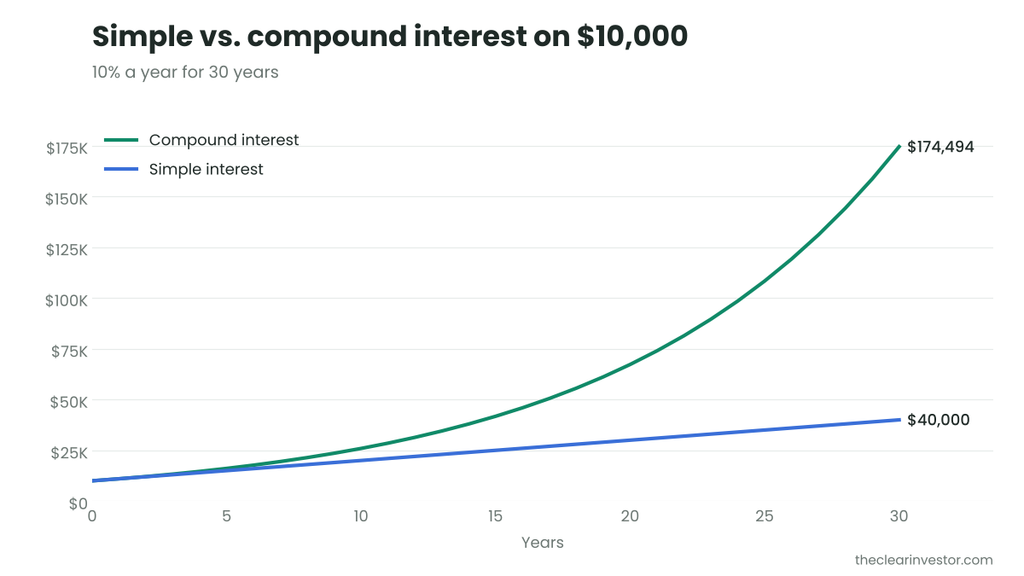
With simple interest, you only earn on your original money. With compound interest, you also earn on your earnings.
Here’s $10,000 at 10% a year for 30 years:
| After 30 years | |
|---|---|
| Simple interest | $40,000 |
| Compound interest | $174,494 |
Same money, same rate. Compounding ends up with more than 4 times as much.
The formula, if you want it: A = P × (1 + r/n)^(n × t). Here P is your starting amount, r is the yearly rate, n is how many times a year it compounds, and t is the number of years. You don’t need to do it by hand. My compound interest calculator does it for you.
The Rule of 72
Here’s a quick shortcut: divide 72 by your yearly return to see how many years it takes your money to double.
- At 10%, your money doubles about every 7.2 years.
- At 7%, about every 10.3 years.
From 18 to 67, that’s about 6 or 7 doublings at 10%. That’s why the numbers get so big.
Why Starting Young Matters So Much
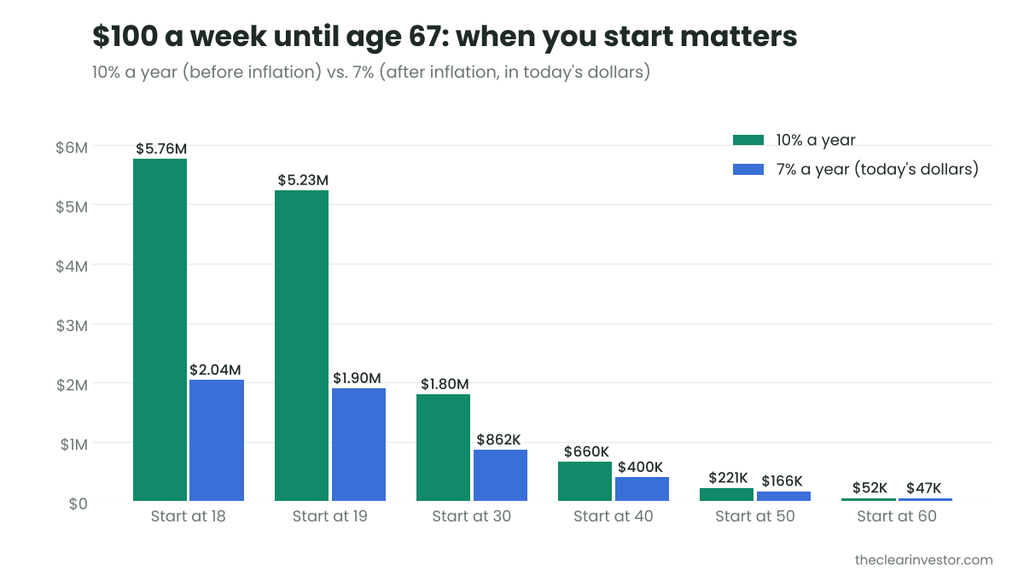
This is the part that fascinated me. Here’s $100 a week ($14 a day), invested until age 67, the full Social Security retirement age for anyone born in 1960 or later:
| Start at | You put in | At 10% a year | At 7% (today’s dollars) |
|---|---|---|---|
| 18 | $254,800 | $5.76 million | $2.04 million |
| 19 | $249,600 | $5.23 million | $1.90 million |
| 30 | $192,400 | $1.80 million | $862,046 |
| 40 | $140,400 | $660,100 | $400,458 |
| 50 | $88,400 | $221,004 | $165,811 |
| 60 | $36,400 | $51,713 | $46,528 |
Look at 18 vs. 30. You’d only put in $62,400 more, but you’d end up with almost $4 million more. Those extra 12 years are the most valuable years you have.
What One Year of Waiting Costs
I started at 19, and I’m glad I did. But look at the first two rows again.
Starting at 18 instead of 19 is worth about $528,828 at 10%. That’s one extra year and $5,200 more of your own money, and it adds up to more than half a million dollars by 67.
The last dollars you invest barely grow. The first dollars you invest do almost all the work. So the best time to start is now, whatever age you are.
Even 7% Is Amazing
The S&P 500 has returned about 10% a year on average over the long run, before inflation. Take out about 3% for inflation and you get about 7%. That’s the “today’s dollars” column, what your money would actually buy.
Even at 7%, $100 a week from 18 to 67 grows to about $2.04 million in today’s dollars. That’s a real millionaire, with today’s buying power, from $100 a week.
Returns aren’t steady, though. Some years the market is up 25%, and some years it’s down 20%. The 10% and 7% are long-run averages, not promises.
How Stocks Compound (Without Paying Interest)
Technically, VOO doesn’t pay “interest.” It compounds in two ways:
- Price growth. The companies inside it grow, so each share is worth more over time.
- Reinvested dividends. The dividends buy more shares, which pay more dividends.
So it’s compound growth, not compound interest. It’s the same snowball either way. If you’re new to VOO, here’s what an ETF is and why I buy VOO.
What My First VOO Buys Could Become
Here are my VOO buys from March to July 2022, when I was 20, during the 2022 market drop:
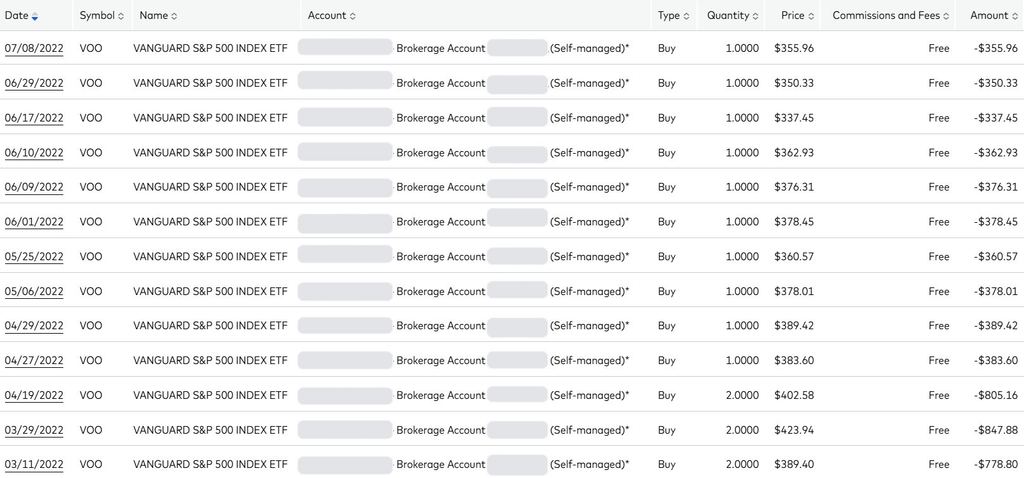
As of October 7, 2026, with VOO at $714.05, these buys are up about 87%, price only. That means every $1,000 I put in back then is worth about $1,870 today.
Now let compounding keep going until I’m 67, about 43 more years:
| Every $1,000 from 2022 | Value |
|---|---|
| Today | about $1,870 |
| At 67, 10% a year | about $112,700 |
| At 67, 7% (today’s dollars) | about $34,300 |
$1,000 I invested at 19 could become over $100,000, without me adding another dollar. That’s why I was happy to buy during the dip. I wrote about how I bought my first stock here.
Dividends: Compounding You Can See
My first VOO dividend, in March 2022, was $5.49:

Then $22.93, then $28.03, because I kept buying. I reinvest every dividend automatically, so each one buys a little more VOO, which pays a little more next time. Today my VOO dividend is in the triple digits every quarter. Here’s how dividends work and what my 4 ETFs pay.
My $500 a Week Plan
Today I invest about $500 a week in VOO:
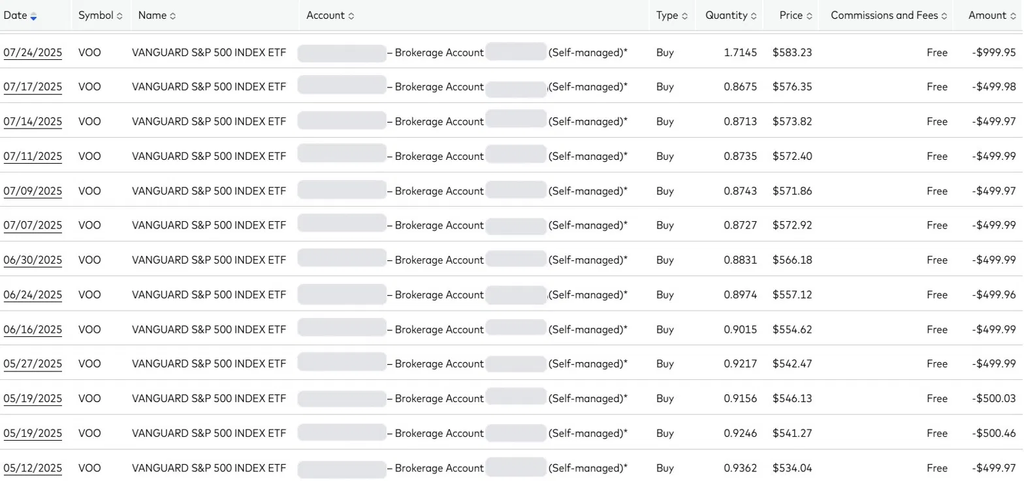
If I keep doing that from 24 to 67 (43 years), compounding does this:
- At 10% a year: about $16.1 million
- At 7% (today’s dollars): about $6.66 million
That’s from about $1.1 million of my own money. As long as I keep investing, compounding has me on track to be a multimillionaire. It’s not a guarantee. Time is the reason it’s realistic.
You don’t need $500 a week. Remember: $100 a week from 18 is $2 million in today’s dollars.
Compound Interest Can Work Against You
Compounding works on debt too, and much faster. My PayPal Credit Card has a 29.64% purchase APR, charged as a daily rate.
If you left $1,000 on a card like that and never paid it:
- After 1 year, you’d owe about $1,345.
- After 5 years, about $4,399.
By the Rule of 72, that debt doubles about every 2.4 years. That’s why I pay my cards off in full every time. If you carry a balance, pay it off before you invest. No investment reliably beats 29.64%.
Compounding in Your Savings
Compounding works in savings too, just more slowly. My emergency fund in Vanguard Cash Plus earns 3.5% APY. “APY” already includes compounding, so $10,000 earns about $350 a year. Here’s what a high-yield savings account is. Savings protects your money. Investing is where compounding builds wealth.
How to Start Compounding Today
- Open a brokerage account. Here’s how I opened my first one.
- Pick a broad ETF, like an S&P 500 ETF.
- Invest on a schedule. Weekly, every payday or monthly, even if it’s small.
- Turn on dividend reinvestment.
- Don’t touch it. Let time do the work.
- Pay off high-interest debt first, and keep an emergency fund.
Want to see your own numbers? Try my compound interest calculator. It has daily, weekly, monthly and yearly contributions, plus a “cost of waiting” box.
My Verdict: Time Is the Real Superpower
What is compound interest? It’s the reason a 19-year-old with a few hundred dollars can become a millionaire. You don’t need a big salary or a lucky stock pick. You need a small amount, invested regularly, and as many years as you can give it.
That YouTube video changed how I saw money. I hope this post does the same for you. Start today, even with $25 a week.
FAQ
What is compound interest in simple terms?
It’s earning money on your money, and then earning money on those earnings too. Over time, it snowballs.
What’s the difference between simple and compound interest?
Simple interest only pays on your original amount. Compound interest also pays on past interest. $10,000 at 10% for 30 years is $40,000 with simple interest and $174,494 with compound interest.
What is the Rule of 72?
Divide 72 by your yearly return to estimate how many years it takes your money to double. At 10%, it’s about 7.2 years.
How much will $100 a week be worth in 40 years?
About $2.41 million at 10% and about $1.07 million at 7%.
Do stocks pay compound interest?
Not technically. Stocks and ETFs like VOO compound through price growth and reinvested dividends. It works the same way.
Is it too late to start investing at 30 or 40?
No. $100 a week from 30 to 67 can still grow to about $1.8 million at 10%. Starting earlier just makes it easier.
Does compound interest work on debt?
Yes. A credit card at 29.64% APR doubles an unpaid balance about every 2.4 years. Pay off high-interest debt first.
This article is for informational purposes only and isn’t financial advice. Returns are not guaranteed, and past performance doesn’t guarantee future results.