Disclosure: I own VOO. This post is for informational purposes only and isn’t financial advice.
Buying your first stock takes just a few minutes once you have a brokerage account. You fund the account, search for what you want to buy, choose how much, and place the order. My first purchase was $200 of VOO, an S&P 500 ETF, on January 16, 2022, when I was 19. It’s up about 69% since.
In this post, I’ll show you how to buy your first stock step by step. I’ll also explain what an ETF is, and why my first purchase was an ETF instead of a single company’s stock.
Table of Contents
Stocks vs. ETFs: What’s the Difference?
A stock is a small piece of one company. If you buy Apple stock, you own a tiny part of Apple. If Apple does well, your stock can go up. If it does badly, it can go down.
An ETF (exchange-traded fund) is a basket of many stocks you buy in one purchase. It trades just like a stock: same buttons, same app, same process.
VOO is an ETF that tracks the S&P 500, the 500 largest companies in the U.S. One share of VOO gives you a small piece of all 500 companies at once.
What I like most about an S&P 500 ETF is that it updates itself. Companies that grow get added, and companies that shrink get removed. You don’t have to pick the winners. The index does it for you.
I explain more in my post on what an ETF is and why I picked VOO. For now, that’s all you need to know to buy your first one.
Why My First Stock Was an ETF
I’d done my research before I ever opened an account, and I knew my first investment would be an ETF, not a single company.
Since 1926, the S&P 500 has averaged a 10% annual return—or about 7% after 3% inflation. Starting at age 19 gave my money 41 years to grow. At a 7% rate of return, every $100 I invested at 19 turns into roughly $1,602 by age 60, nearly 16x my original money, even after inflation.
With that much time on my side, I didn’t need to take a risk on one company. The problem with individual stocks is that you can pick a winner, or you can pick a loser. With an S&P 500 ETF, you own the whole market.
Want to see what your own money could grow to? Try my saving vs investing calculator.
How to Buy Your First Stock, Step by Step
Step 1: Open a brokerage account
You need a brokerage account to buy stocks or ETFs. I opened mine at Vanguard and Public. Here’s my full guide on how to open your first brokerage account.
Step 2: Add money
Link your bank and transfer money in. My first deposit to Vanguard was $100. The money usually takes a few days to settle before you can invest it.
Step 3: Decide what to buy
For your first purchase, keep it simple. A broad ETF like VOO is an easy place to start, because you’re buying 500 companies instead of betting on one.
Step 4: Search for the ticker
Every stock and ETF has a short code called a ticker. AAPL is the ticker for Apple Inc and VOO is the ticker for Vanguard’s S&P 500 ETF. Type it into the search bar in your brokerage app.
Step 5: Choose how much to buy
You can usually buy in one of two ways:
- Buying by dollar amount (Fractional Shares): You set a fixed budget, regardless of the stock price. For example, if VOO is trading at $500 per share and you invest $200, you will own 0.4 shares ($200 ÷ $500). This lets you start investing immediately with whatever amount you have available.
- Buying by number of shares (Whole Shares): You purchase complete units based on the current market price. For example, if VOO costs $500 per share and you buy 2 shares, your total cost will be $1,000 ($500 × 2). Your required investment changes as the stock price moves up or down.
Quick Comparison table:
| Order Type | What you want to do | Example with VOO at $500 | What you receive |
|---|---|---|---|
| Dollar-based | You want to invest $200 in VOO | $200 ÷ $500/share | 0.40 shares |
| Share-based | You want to buy 2 shares of VOO | 2 × $500/share | 2 full shares ($1,000 total) |
Step 6: Pick your order type
- Market Order: Buys immediately at whatever price the stock is selling for right now. (This is like buying an item at full price right now so you can get it instantly.)
- Limit Order: Sets a target price—your order only executes if the stock drops to that exact number or lower. (This is like waiting for an item to go on sale at a specific discount price before you buy it.)
With a 40+ year horizon, a few dollars of difference in price didn’t matter to me, so I just used market orders.
Step 7: Review and place the order
Check the ticker, the amount and the order type, then submit. Most brokers charge $0 commission on stock and ETF trades now. Mine were free.
Step 8: Wait for it to fill
The stock market is open weekdays from 9:30 a.m. to 4 p.m. Eastern, and closed on weekends and market holidays. If you place an order when it’s closed, it waits until the market opens.
My First Stock Purchase: $200 of VOO
I placed my first order on Public on Sunday, January 16, 2022: $200 of VOO as a market order. I knew the market was closed, so it showed as pending:
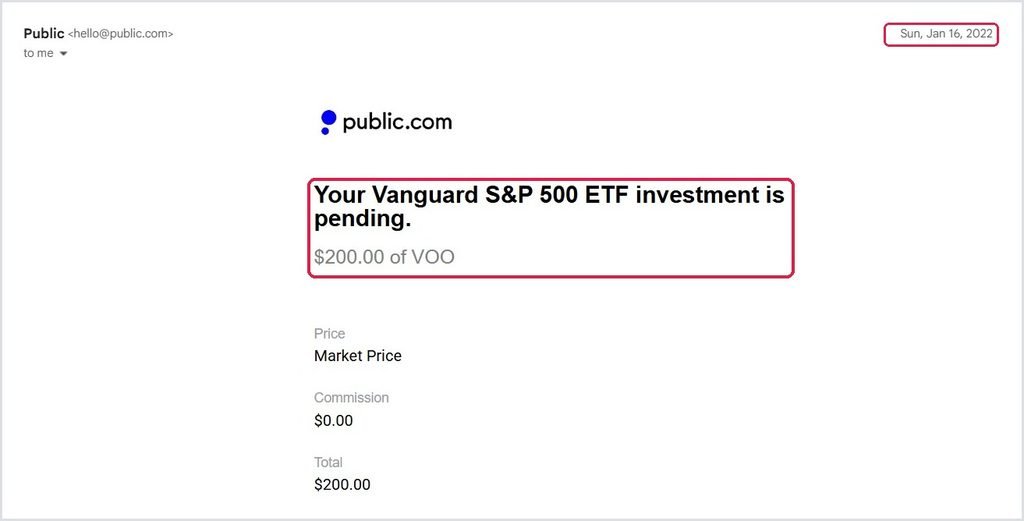
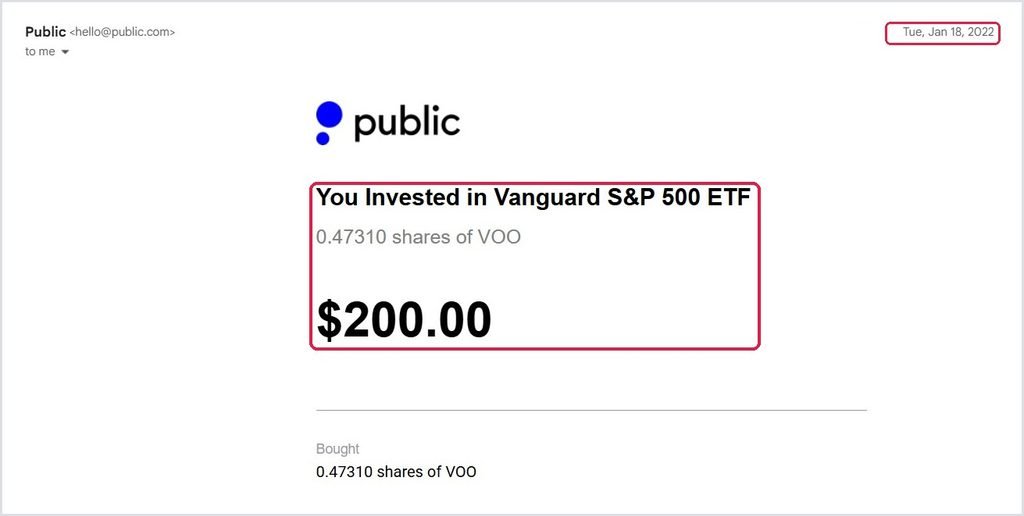
The next day was Martin Luther King Jr. Day, a market holiday, so my order filled on Tuesday, January 18. I got 0.47310 shares of VOO, a fractional share, since one share cost about $423 at the time.
At first, my plan was to keep about 10% of my investments on Public and 90% at Vanguard. Having two accounts turned out to be a hassle, so I later moved everything to my Vanguard brokerage account.
My First Full Shares on Vanguard
A week later, on January 25, 2022, I bought 2 full shares of VOO on Vanguard at $393.21 each.

Vanguard let me buy fractional shares of its own ETFs, but I liked buying whole shares. As a 19-year-old, there was something satisfying about owning 2 full shares of VOO.
Notice the price: VOO dropped about 7% in my first week. That didn’t scare me. It made me happy, because I got to buy at a lower price. I knew the power of compounding, and I had time on my side.
How I Kept Buying: Dollar-Cost Averaging
After my first purchase, I kept buying VOO regularly, no matter what the price was doing. That’s called dollar-cost averaging. Here are some of my purchases from 2022, when I was 20:
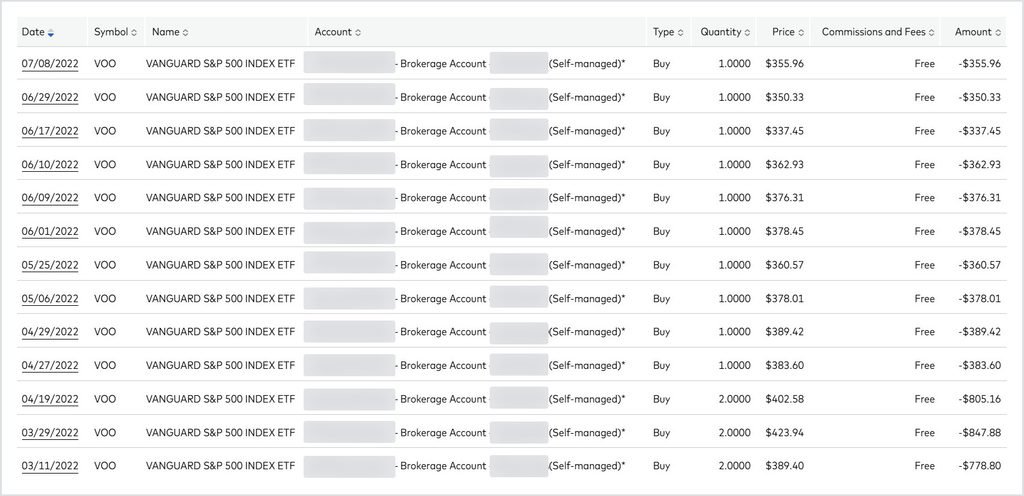
2022 was a down year for the market, and I kept buying through it. My cheapest buy in this list was $337.45 in June 2022.
I also have dividends set to reinvest automatically. VOO pays dividends, and reinvesting them buys more shares, which earn more dividends. That’s how compounding snowballs.
How My First Purchases Have Done
As of October 7, 2026, VOO is at $714.05. Price only, not counting dividends:
- My first $200 on Public (bought at about $423): up about 69%
- My first 2 shares on Vanguard ($393.21): up about 82%
- My 2022 purchases at age 20 ($337.45 to $423.94): up 68% to 112%, about 87% on average
The shares I bought during the 2022 dip have done the best. That’s why dollar-cost averaging works.
Past returns don’t guarantee future returns. VOO can drop, sometimes a lot. That’s why I only invest money I won’t need for years.
What About Individual Stocks?
I didn’t buy individual stocks until much later, in 2026, after I’d built a solid base in VOO. I’ll write about that separately. For your first stock, I’d still start with an ETF.
My Advice for Buying Your First Stock
If you’re buying your first stock today, I’d tell you the same thing I did: start with an S&P 500 ETF like VOO. You get the 500 largest U.S. companies in one purchase, winners get added, losers get removed, and you don’t have to guess which company will do well.
Then keep buying regularly, reinvest your dividends, and don’t panic when the price drops. Time does most of the work.
FAQ
How much money do I need to buy my first stock?
Not much. Many brokers let you buy fractional shares, so you can start with a few dollars. My first purchase was $200.
Is an ETF a stock?
No, but you buy and sell it the same way. A stock is one company. An ETF is a basket of many stocks. Here’s what an ETF is in more detail.
What is VOO?
VOO is Vanguard’s S&P 500 exchange-traded fund (ETF)—think of it as a single basket that holds shares of 500 top U.S. companies like Apple, Microsoft, and Amazon.
Should I use a market order or a limit order?
For a long-term investor buying a broad ETF, a market order is simple and fine. A limit order lets you set the most you’re willing to pay.
Can I buy stocks on the weekend?
You can place an order, but it won’t fill until the market opens on the next trading day.
What is dollar-cost averaging?
Dollar-cost averaging (DCA) is when you invest a set amount of money on a regular schedule—like $500 every month—regardless of whether the market is up or down. This helps take the guesswork out of timing the market and smooths out your average purchase price over time.
What is a ticker symbol?
A ticker symbol is a unique shorthand code—like AAPL for Apple Inc or VOO for Vanguard’s S&P 500 ETF—used to quickly search and trade specific stocks or funds on the stock market.
This post is for informational purposes only and isn’t financial advice. Past performance doesn’t guarantee future results.