Disclosure: I’m not a financial advisor, and this isn’t financial advice. I own shares of VOO, QQQM, FTEC and VUG. This post is my own experience, and I don’t get paid by Vanguard or anyone else mentioned here.
When I was 19, I put $200 into my first brokerage account and made my first investment. It wasn’t Apple, Tesla or some hyped penny stock. It was a boring ETF called VOO.
Years later, I’m still buying it almost every week.
If you read my guides on how to open your first brokerage account and how to buy your first stock, you already know I started with an ETF. I promised a deeper post on what an ETF actually is and why I picked VOO. This is it.
In this post, I’ll show you real screenshots of my VOO buys from 2022, 2023, 2025 and 2026, my first dividends, and the math that convinced me.
Table of Contents
What Is an ETF? (The Plain English Version)
An ETF (exchange-traded fund) is a basket consisting of many investments that you can buy and sell on the stock market, just like a single stock.
When you buy one share of an ETF, you’re buying a tiny piece of every company inside that basket at the same time. Buy one share of VOO and you own a sliver of about 500 companies in one click.
Think of it like a grocery store fruit basket. You could buy apples, oranges and grapes one at a time, or grab the basket that already has all of them. An ETF is the basket.
ETF vs. Stock vs. Mutual Fund
These three get mixed up a lot, so here’s the difference.
A stock is a piece of one company. If that company does great, you make money. If it goes bankrupt, your money can go to zero.
A mutual fund is a basket of many stocks, but it works differently:
- It only trades once a day, at the price set after the market closes.
- Many have minimums to get started. For example, Vanguard’s S&P 500 mutual fund (VFIAX) needs $3,000 to get in.
- Actively managed mutual funds, where a manager picks the stocks, usually charge higher fees.
An ETF gives you the basket of a mutual fund with the flexibility of a stock:
- It trades all day while the market is open.
- You can buy one share, or a fraction of a share at many brokerages, so you can start with a few dollars.
- Index ETFs like VOO usually have very low fees.
| Stock | Mutual fund | ETF | |
|---|---|---|---|
| What you own | 1 company | Many companies | Many companies |
| When it trades | All day | Once a day, after close | All day |
| Minimum to start | 1 share (or a fraction) | Often $1,000–$3,000 | 1 share (or a fraction) |
| Fees | No yearly fee | Often higher | Often very low |
| Risk of one company sinking you | High | Low | Low |
What Is VOO?
VOO is the Vanguard S&P 500 ETF. It tracks the S&P 500, a list of about 500 of the largest companies in the United States.
So when I buy VOO, I own a tiny piece of companies like Apple, Microsoft, Nvidia, Amazon and Google, plus hundreds of others in every part of the economy: banks, healthcare, energy, retail and more.
Why I Chose VOO at 19
When I started, VOO was the most common recommendation for beginners, and it also made the most sense to me. Here’s why.
1. It adds the winners and drops the losers automatically
This is the part I like most. I don’t have to guess which company will win.
A committee at S&P Dow Jones Indices reviews the S&P 500 regularly. To get in, a company has to be big, based in the U.S., actively traded and profitable. When a company shrinks, gets bought out or stops fitting the rules, it gets removed and a new one takes its spot. VOO follows those changes on its own.
That means if one company in the index turns out to be a loser, it gets smaller inside the fund and can eventually get kicked out, while growing companies take up more space. If I had put all my money into that one losing stock, I’d be stuck with it. With VOO, the fund cleans itself up and I never have to lift a finger.
2. The fee is so small it’s almost free
Every fund charges a yearly fee called an expense ratio. VOO’s expense ratio is 0.03%.
Here’s what that means in real money:
- $1,000 invested in VOO costs you $0.30 a year.
- $10,000 costs you $3 a year.
Now compare that to a fund that charges 1% a year:
- $10,000 costs you $100 a year, and that fee grows as your money grows.
That difference looks tiny at first, but it compounds. If you put $10,000 in and it grew 10% a year for 41 years:
- With a 0.03% fee, you’d end up with about $492,000.
- With a 1% fee, you’d end up with about $342,000.
That’s about $150,000 lost to fees from a single $10,000 investment. Low fees matter.
3. I had 4 decades for compounding to work
I was 19. Even if I retire at 60, that’s 41 years of compounding. Compounding means your money earns returns, and then those returns earn returns too. The longer you give it, the faster it snowballs.
The S&P 500 has returned about 10% a year on average over the long run, before inflation. Here’s what that could look like:
If you invested $100 a week from age 19 to 60 and earned 10% a year:
- You’d put in about $213,200 of your own money.
- You’d end up with about $2.66 million.
- That’s about $2.4 million that came from compounding, not from you.
Prices also go up over time, so that $2.66 million won’t buy what it buys today. Adjusted for about 3% inflation a year, it’s worth about $1.15 million in today’s dollars. That’s still more than 5 times what you put in.
The 10% is a historical average, not a promise. Some years the market is up 25%, and some years it’s down 20% or more. But over decades, the average has been strong.
Want to run your own numbers? Try my Saving vs. Investing Calculator. It shows how much your money could grow in savings, a high-yield savings account and the stock market, after inflation.
My Buying Rule: At Least Once a Week
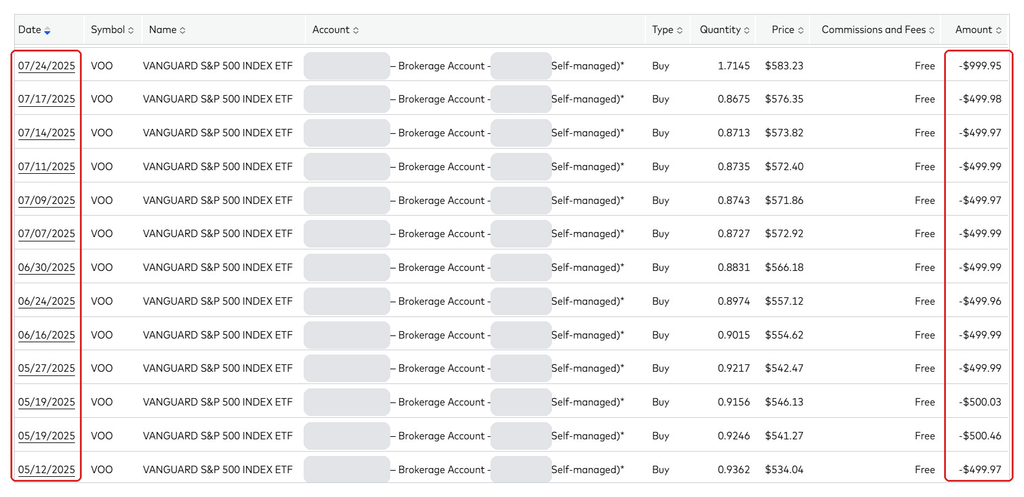
My strategy is simple, almost boring: whatever cash I have to invest that week is what I invest. My goal is to buy at least once a week.
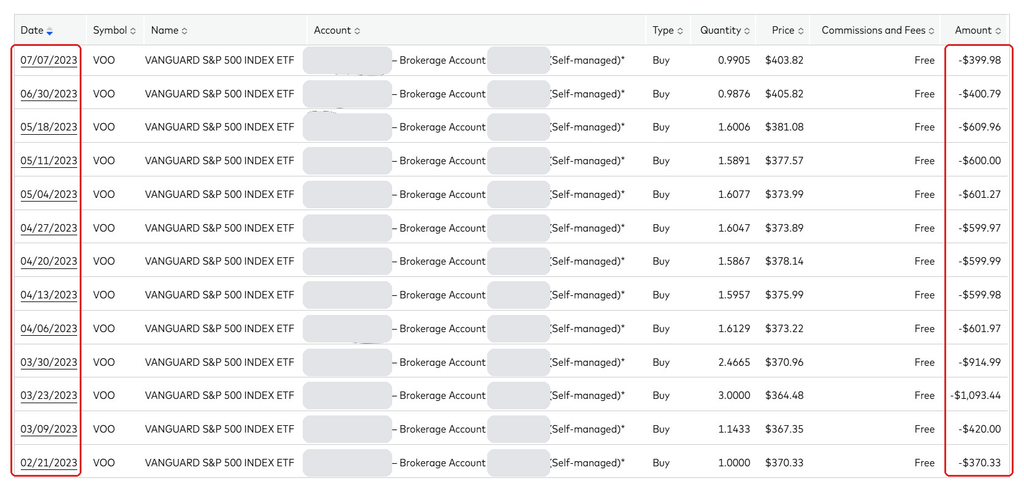
Some weeks that’s $370. Some weeks it’s $600. When I had extra, I put in $1,000. This is called dollar-cost averaging: investing on a regular schedule no matter what the price is. Sometimes I buy high, sometimes I buy low, and over time it evens out.
Here are some of my VOO buys from 2023:
From 2025, when I settled into about $500 a week:
And from 2026:
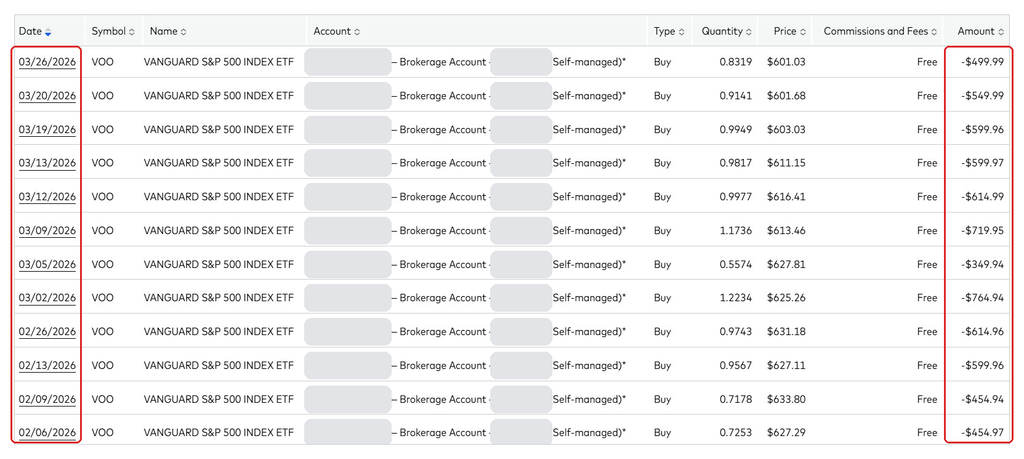
Every one of these trades shows “Free” under fees. Vanguard doesn’t charge a commission to buy ETFs, so 100% of my money goes into VOO.
The year I didn’t invest: I didn’t buy VOO at all in 2024. I needed that money for college expenses, so I paid those first. That’s important: investing should come from money you won’t need soon. Once I was in a better spot, I went right back to my weekly buys.
Buying the Dip in 2022
2022 was a rough year for the market. The S&P 500 fell about 19%, its worst year since 2008.
You can see it in my own buys. Look at the price column:
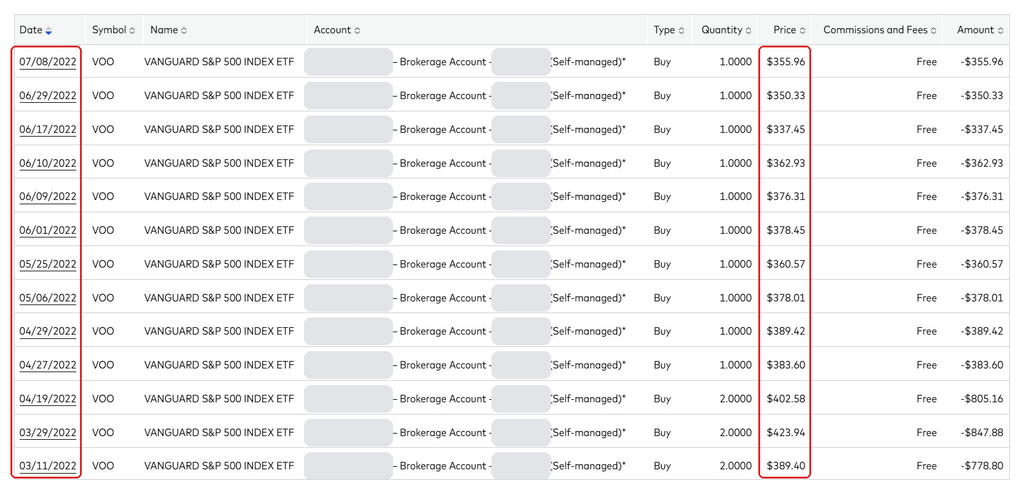
In March 2022, I paid $423.94 per share. By June, the same share cost $337.45. That’s about 20% lower.
A lot of beginners panic when they see red and sell. I didn’t sweat it. With a 40-plus-year horizon, I knew the market had plenty of time to come back, so I was actually happier to buy at a discount. Same companies, lower price.
And it did come back. In March 2026, I was paying over $600 a share. The share I bought for $337.45 in June 2022 is up about 78% compared to that price.
That doesn’t mean the market will always recover this fast. Sometimes it takes years. That’s why time is the most important part of this plan.
Dividends: When My Money Started Making Money
VOO pays a dividend every quarter. Many companies in the S&P 500 share part of their profits with their shareholders, and VOO passes that cash on to you.
Here were my first three dividends in 2022:

- March 2022: $5.49
- July 2022: $22.93
- October 2022: $28.03
That’s $56.45 in my first year, and it grew each quarter because I kept buying more shares.
$5.49 doesn’t sound like much, but that first dividend was inspiring. It was the first time I felt my money working for me. I didn’t do anything, and my money made more money. I saw the system work, and it made me even more motivated to keep going.
I have my dividends set to reinvest automatically. That means each dividend buys a little more VOO, which pays a little more dividend next quarter, which buys a little more VOO. That’s compounding in action.
I broke down how dividends work and what all 4 of my ETFs pay.
Is VOO Risky?
Yes, VOO can lose money. Here’s what you should know before buying:
- It can drop a lot. In 2022 it fell about 19%. In 2008 the S&P 500 fell even more. If you need your money in the next few years, it shouldn’t be in VOO.
- It’s all U.S. large companies. VOO doesn’t hold small companies or international stocks.
- A few giant companies make up a big part of it. The biggest tech companies are a large share of the index, so when they fall, VOO feels it.
- Have an emergency fund first. Keep a few months of expenses in savings before investing, so you’re never forced to sell during a drop.
Do I Only Own VOO?
No, but VOO is my anchor and where I started. I also buy smaller amounts of a few other ETFs:
- QQQM, which tracks the Nasdaq-100, the 100 largest non-financial companies on the Nasdaq. It’s heavier in tech.
- FTEC, a Fidelity ETF that holds only U.S. tech companies.
- VUG, a Vanguard ETF that holds U.S. growth companies.
These lean more toward tech and growth, so they can grow faster but also drop harder. That’s why they’re smaller pieces and VOO is the foundation. I’ll write about these in their own posts later.
How to Start Buying VOO
- Open a brokerage account. Here’s how I opened mine, and the fee to avoid.
- Buy your first share, or a fraction of one. Here’s exactly how I bought my first VOO, step by step.
- Pick a schedule and stick to it. Weekly, every payday, or monthly. Consistency matters more than amount.
- Turn on dividend reinvestment so your dividends keep buying more shares.
- Don’t panic when it drops. Keep buying.
My Verdict: Why VOO Is Still My Anchor
I didn’t need to be a Wall Street expert to start building wealth at 19. I needed a brokerage account, one solid ETF, and the patience to keep buying every week, even when the market was down.
VOO gave me that: 500 companies in one click, a fee that’s almost nothing, and an index that drops losers and adds winners on its own. Years later, it’s still the foundation of everything I invest in.
If you haven’t started, start small. Even $50 a week adds up over 40 years.
Learn how to buy your first stock (and why mine was an ETF).
Don’t have a brokerage account yet? Start here.
FAQ
What does ETF stand for?
ETF stands for exchange-traded fund. It’s a basket of investments, like stocks, that trades on the stock market just like a single stock.
Is VOO a good ETF for beginners?
VOO is one of the most popular ETFs for beginners because it holds about 500 of the largest U.S. companies, has a 0.03% expense ratio and needs no stock picking. It can still lose value in a downturn, so it’s best for money you won’t need for years.
How much does owning VOO cost per year?
VOO’s expense ratio is 0.03%, which means $3 fee a year for every $10,000 invested.
How often does VOO pay dividends?
VOO pays dividends every quarter, usually in March, June or July, September or October, and December. You can take them as cash or reinvest them automatically.
Can I buy less than one share of VOO?
Yes, at brokerages that offer fractional shares, you can buy VOO in dollar amounts instead of whole shares. Most of my buys are fractional, like 0.8675 shares for $499.98.
What’s the difference between VOO and an S&P 500 mutual fund?
Both track the S&P 500. VOO trades all day like a stock and you can start with one share or less. A mutual fund like VFIAX only trades once a day and requires a $3,000 minimum to start.
This post is for informational purposes only and isn’t financial advice. Past performance doesn’t guarantee future results.