Disclosure: I’m not a financial advisor, and this isn’t financial advice. I own VOO. I’m not paid by Vanguard or any bank mentioned here.
A high-yield savings account is a savings account that pays much more interest than a regular one. Mine is a Vanguard Cash Plus account, and it pays 3.5% APY. My first savings account at Wells Fargo paid 0.01%.
That’s 350 times more interest, on the same money.
Vanguard invited me to open one back in 2022, and I brushed it off. I finally opened it in June 2025, and now it’s where I keep my emergency fund. Here’s what a high-yield savings account is, how mine works, and why it took me almost 3 years to open one.
Table of Contents
What Is a High-Yield Savings Account?
A high-yield savings account (HYSA) works like a regular savings account: you deposit money, it’s safe, and you earn interest. The difference is the rate.
Big banks often pay 0.01% on savings, and the national average is only 0.37%. Top high-yield accounts pay around 4%. They’re usually offered by online banks and brokerages, which don’t have branches to pay for, so they can pay you more.
A few things to know:
- The rate is variable. It can go up or down over time.
- It’s FDIC-insured at banks, usually up to $250,000 per bank.
- It’s not an investment. Your balance doesn’t drop when the stock market does.
Regular Savings vs. High-Yield Savings
Here’s what $10,000 earns in one year:
| Account | APY | Interest in 1 year |
|---|---|---|
| Wells Fargo Way2Save (my first savings account) | 0.01% | $1 |
| Average savings account | 0.37% | $37 |
| Vanguard Cash Plus (mine now) | 3.5% | $350 |
Same money, same safety, $349 more a year.
The Invite I Ignored in 2022
In November 2022, Vanguard emailed me about its new account paying 3.5% APY on cash:
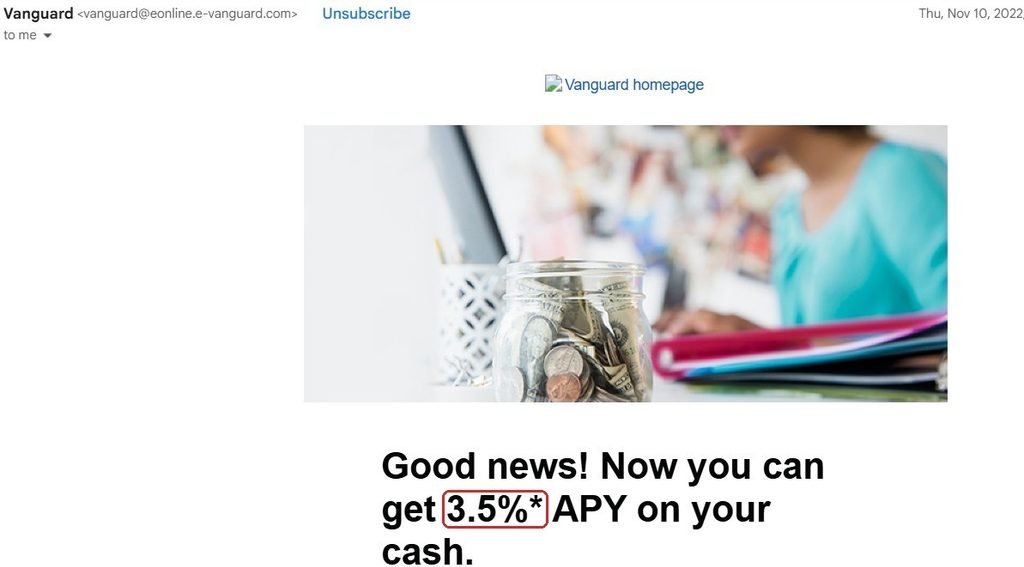
I brushed it off. At the time, I was investing almost every dollar into VOO. Wells Fargo already closed my 0.01% savings account, and I kept my basic emergency fund in checking. Every dollar sitting in cash felt like a dollar not invested.
Why I Finally Opened One in 2025
On June 17, 2025, I finally opened my Vanguard Cash Plus account:
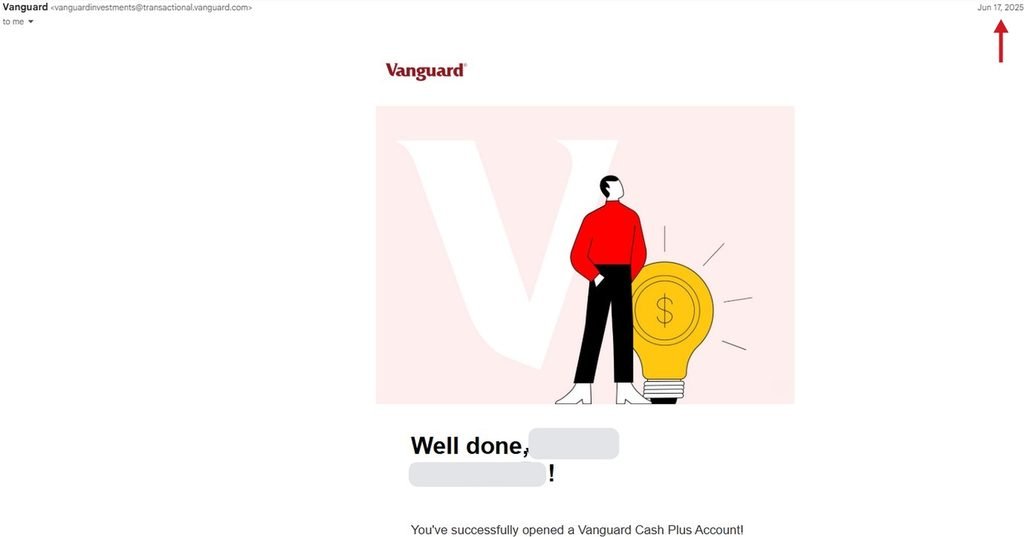
What changed? My brokerage account reached bigger numbers. Once I had a solid base in VOO, I didn’t feel the FOMO to invest every single penny anymore. That’s when it finally made sense to set aside a real emergency fund and let it earn interest.
How Vanguard Cash Plus Works
Vanguard Cash Plus isn’t technically a savings account. It’s a cash account at Vanguard that works like a high-yield savings account. Here’s how it works, from Vanguard’s Cash Plus page:
- Bank sweep: your cash is moved into accounts at partner banks, where it earns interest.
- FDIC-insured up to $1.25 million for an individual account, because your money is spread across several partner banks.
- $0 minimum to open, and no minimum balance.
- $0 account fees with e-delivery, and free transfers to and from your bank.
- Next-day bank transfers. You get routing and account numbers, just like a bank account.
- A 60-day hold for new accounts: during your first 60 days, deposits can only go back to the bank they came from.
Here’s mine. The rate is 3.50% APY as of October 7, 2026:

The rate is variable. It dipped to 3.25% at one point and is now back at 3.5%. I haven’t noticed any fees or minimums.
One more thing: the interest is taxable. Vanguard sends me a 1099-INT every year, and interest is taxed as regular income, not at the lower rate qualified dividends get.
How I Use It: My Emergency Fund Rule
My rule is simple: I keep about 3 months of expenses in Cash Plus. That’s enough to cover rent, bills and food if something goes wrong, without keeping too much money out of the market.
I move money in from my Wells Fargo checking account, and I don’t take money out. It’s strictly for emergencies.
I’ll be honest: when the market dips, that cash is tempting. Having it at Vanguard, right next to my investments, makes it even harder, because I could buy VOO with it in a few clicks. But I don’t. It serves a different purpose. Its job is to be there when something goes wrong, so I never have to sell VOO at a bad time.
Savings vs. Investing: Why I Don’t Keep More Than That in Cash
A high-yield savings account is the best place for an emergency fund, but it’s not where you build wealth. I ran $10,000 through my Saving vs. Investing Calculator for 10 years, with 3% inflation:
| Where you keep $10,000 | Balance in 10 years | Worth in today’s dollars | Buying power |
|---|---|---|---|
| Cash (0%) | $10,000 | $7,441 | $2,559 lost |
| High-yield savings (3.5%) | $14,106 | $10,496 | $496 gained |
| Investing (10%) | $25,937 | $19,300 | $9,300 gained |
A high-yield savings account just barely beats inflation. It protects your money, but it doesn’t grow it much. Investing grew the same $10,000 into almost twice as much buying power.
That’s why I keep only my emergency fund in Cash Plus, and everything else goes into VOO. To try your own numbers, set the high-yield rate in the calculator to your account’s APY.
How to Open a High-Yield Savings Account
- Compare rates. Look for a strong APY from a trusted bank or brokerage.
- Check fees and minimums. The best accounts have none.
- Make sure it’s FDIC-insured.
- Open it online. You’ll need your Social Security number, ID and a bank account to fund it.
- Link your checking account and move your emergency fund in.
- Leave it alone. Only touch it for real emergencies.
Is a High-Yield Savings Account Worth It?
Pros:
- Pays far more than a regular savings account
- FDIC-insured, so your money is safe
- No stock market risk
- Easy to move money in and out
Cons:
- The rate can drop
- Interest is taxed as regular income
- It barely beats inflation, so it’s not for long-term growth
My Verdict: Every Emergency Fund Belongs in a High-Yield Account
My first savings account paid 0.01%. My Vanguard Cash Plus account pays 3.5% on the same kind of money, with the same safety. It took me almost 3 years to open one, because I wanted every dollar invested. But once my investments were big enough, a separate emergency fund earning 3.5% just made sense.
Keep your emergency fund in a high-yield savings account, keep it separate from your investments, and don’t touch it when the market dips. Everything else can go to work in the market.
New to investing? Here’s how to open your first brokerage account.
FAQ
What is a high-yield savings account?
A savings account that pays much higher interest than a regular one, often around 3.5% to 4% compared to the 0.37% national average. It’s usually FDIC-insured.
Is Vanguard Cash Plus a high-yield savings account?
Technically it’s a cash account, not a savings account, but it works like one. Your cash is swept into partner banks, earns a variable rate (3.5% APY as of October 7, 2026), and is FDIC-insured up to $1.25 million for individual accounts.
How much interest does $10,000 earn at 3.5%?
About $350 a year. At 0.01%, the same $10,000 would earn only $1.
Is high-yield savings interest taxable?
Yes. Interest is taxed as regular income, and you’ll get a 1099-INT each year.
How much should I keep in my emergency fund?
A common rule is 3 to 6 months of expenses. I keep about 3 months in my high-yield account.
Can the interest rate on a high-yield savings account change?
Yes. The rate is variable. Mine dipped to 3.25% and is now back at 3.5%.
Should I keep my emergency fund in a high-yield savings account or invest it?
Keep it in a high-yield savings account. The stock market can drop right when you need the money, so your emergency fund should stay safe.
This article is for informational purposes only and isn’t financial advice. Rates, fees and account features can change, so check the latest terms before opening an account.