Disclosure: I’m not a financial advisor, and this isn’t financial advice. I own VOO, QQQM, VUG and FTEC. This post is my own experience, and I’m not paid by Vanguard, Robinhood or any fund company.
My first dividend from QQQM was $0.58. My first from VUG was $0.30.
That’s not a typo. Thirty cents.
Today, my VOO dividend alone is in the triple digits every quarter, and it gets reinvested automatically.
In my last post, I explained what an ETF is and why I’ve bought VOO since I was 19. In this one, I’m breaking down dividends: what they are, how they work, how they’re taxed, and what my 4 ETFs actually pay me.
Table of Contents
What Are Dividends?
A dividend is a cash payment a company makes to its shareholders, usually from its profits.
Think of it like this: you own a tiny slice of a business. When the business makes money, it can either reinvest that money into itself (new products, new stores, new factories) or share some of it with its owners. A dividend is that share.
For example, if a company pays $1 per share a year and you own 10 shares, you get $10
Not every company pays dividends. Older, steady companies like Coca-Cola or Procter & Gamble usually do. Fast-growing companies often pay little or nothing, because they’d rather put every dollar back into growing.
How Do ETFs Pay Dividends?
An ETF holds many companies. When those companies pay dividends, the ETF collects all of them and passes them on to you, usually every quarter (4 times a year).
So when I own VOO, I’m collecting a small piece of the dividends from about 500 companies, bundled into one payment.
All 4 of my ETFs pay quarterly:
| ETF | What it holds | How often it pays | Dividend size |
|---|---|---|---|
| VOO | About 500 of the largest U.S. companies | Quarterly | Biggest of my 4 |
| QQQM | The 100 largest non-financial Nasdaq companies | Quarterly | Small |
| VUG | U.S. growth companies | Quarterly | Small |
| FTEC | U.S. tech companies | Quarterly | Small |
The Dividend Yield: How Much an ETF Pays
The dividend yield tells you how much an investment pays in dividends each year as a percentage of its price.
Yield = yearly dividends ÷ price
If something costs $100 and pays $1 a year, its yield is 1%.
Here’s what $10,000 would pay you in a year at different yields:
| Yield | Example | Yearly dividends on $10,000 |
|---|---|---|
| 0.38% | FTEC (from my Robinhood screenshot) | About $38 |
| About 0.5% | Growth/tech ETFs like QQQM or VUG | About $50 |
| About 1% | VOO | About $100 |
| About 3.5% | A dividend-focused ETF like SCHD | About $350 |
Yields change every day as prices move, so treat these as rough numbers.
My First Dividends: $0.58 and $0.30
Back in March 2022, I owned just 1 share of QQQM and 1 share of VUG. Here’s what they paid me:


58 cents and 30 cents. That’s what 1 share of a growth ETF pays.
This shows something important: growth and tech ETFs pay very small dividends. The companies inside them, like Nvidia, Apple and Microsoft, keep most of their profits to grow the business instead of paying them out. You don’t buy these ETFs for income. You buy them for growth.
How My VOO Dividends Grew
VOO is my biggest position, so it pays my biggest dividends. My first VOO dividend in March 2022 was $5.49 (I showed that in my VOO post).
Because I kept buying VOO almost every week, my dividends kept growing. The first big milestone was when one quarterly payment passed $50:

$56.70 in one quarter. $50 felt like a solid amount to look at, and it motivated me to keep going.
Then this one came:

$95.00 in one quarter. At that point, I knew my next one would cross into triple digits. That motivated me even more, because my VOO dividend was about to break the $100 mark.
And it did. My VOO dividend has been in the triple digits every quarter since.
From $5.49 to over $100 a quarter is more than an 18x increase, and it came from two things:
- Buying more shares every week. More shares mean more dividends.
- Reinvesting every dividend. Each dividend buys more shares, which pay more dividends.
My other ETFs, like FTEC, still pay double digits per quarter, since they’re smaller positions.
A Real Example: FTEC on Robinhood
FTEC lives in my Robinhood account. Here’s what Robinhood shows for it:
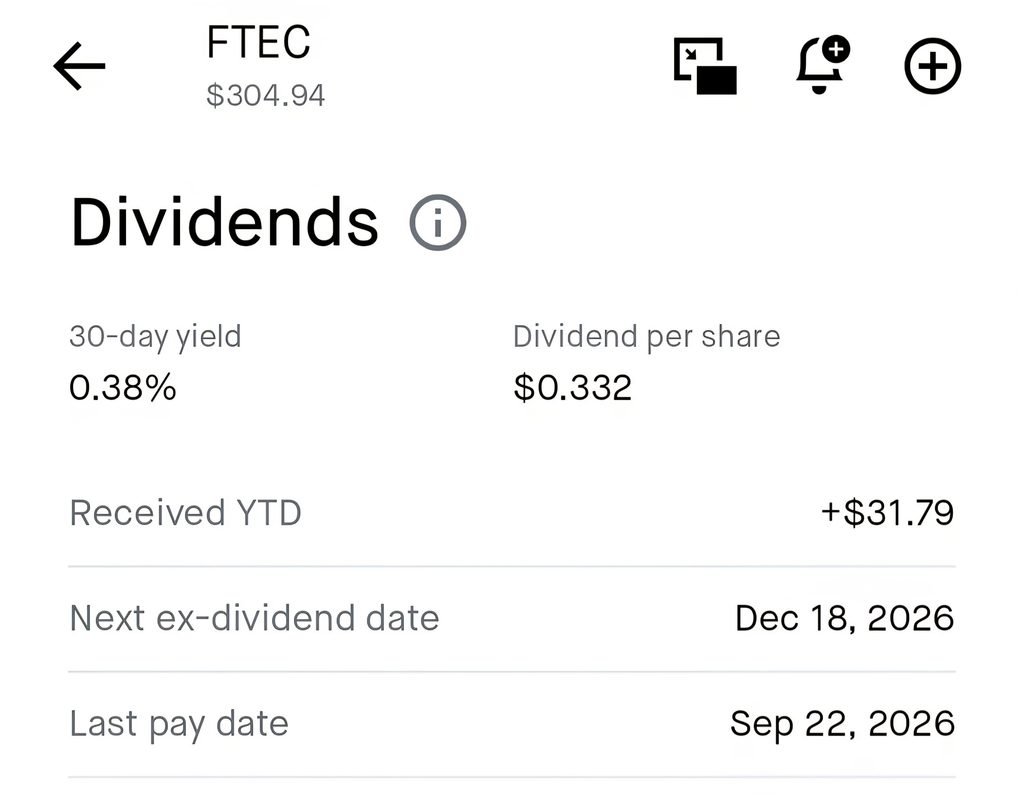
Here’s what each number means:
- 30-day yield (0.38%): FTEC pays about 0.38% of its price a year in dividends. Tech companies pay small dividends, so this is low.
- Dividend per share ($0.332): the last payment was 33.2 cents for every share. If you owned 100 shares, you’d get $33.20.
- Received YTD (+$31.79): what I’ve received from FTEC so far this year.
- Next ex-dividend date (Dec 18, 2026): you have to own FTEC before this date to get the next payment.
- Last pay date (Sep 22, 2026): the day the last dividend landed in my account.
The 3 Dividend Dates You Should Know
1. Ex-dividend date
This is the most important one. To get the dividend, you must own the shares before the ex-dividend date. If you buy on or after it, the next dividend goes to the seller instead.
2. Record date
The date the company checks who its shareholders are. Since trades now settle in one business day, the record date is usually the same day as the ex-dividend date.
3. Pay date
The day the cash actually lands in your account. This can be a few days to a few weeks after the ex-dividend date.
Dividends Aren’t Free Money
This surprises a lot of beginners.
On the ex-dividend date, the share price usually drops by about the amount of the dividend. If a share is $100 and pays a $1 dividend, the price usually opens closer to $99. You now have a $99 share plus $1 in cash: still $100.
So a dividend doesn’t make you richer overnight. It moves part of your investment’s value into cash. What matters is total return: price growth plus dividends.
That’s why I don’t pick ETFs just for a high dividend. A fund with a smaller dividend but more growth can still win over time.
Reinvesting Dividends (DRIP)
When a dividend arrives, you have two choices:
- Take it as cash. It sits in your account, and you can spend it or invest it yourself.
- Reinvest it automatically. This is called a DRIP (dividend reinvestment plan). Your dividend automatically buys more shares, even fractional ones.
My VOO, VUG and QQQM at Vanguard are all set to reinvest automatically. I don’t have to do anything.
Here’s why I do it: each dividend buys a little more VOO. That extra VOO pays a little more dividend next quarter, which buys a little more VOO. It’s a snowball, and it’s one of the easiest ways to let compounding do the work.
Most brokerages let you turn this on in your account settings, usually under something like “dividend reinvestment” or “dividends and capital gains.”
How Dividends Are Taxed
Both my Vanguard and Robinhood accounts are regular taxable brokerage accounts, so I pay taxes on my dividends.
One thing a lot of people don’t know: you still owe taxes on dividends even if you reinvest them. The IRS treats a reinvested dividend like you received the cash and then bought more shares.
Qualified vs. ordinary dividends
There are two types of dividends, and they’re taxed differently:
Qualified dividends get a lower tax rate. Most dividends from U.S. companies are qualified, as long as you’ve held the shares for more than 60 days during the 121-day period that starts 60 days before the ex-dividend date. If you buy and hold an ETF like VOO for years, you easily meet that.
For 2026, the federal tax rates on qualified dividends for a single filer are:
| Your taxable income (single) | Tax rate on qualified dividends |
|---|---|
| Up to $49,450 | 0% |
| $49,451 to $545,500 | 15% |
| Over $545,500 | 20% |
Ordinary (non-qualified) dividends are taxed at your regular income tax rate, which is usually higher.
Example: if you get $500 in qualified dividends and you’re in the 15% bracket, you’d owe about $75 in federal tax. Many states tax dividends too.
The 1099-DIV form
Every year, usually by mid-February, your brokerage sends you a Form 1099-DIV. It shows how much you received in dividends the year before. The two boxes that matter most:
- Box 1a: your total ordinary dividends
- Box 1b: the part of that total that’s qualified
I get a 1099-DIV from my brokerage each year, and I enter it when I file my taxes. If you use tax software, you just type in those boxes, or import the form directly.
Tip: dividends in a Roth IRA grow tax-free, and in a traditional IRA or 401(k) they’re tax-deferred. That’s why some people hold their highest-dividend investments in retirement accounts.
Why I Don’t Chase High Dividends Yet
Funds like SCHD pay a much higher dividend than VOO, around 3% or more compared to VOO’s 1%. So why don’t I buy it?
Because I’m in my 20s, and I don’t need my investments to pay me income right now. I need them to grow. Dividend-focused funds usually hold steady, mature companies that grow more slowly. And in a taxable account, a higher dividend means more taxes every year, even if I reinvest it.
SCHD may come later in life, when I’m in my 50s and getting close to retirement. That’s when steady dividends make sense, because they can act like a paycheck.
Here’s the math on why that takes a big portfolio. To get $40,000 a year from dividends alone:
- At a 1% yield (like VOO), you’d need about $4 million.
- At a 3.5% yield (like a dividend ETF), you’d need about $1.14 million.
So for now, I’m focused on building the biggest base I can with growth. Later, I can shift some of it toward income.
Should You Care About Dividends as a Beginner?
Yes, but not too much. Here’s how I’d think about it:
- Turn on dividend reinvestment. It’s free compounding.
- Don’t pick an ETF only for its dividend. Look at total return, fees, and what it holds.
- Save your 1099-DIV for taxes every year.
- Be patient. My first dividends were 30 cents. The growth comes from buying consistently over years.
If you haven’t started investing yet, start here:
- Open your first brokerage account
- Buy your first stock or ETF
- Learn what an ETF is and why I buy VOO
My Verdict: Let Dividends Do Their Job Quietly
My first dividends were 58 cents and 30 cents. Today my VOO dividend is in the triple digits every quarter, and I didn’t get there by chasing high yields. I got there by buying every week and reinvesting every dividend.
For me, dividends aren’t the goal right now. They’re fuel. Each one buys a little more of my ETFs, which pays a little more next time. Later in life, I may switch to higher-dividend funds so they can pay me like a paycheck. But in my 20s, I’m letting them quietly compound.
Your next step: See what an ETF is and why I’ve bought VOO since I was 19.
FAQ
What are dividends in simple terms?
A dividend is a cash payment a company makes to its shareholders, usually from its profits. If a company pays $1 per share and you own 10 shares, you get $10.
How often do ETFs pay dividends?
Most stock ETFs, like VOO, QQQM, VUG and FTEC, pay dividends quarterly, or 4 times a year.
Do I have to pay taxes on reinvested dividends?
Yes. In a regular taxable brokerage account, dividends are taxed in the year you receive them, even if they’re automatically reinvested.
What is the difference between qualified and ordinary dividends?
Qualified dividends are taxed at lower rates (0%, 15% or 20% at the federal level), as long as you meet the holding period. Ordinary dividends are taxed at your regular income tax rate.
When do I need to buy a stock to get the dividend?
To receive a stock’s upcoming dividend, you must purchase the shares at least one business day before the ex-dividend date.
Why does my ETF pay such a small dividend?
Growth and tech ETFs hold companies that reinvest most of their profits into growing, so they pay small dividends. FTEC, for example, has a yield of about 0.38%.
What is a 1099-DIV?
It’s a tax form your brokerage sends each year showing the dividends you received. Box 1a shows total ordinary dividends, and Box 1b shows the qualified portion.
This is not financial advice. Yields are approximate and change daily. Tax rates are 2026 federal rates for single filers. Check with a tax professional for your situation.