
This Amazon Flex pay calculator shows what a block really pays per hour and per mile after gas and tax, counting your drive to the station, and the lowest offer worth taking for your hourly goal. Want your tax bill for the whole year instead? Use my Amazon Flex tax calculator.
I drove Amazon Flex in California for about 18 months, and most of my blocks ran 4 to 4.5 hours and 100 miles or more. An offer looks good on the screen, but gas, the drive to the station and taxes all come out of it. Amazon says most delivery partners earn $18 to $25 an hour. This shows what’s left.
Amazon Flex Pay Calculator
See what an Amazon Flex block really pays per hour and per mile after gas and tax, and the lowest offer worth taking.
Step 1: The block
Step 2: Your miles and car
Step 3: Your taxes and your goal
Where the money goes
What other offers for this block would pay
| Offer | Amazon’s pay per hour | Per hour after gas and tax |
|---|
How this is calculated
- Pay = block pay (surge pay included) + tips.
- Your time = the hours you actually worked + your drive to the station and back. Amazon’s pay per hour uses the block length instead.
- Gas = all your miles (route miles + miles to the station and back) ÷ your MPG × your gas price. Repairs and wear = all your miles × the cents a mile you entered.
- Profit for taxes = pay minus your route miles × the IRS standard mileage rate of 76 cents a mile (from July 1, 2026). Miles to the station only count if you check the box. Gas isn’t deducted on top, since the mileage rate already covers gas, insurance, repairs and wear.
- Self-employment tax is 15.3% of 92.35% of that profit. It assumes Flex is a regular side income, so your year’s profit is over the $433 line where self-employment tax starts.
- Federal income tax = your bracket × the profit, after half of the self-employment tax and the 20% qualified business income deduction. Tips come off first, up to your profit, for the tips deduction (2025 through 2028).
- State income tax = your state rate × the profit, after half of the self-employment tax. It leaves out the tips deduction, since each state decides whether to follow it.
- What this block really pays per hour = pay minus gas, repairs and wear and tax, divided by your time.
- Lowest offer worth taking = the smallest block pay, rounded up to the next dollar, that clears your hourly goal after gas and tax, with the same tips, hours and miles.
Not included: insurance, car payments and the value your car loses, parking and tolls, and your phone. Your yearly tax also depends on your other income and deductions, so for the full picture use my Amazon Flex tax calculator.
Free tax tracker + deadline reminders
Get my free side income tax tracker
Sign up and I’ll send you my Google Sheets tracker that shows how much of each payout to set aside. You’ll also get an email before each quarterly tax deadline (Jan 15, Apr 15, Jun 15 and Sep 15), plus my new guides. Unsubscribe anytime.
Earn on several platforms or drive for work? Get the full 1099 Side Income Tracker ($12) →
Table of Contents
How to Use the Amazon Flex Pay Calculator
Fill in the three steps from top to bottom. Each box asks for one number.
Step 1: The block
- Block pay. The offer in the Flex app, with any surge pay. Amazon says you earn what the offer shows whether a block ends early or late.
- Tips. Only on tip-eligible blocks, shown as “$XX + tips.” Enter 0 for standard delivery blocks.
- Block length. The hours on the offer.
- Hours you actually worked. From check-in at the station to your last stop.
- Drive to the station and back. Your round trip from home, plus any wait at the station, in minutes.
Step 2: Your miles and car
- Route miles. From the station through your last stop, plus any trip back to return packages. Check your odometer at the station and at your last stop.
- Miles to the station and back. Your round trip from home.
- Gas price and gas mileage. What you pay per gallon and your car’s real MPG.
- Repairs and wear (optional). AAA puts maintenance, repairs and tires at about 11 cents a mile for a new car. Enter 11 to count them, or 0 to count gas only.
Step 3: Your taxes and your goal
- Federal tax bracket. If Flex is your only income, it’s often 0% or 10%. With a full-time job, it’s usually 12% or 22%.
- State income tax rate. Enter 0 if your state has no income tax.
- Hourly goal. The least you’d take for an hour of your time, after gas and tax.
- The station box. Leave it unchecked unless your home is your principal place of business. IRS Publication 463 treats the drive between home and a regular work location as commuting.
Who This Calculator Is For
The Amazon Flex pay calculator is built for US Flex drivers deciding which blocks to take. It’s most useful if you:
- Are new to Flex and want to know what an offer is really worth.
- Live far from your station, so the drive eats into every block.
- Have a minimum hourly pay in mind and want the lowest offer that clears it.
- Wonder whether surge pay is worth it for a longer or farther block.
- Drive a car that’s hard on gas, like a minivan or an SUV.
To see what you’ll owe for the whole year, use my Amazon Flex tax calculator.
How to Read Your Results
The Amazon Flex pay calculator shows your results in four parts.
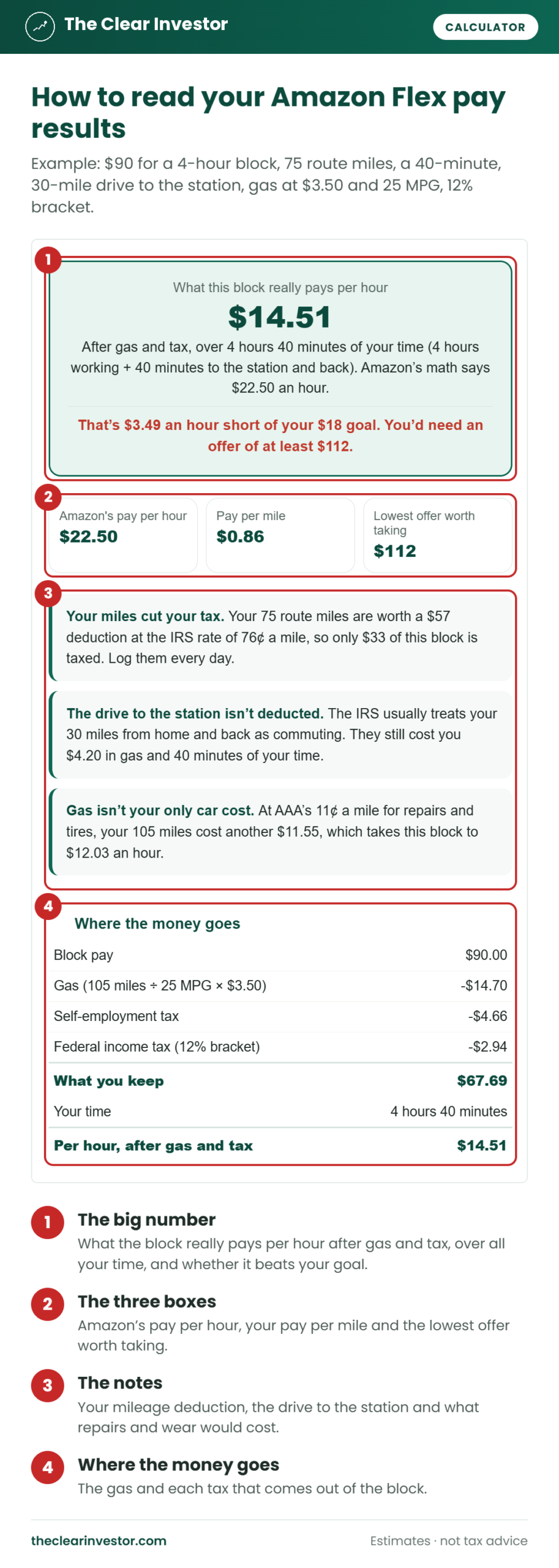
- The big number is what the block really pays per hour, after gas and tax, over all the time you give it. Below it is Amazon’s math, and a line that tells you whether it beats your goal.
- The three boxes show Amazon’s pay per hour, your pay per mile and the lowest offer worth taking for your goal.
- The notes cover your mileage deduction, the drive to the station, finishing early and what repairs and wear would cost.
- Where the money goes lists the gas and each tax that comes out of the block.
Below those, What other offers for this block would pay shows lower and higher offers for the same block, in green when they clear your goal.
Worked Example 1: A $90, 4-Hour Block
This is the calculator’s starting example: a $90 block for 4 hours, 75 route miles and a 40-minute, 30-mile round trip to the station. Gas is $3.50, the car gets 25 MPG, and the driver is in the 12% federal bracket with no state income tax.
| Step | Amount |
|---|---|
| Block pay | $90.00 |
| Gas (105 miles ÷ 25 MPG × $3.50) | −$14.70 |
| Self-employment tax ($33 of profit after a $57 mileage deduction) | −$4.66 |
| Federal income tax (12% bracket) | −$2.94 |
| What you keep | $67.69 |
| Your time | 4 hours 40 minutes |
| Per hour after gas and tax | $14.51 |
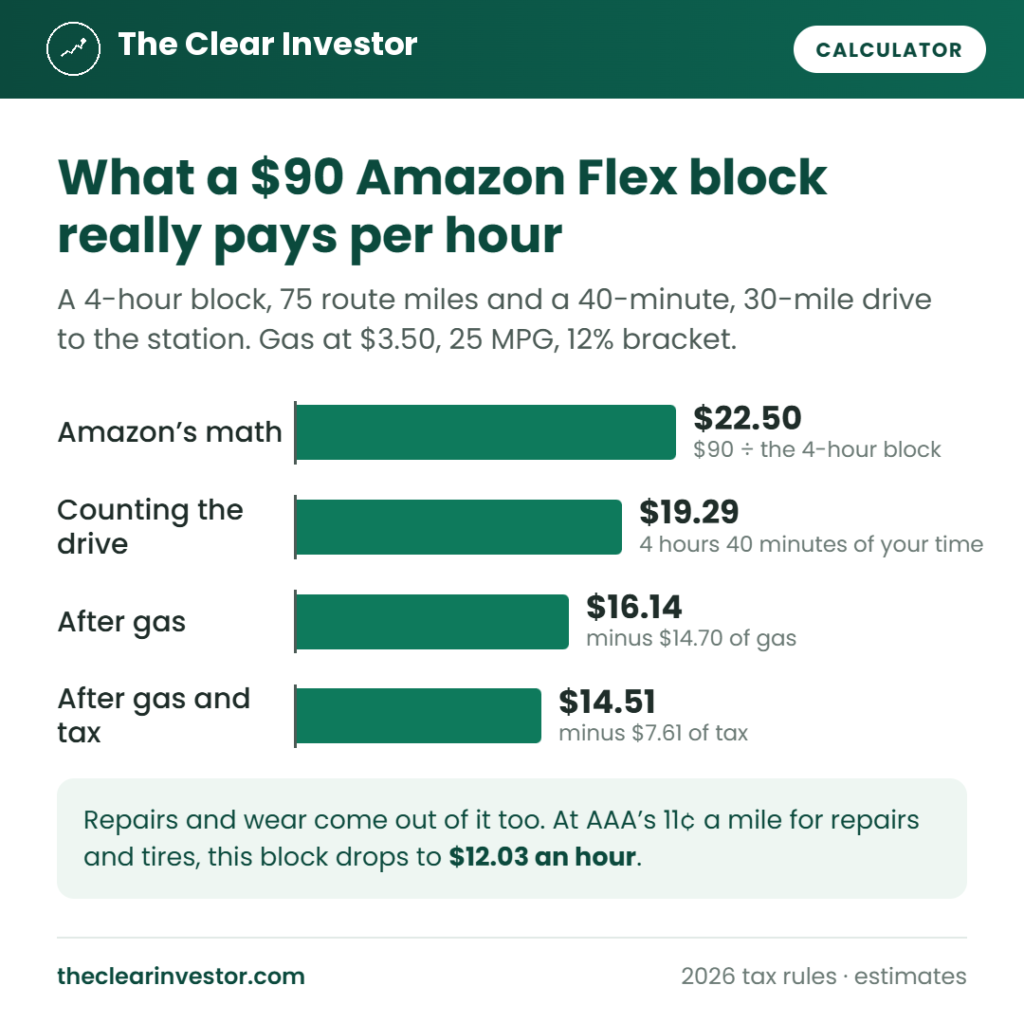
Amazon’s math says $22.50 an hour. The drive to the station alone takes that to $19.29, since it adds 40 minutes nobody pays you for. Gas and tax take it the rest of the way. To clear an $18 goal, this block would need to pay at least $112.
Worked Example 2: The Same Block, Closer to the Station
The same $90 block, but the station is 10 minutes away, a 20-minute, 10-mile round trip, and the route takes 3 hours:
| Step | Amount |
|---|---|
| Block pay | $90.00 |
| Gas (85 miles ÷ 25 MPG × $3.50) | −$11.90 |
| Self-employment tax | −$4.66 |
| Federal income tax (12% bracket) | −$2.94 |
| What you keep | $70.49 |
| Your time | 3 hours 20 minutes |
| Per hour after gas and tax | $21.15 |
Same offer, $6.64 more an hour. The tax doesn’t change, since it only counts route miles. The difference is time: a short drive and finishing early. That’s why the same offer can be a great block for one driver and a bad one for another.
Worked Example 3: A $126 Surge Block in California, With Wear
A $126 block for 4.5 hours, finished in 4. The route is 90 miles, plus a 30-minute, 20-mile round trip to the station. Gas is $4.75, the car gets 28 MPG, and repairs and wear are counted at 11 cents a mile. The driver has a $50,000 job in California, so they’re in the 12% federal bracket and the 6% California bracket:
| Step | Amount |
|---|---|
| Block pay | $126.00 |
| Gas (110 miles ÷ 28 MPG × $4.75) | −$18.66 |
| Repairs and wear (110 miles × 11¢) | −$12.10 |
| Self-employment tax | −$8.14 |
| Federal income tax (12% bracket) | −$5.14 |
| California income tax (6%) | −$3.21 |
| What you keep | $78.75 |
| Your time | 4 hours 30 minutes |
| Per hour after gas and tax | $17.50 |
Amazon’s math says $28 an hour. Without repairs and wear, it would be $20.19. With them, the block falls short of a $20 goal, which would take an offer of at least $142.
Worked Example 4: A 2-Hour Block With Tips
A $54 block for 2 hours, with $20 in tips. The route is 12 miles, plus a 20-minute, 12-mile round trip to the station. Flex is this driver’s only income, so they’re in the 0% bracket:
| Step | Amount |
|---|---|
| Block pay | $54.00 |
| Tips | $20.00 |
| Gas (24 miles ÷ 25 MPG × $3.50) | −$3.36 |
| Self-employment tax | −$9.17 |
| Federal income tax (0% bracket) | $0.00 |
| What you keep | $61.47 |
| Your time | 2 hours 20 minutes |
| Per hour after gas and tax | $26.35 |
Short routes keep gas low, but they also leave a small mileage deduction, so more of the pay gets self-employment tax. The tips owe it too. The tips deduction only lowers federal income tax, and with Flex as the only income, there’s none to lower.
More Example Results
Here’s what a 4-hour block pays per hour after gas and tax, by offer and by how long it really takes you. Each one has 75 route miles, a 30-mile round trip to the station, gas at $3.50, 25 MPG and the 12% federal bracket:
| Offer | 3 hours + 30 minutes to the station | 4 hours + 40 minutes | 4.5 hours + 1 hour |
|---|---|---|---|
| $72 | $15.38 | $11.54 | $9.79 |
| $81 | $17.36 | $13.02 | $11.05 |
| $90 | $19.34 | $14.51 | $12.31 |
| $99 | $21.32 | $15.99 | $13.57 |
| $108 | $23.30 | $17.47 | $14.83 |
| $126 | $27.26 | $20.44 | $17.34 |
How long the block really takes you matters more than the offer’s hourly rate. With the time held the same, extra route miles barely change the hourly pay, since each mile costs 14 cents of gas but also adds a 76-cent deduction. Count repairs and wear, though, and every extra mile costs you.
For the starting example, here’s the lowest offer worth taking at a few hourly goals:
| Your hourly goal after gas and tax | Lowest offer worth taking |
|---|---|
| $15 | $93 |
| $18 | $112 |
| $20 | $124 |
| $25 | $154 |
How the Amazon Flex Pay Calculator Works
The Amazon Flex pay calculator works out one block at a time, the way you’d decide whether to take it.
Your time. The hours you actually worked plus your drive to the station and back. Amazon’s pay per hour divides the offer by the block length instead.
Gas, repairs and wear. Gas is all your miles, the drive to the station included, divided by your MPG and multiplied by your gas price. Repairs and wear are your miles times the cents a mile you enter.
Profit for taxes. Your pay minus your route miles times the IRS standard mileage rate of 76 cents a mile, the 2026 rate from July 1. The rate covers gas, insurance, repairs and depreciation, so gas isn’t deducted on top. The drive to the station only counts if you check the box.
Self-employment tax. 15.3% of 92.35% of your profit. It assumes Flex is a regular side income, so your profit for the year is past the $433 line where it starts.
Income tax. Your federal bracket times your profit, after half of the self-employment tax and the 20% qualified business income deduction. Tips come off first for the tips deduction, up to your profit. Your state rate applies to your profit after half of the self-employment tax, without the tips deduction.
Lowest offer worth taking. The smallest block pay, rounded up to the next dollar, that clears your hourly goal after gas and tax, with the same tips, hours and miles.
What the Calculator Leaves Out
It counts gas, plus repairs and wear if you enter them, but not insurance, car payments or the value your car loses, so driving really costs more. It also leaves out parking, tolls and your phone. The tax is a per-block estimate from your bracket, and it uses the 76-cent rate for every mile, though miles from January to June 2026 were worth 72.5 cents. For your real yearly tax, with all your income and deductions, use my Amazon Flex tax calculator.
Tips for Accurate Results
To get the most out of the Amazon Flex pay calculator:
- Use your odometer, not a guess, for route miles and the drive to the station.
- Time a few blocks from leaving home to getting back, so the drive and the wait at the station count.
- Use your real MPG. Stop-and-go routes burn more gas than your car’s highway rating.
- Count repairs and wear if you drive a lot. The miles add up fast: I drove more than 25,000 miles for Flex in 2025 alone.
- Pick your bracket for the whole year, with any job included, not just Flex.
- Run it again when gas prices change.
What to Do With Your Result
- Set your minimum and skip offers below the lowest offer worth taking.
- Weigh surge blocks by time, not just pay. A bigger offer that runs long or far from home can pay less per hour than a regular one nearby.
- Log every block: the date, pay, hours, gas and miles. I kept a row for every day in a spreadsheet, and that log became my mileage deduction at tax time. Here’s a ready-made version: my Amazon Flex Earnings & Mileage Log. Then upload it to my Amazon Flex earnings calculator for your daily, weekly and monthly averages.
- Set money aside for taxes from each payout. Here’s how Amazon Flex taxes work, from the 1099-NEC to the mileage deduction.
Amazon Flex Pay Calculator FAQ
How much does Amazon Flex pay per hour?
Amazon says most delivery partners earn $18 to $25 an hour. That’s before gas, tax and your drive to the station. A $90, 4-hour block with a 40-minute drive comes to about $14.51 an hour after gas and tax.
Do you get paid for the full block if you finish early?
Yes, on blocks without tips. Amazon says you earn what you see in the offer whether the block ends early or late, so finishing early raises what you make per hour.
Does Amazon pay for gas on Flex?
No. Amazon says you’re responsible for your own expenses as an independent contractor. At tax time, you deduct your miles at the IRS rate instead.
Does the drive to the station count?
For your time and gas, yes, since you can’t do the block without it. For taxes, only if you check the box, since the IRS usually treats it as commuting.
Why is my hourly pay so much lower than Amazon’s?
Amazon’s number divides the offer by the block length. This one takes out gas and tax and counts the time you spend getting to the station and back.
What’s a good Amazon Flex offer?
One that clears your own hourly goal after gas and tax. Enter your goal, and the calculator shows the lowest offer worth taking for that block.
What tax year does the Amazon Flex pay calculator use?
2026: the 76-cent mileage rate and 2026 tax rules. I update it every year.
Estimates for educational purposes only. I’m not a licensed financial advisor or tax professional, and this isn’t tax advice. Not affiliated with Amazon.