
This DoorDash tax calculator estimates your federal, self-employment and state tax on your DoorDash pay and tips, after your mileage and other dashing costs and the new tips deduction, and how much to set aside from each payout. Not sure how DoorDash pay is taxed? Start with DoorDash Taxes: 1099-NEC, Tips, Mileage and What You’ll Owe.
DoorDash Tax Calculator
See how much tax you’ll owe on your DoorDash pay and tips in 2026, after your mileage and other costs, and how much to set aside from each payout.
Your DoorDash earnings in 2026
Your dashing costs
Your other income
Tax you’ve already paid
About you
Your total 2026 tax: before vs. after deductions
| Before deductions | After deductions |
|---|
How your taxable income is worked out
How this is calculated
- DoorDash income = Dasher pay (base pay, Peak Pay, Challenges and other promotions) + customer tips. DoorDash counts earnings in the year they’re deposited, not the year you dashed.
- DoorDash profit = your income minus your dashing costs. It’s self-employment income, reported on Schedule C. Cash reimbursements, like for an order you paid for with the Red Card, aren’t income and aren’t counted here.
- Mileage uses the IRS standard mileage rates for 2026: 72.5 cents a mile from January through June, and 76 cents from July 1, when the IRS raised it. They cover gas, insurance, repairs, depreciation and wear, so gas isn’t deducted on top. Parking and tolls are.
- Self-employment tax is 15.3% (12.4% Social Security and 2.9% Medicare) on 92.35% of your self-employment profit. You only owe it when that comes to $400 or more, which means about $433 of profit. Social Security tax stops at $184,500 of combined W-2 pay and self-employment earnings, and an extra 0.9% Medicare tax applies above $200,000 ($250,000 married). Half of the 15.3% is deductible.
- Federal income tax uses the 2026 brackets and standard deduction ($16,100 single, $32,200 married filing jointly, $24,150 head of household). It also includes the qualified business income deduction: 20% of your self-employment profit after the self-employment tax deduction, and at least $400 when that’s $1,000 or more.
- Tips deduction: Customer tips can count as qualified tips, since the IRS lists app-based delivery workers as a tipped occupation (goods delivery people). The deduction is up to $25,000, no more than your DoorDash profit, and shrinks by $100 for every $1,000 of income over $150,000 ($300,000 married). It lowers federal income tax only, not self-employment tax. It runs from 2025 through 2028.
- Child tax credit is $2,200 per child under 17. Up to $1,700 per child can come back as a refund, based on 15% of your earned income over $2,500.
- State income tax uses 2026 rates, brackets, standard deductions and exemptions from the Tax Foundation, updated for the 2026 cuts in Arkansas, Georgia, South Carolina, Utah and West Virginia. A few states (like California) hadn’t published 2026 bracket amounts, so their 2025 amounts are used. Head of household uses single brackets. The tips deduction is left out of state tax, since each state decides whether to follow it.
- Tax on your DoorDash income = your total tax minus what your total tax would be without DoorDash. That’s the extra tax dashing adds. The set-aside percentage is that tax divided by your pay and tips.
- Tax already paid: Tax withheld on your 1099 (box 4) and your estimated payments are subtracted to show what’s left.
- Tax forms: DoorDash has to send a Form 1099-NEC when it pays you $2,000 or more in a year (the line was $600 through 2025). For 2025, it left tips off the 1099 and emailed your tip total separately. Either way, you report all of it.
- Before deductions leaves out your mileage and other dashing costs, the standard deduction, the qualified business income deduction, the tips deduction, and state deductions and exemptions, so you can see how much they save you.
Not included: the actual car expense method, the earned income tax credit, city and county income taxes (like New York City or Maryland counties), state low-income credits, itemized deductions, retirement or health insurance deductions, and tax withheld from a W-2 job. Your real tax can be lower.
Free tax tracker + deadline reminders
Get my free side income tax tracker
Sign up and I’ll send you my Google Sheets tracker that shows how much of each payout to set aside. You’ll also get an email before each quarterly tax deadline (Jan 15, Apr 15, Jun 15 and Sep 15), plus my new guides. Unsubscribe anytime.
Earn on several platforms or drive for work? Get the full 1099 Side Income Tracker ($12) →
Table of Contents
How to Use the DoorDash Tax Calculator
Each box asks for one number. Here’s where to find it.
Your DoorDash earnings
- Dasher pay. Base pay plus Peak Pay, Challenges and other promotions, without tips. Your earnings history in the Dasher app shows it, and for 2025 it was the total on your 1099-NEC, since tips were left off.
- Customer tips. DoorDash emails your yearly tip total by January 31, and your earnings history shows tips for each dash.
Your dashing costs
- Miles driven January to June. From your mileage log: to the restaurant or store, to the customer and between orders. Each mile is worth 72.5¢.
- Miles driven July to December. The IRS raised the rate to 76¢ on July 1, 2026, so these miles are entered separately.
- Parking and tolls. What you paid while dashing.
- Phone and data. The share of your phone and plan you use for dashing.
- Other dashing costs. Hot bags, a phone mount, Fast Pay fees and other supplies.
Your other income, tax already paid and you
- Other self-employment profit. Uber Eats, Instacart, Amazon Flex or other 1099 work, after expenses.
- W-2 job income. Use box 1 of your W-2. If you’re married filing jointly, add your spouse’s.
- Tax withheld on your 1099 and estimated payments. DoorDash doesn’t withhold, so the first is usually $0.
- Filing status, children under 17 and state. These set your standard deduction, child tax credit and state tax.
Here’s what your miles are worth at a few levels, split evenly between the two halves of 2026:
| Miles in 2026 | Mileage deduction |
|---|---|
| 2,000 | $1,485 |
| 6,000 | $4,455 |
| 12,000 | $8,910 |
| 25,000 | $18,563 |
Who This Calculator Is For
The DoorDash tax calculator is built for US Dashers. It’s most useful if you:
- Just got your first DoorDash 1099-NEC and want to know what you actually owe.
- Drive a lot of miles, so your mileage deduction matters.
- Earn a lot in tips and want to see what the tips deduction saves.
- Have a W-2 job, so your profit is taxed from the first dollar.
- Earn enough to owe $1,000 or more and need a number for quarterly payments.
If you dash outside the US, your country’s rules apply, and the numbers here won’t.
How to Read Your Results
The DoorDash tax calculator shows your results in three parts.
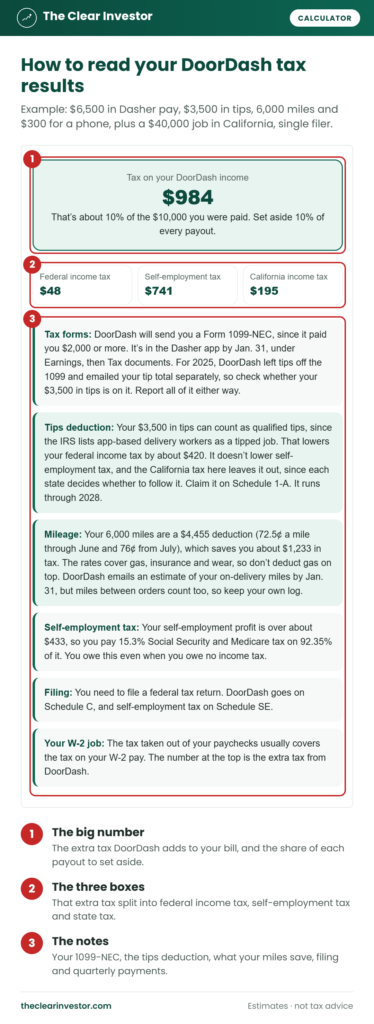
- The big number is the extra tax your DoorDash income adds to your bill. Underneath, you’ll see it as a share of your pay and tips, with the percentage of each payout to set aside, rounded up. If you entered tax already paid, a line underneath shows what’s left.
- The three boxes split it into federal income tax, self-employment tax and state tax.
- The notes cover your 1099-NEC, the tips deduction, what your mileage saves you, whether you need to file and quarterly payments.
Below the notes, Before vs. after deductions shows your whole tax bill with and without your mileage, other costs, the standard deduction, the qualified business income deduction and the tips deduction. Here’s what every part of the results means.
Worked Example 1: $10,000 in Pay and Tips, No Other Income, in Florida
This is the calculator’s starting example. A part-time Dasher with no other income:
| Step | Amount |
|---|---|
| Dasher pay | $6,500 |
| Customer tips | $3,500 |
| Mileage (3,000 miles × 72.5¢ + 3,000 miles × 76¢) | −$4,455 |
| Phone and data | −$300 |
| DoorDash profit | $5,245 |
| Self-employment tax ($5,245 × 92.35% × 15.3%) | $741 |
| Federal income tax | $0 (under the standard deduction) |
| Florida income tax | $0 (no state income tax) |
| Tax on DoorDash income | $741 |
That’s about 7% of the $10,000 DoorDash paid, which the calculator rounds up to 8% to set aside from each payout. The tips deduction doesn’t save anything here, since there’s no income tax to lower.
Worked Example 2: The Same Dasher + a $40,000 Job in California
This is the example in the screenshot above. The same $10,000 of pay and tips and 6,000 miles, plus a $40,000 job:
| Step | Amount |
|---|---|
| DoorDash profit | $5,245 |
| Self-employment tax | $741 |
| Federal income tax (12% bracket, after the tips deduction and the qualified business income deduction) | $48 |
| California income tax (no tips deduction) | $195 |
| Tax on DoorDash income | $984 |
That’s about 10% of the $10,000 DoorDash paid. The tips deduction saves about $420 of federal income tax, and the miles save about $1,233. The calculator leaves the tips deduction out of California tax, so the state tax is figured on the whole $5,245.
Worked Example 3: Your Mileage Log vs. On-Delivery Miles Only
A Dasher with a $40,000 job in Texas earns $10,000 in pay and tips. Their log shows 6,000 miles, but say DoorDash’s on-delivery estimate shows 3,600:
| Miles entered | Mileage deduction | DoorDash profit | Tax on DoorDash income |
|---|---|---|---|
| 6,000 (the log) | $4,455 | $5,245 | $789 |
| 3,600 (on-delivery only) | $2,673 | $7,027 | $1,200 |
The log is worth $411. At $1,200, the on-delivery-only version also crosses the $1,000 line for quarterly payments.
Worked Example 4: A Full-Time Dasher in Illinois
A Dasher with no other income earns $24,000 in pay and $12,000 in tips and drives 25,000 miles, half in each part of the year. They pay $400 in parking and tolls, $600 for the dashing share of their phone and $300 for hot bags and Fast Pay fees:
| Step | Amount |
|---|---|
| Dasher pay and tips | $36,000 |
| Mileage (12,500 miles × 72.5¢ + 12,500 miles × 76¢) | −$18,563 |
| Parking, tolls, phone and other costs | −$1,300 |
| DoorDash profit | $16,138 |
| Self-employment tax | $2,280 |
| Federal income tax | $0 (under the standard deduction) |
| Illinois income tax | $598 |
| Tax on DoorDash income | $2,878 |
That’s about 8% of the $36,000 DoorDash paid. Illinois has no standard deduction like the federal one, so state tax still applies when federal income tax doesn’t. At $2,280 of federal tax, this Dasher should make quarterly payments.
More Example Results
Here’s what the DoorDash tax calculator shows for a single filer in Texas, with 6 miles for every $10 of pay and tips and about a third of it in tips:
| Situation | Federal income tax | Self-employment tax | Tax on DoorDash income |
|---|---|---|---|
| $5,000 pay and tips, no other income | $0 | $349 | $349 (7%) |
| $20,000 pay and tips, no other income | $0 | $1,525 | $1,525 (8%) |
| $40,000 pay and tips, no other income | $0 | $3,092 | $3,092 (8%) |
| $10,000 + a $40,000 W-2 job | $48 | $741 | $789 (8%) |
| $20,000 + a $40,000 W-2 job | $123 | $1,525 | $1,647 (8%) |
| $10,000 + a $90,000 W-2 job | $88 | $741 | $829 (8%) |
| $40,000 + a $90,000 W-2 job | $499 | $3,092 | $3,590 (9%) |
| $10,000, no tips, + a $40,000 W-2 job | $468 | $741 | $1,209 (12%) |
| $10,000, no miles, + a $40,000 W-2 job | $445 | $1,371 | $1,816 (18%) |
With a mileage log and decent tips, it’s mostly self-employment tax, at about 7% to 9% of your pay and tips. In a state with an income tax, add your state’s rate.
How the DoorDash Tax Calculator Works
The DoorDash tax calculator figures your total tax twice, once with your DoorDash income and once without, and shows you the difference. That way, your other income, the standard deduction and your tax bracket are all accounted for.
Profit. Your pay and tips minus your mileage, parking, tolls, phone and other dashing costs. That’s your self-employment income on Schedule C.
Mileage. It uses the IRS standard mileage rates for 2026: 72.5 cents a mile through June 30 and 76 cents from July 1. Parking and tolls come off on top, as the IRS allows.
Tips deduction. Up to $25,000 of your tips, but no more than your DoorDash profit, comes off your income for federal income tax. It shrinks above $150,000 of income ($300,000 married filing jointly), and it’s left out of state tax.
Self-employment tax and income tax. Self-employment tax is 15.3% of 92.35% of your profit once that passes about $433, figured on Schedule SE. Income tax uses the current brackets, standard deduction and qualified business income deduction, and your state’s tax goes on top.
Tax already paid. Tax withheld on your 1099 and your estimated payments are subtracted from the tax on your DoorDash income to show what’s left.
Quarterly payments. The note follows the IRS’s $1,000 rule for estimated taxes, after any tax withheld.
Every number it uses, from the brackets and standard deduction to each state’s rates, is on my How My Tax Calculators Work page, with sources.
What the Calculator Leaves Out
It uses the standard mileage rates, not the actual car expense method, and it doesn’t check whether your state follows the tips deduction, so it leaves the deduction out of state tax. It also skips the earned income tax credit, city and county income taxes, and retirement and health insurance deductions, so your real tax can be lower. Here’s the full list of what my calculators leave out.
Tips for Accurate Results
To get the most out of the DoorDash tax calculator:
- Start from your 1099-NEC for pay, and DoorDash’s January email for tips.
- Use your own mileage log, not just DoorDash’s on-delivery estimate.
- Split your miles between January to June and July to December, since the rate changed.
- Only enter the dashing share of your phone and anything else you use personally.
- Add your other gig apps under other self-employment profit, so your bracket is right.
- Re-run it after a busy month, so your quarterly payments keep up.
What to Do With Your Result
- Set aside that percentage from each payout.
- Make quarterly payments if the calculator says you’ll owe $1,000 or more in federal tax. With a job, you can raise your W-4 withholding instead.
- Keep your records: your 1099-NEC, DoorDash’s tips and mileage emails, your mileage log and receipts.
- Report it on Schedule C. Here’s how DoorDash taxes work, from the 1099-NEC to the tips deduction.
DoorDash Tax Calculator FAQ
What should I enter for Dasher pay?
Base pay plus Peak Pay, Challenges and other promotions, without tips. Your earnings history in the Dasher app shows it.
Where do I find my DoorDash tips total?
DoorDash emails it by January 31. Your earnings history in the Dasher app also shows the tips for each dash.
Why are there two mileage boxes?
The IRS raised the 2026 rate from 72.5 cents to 76 cents a mile on July 1, so miles from each half of the year are worth different amounts.
Should I use DoorDash’s mileage estimate?
Only if you have nothing else. It counts on-delivery miles, so your own log, with the miles between orders, is usually higher.
Why didn’t the tips deduction lower my tax?
With no other income, the standard deduction often covers your income tax already, so there’s nothing left for it to lower. It never lowers self-employment tax.
Why is my income tax $0?
Your mileage and the standard deduction can cover all of your income. You still owe self-employment tax once your profit passes about $433.
Can I enter Uber Eats or Instacart pay too?
Yes, under other self-employment profit, after their expenses. Count each mile only once.
What tax year does the DoorDash tax calculator use?
2026. I update the brackets, standard deduction, mileage rates and state rates every year.
Estimates for educational purposes only. I’m not a licensed financial advisor or tax professional, and this isn’t tax advice. Not affiliated with DoorDash.