
Updated November 6, 2026
This free YouTube tax calculator (no email or sign-up needed) estimates your federal, self-employment and state tax on your YouTube income, from AdSense payouts to brand deals, affiliate income and gifted products, and how much to set aside from each payment. It also handles channel expenses, the 24% Google holds back without your tax info, quarterly payments and the hobby rules. Not sure how YouTube income is taxed? Start with Do You Have to Pay Taxes on YouTube Money?
YouTube Tax Calculator
See how much tax you’ll owe on your YouTube income in 2026, brand deals and gifted products included, and how much to set aside from each payment.
Your YouTube income in 2026
Your channel expenses
Your other income
Tax you’ve already paid
About you
Your total 2026 tax: before vs. after deductions
| Before deductions | After deductions |
|---|
How your taxable income is worked out
How this is calculated
- YouTube income = YouTube payouts + sponsorships and brand deals + affiliate, merch and fan support + gifted products. Products a brand sends you to feature count at what they’d cost to buy.
- As a business (the default), your YouTube profit is your income minus channel expenses. It’s self-employment income, reported on Schedule C. Google lists YouTube earnings as royalties (box 2 of the 1099-MISC), and IRS rules put royalties from self-employed creative work on Schedule C, not Schedule E.
- As a hobby, all of your YouTube income goes on Schedule 1 as other income. There’s no self-employment tax and no qualified business income deduction, and channel expenses can’t be deducted.
- Self-employment tax is 15.3% (12.4% Social Security and 2.9% Medicare) on 92.35% of your self-employment profit. You only owe it when that comes to $400 or more, which means about $433 of profit. Social Security tax stops at $184,500 of combined W-2 pay and self-employment earnings, and an extra 0.9% Medicare tax applies above $200,000 ($250,000 married). Half of the 15.3% is deductible.
- Federal income tax uses the 2026 brackets and standard deduction ($16,100 single, $32,200 married filing jointly, $24,150 head of household). It also includes the qualified business income deduction: 20% of your self-employment profit after the self-employment tax deduction, and at least $400 when that’s $1,000 or more.
- Child tax credit is $2,200 per child under 17. Up to $1,700 per child can come back as a refund, based on 15% of your earned income over $2,500. Hobby income doesn’t count as earned income.
- State income tax uses 2026 rates, brackets, standard deductions and exemptions from the Tax Foundation, updated for the 2026 cuts in Arkansas, Georgia, South Carolina, Utah and West Virginia. A few states (like California) hadn’t published 2026 bracket amounts, so their 2025 amounts are used. Head of household uses single brackets.
- Tax on your YouTube income = your total tax minus what your total tax would be without YouTube. That’s the extra tax YouTube adds. The set-aside percentage is that tax divided by the cash you were paid, so gifted products raise it.
- Tax already paid: Tax Google held back (box 4 of the 1099-MISC) and your estimated payments are subtracted to show what’s left. Google holds back 24% when your US tax info is missing.
- Tax forms: Google sends a 1099-MISC for royalties of $10 or more, typically by early March. A brand that pays you $2,000 or more in a year sends a 1099-NEC. Gifted products usually come with no form. Either way, you report all of it.
- Equipment: Gear that costs $2,500 or less per item can usually be deducted in full the year you buy it under the IRS de minimis safe harbor. This calculator deducts all of your equipment in the year you enter it.
- Tips deduction: Super Chat, Super Stickers and Super Thanks you enter can count as qualified tips, since the IRS lists digital content creators as a tipped occupation. The deduction is up to $25,000, no more than your channel’s profit, and shrinks by $100 for every $1,000 of income over $150,000 ($300,000 married). It lowers federal income tax only, not self-employment tax, and isn’t available for a hobby. It runs from 2025 through 2028.
- Before deductions leaves out channel expenses, the standard deduction, the qualified business income deduction, and state deductions and exemptions, so you can see how much they save you.
Not included: the earned income tax credit, city and county income taxes (like New York City or Maryland counties), state low-income credits, itemized deductions, retirement or health insurance deductions, and tax withheld from a W-2 job. Your real tax can be lower.
Free tax tracker + deadline reminders
Get my free side income tax tracker
Sign up and I’ll send you my Google Sheets tracker that shows how much of each payout to set aside. You’ll also get an email before each quarterly tax deadline (Jan 15, Apr 15, Jun 15 and Sep 15), plus my new guides. Unsubscribe anytime.
Earn on several platforms or drive for work? Get the full 1099 Side Income Tracker ($12) →
Table of Contents
How to Use the YouTube Tax Calculator
Each box asks for one number. Here’s where to find it.
Your YouTube income
- YouTube payouts (AdSense). Ads, YouTube Premium, memberships, Super Chat, Super Stickers and Super Thanks. Add up your payments in AdSense for YouTube, or use box 2 of your 1099-MISC. Use the total before any tax Google held back. YouTube Studio’s revenue numbers are estimates, so go by what was paid.
- Of that, Super Chat, Super Stickers and Super Thanks. Optional. The part of your AdSense payouts that came from these, from your YouTube Studio revenue report. They can count as qualified tips, which lowers your federal income tax. Don’t add them on top of your payouts.
- Sponsorships and brand deals. Everything brands paid you to feature them.
- Affiliate, merch and fan support. Affiliate commissions, profit from merch, and money from Patreon or tips outside YouTube.
- Gifted products you kept. What the products would cost to buy. Leave out anything you sent back.
Your channel expenses
- Equipment. Your camera, microphone, lights and editing computer, or the business share if you also use them personally.
- Software and help. Editing software, music licenses, editors and thumbnail designers.
- Other channel costs. Props, travel to film, ads, a home office, and the work share of your internet and phone.
Your other income and tax already paid
- Other self-employment profit. TikTok, Twitch, Outlier or other 1099 work, after expenses.
- W-2 job income. Use box 1 of your W-2. If you’re married filing jointly, add your spouse’s.
- Tax Google held back. Box 4 of your 1099-MISC. Enter 0 if your tax info was on file all year.
- Estimated tax payments. Federal quarterly payments you’ve already sent for this year.
About you
- How you run your channel. Choose “As a business” if you run it to make money, which is most monetized creators. Choose “As a hobby” only if you don’t.
- Filing status, children under 17 and state. These set your standard deduction, child tax credit and state tax.
Don’t know your yearly total yet? YouTube Studio shows your RPM, what you earn per 1,000 views. Multiply it by your views:
| Views in a year | At a $2 RPM | At a $5 RPM | At a $10 RPM |
|---|---|---|---|
| 100,000 | $200 | $500 | $1,000 |
| 500,000 | $1,000 | $2,500 | $5,000 |
| 1 million | $2,000 | $5,000 | $10,000 |
| 5 million | $10,000 | $25,000 | $50,000 |
RPMs vary a lot by topic and audience, so use your own.
Who This Calculator Is For
The YouTube tax calculator is built for US creators. It’s most useful if you:
- Just got your first AdSense payments and want to know what to set aside.
- Earn from more than ads, like brand deals, affiliate links or gifted products.
- Have channel expenses and want to see how much they save you.
- Have a W-2 job, so your YouTube income is taxed from the first dollar.
- Earn enough to owe $1,000 or more and need a number for quarterly payments.
- Had 24% held back because your tax info wasn’t on file.
If you live outside the US, your country’s rules and its tax treaty apply, and the numbers here won’t.
How to Read Your Results
The YouTube tax calculator shows your results in three parts.
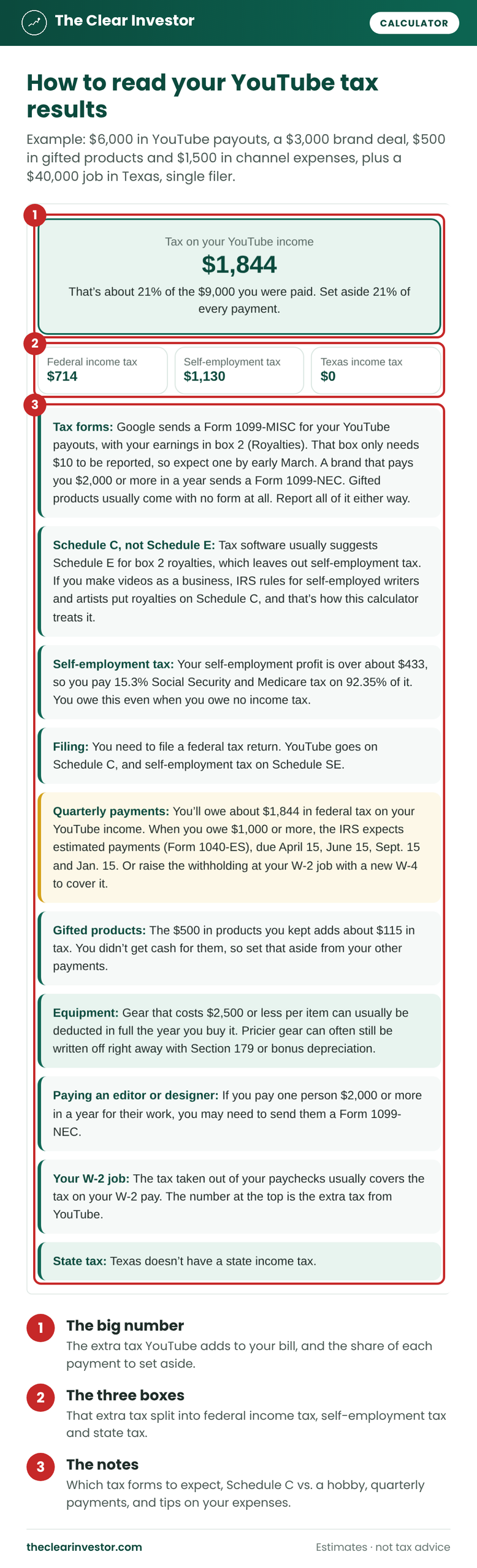
- The big number is the extra tax your YouTube income adds to your bill, with the percentage of each payment to set aside. The percentage is your tax divided by the cash you were paid, rounded up, so gifted products push it higher. If you entered tax already paid, a line underneath shows what’s left.
- The three boxes split it into federal income tax, self-employment tax and state tax.
- The notes cover the tax forms to expect, Schedule C vs. a hobby, whether you need to file, quarterly payments, and tips on your expenses.
Below the notes, Before vs. after deductions shows your whole tax bill with and without your channel expenses, the standard deduction and the qualified business income deduction. Here’s what every part of the results means.
Worked Example 1: $10,000 From YouTube, No Other Income, in Florida
Here’s how the YouTube tax calculator handles a full-time creator who earns $10,000 in AdSense payouts, with no other income and no expenses:
| Step | Amount |
|---|---|
| YouTube payouts | $10,000 |
| Net earnings ($10,000 × 92.35%) | $9,235 |
| Self-employment tax ($9,235 × 15.3%) | $1,413 |
| Half of self-employment tax (deduction) | −$706 |
| Income left for income tax | $9,294 |
| Federal income tax | $0 (under the standard deduction) |
| Florida income tax | $0 (no state income tax) |
| Tax on YouTube income | $1,413, about 14% |
That’s over $1,000, so the calculator’s quarterly note shows up: about $353 on each federal due date.
Worked Example 2: YouTube, a Brand Deal and Gifted Products + a $40,000 Job in Texas
This is the example in the screenshot above. A creator with a full-time job earns $6,000 in AdSense payouts, takes a $3,000 brand deal, keeps $500 worth of gifted products, and spends $900 on equipment and $600 on an editor:
| Step | Amount |
|---|---|
| YouTube payouts | $6,000 |
| Sponsorships and brand deals | $3,000 |
| Gifted products | $500 |
| Channel expenses ($900 + $600) | −$1,500 |
| YouTube profit | $8,000 |
| Self-employment tax ($8,000 × 92.35% × 15.3%) | $1,130 |
| Half of self-employment tax (deduction) | −$565 |
| Qualified business income deduction (20% of $7,435) | −$1,487 |
| YouTube’s addition to taxable income | $5,948 |
| Federal income tax ($5,948 × 12%) | $714 |
| Texas income tax | $0 (no state income tax) |
| Tax on YouTube income | $1,844 |
That’s about 21% of the $9,000 in cash this creator was paid. The gifted products alone add about $115, and the $1,500 in expenses saves about $350 compared with no expenses. At $1,844, it’s also over the $1,000 line for quarterly payments, or a W-4 change at the job.
Worked Example 3: Business vs. Hobby
Same $40,000 job in Texas, $3,000 in AdSense payouts. Here’s what the YouTube tax calculator shows as a business and as a hobby:
| Channel expenses | As a business | As a hobby |
|---|---|---|
| $0 | $692 | $360 |
| $500 | $576 | $360 |
| $2,500 | $115 | $360 |
A hobby skips self-employment tax, so it looks cheaper with few expenses. But it can’t deduct anything, so once you spend real money on your channel, a business usually comes out ahead. Either way, you don’t get to pick: the IRS goes by whether you run the channel to make a profit.
Worked Example 4: Google Held Back 24%
A creator never submitted a Form W-9, so Google held back 24% of $5,000, which is $1,200. With no other income in Florida:
| Step | Amount |
|---|---|
| YouTube payouts | $5,000 |
| Tax on YouTube income | $706 |
| Tax Google held back (box 4) | −$1,200 |
| Left over | $494 |
The extra $494 comes back as a refund when they file. With a $40,000 job instead, the tax is $1,153, and the $1,200 held back covers it with about $47 to spare.
More Example Results
Here’s what the YouTube tax calculator shows for a single filer in Texas or Florida, with no channel expenses:
| Situation | Federal income tax | Self-employment tax | Tax on YouTube income |
|---|---|---|---|
| $1,000, no other income | $0 | $141 | $141 (14%) |
| $5,000, no other income | $0 | $706 | $706 (14%) |
| $10,000, no other income | $0 | $1,413 | $1,413 (14%) |
| $3,000 + a $40,000 W-2 job | $268 | $424 | $692 (23%) |
| $10,000 + a $40,000 W-2 job | $892 | $1,413 | $2,305 (23%) |
| $5,000 + a $90,000 W-2 job | $818 | $706 | $1,524 (30%) |
| $10,000 + a $90,000 W-2 job | $1,636 | $1,413 | $3,049 (30%) |
| $10,000 as a hobby + a $40,000 W-2 job | $1,200 | $0 | $1,200 (12%) |
About 14% while the standard deduction covers your income tax, about 23% in the 12% bracket and about 30% in the 22% bracket. In a state with an income tax, add your state’s rate.
How the YouTube Tax Calculator Works
The YouTube tax calculator figures your total tax twice, once with your YouTube income and once without, and shows you the difference. That way, your other income, the standard deduction and your tax bracket are all accounted for.
Business or hobby. Google treats YouTube earnings as royalties, and IRS rules for royalties put them on Schedule C when you’re in business as a self-employed artist. So by default, the calculator treats your YouTube profit as self-employment income. Choose “As a hobby” and it moves your income to Schedule 1 instead, with no self-employment tax, no expense deductions and no qualified business income deduction.
Self-employment tax and income tax. As a business, self-employment tax is 15.3% of 92.35% of your YouTube profit once that passes about $433, figured on Schedule SE. Income tax uses the current brackets, standard deduction and qualified business income deduction, and your state’s tax goes on top.
Tax already paid. Tax Google held back counts as federal tax withheld, and your estimated payments count too. The calculator subtracts both from the tax on your YouTube income to show what’s left.
Quarterly payments. The note follows the IRS’s $1,000 rule for estimated taxes, after any tax Google held back.
Every number it uses, from the brackets and standard deduction to each state’s rates, is on my How My Tax Calculators Work page, with sources.
What the Calculator Leaves Out
It deducts all of your equipment in the year you enter it, which matches the $2,500-per-item safe harbor and Section 179, but not gear you choose to depreciate over several years. It also leaves out retirement and health insurance deductions, and it covers US creators only. Here’s the full list of what my calculators leave out.
Tips for Accurate Results
To get the most out of the YouTube tax calculator:
- Use what was paid, not estimated revenue. YouTube Studio’s numbers are estimates. Your AdSense payments and 1099-MISC are what count.
- Count by pay date. December earnings paid in January belong to the new year.
- Include every brand deal, even the ones under $2,000 that come with no form.
- Value gifted products honestly, at what they’d cost to buy, and leave out anything you returned.
- Only enter the business share of gear you also use personally.
- Re-run it when a video takes off, so your quarterly payments keep up.
What to Do With Your Result
- Set aside that percentage from each monthly payout and each brand deal.
- Make quarterly payments if the calculator says you’ll owe $1,000 or more in federal tax. With a job, you can raise your W-4 withholding instead.
- Submit your W-9 in AdSense for YouTube if Google is holding back 24%.
- Keep your records: AdSense payment history, brand contracts, gifted product values and receipts.
- Report it on Schedule C. Here’s how YouTube taxes work, and what Google’s 1099 means.
YouTube Tax Calculator FAQ
What should I enter as my YouTube payouts?
What AdSense for YouTube paid you during the year, before any tax Google held back. It should match box 2 of your 1099-MISC.
Should I include sponsorships and gifted products?
Yes. Brand deals are income whether or not you get a 1099-NEC, and gifted products you keep count at what they’d cost to buy.
Should I choose business or hobby?
Business, if you run your channel to make money, which covers most monetized creators. Hobby is only for channels not run for profit.
Why is self-employment tax so high?
It’s 15.3%, covering both halves of Social Security and Medicare, since no employer pays half for you.
Why is my income tax $0?
With no other income, the standard deduction covers it until your income passes it. You still owe self-employment tax.
What if Google held back 24%?
Enter it in “Tax Google held back.” It counts as tax you’ve already paid, and the calculator shows what’s left or what comes back.
Can my channel expenses be more than my income?
Yes. As a business, the loss lowers the tax on your other income, and the calculator shows how much.
What tax year does the YouTube tax calculator use?
The current tax year. I update the brackets, standard deduction and state rates every year.
Should I include Shorts revenue?
Yes. Shorts revenue is paid through AdSense with the rest of your YouTube earnings, so it’s part of your payouts.
Does it include the tips deduction?
Yes. Enter your Super Chats, Super Stickers and Super Thanks in their box. They stay in your payouts and still get self-employment tax, but they can lower your federal income tax as qualified tips.
Estimates for educational purposes only. I’m not a licensed financial advisor or tax professional, and this isn’t tax advice. Not affiliated with YouTube or Google.