Disclosure: I’m not a financial advisor, and this isn’t financial advice. I own VOO. I’m not paid by Wells Fargo, Vanguard or any bank mentioned here.
Do you need a savings account? It depends on what it pays you.
At 19, I opened my first savings account at Wells Fargo on the same day I opened my checking account. I put $25 in each. My savings account paid 0.01% interest, and in almost a year, it earned me exactly nothing.
So I barely used it. I moved the last $5 out in July 2022, and two months later Wells Fargo closed the account. When I got the email, I chuckled, because by then I’d already put thousands of dollars into VOO.
Here’s what a savings account is, why mine was pointless, and when a savings account actually makes sense.
Table of Contents
What Is a Savings Account?
A savings account is a bank account for money you’re not spending right away. The bank pays you interest for keeping your money there, shown as an APY (annual percentage yield).
It’s different from a checking account:
- Checking account: for everyday spending. It comes with a debit card, and most pay little or no interest.
- Savings account: for money you want to set aside. It pays interest, but you usually don’t get a debit card.
The catch is the interest rate. Big banks often pay almost nothing on savings.
My First Savings Account: Wells Fargo Way2Save (2021)
In late 2021, I opened a Wells Fargo checking account and a Way2Save savings account at the same branch, on the same day. I deposited $25 into each. You can read how I got my checking account and first debit card here.
Way2Save has a $5 monthly fee, but it’s waived if you’re 24 or younger. I was 19, so I never paid a fee.
The problem was the interest rate. Way2Save pays 0.01% APY. I never earned a single cent of interest from it.
Why I Barely Used It
0.01% is so small it’s almost a joke. Here’s what it means in real money:
- $1,000 in a 0.01% account earns 10 cents a year.
- $10,000 earns $1 a year.
Meanwhile, prices go up about 3% a year from inflation. So $1,000 sitting in that account loses about $30 of buying power every year, while earning 10 cents.
At that age, I was about to buy my first VOO shares, and I already knew that saving at 0.01% made no sense. So I did two things:
- I kept my emergency fund in checking. Back then it was $1,000. Since savings paid nothing anyway, checking was just as good and easier to reach.
- I invested the rest. Every extra dollar went into my Vanguard brokerage account to buy VOO.
My savings account just sat there.
How Wells Fargo Closed My Savings Account
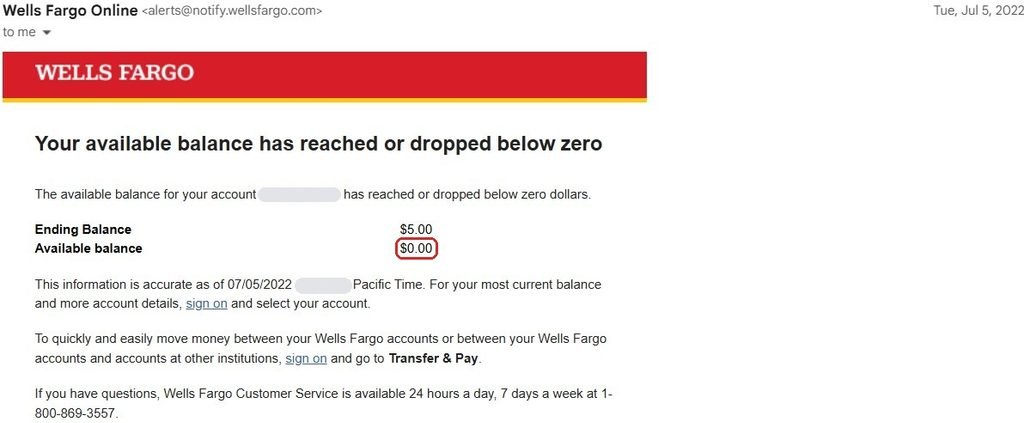
Over time, I moved my savings money into checking. On July 5, 2022, I moved the last $5 out, and Wells Fargo sent me this alert:
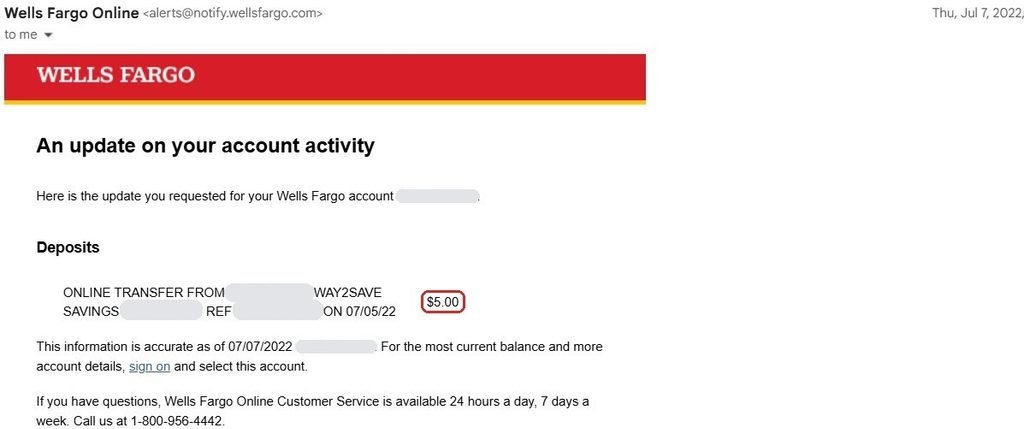
Two days later, the $5 showed up in my checking account from Way2Save Savings:
After that, my savings account sat at $0 from July to September. Then I got this:
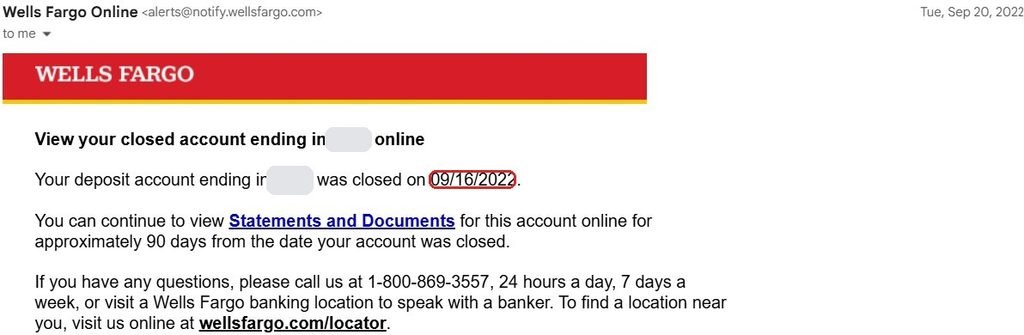
Wells Fargo closed it on September 16, 2022. That’s a Wells Fargo policy since August 2021: it can close an account with a $0 balance, without warning.
I wasn’t upset at all. I had zero interest in using that account, and by then I’d invested thousands of dollars in VOO. Honestly, I chuckled.
Savings vs. Investing: What $10,000 Turns Into
Here’s why a 0.01% savings account loses money. I ran $10,000 through my Saving vs. Investing Calculator for 10 years, with 3% inflation:
| Where you keep $10,000 | Balance in 10 years | Worth in today’s dollars |
|---|---|---|
| Cash (0%) | $10,000 | $7,441 |
| Wells Fargo Way2Save (0.01%) | $10,010 | $7,448 |
| Average savings account (0.37%) | $10,376 | $7,721 |
| High-yield savings (3.5%) | $14,106 | $10,496 |
| Investing (10%) | $25,937 | $19,300 |
A 0.01% savings account earned $10 in 10 years and was worth only $7 more than cash. In both cases, you lose about a quarter of your buying power.
Investing grew the same $10,000 into $19,300 in today’s dollars. That’s why I put my money into VOO instead.
Investing isn’t guaranteed, though. The market can drop a lot in a single year, so it’s only for money you won’t need for years.
So, Do You Need a Savings Account?
Yes, but not one that pays 0.01%.
You need a safe place for your emergency fund, money you can reach quickly if your car breaks down or you lose income. That money shouldn’t be in the stock market, because the market could be down right when you need it.
But a regular savings account at a big bank isn’t the best place for it either. The national average savings rate is only 0.37%, and many big banks pay 0.01%. A high-yield savings account pays around 3.5% to 4%, about 350 times more than my Wells Fargo account did.
Here’s how I’d split it:
- Emergency fund: a high-yield savings account.
- Everyday spending: a checking account.
- Long-term money: investing, like an S&P 500 ETF.
What I’d Do Differently
I don’t regret skipping a 0.01% savings account. But I’d have opened a high-yield savings account sooner instead of keeping my emergency fund in checking. My $1,000 would have earned about $35 a year instead of nothing.
I eventually did, at Vanguard. Here’s where I keep my emergency fund now, at 3.5% APY.
Mistakes to Avoid With Your First Savings Account
- Accepting a tiny rate. 0.01% is basically nothing. Compare rates before you open an account.
- Paying a monthly fee. Many savings accounts waive the fee if you’re young or keep a minimum balance. Check the rules.
- Leaving an account at $0. Banks can close empty accounts. If you don’t need it, close it yourself, or keep a small balance.
- Keeping long-term money in savings. Savings is for safety, not growth. Money you won’t need for years usually belongs in investments.
My Verdict: Skip the 0.01% Savings Account
My first savings account paid 0.01%, earned me nothing, and got closed after it sat empty. I didn’t miss it, because my money was working much harder in VOO.
You do need somewhere safe for your emergency fund. Just make it a high-yield savings account, not a big-bank account that pays almost nothing. Here’s what a high-yield savings account is and how I use mine.
FAQ
Do I need a savings account?
You need a safe place for your emergency fund, but it should be a high-yield savings account, not a regular one paying 0.01%. Long-term money usually belongs in investments.
Can a bank close my account for having a zero balance?
Yes. Wells Fargo closed my savings account after it sat at $0 for about two months. Its policy allows closing zero-balance accounts without notice.
What interest rate does Wells Fargo Way2Save pay?
Way2Save pays 0.01% APY. On $1,000, that’s 10 cents a year.
Does Wells Fargo Way2Save have a monthly fee?
It has a $5 monthly fee, which is waived if you’re 24 or younger, keep a $300 minimum daily balance, or set up a qualifying automatic transfer.
Is it better to save or invest?
Both. Save your emergency fund in a high-yield savings account, and invest money you won’t need for at least 5 years.
Should I keep my emergency fund in checking?
It’s safe there, but it earns nothing. A high-yield savings account keeps it just as safe and pays interest.
This article is for informational purposes only and isn’t financial advice. Rates, fees and bank policies can change, so check the latest terms before opening an account.